Recognition: unknown
A Unified Conditional Flow for Motion Generation, Editing, and Intra-Structural Retargeting
Pith reviewed 2026-05-10 12:40 UTC · model grok-4.3
The pith
A single rectified-flow model unifies motion generation, editing, and intra-structural retargeting by modulating either text or skeletal conditioning at inference.
A machine-rendered reading of the paper's core claim, the machinery that carries it, and where it could break.
Core claim
By leveraging recent advances in flow matching, editing and retargeting are fundamentally the same generative task, distinguished only by which conditioning signal, semantic or structural, is modulated during inference. The implementation is a rectified-flow motion model jointly conditioned on text prompts and target skeletal structures, built on a DiT-style transformer with per-joint tokenization and explicit joint self-attention to enforce kinematic dependencies, together with multi-condition classifier-free guidance.
What carries the argument
Rectified-flow motion model jointly conditioned on text and skeletal structure, using per-joint tokenization, joint self-attention, and multi-condition classifier-free guidance to enforce both semantic and structural constraints during sampling.
If this is right
- One trained model supports text-to-motion generation, zero-shot text editing, and zero-shot retargeting to new bone lengths.
- Structural consistency of the generated motions improves relative to separate task-specific methods.
- Deployment is simplified because no incompatible input representations or post-processing stages are required.
- Kinematic dependencies remain strictly enforced through joint self-attention regardless of which conditioning signal is active.
Where Pith is reading between the lines
- The same conditioning-modulation principle may apply to other motion tasks such as style transfer or interpolation without new architectures.
- Interactive tools could let users fluidly alternate between semantic and structural controls on the same underlying flow.
- Performance on large bone-length differences or complex multi-character scenes would be a direct test of whether the joint conditioning truly separates the two signals.
Load-bearing premise
Joint training on text and skeletal conditioning lets the model switch between editing and retargeting at inference time by changing only the conditioning input, without any task-specific fine-tuning or loss of kinematic validity.
What would settle it
Train the model once and measure whether zero-shot editing and retargeting outputs remain kinematically valid and text-faithful on held-out sequences, or whether they require post-processing or fine-tuning to match the quality of specialized baselines.
Figures


read the original abstract
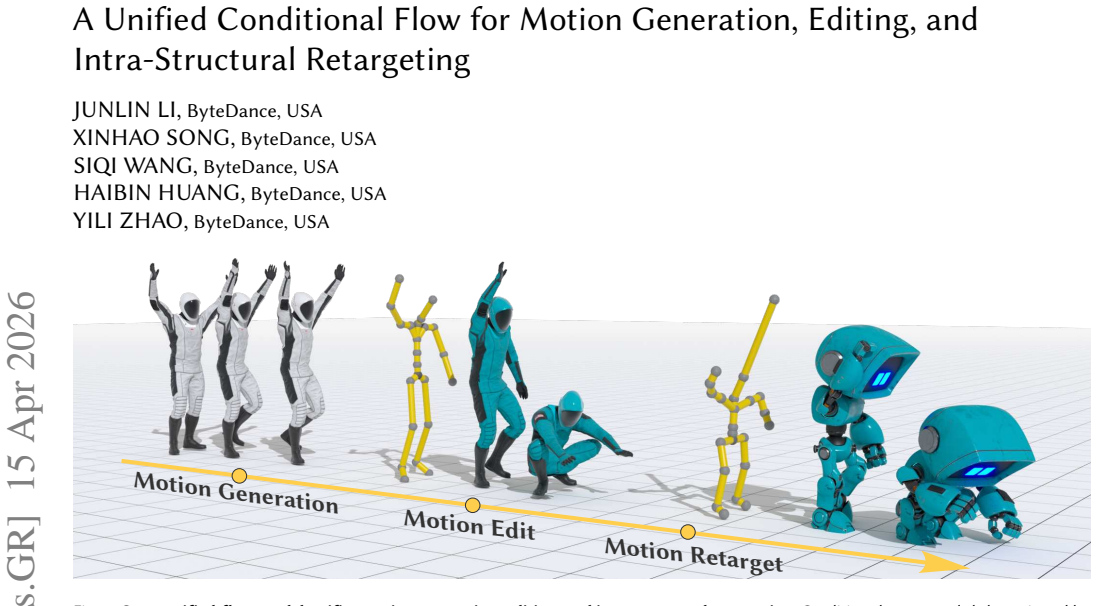
Text-driven motion editing and intra-structural retargeting, where source and target share topology but may differ in bone lengths, are traditionally handled by fragmented pipelines with incompatible inputs and representations: editing relies on specialized generative steering, while retargeting is deferred to geometric post-processing. We present a unifying perspective where both tasks are cast as instances of conditional transport within a single generative framework. By leveraging recent advances in flow matching, we demonstrate that editing and retargeting are fundamentally the same generative task, distinguished only by which conditioning signal, semantic or structural, is modulated during inference. We implement this vision via a rectified-flow motion model jointly conditioned on text prompts and target skeletal structures. Our architecture extends a DiT-style transformer with per-joint tokenization and explicit joint self-attention to strictly enforce kinematic dependencies, while a multi-condition classifier-free guidance strategy balances text adherence with skeletal conformity. Experiments on SnapMoGen and a multi-character Mixamo subset show that a single trained model supports text-to-motion generation, zero-shot editing, and zero-shot intra-structural retargeting. This unified approach simplifies deployment and improves structural consistency compared to task-specific baselines.
Editorial analysis
A structured set of objections, weighed in public.
Referee Report
Summary. The manuscript proposes a unified rectified-flow model for text-driven motion generation, editing, and intra-structural retargeting. It casts both editing and retargeting as conditional transport in a single DiT-style transformer jointly conditioned on text prompts and target skeletal structures, with per-joint tokenization, explicit joint self-attention, and multi-condition classifier-free guidance. The central claim is that these tasks differ only in which conditioning signal is modulated at inference, enabling zero-shot performance from one trained model on SnapMoGen and a Mixamo subset.
Significance. If the empirical results and architectural choices hold, the work offers a genuine simplification of motion pipelines by replacing separate generative steering and geometric retargeting stages with a single conditional flow. The per-joint self-attention mechanism to enforce kinematic dependencies and the joint text-structure conditioning are concrete strengths that could improve structural consistency over task-specific baselines.
major comments (2)
- [Abstract] Abstract: The claim that 'editing and retargeting are fundamentally the same generative task, distinguished only by which conditioning signal... is modulated during inference' is load-bearing for the unification thesis. However, the architecture is described as conditioned solely on text prompts and target skeletal structures; no source-motion sequence is injected or denoised from. This means both tasks reduce to sampling a new motion matching the modulated condition, without explicit preservation of the original pose trajectory or timing. The unification therefore holds only under a non-standard redefinition of editing that abandons fidelity to an input motion sequence.
- [Method] Method (architecture and guidance): The multi-condition classifier-free guidance is presented as balancing semantic and structural adherence, yet the manuscript provides no derivation or ablation showing that the guidance scales permit zero-shot editing/retargeting while maintaining kinematic validity. Without an explicit source-motion conditioning pathway, it is unclear whether the joint self-attention alone suffices to prevent drift from the original dynamics when only one condition is changed.
minor comments (1)
- [Experiments] Experiments: The abstract states that experiments 'show' support for the claims, but quantitative metrics, ablation tables on guidance scales, and direct comparisons to task-specific baselines are not referenced in the summary description; these are needed to evaluate whether the unified model matches or exceeds specialized methods.
Simulated Author's Rebuttal
We thank the referee for the constructive feedback on our manuscript. We address the major comments point by point below and outline the revisions we will make.
read point-by-point responses
-
Referee: [Abstract] Abstract: The claim that 'editing and retargeting are fundamentally the same generative task, distinguished only by which conditioning signal... is modulated during inference' is load-bearing for the unification thesis. However, the architecture is described as conditioned solely on text prompts and target skeletal structures; no source-motion sequence is injected or denoised from. This means both tasks reduce to sampling a new motion matching the modulated condition, without explicit preservation of the original pose trajectory or timing. The unification therefore holds only under a non-standard redefinition of editing that abandons fidelity to an input motion sequence.
Authors: We appreciate the referee's careful reading and agree that our framing of editing requires clarification. In our work, 'text-driven motion editing' is defined as generating a new motion sequence that adheres to a modified text prompt while using the skeletal structure from the source motion as the structural condition. This is distinct from traditional editing methods that take a source motion sequence as input and modify it while preserving timing and poses. By treating both editing and retargeting as conditional generation tasks (modulating text or structure), we achieve unification within the rectified flow framework. We will revise the abstract to explicitly state this definition of editing and note that it does not preserve the original motion trajectory, as the generation starts from noise. This redefinition is intentional to enable a single model for multiple tasks. revision: yes
-
Referee: [Method] Method (architecture and guidance): The multi-condition classifier-free guidance is presented as balancing semantic and structural adherence, yet the manuscript provides no derivation or ablation showing that the guidance scales permit zero-shot editing/retargeting while maintaining kinematic validity. Without an explicit source-motion conditioning pathway, it is unclear whether the joint self-attention alone suffices to prevent drift from the original dynamics when only one condition is changed.
Authors: We acknowledge the lack of explicit derivation and ablations in the original manuscript. The multi-condition CFG is achieved by training with independent dropout of text and structure conditions, enabling separate guidance strengths at inference. The per-joint tokenization combined with joint self-attention layers enforces inter-joint dependencies and kinematic constraints throughout the denoising process, which helps maintain valid poses and dynamics even under modulated conditions. Since the model does not condition on or denoise from a source motion sequence, there are no 'original dynamics' to drift from; the motion is synthesized anew to match the provided conditions. To strengthen this, we will include a new section with ablations on guidance scales, their effect on zero-shot performance, and kinematic metrics (e.g., foot contact, velocity consistency) in the revised version. We believe the joint attention mechanism is key to validity, as evidenced by our comparisons to baselines. revision: yes
Circularity Check
No circularity: unification via conditional model training and experiments
full rationale
The paper casts editing and retargeting as conditional generation in a flow-matching DiT model jointly trained on text and skeletal structure, with experiments on SnapMoGen and Mixamo demonstrating zero-shot performance by modulating one conditioning signal. No equations, derivations, or fitted parameters are shown that reduce the central claim to its inputs by construction. The architecture and multi-condition guidance are presented as design choices supported by external datasets and baselines, without self-citation load-bearing uniqueness theorems or ansatzes smuggled from prior author work. The argument is self-contained as an empirical demonstration within the generative framework.
Axiom & Free-Parameter Ledger
axioms (1)
- domain assumption Flow matching admits interchangeable semantic and structural conditioning signals without requiring separate models or loss terms.
Reference graph
Works this paper leans on
-
[1]
MotionFix: Text-Driven 3D Human Motion Editing. InSIGGRAPH Asia 2024 Conference Papers. Shuai Bai, Yuxuan Cai, Ruizhe Chen, Keqin Chen, Xionghui Chen, Zesen Cheng, Liang- hao Deng, Wei Ding, Chang Gao, Chunjiang Ge, Wenbin Ge, Zhifang Guo, Qidong Huang, Jie Huang, Fei Huang, Binyuan Hui, Shutong Jiang, Zhaohai Li, Mingsheng Li, Mei Li, Kaixin Li, Zicheng ...
work page internal anchor Pith review Pith/arXiv arXiv doi:10.1145/3721238.3730621 2024
-
[2]
InProceedings of the IEEE/CVF International Conference on Computer Vision
Flowedit: Inversion-free text-based editing using pre-trained flow models. InProceedings of the IEEE/CVF International Conference on Computer Vision. 19721– 19730. Sunmin Lee, Taeho Kang, Jungnam Park, Jehee Lee, and Jungdam Won. 2023. SAME: Skeleton-Agnostic Motion Embedding for Character Animation. InSIGGRAPH Asia 2023 Conference Papers(Sydney, NSW, Aus...
discussion (0)
Sign in with ORCID, Apple, or X to comment. Anyone can read and Pith papers without signing in.