Recognition: unknown
Prospects for GRB Afterglow Discovery with the Eric and Wendy Schmidt Observatory System
Pith reviewed 2026-05-10 13:06 UTC · model grok-4.3
The pith
Argus and DSA will detect afterglows from 24% and 42% of Fermi long GRBs, plus 116 optical and 217 radio afterglows yearly without any trigger.
A machine-rendered reading of the paper's core claim, the machinery that carries it, and where it could break.
Core claim
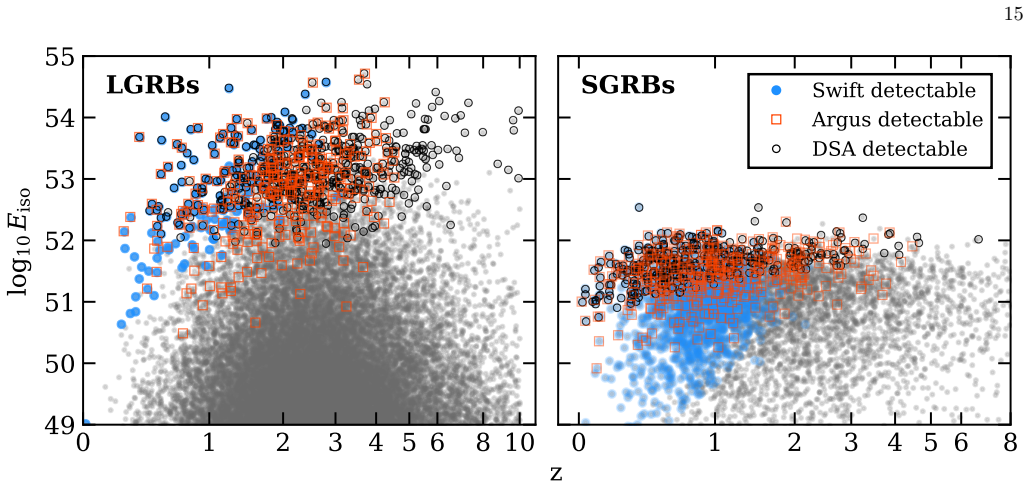
Simulations of GRB afterglow populations show that of the long-duration GRBs detected by the Fermi Gamma-ray Burst Monitor, 24 percent will yield afterglow detections with Argus and 42 percent with DSA, for rates of 47 and 82 per year. The observatory system will additionally detect 116 optical and 217 radio afterglows per year independent of GRB triggers. Projected rates are given for the StarBurst and MoonBEAM monitors as well. Short-duration GRB afterglows will be recovered at 5 to 10 percent the long-GRB rate. Argus will observe roughly 18 percent of afterglows prior to peak because of its second-minute cadence.
What carries the argument
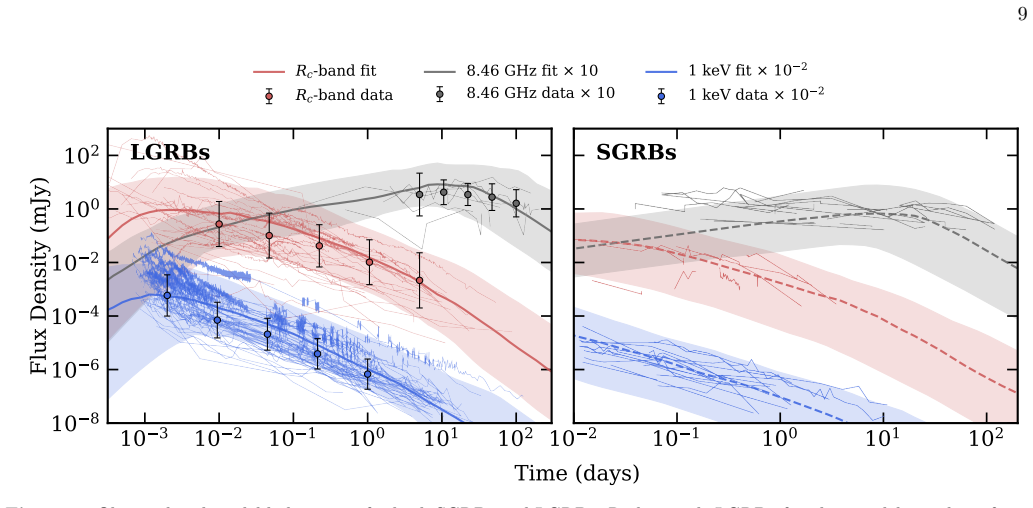
Monte Carlo simulations that fold GRB afterglow light curves, drawn from population models and luminosity functions, through the sensitivity, cadence, and field of view of the Argus Array and DSA instruments.
If this is right
- The observatory system will detect 116 optical and 217 radio afterglows per year independent of GRB triggers, exceeding current global follow-up rates.
- Short-duration GRB afterglows will be detected at 5-10 percent the long-GRB rate, supporting multi-messenger follow-up of gravitational-wave events from neutron star mergers.
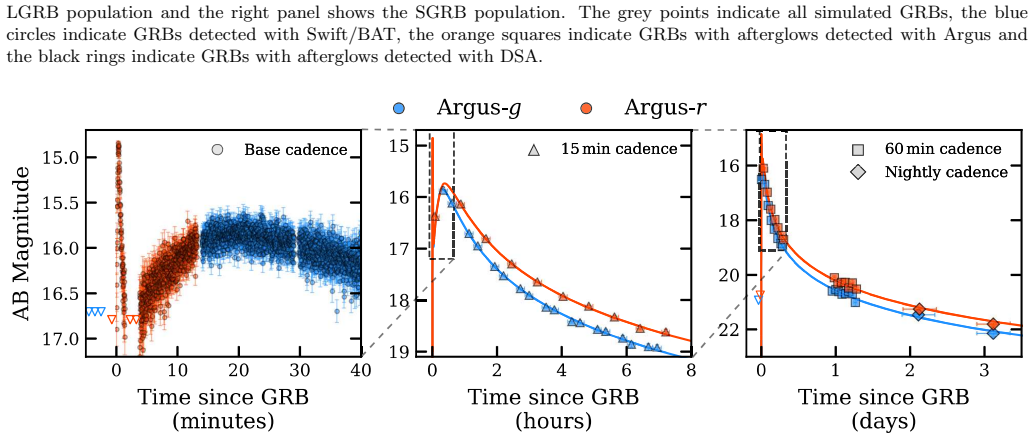
- Argus will detect afterglows before they peak about 18 percent of the time, expanding the sample of reverse-shock and prompt optical emission observations.
- StarBurst is projected to yield 62 optical and 117 radio afterglow detections per year; MoonBEAM is projected to yield 62 and 105.
- Overall afterglow samples will grow substantially, allowing statistical studies of GRB jet physics and energetics.
Where Pith is reading between the lines
- Independent detections without triggers could remove selection biases that affect targeted follow-up programs today.
- Early pre-peak observations may enable rapid alerts that coordinate other telescopes on prompt and reverse-shock phases in real time.
- The larger, less biased sample could be used to test and refine the very population models that fed the simulations.
- Similar survey strategies might be applied to other fast transients such as kilonovae or fast radio bursts.
Load-bearing premise
The simulated detection rates depend on how well the chosen GRB afterglow population models and luminosity functions match reality.
What would settle it
Actual annual detection counts with Argus and DSA once both are operating, compared against the predicted 47 and 82 triggered detections from Fermi GRBs or the 116 and 217 independent detections.
Figures





read the original abstract
Two time domain surveys, recently funded as part of the Eric and Wendy Schmidt Observatory System; the Argus Array, in the optical, and the Deep Synoptic Array (DSA), in the radio, will transform gamma-ray burst (GRB) science via the serendipitous discovery of hundreds of GRB afterglows per year. In this work, we simulate DSA and Argus observations of GRB afterglows. We find that, of the long-duration GRBs (LGRBs) detected by the Fermi Gamma-ray Burst Monitor, $(24 \pm 2)\%$ will yield afterglow detections with Argus and $(42 \pm 3)\%$ with DSA, corresponding to rate of $47 \pm 4$ and $82 \pm 7$ per year respectively. We also compute rates for both upcoming and proposed GRB monitors; the forthcoming StarBurst Multi-messenger Pioneer, with $62 \pm 5$ detections per year in Argus and $117 \pm 8$ detections per year in DSA and the Moon Burst Energetics All-sky Monitor (MoonBEAM) concept, with $62 \pm 6$ per year in Argus and $105 \pm 10$ per year in DSA. The observatory system will detect also 116$\pm$8 optical and 217$\pm$15 radio afterglows per year, independent of GRB triggers, exceeding the current annual rate with global follow-up. Afterglow counterparts to short-duration GRBs, originating from neutron star mergers, will be detected at $5$-$10$% of the LGRB afterglow rate, which is promising for multi-messenger detections of gravitational wave sources and constraining the neutron star merger rate. The Argus Array, with its second-minute cadence, will detect afterglows before they peak $\sim 18\%$ of the time which will dramatically increase the sample of observed reverse shock and prompt optical emission.
Editorial analysis
A structured set of objections, weighed in public.
Referee Report
Summary. The paper uses Monte Carlo simulations to forecast GRB afterglow detection rates with the Argus Array (optical) and Deep Synoptic Array (DSA, radio) within the Eric and Wendy Schmidt Observatory System. It reports that (24 ± 2)% of Fermi GBM long-duration GRBs (LGRBs) will yield Argus afterglow detections (47 ± 4 per year) and (42 ± 3)% will yield DSA detections (82 ± 7 per year). Additional forecasts are given for StarBurst and MoonBEAM monitors, independent (trigger-free) afterglow rates of 116 ± 8 optical and 217 ± 15 radio per year, short-GRB afterglow rates at 5–10% of the LGRB rate, and Argus pre-peak detections ~18% of the time.
Significance. If robust, the results provide concrete, quantitative guidance on the expected scientific return from two new wide-field facilities, showing that serendipitous afterglow discoveries will substantially exceed current global follow-up rates and open new windows for reverse-shock studies and multi-messenger neutron-star-merger observations.
major comments (2)
- [Simulation setup and results sections (Monte Carlo sampling of afterglow light curves)] The central detection fractions ((24 ± 2)% Argus, (42 ± 3)% DSA) and their quoted uncertainties are obtained from a single forward-model realization of the afterglow population (luminosity function, light-curve parameters, jet structure, host extinction). No systematic re-runs with altered faint-end slopes, reverse-shock prescriptions, or extinction distributions are presented; because these parameters directly control the fraction of afterglows that exceed the stated sensitivity thresholds, the reported statistical errors alone do not bound the true uncertainty on the percentages.
- [Independent afterglow detection rate calculation] The independent (trigger-free) rates of 116 ± 8 optical and 217 ± 15 radio afterglows per year are likewise derived from the same fixed population model without cross-validation against the observed afterglow luminosity function or existing survey yields; a modest change in the assumed redshift or luminosity distribution would rescale these numbers by amounts comparable to the quoted errors.
minor comments (2)
- [Abstract] The abstract states the independent rates without repeating the 'per year' qualifier that appears in the body; adding it would improve immediate readability.
- [Throughout] Notation for short-duration GRBs alternates between 'SGRBs' and 'short-duration GRBs'; consistent abbreviation after first use would reduce minor confusion.
Simulated Author's Rebuttal
We thank the referee for their constructive and detailed comments on our manuscript. The points raised regarding the quantification of uncertainties in our Monte Carlo simulations are well taken, and we outline below how we will strengthen the presentation of our results in revision. We address each major comment in turn.
read point-by-point responses
-
Referee: [Simulation setup and results sections (Monte Carlo sampling of afterglow light curves)] The central detection fractions ((24 ± 2)% Argus, (42 ± 3)% DSA) and their quoted uncertainties are obtained from a single forward-model realization of the afterglow population (luminosity function, light-curve parameters, jet structure, host extinction). No systematic re-runs with altered faint-end slopes, reverse-shock prescriptions, or extinction distributions are presented; because these parameters directly control the fraction of afterglows that exceed the stated sensitivity thresholds, the reported statistical errors alone do not bound the true uncertainty on the percentages.
Authors: We agree that the quoted uncertainties primarily reflect statistical sampling variance within our adopted population model rather than a full exploration of systematic variations in the underlying assumptions. The Monte Carlo draws parameters from observationally motivated distributions, but alternative choices for the faint-end luminosity-function slope, reverse-shock prescriptions, or host-extinction law could shift the detection fractions. In the revised manuscript we will add a dedicated subsection on systematic uncertainties. This will include results from additional Monte Carlo realizations that vary the faint-end slope by ±0.2, adopt both standard and enhanced reverse-shock models, and employ two different extinction distributions. The impact on the central detection fractions and rates will be quantified and reported, providing a more complete uncertainty budget. revision: yes
-
Referee: [Independent afterglow detection rate calculation] The independent (trigger-free) rates of 116 ± 8 optical and 217 ± 15 radio afterglows per year are likewise derived from the same fixed population model without cross-validation against the observed afterglow luminosity function or existing survey yields; a modest change in the assumed redshift or luminosity distribution would rescale these numbers by amounts comparable to the quoted errors.
Authors: We acknowledge that the independent rates rest on the same population model and would benefit from explicit cross-checks. In revision we will add a paragraph comparing the simulated afterglow luminosity function and redshift distribution to those compiled from Swift optical and VLA radio afterglow samples. We will also propagate modest variations in the assumed redshift and luminosity distributions through the independent-rate calculation and report the resulting range alongside the nominal values. These checks will be incorporated into the same systematic-uncertainty subsection described above. revision: yes
Circularity Check
No circularity: forward Monte Carlo projections from external models
full rationale
The paper derives detection fractions and annual rates by Monte Carlo sampling of afterglow light curves drawn from literature population models, luminosity functions, and decay indices, then applying the stated instrument sensitivity and cadence. These outputs are not equivalent to the inputs by construction, nor are any parameters fitted to the target rates themselves. No self-citations are invoked as load-bearing uniqueness theorems, and no ansatz or renaming reduces the central claims to tautology. The derivation remains self-contained against external benchmarks.
Axiom & Free-Parameter Ledger
free parameters (3)
- GRB afterglow luminosity function parameters
- Instrument sensitivity thresholds
- GRB rate and redshift distribution
axioms (2)
- domain assumption GRB afterglows follow standard synchrotron emission models
- domain assumption Detection is determined by flux exceeding instrument limits at certain times
Reference graph
Works this paper leans on
-
[1]
Abbott, B. P., Abbott, R., Abbott, T. D., et al. 2017a, ApJL, 848, L12, doi: 10.3847/2041-8213/aa91c9
-
[2]
ApJ848(2), 13 (2017) https://doi.org/10.3847/2041-8213/aa920c arXiv:1710.05834 [astro-ph.HE]
Abbott, B. P., Abbott, R., Abbott, T. D., et al. 2017b, ApJL, 848, L13, doi: 10.3847/2041-8213/aa920c
-
[3]
Abbott, B. P., Abbott, R., Abbott, T. D., et al. 2018, PhRvL, 121, 161101, doi: 10.1103/PhysRevLett.121.161101
-
[4]
2020, MNRAS, 491, 5852, doi: 10.1093/mnras/stz3381
Andreoni, I., Cooke, J., Webb, S., et al. 2020, MNRAS, 491, 5852, doi: 10.1093/mnras/stz3381
-
[5]
Andreoni, I., Coughlin, M. W., Kool, E. C., et al. 2021, ApJ, 918, 63, doi: 10.3847/1538-4357/ac0bc7
-
[6]
2022, in Society of Photo-Optical Instrumentation Engineers (SPIE) Conference Series, Vol
Angel, R., Bender, C., Berkson, J., et al. 2022, in Society of Photo-Optical Instrumentation Engineers (SPIE) Conference Series, Vol. 12182, Ground-based and Airborne Telescopes IX, ed. H. K. Marshall, J. Spyromilio, & T. Usuda, 121821U, doi: 10.1117/12.2629655
-
[7]
Ashton, G., H¨ ubner, M., Lasky, P. D., et al. 2019, ApJS, 241, 27, doi: 10.3847/1538-4365/ab06fc Astropy Collaboration, Robitaille, T. P., Tollerud, E. J., et al. 2013, A&A, 558, A33, doi: 10.1051/0004-6361/201322068 Astropy Collaboration, Price-Whelan, A. M., Sip˝ ocz, B. M., et al. 2018, AJ, 156, 123, doi: 10.3847/1538-3881/aabc4f Astropy Collaboration...
-
[8]
1993, ApJ, 413, 281, doi: 10.1086/172995
Band, D., Matteson, J., Ford, L., et al. 1993, ApJ, 413, 281, doi: 10.1086/172995
-
[9]
2016, SNCosmo: Python library for supernova cosmology,, Astrophysics Source Code Library, record ascl:1611.017 http://ascl.net/1611.017
Barbary, K., Barclay, T., Biswas, R., et al. 2016, SNCosmo: Python library for supernova cosmology,, Astrophysics Source Code Library, record ascl:1611.017 http://ascl.net/1611.017
2016
-
[10]
Barthelmy, S. D., Barbier, L. M., Cummings, J. R., et al. 2005, SSRv, 120, 143, doi: 10.1007/s11214-005-5096-3
-
[11]
Bellm, E. C., Kulkarni, S. R., Graham, M. J., et al. 2019, PASP, 131, 018002, doi: 10.1088/1538-3873/aaecbe
-
[12]
2016, MNRAS, 461, 51, doi: 10.1093/mnras/stw1331
Beniamini, P., Nava, L., & Piran, T. 2016, MNRAS, 461, 51, doi: 10.1093/mnras/stw1331
-
[13]
Beniamini, P., & van der Horst, A. J. 2017, MNRAS, 472, 3161, doi: 10.1093/mnras/stx2203
-
[14]
, archivePrefix = "arXiv", eprint =
Berger, E. 2010, ApJ, 722, 1946, doi: 10.1088/0004-637X/722/2/1946
-
[15]
2010, ApJL, 719, L10, doi: 10.1088/2041-8205/719/1/L10
Beskin, G., Karpov, S., Bondar, S., et al. 2010, ApJL, 719, L10, doi: 10.1088/2041-8205/719/1/L10
-
[16]
Bloom, J. S., Kulkarni, S. R., & Djorgovski, S. G. 2002, AJ, 123, 1111, doi: 10.1086/338893
-
[17]
Bloom, J. S., Perley, D. A., Li, W., et al. 2009, ApJ, 691, 723, doi: 10.1088/0004-637X/691/1/723
-
[18]
2024, Universe, 10, 187, doi: 10.3390/universe10040187
Bozzo, E., Amati, L., Baumgartner, W., et al. 2024, Universe, 10, 187, doi: 10.3390/universe10040187
-
[19]
Cenko, S. B., Kulkarni, S. R., Horesh, A., et al. 2013, ApJ, 769, 130, doi: 10.1088/0004-637X/769/2/130
-
[20]
Chandra, P., & Frail, D. A. 2012, ApJ, 746, 156, doi: 10.1088/0004-637X/746/2/156
-
[21]
Chen, H.-W., Prochaska, J. X., Bloom, J. S., & Thompson, I. B. 2005, ApJL, 634, L25, doi: 10.1086/498646
-
[22]
Chevalier, R. A., & Li, Z.-Y. 1999, ApJL, 520, L29, doi: 10.1086/312147
-
[23]
Chevalier, R. A., & Li, Z.-Y. 2000, ApJ, 536, 195, doi: 10.1086/308914
-
[24]
2001, MNRAS, 322, 231, doi: 10.1046/j.1365-8711.2001.04022.x
Cole, S., Norberg, P., Baugh, C. M., et al. 2001, MNRAS, 326, 255, doi: 10.1046/j.1365-8711.2001.04591.x
-
[25]
2022, in Society of Photo-Optical Instrumentation Engineers (SPIE) Conference Series, Vol
Corbett, H., Vasquez Soto, A., Machia, L., et al. 2022, in Society of Photo-Optical Instrumentation Engineers (SPIE) Conference Series, Vol. 12189, Software and Cyberinfrastructure for Astronomy VII, 1218910, doi: 10.1117/12.2629533
-
[26]
2013, MNRAS, 432, 1231, doi: 10.1093/mnras/stt540
Covino, S., Melandri, A., Salvaterra, R., et al. 2013, MNRAS, 432, 1231, doi: 10.1093/mnras/stt540
-
[27]
Coward, D. M., Howell, E. J., Wan, L., & MacPherson, D. 2015, MNRAS, 449, L6, doi: 10.1093/mnrasl/slu192 19 de Ruiter, I., Dobie, D., Murphy, T., et al. 2026, arXiv e-prints, arXiv:2602.22739, doi: 10.48550/arXiv.2602.22739 D’Elia, V., Fynbo, J. P. U., Covino, S., et al. 2010, A&A, 523, A36, doi: 10.1051/0004-6361/201015216
-
[28]
Eichler, D., Livio, M., Piran, T., & Schramm, D. N. 1989, Nature, 340, 126, doi: 10.1038/340126a0
-
[29]
Evans, P. A., Beardmore, A. P., Page, K. L., et al. 2007, A&A, 469, 379, doi: 10.1051/0004-6361:20077530
-
[30]
Fitzpatrick, E. L., & Massa, D. 2007, ApJ, 663, 320, doi: 10.1086/518158
-
[31]
M., Goldstein, A., & The MoonBEAM Team
Fletcher, C., Hui, C. M., Goldstein, A., & The MoonBEAM Team. 2023, arXiv e-prints, arXiv:2308.16293, doi: 10.48550/arXiv.2308.16293
-
[32]
Fong, W., Berger, E., Margutti, R., & Zauderer, B. A. 2015, ApJ, 815, 102, doi: 10.1088/0004-637X/815/2/102
-
[33]
2013, ApJ, 769, 56, doi: 10.1088/0004-637X/769/1/56
Fong, W., Berger, E., Chornock, R., et al. 2013, ApJ, 769, 56, doi: 10.1088/0004-637X/769/1/56
-
[34]
Foreman-Mackey, D., Hogg, D. W., Lang, D., & Goodman, J. 2013, PASP, 125, 306, doi: 10.1086/670067
-
[35]
Fraija, N., Dichiara, S., Pedreira, A. C. C. d. E. S., et al. 2019, ApJL, 879, L26, doi: 10.3847/2041-8213/ab2ae4
-
[36]
Frail, D. A., Kulkarni, S. R., Berger, E., & Wieringa, M. H. 2003, AJ, 125, 2299, doi: 10.1086/374364
-
[37]
2024, MNRAS, 531, 4836, doi: 10.1093/mnras/stae1489
Freeburn, J., Cooke, J., M¨ oller, A., et al. 2024, MNRAS, 531, 4836, doi: 10.1093/mnras/stae1489
-
[38]
2025, MNRAS, 537, 2061, doi: 10.1093/mnras/staf147
Freeburn, J., O’Connor, B., Cooke, J., et al. 2025, MNRAS, 537, 2061, doi: 10.1093/mnras/staf147
-
[39]
Fynbo, J. P. U., Starling, R. L. C., Ledoux, C., et al. 2006, A&A, 451, L47, doi: 10.1051/0004-6361:20065056
-
[40]
Galama, T. J., Vreeswijk, P. M., van Paradijs, J., et al. 1998, Nature, 395, 670, doi: 10.1038/27150
-
[41]
Gehrels, N., Sarazin, C. L., O’Brien, P. T., et al. 2005, Nature, 437, 851, doi: 10.1038/nature04142
-
[42]
Ghirlanda, G., Nava, L., Ghisellini, G., et al. 2012, MNRAS, 420, 483, doi: 10.1111/j.1365-2966.2011.20053.x
-
[43]
2022, ApJ, 932, 10, doi: 10.3847/1538-4357/ac6e43
Ghirlanda, G., & Salvaterra, R. 2022, ApJ, 932, 10, doi: 10.3847/1538-4357/ac6e43
-
[44]
Ghirlanda, G., Salafia, O. S., Pescalli, A., et al. 2016, A&A, 594, A84, doi: 10.1051/0004-6361/201628993
-
[45]
2018, A&A, 609, A112, doi: 10.1051/0004-6361/201731598 G´ orski, K
Ghirlanda, G., Nappo, F., Ghisellini, G., et al. 2018, A&A, 609, A112, doi: 10.1051/0004-6361/201731598 G´ orski, K. M., Hivon, E., Banday, A. J., et al. 2005, ApJ, 622, 759, doi: 10.1086/427976
-
[46]
& Sari, R.\ 2002, , 568, 2, 820
Granot, J., & Sari, R. 2002, ApJ, 568, 820, doi: 10.1086/338966
-
[47]
Granot, J., & van der Horst, A. J. 2014, PASA, 31, e008, doi: 10.1017/pasa.2013.44
-
[48]
Green, G. M. 2018, The Journal of Open Source Software, 3, 695, doi: 10.21105/joss.00695
-
[49]
2008, PASP, 120, 405, doi: 10.1086/587032
Greiner, J., Bornemann, W., Clemens, C., et al. 2008, PASP, 120, 405, doi: 10.1086/587032
-
[50]
2011, A&A, 528, A15, doi: 10.1051/0004-6361/201015891
Gruber, D., Kr¨ uhler, T., Foley, S., et al. 2011, A&A, 528, A15, doi: 10.1051/0004-6361/201015891
-
[51]
2025, MNRAS, 538, 2676, doi: 10.1093/mnras/staf452
Gulati, A., Murphy, T., Dobie, D., et al. 2025, MNRAS, 538, 2676, doi: 10.1093/mnras/staf452
-
[52]
Gulati, A., Murphy, T., Kaplan, D. L., et al. 2026, arXiv e-prints, arXiv:2602.20522, doi: 10.48550/arXiv.2602.20522
-
[53]
The DSA-2000 -- A Radio Survey Camera
Hallinan, G., Ravi, V., Weinreb, S., et al. 2019, in Bulletin of the American Astronomical Society, Vol. 51, 255, doi: 10.48550/arXiv.1907.07648
work page internal anchor Pith review Pith/arXiv arXiv doi:10.48550/arxiv.1907.07648 2019
-
[54]
Harris, C. R., Millman, K. J., van der Walt, S. J., et al. 2020, Nature, 585, 357, doi: 10.1038/s41586-020-2649-2
-
[55]
Hjorth,et al., A very energetic supernova associated with the𝛾-ray burst of 29 March 2003
Hjorth, J., Sollerman, J., Møller, P., et al. 2003, Nature, 423, 847, doi: 10.1038/nature01750
-
[56]
2012, ApJ, 756, 187, doi: 10.1088/0004-637X/756/2/187
Hjorth, J., Malesani, D., Jakobsson, P., et al. 2012, ApJ, 756, 187, doi: 10.1088/0004-637X/756/2/187
-
[57]
Ho, A. Y. Q., Perley, D. A., Yao, Y., et al. 2022, ApJ, 938, 85, doi: 10.3847/1538-4357/ac8bd0
-
[58]
Hunter, J. D. 2007, Computing in Science and Engineering, 9, 90, doi: 10.1109/MCSE.2007.55 Ivezi´ c,ˇZ., Kahn, S. M., Tyson, J. A., et al. 2019, ApJ, 873, 111, doi: 10.3847/1538-4357/ab042c
-
[59]
2014, ApJ, 785, 84, doi: 10.1088/0004-637X/785/2/84
Japelj, J., Kopaˇ c, D., Kobayashi, S., et al. 2014, ApJ, 785, 84, doi: 10.1088/0004-637X/785/2/84
-
[60]
Jayaraman, R., Fausnaugh, M., Ricker, G. R., Vanderspek, R., & Mo, G. 2024, ApJ, 972, 162, doi: 10.3847/1538-4357/ad5e7b Jel´ ınek, M., Ierardi, A., Novotn´ y, F., et al. 2026, arXiv e-prints, arXiv:2603.05608, doi: 10.48550/arXiv.2603.05608
-
[61]
2013, ApJ, 774, 114, doi: 10.1088/0004-637X/774/2/114
Jin, Z.-P., Covino, S., Della Valle, M., et al. 2013, ApJ, 774, 114, doi: 10.1088/0004-637X/774/2/114
-
[62]
Kann, D. A., Klose, S., & Zeh, A. 2006, ApJ, 641, 993, doi: 10.1086/500652
-
[63]
A., Klose, S., Zhang, B., et al
Kann, D. A., Klose, S., Zhang, B., et al. 2010, ApJ, 720, 1513, doi: 10.1088/0004-637X/720/2/1513
-
[64]
A., Klose, S., Zhang, B., et al
Kann, D. A., Klose, S., Zhang, B., et al. 2011, ApJ, 734, 96, doi: 10.1088/0004-637X/734/2/96
-
[65]
2017, Nature, 551, 80, doi: 10.1038/nature24453
Ramirez-Ruiz, E. 2017, Nature, 551, 80, doi: 10.1038/nature24453
-
[66]
2006, Nature, 440, 184, doi: 10.1038/nature04498
Kawai, N., Kosugi, G., Aoki, K., et al. 2006, Nature, 440, 184, doi: 10.1038/nature04498
-
[67]
Kistler, M. D., Y¨ uksel, H., Beacom, J. F., Hopkins, A. M., & Wyithe, J. S. B. 2009, ApJL, 705, L104, doi: 10.1088/0004-637X/705/2/L104
-
[68]
Klotz, A., Bo¨ er, M., Atteia, J. L., & Gendre, B. 2009, AJ, 137, 4100, doi: 10.1088/0004-6256/137/5/4100 20
-
[69]
& Zhang, B.\ 2003, , 582, 2, L75
Kobayashi, S., & Zhang, B. 2003, ApJL, 582, L75, doi: 10.1086/367691
-
[70]
2012, ApJ, 747, 146, doi: 10.1088/0004-637X/747/2/146
Kocevski, D. 2012, ApJ, 747, 146, doi: 10.1088/0004-637X/747/2/146
-
[71]
E., Briggs, M., et al
Kocevski, D., Grove, J. E., Briggs, M., et al. 2024, in AAS/High Energy Astrophysics Division, Vol. 21, AAS High Energy Astrophysics Division Meeting #21, 406.02
2024
-
[72]
Kornilov, V. G., Lipunov, V. M., Gorbovskoy, E. S., et al. 2012, Experimental Astronomy, 33, 173, doi: 10.1007/s10686-011-9280-z
-
[73]
Lacy, M., Baum, S. A., Chandler, C. J., et al. 2020, PASP, 132, 035001, doi: 10.1088/1538-3873/ab63eb
-
[74]
Lamb, D. Q., & Reichart, D. E. 2000, ApJ, 536, 1, doi: 10.1086/308918
-
[75]
M., Fors, O., Ratzloff, J., et al
Law, N. M., Fors, O., Ratzloff, J., et al. 2015, PASP, 127, 234, doi: 10.1086/680521
-
[76]
and Corbett, Hank and Galliher, Nathan W
Law, N. M., Corbett, H., Galliher, N. W., et al. 2022, PASP, 134, 035003, doi: 10.1088/1538-3873/ac4811
-
[77]
K., Murphy, T., Lenc, E., et al
Leung, J. K., Murphy, T., Lenc, E., et al. 2023, MNRAS, 523, 4029, doi: 10.1093/mnras/stad1670
-
[78]
K., Murphy, T., Ghirlanda, G., et al
Leung, J. K., Murphy, T., Ghirlanda, G., et al. 2021, MNRAS, 503, 1847, doi: 10.1093/mnras/stab326
-
[79]
2010, ApJ, 725, 2209, doi: 10.1088/0004-637X/725/2/2209
Liang, E.-W., Yi, S.-X., Zhang, J., et al. 2010, ApJ, 725, 2209, doi: 10.1088/0004-637X/725/2/2209
-
[80]
Lien, A., Sakamoto, T., Barthelmy, S. D., et al. 2016, ApJ, 829, 7, doi: 10.3847/0004-637X/829/1/7 LSST Dark Energy Science Collaboration (LSST DESC),
discussion (0)
Sign in with ORCID, Apple, or X to comment. Anyone can read and Pith papers without signing in.