Recognition: unknown
Radial Velocity Evidence for a Post-Mass-Transfer Massive Binary System: NaSt1
Pith reviewed 2026-05-10 12:00 UTC · model grok-4.3
The pith
Detection of opposing radial velocity variations in NaSt1's emission lines establishes it as a massive binary system after mass transfer.
A machine-rendered reading of the paper's core claim, the machinery that carries it, and where it could break.
Core claim
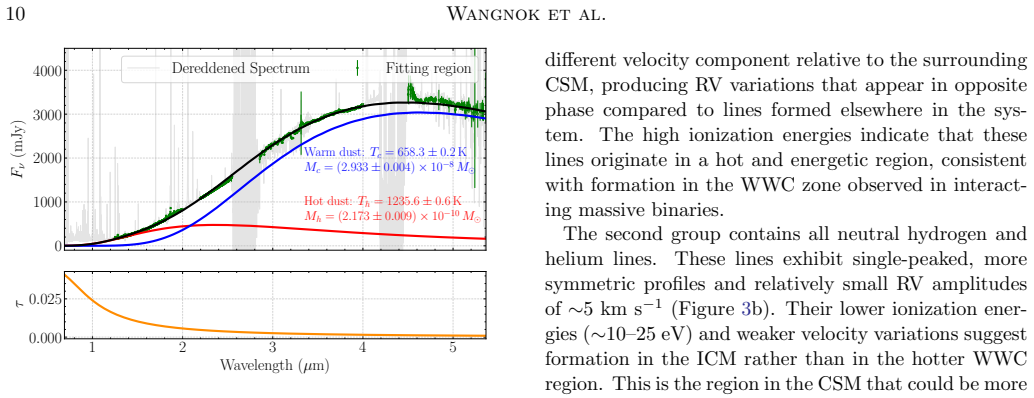
Multi-epoch high-resolution optical spectroscopy of NaSt1 reveals two groups of 35 emission lines that exhibit radial velocity variations with a period of 310 ± 6 days but in opposing phases. These are interpreted as originating from the optically thick wind of the stripped primary star and the wind-wind collision region with its companion, offering strong evidence for the system's binary nature. The period matches the light curve period, inconsistent with pulsations or ellipsoidal modulation, while modeling shows hot and warm dust and an expanding nebula with a dynamical age of about 40 years.
What carries the argument
The radial velocity curves of two opposing-phase groups of emission lines, associated with the primary star's wind and the wind-collision zone.
If this is right
- The consistent RV and light curve periods exclude ellipsoidal modulation as the cause of variability.
- The phase relationship rules out stellar pulsations in favor of a binary interpretation.
- Modeling of the infrared spectrum identifies two optically thin dust components at different temperatures.
- Spatially resolved spectroscopy shows a circumstellar nebula expanding at 31 km/s with a dynamical age of roughly 40 years.
- The system serves as a Galactic example of a massive binary in the process of becoming a stripped-envelope supernova progenitor.
Where Pith is reading between the lines
- If the line identifications hold, similar RV monitoring of other emission-line objects could uncover additional post-mass-transfer binaries.
- The short dynamical age of the nebula implies that the mass-loss episode is recent, which could be tested by searching for changes in the nebula's size or brightness over the next decade.
- Confirmation of this binary channel would help calibrate models of envelope stripping in massive stars leading to supernovae.
Load-bearing premise
The two groups of emission lines must originate from the primary's wind and the wind-collision region specifically, and the observed period must be the orbital period rather than a harmonic or unrelated cycle.
What would settle it
Future observations that fail to show the 310-day periodicity persisting in the radial velocities of the two line groups or that show the phases no longer opposing each other would falsify the binary interpretation.
Figures




read the original abstract
We present multi-epoch high-resolution optical spectroscopy ($R \simeq 80{,}000$) of the emission-line object NaSt1 to test its proposed binary nature, along with long-term multiband photometry, mid-infrared spectroscopy, and spatially resolved integral field unit (IFU) spectroscopy to probe the circumstellar kinematics of the system. We detect two groups of 35 emission lines showing radial velocities (RVs) variation of the same period of 310 $\pm$ 6 d, but with opposing phase, which we associate with the optically thick wind of the stripped primary star and the wind-wind collision region with the companion star, providing a strong evidence for binarity. The RV and light curve (LC) periods are consistent within the uncertainties, ruling out ellipsoidal modulation, which would require an orbital period of about 620 d. The phase relationship between the RV and LC is inconsistent with stellar pulsations and supports a binary origin. We model the 1--5~$\mu$m spectrum of NaSt1 and find two optically thin dust components: hot $T_{\rm h} \simeq 1230$ K, $M_{\rm h} \simeq 2 \times 10^{-10} M_{\odot}$ and warm $T_{\rm c} \simeq 660$ K, $M_{\rm c} \simeq 3 \times 10^{-8} M_{\odot}$. IFU spectroscopy spatially resolves the circumstellar medium in the [\ion{N}{2}] $\lambda6548$ and $\lambda6584$ emission lines, showing a deprojected expansion velocity of $\sim31$ km~s$^{-1}$, implying a dynamical age of $\sim40$ yr. This short timescale suggests that the nebula was produced by recent mass loss. The system may represent a Galactic analog of a massive binary undergoing a mass-loss process to become a stripped-envelope supernova progenitor.
Editorial analysis
A structured set of objections, weighed in public.
Referee Report
Summary. The manuscript reports multi-epoch high-resolution optical spectroscopy (R ≃ 80,000) of NaSt1, identifying two groups of emission lines whose radial velocities vary with a shared period of 310 ± 6 d but opposite phases. These are interpreted as tracing the optically thick wind of a stripped primary and the wind-wind collision region with a companion, constituting evidence for binarity. Supporting observations include long-term multiband photometry (ruling out 620 d ellipsoidal modulation), 1–5 μm spectroscopy modeled with two optically thin dust components, and IFU spectroscopy resolving the nebula with ~31 km s⁻¹ expansion implying a ~40 yr dynamical age.
Significance. If the line-to-region mapping holds, the work supplies direct radial-velocity evidence for a post-mass-transfer massive binary and a Galactic analog to stripped-envelope supernova progenitors. The multi-epoch high-resolution spectroscopy yielding opposing-phase signals, combined with the light-curve period consistency that excludes the ellipsoidal alternative, represents a clear observational strength and a falsifiable test of the binary hypothesis.
major comments (2)
- [RV analysis section] RV analysis section: The division of the emission lines into two groups and their specific association with the primary wind versus the wind-collision region rests solely on the shared 310 d period and phase opposition. No line identifications, profile modeling, or radiative-transfer verification is provided to exclude alternatives such as stratified wind zones or non-orbital variability; this mapping is load-bearing for the binarity claim.
- [Line selection and measurement subsection] Line selection and measurement subsection: Details of how the 35 lines were chosen, the precise RV extraction method, and the per-line velocity uncertainties are not reported. These are required to evaluate the statistical significance of the period fit and the robustness of the opposing-phase detection.
minor comments (2)
- [Abstract] Abstract: clarify whether 'two groups of 35 emission lines' refers to 35 lines total or 35 lines per group.
- [Dust modeling paragraph] Dust modeling paragraph: state the specific assumptions (e.g., grain properties, geometry) and any fitting code or references used for the hot and warm components.
Simulated Author's Rebuttal
We thank the referee for their thorough review and for recognizing the significance of our radial velocity evidence for the binarity of NaSt1. We address each of the major comments below.
read point-by-point responses
-
Referee: [RV analysis section] The division of the emission lines into two groups and their specific association with the primary wind versus the wind-collision region rests solely on the shared 310 d period and phase opposition. No line identifications, profile modeling, or radiative-transfer verification is provided to exclude alternatives such as stratified wind zones or non-orbital variability; this mapping is load-bearing for the binarity claim.
Authors: The association of the two groups with the primary wind and the wind-wind collision region is indeed based on the observed RV period and phase opposition, which is difficult to explain without invoking orbital motion in a binary system. In the revised manuscript, we will add the specific identifications of the lines in each group and include a more detailed discussion of the line profiles to support the mapping. While a full radiative transfer calculation is beyond the scope of this paper, we will explicitly address why alternatives like stratified winds are unlikely given the clear phase opposition and the consistency with the photometric period. We believe this strengthens the binarity claim without overclaiming. revision: partial
-
Referee: [Line selection and measurement subsection] Details of how the 35 lines were chosen, the precise RV extraction method, and the per-line velocity uncertainties are not reported. These are required to evaluate the statistical significance of the period fit and the robustness of the opposing-phase detection.
Authors: We agree that these details are essential for assessing the robustness of our results. In the revised manuscript, we will expand the relevant subsection to describe the selection criteria for the 35 emission lines (focusing on unblended, high signal-to-noise lines), the method used for RV extraction (e.g., centroid fitting or Gaussian profile fitting), and provide the per-line velocity uncertainties. This will enable a better evaluation of the period significance and the opposing-phase detection. revision: yes
Circularity Check
No circularity: central binarity claim follows directly from period fits to new RV data.
full rationale
The paper measures radial velocities from 35 emission lines across multiple epochs, fits a common 310-day period with opposing phases, and compares it to the light-curve period. These steps are data-driven extractions and statistical fits with no equations that define the target period or binary geometry in terms of themselves. No self-citations, ansatzes, or uniqueness theorems are invoked to force the result. The physical association of line groups is an interpretation, not a definitional reduction. The derivation chain is therefore self-contained against external benchmarks.
Axiom & Free-Parameter Ledger
free parameters (2)
- RV period =
310 ± 6 d
- Dust temperatures and masses =
Th ≈ 1230 K, Mh ≈ 2×10^{-10} M⊙; Tc ≈ 660 K, Mc ≈ 3×10^{-8} M⊙
axioms (2)
- domain assumption The two groups of emission lines trace the optically thick wind of the stripped primary and the wind-wind collision region
- domain assumption The observed RV period is the orbital period of the binary
Reference graph
Works this paper leans on
-
[1]
Astropy Collaboration, Robitaille, T. P., Tollerud, E. J., et al. 2013, A&A, 558, A33, doi: 10.1051/0004-6361/201322068
-
[2]
Bellm, E. C., Kulkarni, S. R., Graham, M. J., et al. 2019, PASP, 131, 018002, doi: 10.1088/1538-3873/aaecbe
-
[3]
Cox, D. P., & Mathews, W. G. 1969, ApJ, 155, 859, doi: 10.1086/149916
-
[4]
Crowther, P. A. 2007, ARA&A, 45, 177, doi: 10.1146/annurev.astro.45.051806.110615
-
[5]
Crowther, P. A., & Smith, L. J. 1999, Monthly Notices of the Royal Astronomical Society, 308, 82, doi: 10.1046/j.1365-8711.1999.02707.x
-
[6]
Cushing, M. C., Vacca, W. D., & Rayner, J. T. 2004, PASP, 116, 362, doi: 10.1086/382907
-
[7]
De, K., Hankins, M. J., Kasliwal, M. M., et al. 2020a, Publications of the Astronomical Society of the Pacific, 132, 025001, doi: 10.1088/1538-3873/ab6069
-
[8]
De, K., Ashley, M. C. B., Andreoni, I., et al. 2020b, The Astrophysical Journal Letters, 901, L7, doi: 10.3847/2041-8213/abb3c5 Djuraˇ sevi´ c, G., Vince, I., & Atanackovi´ c, O. 2008, The Astronomical Journal, 136, 767, doi: 10.1088/0004-6256/136/2/767
-
[9]
Draine, B. T., & Lee, H. M. 1984, ApJ, 285, 89, doi: 10.1086/162480
-
[10]
V., Li, W
Filippenko, A. V., Li, W. D., Treffers, R. R., & Modjaz, M. 2001, in Astronomical Society of the Pacific Conference
2001
-
[11]
Fitzpatrick, E. L. 1999, PASP, 111, 63, doi: 10.1086/316293
-
[12]
Foreman-Mackey, D., Hogg, D. W., Lang, D., & Goodman, J. 2013, Publications of the Astronomical Society of the Pacific, 125, 306, doi: 10.1086/670067
-
[13]
Fox, O. D., Chevalier, R. A., Dwek, E., et al. 2010, The Astrophysical Journal, 725, 1768, doi: 10.1088/0004-637X/725/2/1768
-
[14]
Summary of the contents and survey properties
Gagne, M., Townsley, L., Corcoran, M., et al. 2010, in AAS/High Energy Astrophysics Division, Vol. 11, AAS/High Energy Astrophysics Division #11, 17.12 Gaia Collaboration, Brown, A. G. A., Vallenari, A., et al. 2021, A&A, 649, A1, doi: 10.1051/0004-6361/202039657
-
[15]
Goldberg, J. A., Joyce, M., & Moln´ ar, L. 2024, The Astrophysical Journal, 977, 35, doi: 10.3847/1538-4357/ad87f4
-
[16]
Harris, C. R., Millman, K. J., van der Walt, S. J., et al. 2020, Nature, 585, 357, doi: 10.1038/s41586-020-2649-2
-
[17]
Heinze, A. N., Tonry, J. L., Denneau, L., et al. 2018, The Astronomical Journal, 156, 241, doi: 10.3847/1538-3881/aae47f
-
[18]
Hunter, J. D. 2007, Computing in Science & Engineering, 9, 90, doi: 10.1109/MCSE.2007.55
-
[19]
Indebetouw, R., Mathis, J. S., Babler, B. L., et al. 2005, ApJ, 619, 931, doi: 10.1086/426679
-
[20]
Jayasinghe, T., Stanek, K. Z., Kochanek, C. S., et al. 2020, Monthly Notices of the Royal Astronomical Society, 493, 4186, doi: 10.1093/mnras/staa499
-
[21]
Kochanek, C. S., Shappee, B. J., Stanek, K. Z., et al. 2017, Publications of the Astronomical Society of the Pacific, 129, 104502, doi: 10.1088/1538-3873/aa80d9
-
[22]
Laor, A., & Draine, B. T. 1993, ApJ, 402, 441, doi: 10.1086/172149 Radial velocity evidence for NaSt115 0.75 1.00 1.25 1.50 1.75 2.00 2.25 Continuum Normalized Flux He I λ3889 1.0 1.5 2.0 2.5 3.0 3.5 [Fe III] λ4658 2 4 6 8 He II λ4686 0.8 1.0 1.2 1.4 1.6 1.8 2.0 [Fe III] λ4701 1.0 1.5 2.0 2.5 3.0 He I λ4713 1.0 1.2 1.4 1.6 1.8 2.0 2.2 2.4 He II λ4859 1 2 ...
-
[23]
Lau, R. M., Tinyanont, S., Hankins, M. J., et al. 2021, The Astrophysical Journal, 922, 5, doi: 10.3847/1538-4357/ac2237
-
[24]
1990, ApJ, 362, 267, doi: 10.1086/169263
Luo, D., McCray, R., & Mac Low, M.-M. 1990, ApJ, 362, 267, doi: 10.1086/169263
-
[25]
The Zwicky Transient Facility: Data Processing, Products, and Archive
Masci, F. J., Laher, R. R., Rusholme, B., et al. 2018, Publications of the Astronomical Society of the Pacific, 131, 018003, doi: 10.1088/1538-3873/aae8ac
work page internal anchor Pith review doi:10.1088/1538-3873/aae8ac 2018
-
[26]
Mauerhan, J., Smith, N., Van Dyk, S. D., et al. 2015, MNRAS, 450, 2551, doi: 10.1093/mnras/stv257 16W angnok et al. A=4.12+0.08 °0.07 0.930 0.945 0.960 0.975 ! !=0.95+0.01 °0.01 ° 20 .1 ° 19 .8 ° 19 .5 ° 19 .2 ¡ ¡=°19.65+0.14 °0.14 3.90 4.05 4.20 4.35 A ° 2.70 ° 2.55 ° 2.40 ° 2.25 C 0.930 0.945 0.960 0.975 ! ° 20 .1 ° 19 .8 ° 19 .5 ° 19 .2 ¡ ° 2.70 ° 2.55...
-
[27]
Medina, S. N. X., Urquhart, J. S., Dzib, S. A., et al. 2019, A&A, 627, A175, doi: 10.1051/0004-6361/201935249
-
[28]
Morrissey, P., Matuszewski, M., Martin, D. C., et al. 2018, ApJ, 864, 93, doi: 10.3847/1538-4357/aad597
-
[29]
Morton, D. C. 1991, ApJS, 77, 119, doi: 10.1086/191601
-
[30]
J., Stephenson, C., & MacConnell, D
Nassau, J. J., Stephenson, C., & MacConnell, D. 1965, Luminous Stars in the Northern Milky Way...: VI. (Hamburger sternwarte Warner and Swasey observatory)
1965
-
[31]
2023, KCWI DRP: Keck Cosmic Web Imager Data Reduction Pipeline in Python,, Astrophysics Source Code Library, record ascl:2301.019 http://ascl.net/2301.019
Rizzi, L. 2023, KCWI DRP: Keck Cosmic Web Imager Data Reduction Pipeline in Python,, Astrophysics Source Code Library, record ascl:2301.019 http://ascl.net/2301.019
2023
-
[32]
Lockwood, C. T., & Vogt, S. S. 2010, in Society of Photo-Optical Instrumentation Engineers (SPIE) Conference Series, Vol. 7735, Ground-based and Airborne Instrumentation for Astronomy III, ed. I. S. McLean, S. K. Ramsay, & H. Takami, 77354K, doi: 10.1117/12.857726
-
[33]
Rayner, J. T., Toomey, D. W., Onaka, P. M., et al. 2003, PASP, 115, 362, doi: 10.1086/367745
-
[34]
doi:10.1126/science.1223344 , eprint =
Sana, H., de Mink, S. E., de Koter, A., et al. 2012, Science, 337, 444, doi: 10.1126/science.1223344
-
[35]
2022, A&A, 668, A57, doi: 10.1051/0004-6361/202244391
Sarangi, A. 2022, A&A, 668, A57, doi: 10.1051/0004-6361/202244391
-
[36]
2023, Monthly Notices of the Royal Astronomical Society, 523, 6048, doi: 10.1093/mnras/stad1681
Shahbandeh, M., Sarangi, A., Temim, T., et al. 2023, Monthly Notices of the Royal Astronomical Society, 523, 6048, doi: 10.1093/mnras/stad1681
-
[37]
Shappee, B. J., Prieto, J. L., Grupe, D., et al. 2014, The Astrophysical Journal, 788, 48, doi: 10.1088/0004-637X/788/1/48
-
[38]
Sokal, K. R. 2010, The Astronomical Journal, 139, 825, doi: 10.1088/0004-6256/139/3/825
-
[39]
Skrutskie, M. F., Cutri, R. M., Stiening, R., et al. 2006, AJ, 131, 1163, doi: 10.1086/498708
-
[40]
Smith, J. D. T., & Houck, J. R. 2001, AJ, 121, 2115, doi: 10.1086/319968
-
[41]
doi:10.1046/j.1365-8711.2002.05889.x , archiveprefix =
Smith, N. 2002, MNRAS, 337, 1252, doi: 10.1046/j.1365-8711.2002.05966.x
-
[42]
2014, ARA&A, 52, 487, doi: 10.1146/annurev-astro-081913-040025
Smith, N. 2014, ARA&A, 52, 487, doi: 10.1146/annurev-astro-081913-040025
-
[43]
2011, MNRAS, 415, 2101, doi: 10.1111/j.1365-2966.2011.18820.x
Smith, N., Gehrz, R. D., Campbell, R., et al. 2011, MNRAS, 418, 1959, doi: 10.1111/j.1365-2966.2011.19614.x
-
[44]
D., Stahl, O., Balick, B., & Kaufer, A
Smith, N., Gehrz, R. D., Stahl, O., Balick, B., & Kaufer, A. 2002, The Astrophysical Journal, 578, 464, doi: 10.1086/342365 Radial velocity evidence for NaSt117
-
[45]
Smith, N., E Andrews, J., Moe, M., et al. 2020, Monthly Notices of the Royal Astronomical Society, 492, 5897, doi: 10.1093/mnras/staa061 The Astropy Collaboration, Price-Whelan, A. M., Sip˝ ocz, B. M., et al. 2018, The Astronomical Journal, 156, 123, doi: 10.3847/1538-3881/aabc4f
-
[46]
Tinyanont, S., Fox, O. D., Shahbandeh, M., et al. 2025, The Astrophysical Journal, 985, 198, doi: 10.3847/1538-4357/adccc0
-
[47]
ATLAS: A High-Cadence All-Sky Survey System
Tonry, J. L., Denneau, L., Heinze, A. N., et al. 2018, Publications of the Astronomical Society of the Pacific, 130, 064505, doi: 10.1088/1538-3873/aabadf
work page internal anchor Pith review doi:10.1088/1538-3873/aabadf 2018
-
[48]
Usov, V. V. 1992, ApJ, 389, 635, doi: 10.1086/171236
-
[49]
Vacca, W. D., Cushing, M. C., & Rayner, J. T. 2003, PASP, 115, 389, doi: 10.1086/346193
-
[50]
Vogt, S. S., Radovan, M., Kibrick, R., et al. 2014, PASP, 126, 359, doi: 10.1086/676120
-
[51]
Wright, A. E., & Barlow, M. J. 1975, Monthly Notices of the Royal Astronomical Society, 170, 41, doi: 10.1093/mnras/170.1.41
discussion (0)
Sign in with ORCID, Apple, or X to comment. Anyone can read and Pith papers without signing in.