Recognition: unknown
Could the high-mass black holes from gravitational-wave observations be explained by lensing?
Pith reviewed 2026-05-10 13:07 UTC · model grok-4.3
The pith
Lensing magnification cannot explain the high-mass black holes seen by LIGO and Virgo.
A machine-rendered reading of the paper's core claim, the machinery that carries it, and where it could break.
Core claim
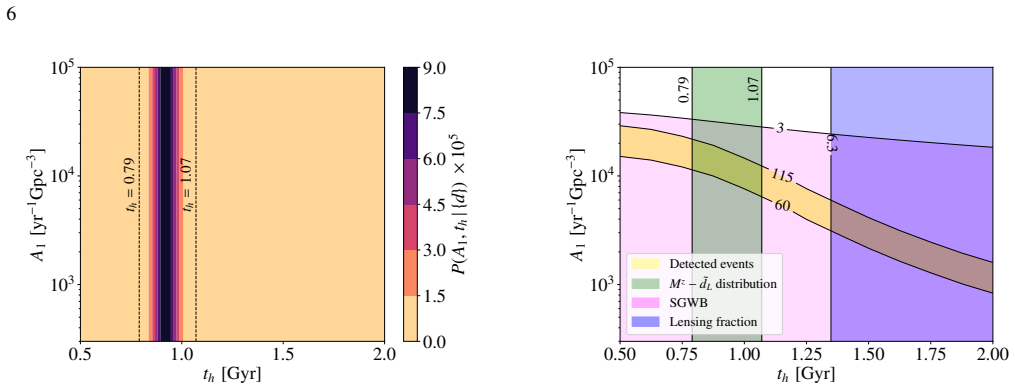
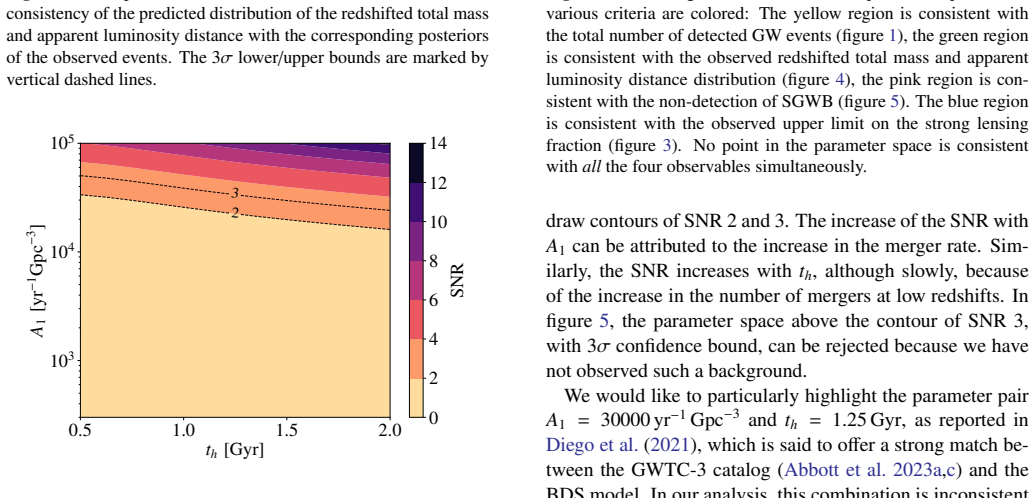
Simulations of lensed BBH mergers with the BDS model show that it is inconsistent with the observed number of BBH mergers, the joint distribution of redshifted total mass and apparent luminosity distance, the non-detection of strongly lensed events, and the non-observation of the stochastic GW background. Therefore, gravitational lensing is not a viable explanation for the high-mass black holes discovered by LIGO and Virgo.
What carries the argument
Numerical simulations of lensed binary black hole mergers that incorporate the BDS redshift distribution and lensing magnification, then tested for consistency against multiple LIGO-Virgo observational constraints.
If this is right
- High-mass black holes in mergers must originate from intrinsic processes such as the collapse of metal-poor massive stars.
- Population models for future gravitational-wave forecasts should treat the observed masses as close to the true masses without lensing corrections.
- The non-detection of a stochastic background already limits the allowed merger rate density under lensing scenarios.
- Searches for strongly lensed events can proceed without expecting a large hidden population from the BDS redshift distribution.
Where Pith is reading between the lines
- The result tightens the requirement that alternative channels, such as hierarchical mergers in dense clusters, must produce the observed high-mass population.
- Similar lensing-based reinterpretations of other gravitational-wave anomalies should be subjected to the same multi-observable consistency tests.
- Refined forecasts for third-generation detectors can now exclude lensing as a dominant bias when estimating intrinsic black-hole mass functions.
Load-bearing premise
The simulations accurately capture the joint effects of lensing magnification, selection biases in LIGO-Virgo detection, and the proposed redshift distribution without unaccounted systematic errors in apparent luminosity distance or event rates.
What would settle it
Detection of even one strongly lensed BBH event showing multiple images, or a future measurement of the stochastic gravitational-wave background amplitude that matches the BDS-predicted rates, would indicate that the model can be made consistent with observations.
Figures




read the original abstract
The high-mass ($M \gtrsim 30 M_\odot$) black holes (BHs) from the gravitational-wave (GW) observations of LIGO and Virgo came as a surprise to many astronomers. While the collapse of metal-poor massive stars could produce such BHs, gravitational lensing has been invoked to explain their high masses. Broadhurst, Diego, and Smoot (henceforth BDS) argued that the mass distribution of BHs in coalescing binaries is very similar to that of the galactic BHs, and the inferred high masses are the result of neglecting the lensing magnification. They also proposed a redshift distribution of binary BH (BBH) mergers to explain the observed LIGO-Virgo mass distribution. We ask whether such a model is consistent with different aspects of the GW observations: 1) the observed number of BBH mergers, 2) the distribution of their redshifted total mass and apparent luminosity distance, 3) the non-detection of strongly lensed events, and 4) the non-observation of the stochastic GW background. By simulating lensed BBH mergers with the BDS model and comparing them with observations, we conclude that no choice of BDS model parameters is consistent with all aspects of the observations. Lensing magnification is not a viable explanation for the high-mass BHs discovered by LIGO and Virgo.
Editorial analysis
A structured set of objections, weighed in public.
Referee Report
Summary. The manuscript simulates lensed binary black hole (BBH) merger populations under the Broadhurst-Diego-Smoot (BDS) model and tests consistency against four independent LIGO-Virgo constraints: the observed BBH event rate, the joint distribution of redshifted total mass and apparent luminosity distance, the non-detection of strongly lensed events, and the non-observation of the stochastic gravitational-wave background. Forward modeling shows that no choice of BDS parameters simultaneously satisfies all four observables, leading to the conclusion that lensing magnification cannot explain the high-mass black holes in the GW catalog.
Significance. If the simulations correctly incorporate selection effects and magnification statistics, the multi-constraint rejection of the BDS scenario provides strong evidence against lensing as the origin of the apparent high-mass BH population. This supports astrophysical interpretations (e.g., formation in metal-poor environments) and demonstrates the value of exhaustive forward modeling against public summary statistics rather than fitting to the target data. The absence of free parameters tuned to the LIGO-Virgo sample is a methodological strength.
minor comments (2)
- [Methods] The handling of LIGO-Virgo detection efficiency, luminosity-distance errors, and the precise form of the magnification PDF should be expanded in the methods section with explicit equations or pseudocode to enable independent reproduction of the four constraint comparisons.
- [Results] Figure captions for the mass-distance and rate plots should explicitly state the assumed cosmology, the redshift range of the simulated population, and the exact observational data sets (e.g., GWTC-3 or specific catalog releases) used for comparison.
Simulated Author's Rebuttal
We thank the referee for their positive assessment of our manuscript and for recommending minor revision. The referee's summary accurately reflects our main result: that no choice of parameters in the BDS lensing model is simultaneously consistent with the observed BBH rate, the joint mass-distance distribution, the absence of strongly lensed events, and the non-detection of the stochastic background. We appreciate the recognition of our forward-modeling approach and the absence of tuning to the LIGO-Virgo catalog. As no specific major comments were raised in the report, we have no point-by-point rebuttals to provide. We will incorporate any minor editorial suggestions in the revised version.
Circularity Check
No significant circularity in forward simulation and comparison
full rationale
The paper takes the external BDS model (Broadhurst et al.), performs forward simulations of lensed BBH populations, and compares the resulting predictions for event rates, mass-distance joint distributions, absence of strongly lensed events, and stochastic background against independent public observational summaries. No parameters are fitted to the target LIGO-Virgo data inside the derivation, and no self-citations or ansatzes are used to justify load-bearing steps. The multi-constraint rejection is therefore a genuine test rather than a re-expression of inputs.
Axiom & Free-Parameter Ledger
axioms (1)
- domain assumption Standard assumptions about binary black hole population distributions, gravitational lensing magnification statistics, and LIGO-Virgo selection functions hold in the simulated catalogs.
Forward citations
Cited by 2 Pith papers
-
How do the LIGO-Virgo-KAGRA's Heavy Black Holes Form? No evidence for core-collapse Intermediate-mass black holes in GWTC-4
No evidence for core-collapse IMBHs in GWTC-4; heavy BHs from hierarchical mergers, with low-spin mass distribution truncating at ~65 solar masses and PIMG upper edge estimated at 150 solar masses.
-
How do the LIGO-Virgo-KAGRA's Heavy Black Holes Form? No evidence for core-collapse Intermediate-mass black holes in GWTC-4
No evidence for core-collapse formed low-spin IMBHs in GWTC-4, with 90% upper limit on merger rate of 0.077 Gpc^{-3} yr^{-1}, low-spin BH mass truncation at 65 solar masses consistent with pair-instability gap lower e...
Reference graph
Works this paper leans on
-
[1]
, " * write output.state after.block = add.period write newline
ENTRY address archivePrefix author booktitle chapter doi edition editor eprint howpublished institution journal key month number organization pages publisher school series title misctitle type volume year version url label extra.label sort.label short.list INTEGERS output.state before.all mid.sentence after.sentence after.block FUNCTION init.state.consts ...
-
[2]
write newline
" write newline "" before.all 'output.state := FUNCTION format.url url empty "" new.block "" url * "" * if FUNCTION format.eprint eprint empty "" archivePrefix empty "" archivePrefix "arXiv" = new.block " " eprint * " " * new.block " " eprint * " " * if if if FUNCTION format.doi doi empty "" " " doi * " " * if FUNCTION format.pid doi empty eprint empty ur...
-
[3]
thebibliography [1] 20pt to REFERENCES 6pt =0pt -12pt 10pt plus 3pt =0pt =0pt =1pt plus 1pt =0pt =0pt -12pt =13pt plus 1pt =20pt =13pt plus 1pt \@M =10000 =-1.0em =0pt =0pt 0pt =0pt =1.0em @enumiv\@empty 10000 10000 `\.\@m \@noitemerr \@latex@warning Empty `thebibliography' environment \@ifnextchar \@reference \@latexerr Missing key on reference command E...
discussion (0)
Sign in with ORCID, Apple, or X to comment. Anyone can read and Pith papers without signing in.