Recognition: unknown
Filament: Denning-Style Information Flow Control for Rust
Pith reviewed 2026-05-10 11:19 UTC · model grok-4.3
The pith
Filament adds information flow control to Rust without compiler changes
A machine-rendered reading of the paper's core claim, the machinery that carries it, and where it could break.
Core claim
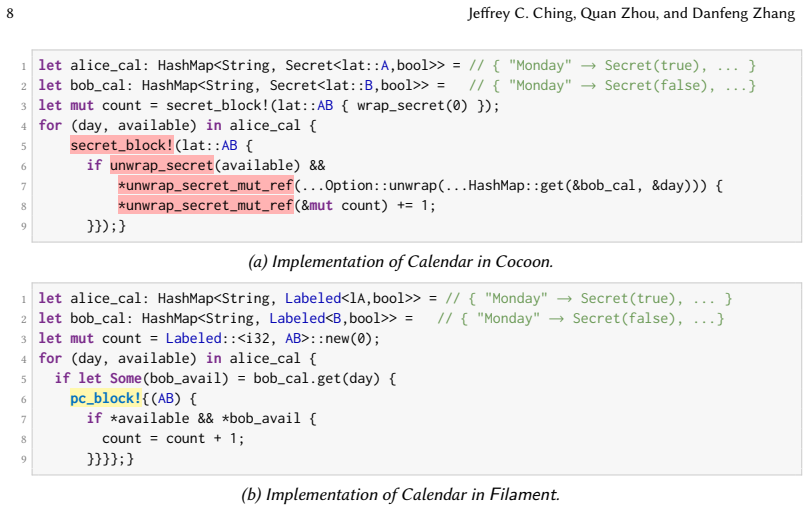
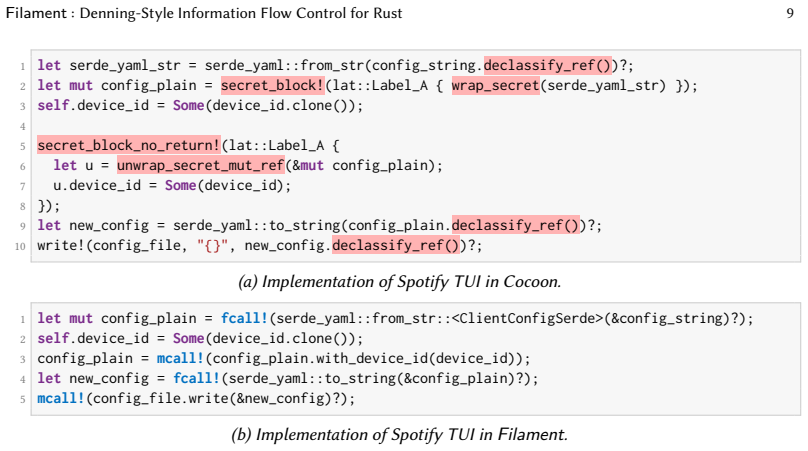
Filament is a static information flow control library for Rust that enforces both explicit and implicit flows at compile time with no compiler modifications. It uses Rust's type inference to reduce annotation needs for explicit flows, introduces the pc_block! macro to track a program counter label for implicit flows, and supplies fcall! and mcall! macros to allow safe calls into standard and third-party libraries. Evaluation shows negligible compile-time overhead, modest annotation requirements, and a more permissive programming model that reduces the need for escape hatches.
What carries the argument
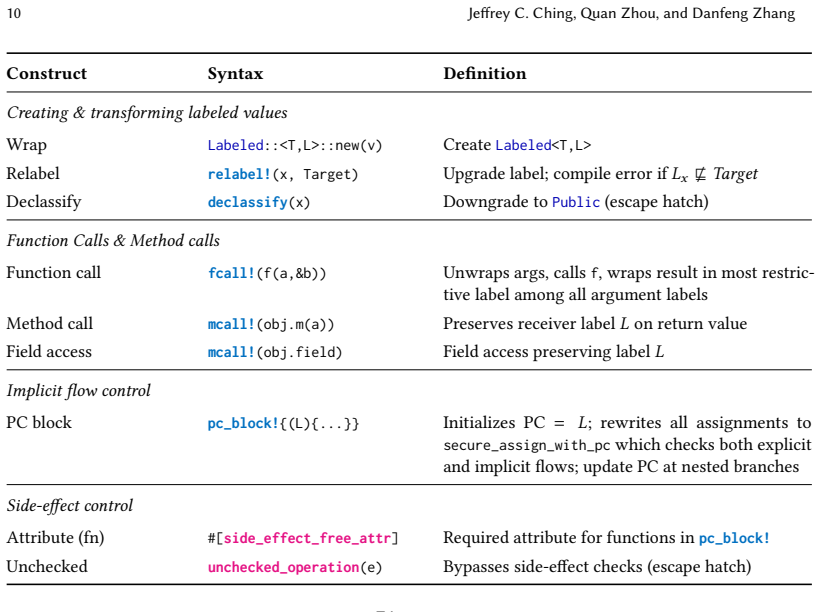
The pc_block!, fcall!, and mcall! macros working together with Rust type inference to track security labels on data and control flow at compile time.
Load-bearing premise
The macros and type inference are enough to block all explicit and implicit flows without missing leaks or creating new channels, even when third-party libraries are used.
What would settle it
A concrete Rust program that uses Filament yet compiles successfully while allowing a high-security value to influence a low-security output through control flow or a library call.
Figures



read the original abstract
Existing language-based information-flow control (IFC) tools face a fundamental tension: Denning-style systems that track explicit and implicit flows at the variable level typically require compiler modifications, while more coarse-grained approaches, including recent work Cocoon, avoid compiler changes but impose more restrictive programming models. We present Filament, a Denning-style static IFC library for Rust that requires no compiler modifications. Filament addresses three key challenges in building a practical IFC library for Rust. First, it enables fine-grained explicit-flow checking with minimal annotation overhead by leveraging Rust's type inference. Second, it introduces pc_block!, a lightweight construct for enforcing implicit flows via a compile-time program counter label, without requiring compiler support. Third, it provides fcall! and mcall! macros to support seamless and safe interoperability with standard and third-party libraries. Our evaluation shows that Filament incurs negligible compile-time overhead and requires only modest annotations. Moreover, compared to Cocoon, Filament offers a more permissive programming model, reducing the need for frequent escape hatches that bypass security checks.
Editorial analysis
A structured set of objections, weighed in public.
Referee Report
Summary. The manuscript presents Filament, a Denning-style static information-flow control library for Rust implemented without compiler modifications. It uses Rust type inference to minimize annotations for explicit flows, introduces the pc_block! macro to track implicit flows via a compile-time program-counter label, and supplies fcall! and mcall! macros to enable safe calls into standard and third-party libraries. The central claims are that the approach enforces both explicit and implicit flows, incurs negligible compile-time overhead, requires only modest annotations, and provides a more permissive programming model than Cocoon by reducing the need for escape hatches.
Significance. If the security properties hold for realistic code, Filament demonstrates a viable engineering path for fine-grained IFC in an existing systems language without language extensions. This is significant because it lowers the barrier to adoption compared with compiler-based IFC systems while addressing the restrictiveness of prior library-based approaches such as Cocoon. The emphasis on leveraging existing Rust features (type inference, macros) for both security and usability is a concrete contribution to practical secure programming.
major comments (2)
- [Design and Implementation (around the macro definitions)] The abstract and introduction assert that pc_block!, fcall!, and mcall! together with Rust type inference suffice to enforce both explicit and implicit flows without introducing new leakage channels or requiring runtime checks. However, the manuscript provides no formal argument or proof sketch showing that these macros close all implicit-flow channels when third-party libraries are involved or when control flow depends on labeled values. This is load-bearing for the central security claim.
- [Evaluation] Evaluation claims 'negligible compile-time overhead' and 'modest annotations' and a reduction in escape hatches relative to Cocoon, yet the provided text contains no quantitative data, benchmarks, or annotation counts. If §Evaluation does not report concrete numbers (e.g., compile-time deltas, lines of annotation per LOC, or escape-hatch counts on the evaluated programs), the comparative claims cannot be assessed.
minor comments (2)
- [Introduction] The threat model and attacker assumptions (e.g., whether the adversary controls third-party crates or can observe timing) are not stated explicitly; adding a short dedicated paragraph would clarify the scope of the guarantees.
- [Background] Notation for labels and the program-counter label is introduced informally; a small table or diagram summarizing the label lattice and how pc_block! updates it would improve readability.
Simulated Author's Rebuttal
We thank the referee for the careful reading and constructive feedback. We address the two major comments point by point below and indicate the revisions we will make to strengthen the manuscript.
read point-by-point responses
-
Referee: [Design and Implementation (around the macro definitions)] The abstract and introduction assert that pc_block!, fcall!, and mcall! together with Rust type inference suffice to enforce both explicit and implicit flows without introducing new leakage channels or requiring runtime checks. However, the manuscript provides no formal argument or proof sketch showing that these macros close all implicit-flow channels when third-party libraries are involved or when control flow depends on labeled values. This is load-bearing for the central security claim.
Authors: We agree that an explicit argument for the absence of new leakage channels is necessary to support the central security claim. The current manuscript presents an informal argument grounded in the design of the macros and the guarantees of Rust's type system and borrow checker, but does not include a proof sketch. In the revised version we will add a dedicated subsection that sketches the security argument: pc_block! maintains a compile-time program-counter label that is joined into the label of every expression inside the block, fcall! and mcall! propagate labels through library boundaries by requiring explicit label annotations on the call site, and Rust's type inference together with the macro hygiene rules prevent label erasure. We will also discuss the assumptions under which third-party code cannot introduce leaks (i.e., that it respects the Rust type system and does not use unsafe code to bypass the macros). revision: yes
-
Referee: [Evaluation] Evaluation claims 'negligible compile-time overhead' and 'modest annotations' and a reduction in escape hatches relative to Cocoon, yet the provided text contains no quantitative data, benchmarks, or annotation counts. If §Evaluation does not report concrete numbers (e.g., compile-time deltas, lines of annotation per LOC, or escape-hatch counts on the evaluated programs), the comparative claims cannot be assessed.
Authors: The referee is correct that the current evaluation section states the qualitative claims without accompanying quantitative data. We will revise §Evaluation to include concrete measurements: (1) compile-time overhead reported as percentage increase over baseline Rust compilation for the evaluated programs, (2) annotation density expressed as number of label annotations and macro invocations per thousand lines of code, and (3) a side-by-side count of escape-hatch uses required by Filament versus Cocoon on the same case studies. These numbers will be obtained from the existing benchmark suite and will be presented in a new table. revision: yes
Circularity Check
No significant circularity; design is self-contained engineering contribution
full rationale
The paper presents Filament as a library-based IFC system for Rust that leverages existing language features (type inference, macros for pc_block!, fcall!, mcall!) to enforce Denning-style tracking without compiler changes. No equations, fitted parameters, predictions, or first-principles derivations are present that could reduce to inputs by construction. The central claims rest on the described implementation and empirical evaluation (compile-time overhead, annotation count, permissiveness vs. Cocoon), which are independent of any self-referential definitions or load-bearing self-citations. The approach is positioned as an engineering trade-off relying on Rust's type system rather than any circular justification.
Axiom & Free-Parameter Ledger
axioms (1)
- domain assumption Rust's type inference and macro expansion can be used to propagate and check security labels without compiler modifications.
invented entities (2)
-
pc_block! macro
no independent evidence
-
fcall! and mcall! macros
no independent evidence
Reference graph
Works this paper leans on
-
[1]
[n. d.]. Filament Implementation. https://github.com/jeffreyccching/filament-ifc-proto
-
[2]
Cocoon-implementation
2024. Cocoon-implementation. https://github.com/PLaSSticity/Cocoon-implementation/
2024
-
[3]
Jif:Java+ Information Flow
2026. Jif:Java+ Information Flow. https://www.cs.cornell.edu/jif/. Accessed: 2026-03-13
2026
-
[4]
Vincent Beardsley, Chris Xiong, Ada Lamba, and Michael D Bond. 2025. Carapace: Static–Dynamic Information Flow Control in Rust.Proceedings of the ACM on Programming Languages9, OOPSLA1 (2025), 364–392
2025
-
[5]
1973.Secure computer systems: Mathematical foundations
D Elliot Bell and Leonard J LaPadula. 1973.Secure computer systems: Mathematical foundations. Technical Report
1973
-
[6]
Pablo Buiras, Dimitrios Vytiniotis, and Alejandro Russo. 2015. HLIO: Mixing static and dynamic typing for information- flow control in Haskell. InProceedings of the 20th ACM SIGPLAN International Conference on Functional Programming. 289–301
2015
-
[7]
Clarkson, Stephen Chong, and Andrew C
Michael R. Clarkson, Stephen Chong, and Andrew C. Myers. 2008. Civitas: Toward a Secure Voting System. In2008 IEEE Symposium on Security and Privacy (SP 2008). IEEE, Oakland, CA, USA, 354–368
2008
-
[8]
Will Crichton, Marco Patrignani, Maneesh Agrawala, and Pat Hanrahan. 2022. Modular information flow through ownership. InProceedings of the 43rd ACM SIGPLAN International Conference on Programming Language Design and Implementation. 1–14
2022
-
[9]
Dorothy E Denning. 1976. A lattice model of secure information flow.Commun. ACM19, 5 (1976), 236–243
1976
-
[10]
Dorothy E Denning and Peter J Denning. 1977. Certification of programs for secure information flow.Commun. ACM 20, 7 (1977), 504–513
1977
-
[11]
Petros Efstathopoulos, Maxwell Krohn, Steve VanDeBogart, Cliff Frey, David Ziegler, Eddie Kohler, David Mazieres, Frans Kaashoek, and Robert Morris. 2005. Labels and event processes in the Asbestos operating system.ACM SIGOPS Operating Systems Review39, 5 (2005), 17–30
2005
-
[12]
Earlence Fernandes, Justin Paupore, Amir Rahmati, Daniel Simionato, Mauro Conti, and Atul Prakash. 2016. {FlowFence}: Practical data protection for emerging{IoT} application frameworks. In25th USENIX security symposium (USENIX Security 16). 531–548
2016
-
[13]
Simon Gregersen, Søren Eller Thomsen, and Aslan Askarov. 2019. A dependently typed library for static information- flow control in Idris. InInternational Conference on Principles of Security and Trust. Springer, 51–75
2019
-
[14]
Stefan Heule, Deian Stefan, Edward Z Yang, John C Mitchell, and Alejandro Russo. 2015. IFC inside: Retrofitting languages with dynamic information flow control. InInternational Conference on Principles of Security and Trust. Springer, 11–31
2015
-
[15]
Boniface Hicks, Kiyan Ahmadizadeh, and Patrick McDaniel. 2006. From languages to systems: Understanding practical application development in security-typed languages. In2006 22nd Annual Computer Security Applications Conference (ACSAC’06). IEEE, 153–164
2006
-
[16]
Andrew Johnson, Lucas Waye, Scott Moore, and Stephen Chong. 2015. Exploring and enforcing security guarantees via program dependence graphs.ACM SIGPLAN Notices50, 6 (2015), 291–302
2015
-
[17]
Elisavet Kozyri, Owen Arden, Andrew C Myers, and Fred B Schneider. 2019. JRIF: reactive information flow control for java. InFoundations of Security, Protocols, and Equational Reasoning: Essays Dedicated to Catherine A. Meadows. Springer, 70–88
2019
-
[18]
Elisavet Kozyri and Fred B Schneider. 2020. RIF: Reactive information flow labels.Journal of Computer Security28, 2From dynamic to static and back: Ridi (2020), 191–228. 24 Jeffrey C. Ching, Quan Zhou, and Danfeng Zhang
2020
-
[19]
Maxwell Krohn, Alexander Yip, Micah Brodsky, Natan Cliffer, M Frans Kaashoek, Eddie Kohler, and Robert Morris
-
[20]
Information flow control for standard OS abstractions.ACM SIGOPS Operating Systems Review41, 6 (2007), 321–334
2007
-
[21]
Ada Lamba, Max Taylor, Vincent Beardsley, Jacob Bambeck, Michael D Bond, and Zhiqiang Lin. 2024. Cocoon: Static Information Flow Control in Rust.Proceedings of the ACM on Programming Languages8, OOPSLA1 (2024), 166–193
2024
-
[22]
Peng Li and Steve Zdancewic. 2006. Encoding information flow in Haskell. In19th IEEE Computer Security Foundations Workshop (CSFW’06). IEEE, 12–pp
2006
-
[23]
Peixuan Li and Danfeng Zhang. 2022. Towards a General-Purpose Dynamic Information Flow Policy. In2022 IEEE 35th Computer Security Foundations Symposium (CSF). IEEE, Haifa, Israel, 260–275
2022
-
[24]
Jed Liu, Michael D George, Krishnaprasad Vikram, Xin Qi, Lucas Waye, and Andrew C Myers. 2009. Fabric: A platform for secure distributed computation and storage. InProceedings of the ACM SIGOPS 22nd symposium on Operating systems principles. 321–334
2009
-
[25]
Andrew C Myers. 1999. JFlow: Practical mostly-static information flow control. InProceedings of the 26th ACM SIGPLAN-SIGACT symposium on Principles of programming languages. 228–241
1999
-
[26]
Andrew C Myers and Barbara Liskov. 1997. A decentralized model for information flow control.ACM SIGOPS Operating Systems Review31, 5 (1997), 129–142
1997
-
[27]
Nadia Polikarpova, Deian Stefan, Jean Yang, Shachar Itzhaky, Travis Hance, and Armando Solar-Lezama. 2020. Liquid information flow control.Proceedings of the ACM on Programming Languages4, ICFP (2020), 1–30
2020
-
[28]
François Pottier and Vincent Simonet. 2002. Information flow inference for ML. InProceedings of the 29th ACM SIGPLAN-SIGACT symposium on Principles of programming languages. 319–330
2002
-
[29]
Vineet Rajani, Iulia Bastys, Willard Rafnsson, and Deepak Garg. 2017. Type systems for information flow control: The question of granularity.ACM SIGLOG News4, 1 (2017), 6–21
2017
-
[30]
Vineet Rajani and Deepak Garg. 2018. Types for information flow control: Labeling granularity and semantic models. In2018 IEEE 31st Computer Security Foundations Symposium (CSF). IEEE, 233–246
2018
-
[31]
Vineet Rajani and Deepak Garg. 2020. On the expressiveness and semantics of information flow types.Journal of Computer Security28, 1 (2020), 129–156
2020
-
[32]
Indrajit Roy, Donald E Porter, Michael D Bond, Kathryn S McKinley, and Emmett Witchel. 2009. Laminar: Practical fine- grained decentralized information flow control. InProceedings of the 30th ACM SIGPLAN conference on programming language design and implementation. 63–74
2009
-
[33]
Alejandro Russo. 2015. Functional pearl: two can keep a secret, if one of them uses Haskell.ACM SIGPLAN Notices50, 9 (2015), 280–288
2015
-
[34]
Alejandro Russo, Koen Claessen, and John Hughes. 2008. A library for light-weight information-flow security in Haskell.ACM Sigplan Notices44, 2 (2008), 13–24
2008
-
[35]
Andrei Sabelfeld and Andrew C. Myers. 2003. Language-based information-flow security.IEEE Journal on Selected Areas in Communications21, 1 (January 2003), 5–19
2003
-
[36]
Vincent Simonet. 2003. The flow caml system.Software release. Located at http://cristal. inria. fr/˜ simonet/soft/flowcaml 116 (2003), 119–156
2003
-
[37]
Mitchell, and David Mazières
Deian Stefan, Alejandro Russo, John C. Mitchell, and David Mazières. 2011. Flexible Dynamic Information Flow Control in Haskell. InProceedings of the 4th ACM Symposium on Haskell. ACM, Tokyo, Japan, 95–106
2011
-
[38]
Marco Vassena, Alejandro Russo, Pablo Buiras, and Lucas Waye. 2018. Mac a verified static information-flow control library.Journal of logical and algebraic methods in programming95 (2018), 148–180
2018
-
[39]
Marco Vassena, Alejandro Russo, Deepak Garg, Vineet Rajani, and Deian Stefan. 2019. From fine-to coarse-grained dynamic information flow control and back.Proceedings of the ACM on Programming Languages3, POPL (2019), 1–31
2019
-
[40]
Dennis Volpano, Cynthia Irvine, and Geoffrey Smith. 1996. A sound type system for secure flow analysis.Journal of computer security4, 2-3 (1996), 167–187
1996
-
[41]
Nickolai Zeldovich, Silas Boyd-Wickizer, and David Mazieres. 2008. Securing Distributed Systems with Information Flow Control.. InNSDI, Vol. 8. 293–308
2008
-
[42]
Quan Zhou, Sixuan Dang, and Danfeng Zhang. 2024. CtCheker: A Precise, Sound and Efficient Static Analysis for Constant-Time Programming. In38th European Conference on Object-Oriented Programming (ECOOP 2024). Schloss Dagstuhl–Leibniz-Zentrum für Informatik, 46–1
2024
discussion (0)
Sign in with ORCID, Apple, or X to comment. Anyone can read and Pith papers without signing in.