Recognition: unknown
Controllable Video Object Insertion via Multiview Priors
Pith reviewed 2026-05-10 11:41 UTC · model grok-4.3
The pith
Multi-view object priors allow stable insertion of new objects into existing videos by handling occlusions and identity consistency.
A machine-rendered reading of the paper's core claim, the machinery that carries it, and where it could break.
Core claim
By lifting 2D reference images into multi-view representations and leveraging a dual-path view-consistent conditioning mechanism, the framework ensures stable identity guidance and robust integration across diverse viewpoints. A quality-aware weighting mechanism adapts to noisy inputs. An Integration-Aware Consistency Module guarantees spatial realism, resolving occlusion and boundary artifacts while maintaining temporal continuity across frames.
What carries the argument
The dual-path view-consistent conditioning mechanism together with the Integration-Aware Consistency Module, which together turn 2D references into reliable multi-view guidance and enforce spatial and temporal realism during insertion.
If this is right
- Inserted objects keep the same appearance from every angle shown in the video.
- Hidden parts and object edges integrate naturally without visible seams or distortions.
- Motion stays smooth from one frame to the next even in moving scenes.
- Noisy or incomplete reference images can still be used without major quality loss.
Where Pith is reading between the lines
- The same lifting step could support inserting multiple objects at once if the consistency module is extended to handle interactions between them.
- Reducing the number of generated views might allow the method to run on mobile devices for on-the-fly video edits.
- The multi-view representations might also help other tasks like removing objects or changing backgrounds while preserving realism.
- Testing on videos longer than a few seconds would reveal whether consistency holds over extended time spans.
Load-bearing premise
That lifting single 2D images into multi-view forms plus the dual conditioning paths and consistency module will fix hiding and edge problems without creating new appearance or motion errors.
What would settle it
A video sequence in which the inserted object visibly changes shape, color, or position when it moves behind another object would show the consistency module has not succeeded.
Figures





read the original abstract
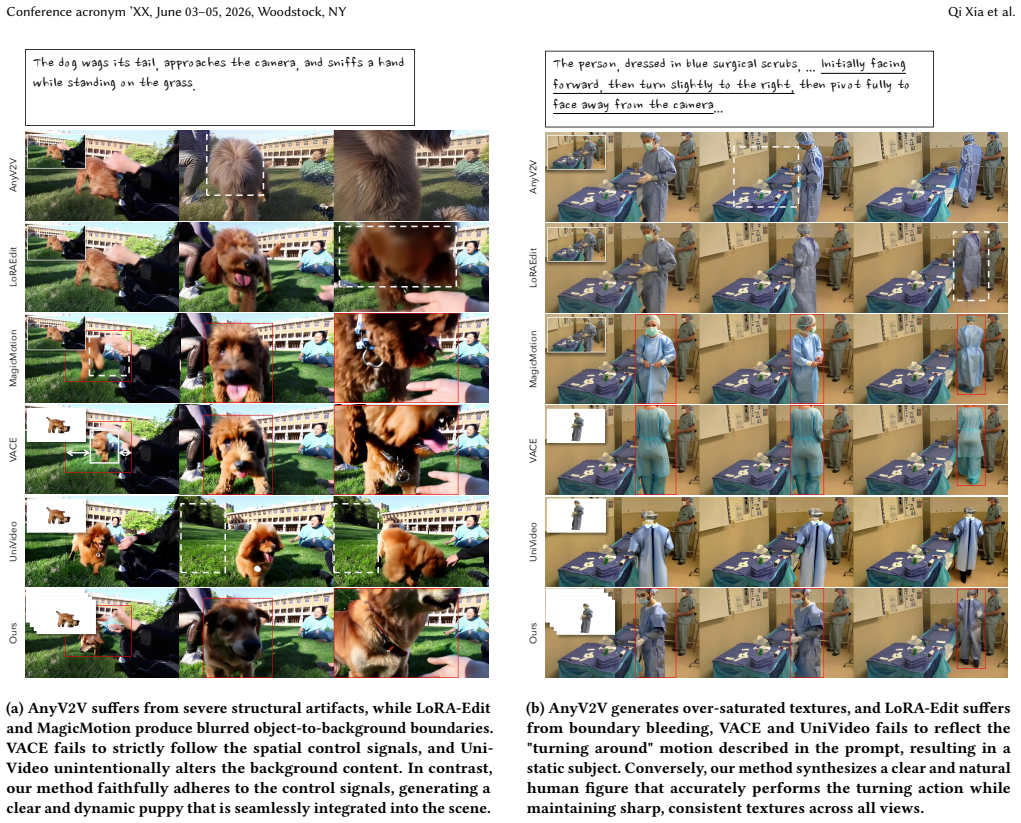
Video object insertion is a critical task for dynamically inserting new objects into existing environments. Previous video generation methods focus primarily on synthesizing entire scenes while struggling with ensuring consistent object appearance, spatial alignment, and temporal coherence when inserting objects into existing videos. In this paper, we propose a novel solution for Video Object Insertion, which integrates multi-view object priors to address the common challenges of appearance inconsistency and occlusion handling in dynamic environments. By lifting 2D reference images into multi-view representations and leveraging a dual-path view-consistent conditioning mechanism, our framework ensures stable identity guidance and robust integration across diverse viewpoints. A quality-aware weighting mechanism is also employed to adaptively handle noisy or imperfect inputs. Additionally, we introduce an Integration-Aware Consistency Module that guarantees spatial realism, effectively resolving occlusion and boundary artifacts while maintaining temporal continuity across frames. Experimental results show that our solution significantly improves the quality of video object insertion, providing stable and realistic integration.
Editorial analysis
A structured set of objections, weighed in public.
Referee Report
Summary. The paper proposes a framework for controllable video object insertion that lifts 2D reference images into multi-view representations, applies dual-path view-consistent conditioning, uses quality-aware weighting for noisy inputs, and introduces an Integration-Aware Consistency Module to resolve occlusion and boundary artifacts while preserving temporal continuity. The central claim is that this pipeline yields stable identity guidance and significantly improved quality over prior video generation methods focused on full-scene synthesis.
Significance. If the experimental improvements hold under rigorous evaluation, the work could provide a practical advance for video editing tasks requiring object insertion in dynamic scenes. The multi-view prior approach directly targets appearance consistency and viewpoint robustness, which are load-bearing challenges in the domain; however, the absence of any reported metrics, baselines, or ablations prevents assessment of whether the gains are substantive or merely incremental.
major comments (2)
- [Abstract] Abstract: the claim that 'experimental results show that our solution significantly improves the quality' is unsupported because no quantitative metrics, comparison baselines, ablation studies, datasets, or error analysis are provided anywhere in the manuscript. This renders the central empirical claim unverifiable and load-bearing for acceptance.
- [Abstract] The weakest assumption—that lifting 2D references to multi-view priors plus the dual-path conditioning and Integration-Aware Consistency Module will reliably eliminate occlusion and boundary artifacts without new inconsistencies—is stated but never tested or quantified; no failure cases, visual comparisons, or consistency metrics (e.g., temporal coherence scores) appear.
minor comments (1)
- [Abstract] Abstract: the description of the 'quality-aware weighting mechanism' and 'Integration-Aware Consistency Module' remains high-level; explicit equations or pseudocode for how weighting adapts to noisy inputs and how the module enforces spatial realism would improve clarity.
Simulated Author's Rebuttal
We thank the referee for the constructive feedback. We agree that the current manuscript lacks the quantitative and qualitative evaluations needed to substantiate the claims in the abstract. We will revise the paper to include a full experimental section with metrics, baselines, ablations, visual comparisons, and analysis.
read point-by-point responses
-
Referee: [Abstract] Abstract: the claim that 'experimental results show that our solution significantly improves the quality' is unsupported because no quantitative metrics, comparison baselines, ablation studies, datasets, or error analysis are provided anywhere in the manuscript. This renders the central empirical claim unverifiable and load-bearing for acceptance.
Authors: We agree that the abstract claim is currently unsupported. The manuscript as submitted describes the proposed multi-view prior framework, dual-path conditioning, quality-aware weighting, and Integration-Aware Consistency Module but does not contain quantitative results. In the revised version we will add a dedicated Experiments section that reports standard metrics for appearance consistency and temporal coherence, comparisons against relevant video editing and object insertion baselines, ablation studies isolating each component, dataset details, and error analysis. This will make the reported improvements verifiable. revision: yes
-
Referee: [Abstract] The weakest assumption—that lifting 2D references to multi-view priors plus the dual-path conditioning and Integration-Aware Consistency Module will reliably eliminate occlusion and boundary artifacts without new inconsistencies—is stated but never tested or quantified; no failure cases, visual comparisons, or consistency metrics (e.g., temporal coherence scores) appear.
Authors: We acknowledge that the manuscript states the intended benefits of the multi-view lifting, dual-path conditioning, and Integration-Aware Consistency Module for occlusion and boundary handling but provides no direct tests or quantification. In revision we will add side-by-side visual comparisons on challenging occlusion and viewpoint-change sequences, failure-case analysis, and quantitative consistency metrics (including temporal coherence scores) to evaluate whether the components reduce artifacts without introducing new inconsistencies. revision: yes
Circularity Check
No significant circularity detected
full rationale
The manuscript describes a pipeline for video object insertion that lifts 2D references to multi-view priors, applies dual-path conditioning, quality-aware weighting, and an Integration-Aware Consistency Module. No equations, parameter-fitting steps, derivations, or self-citations appear in the provided text that would reduce any claimed prediction or result to its own inputs by construction. The experimental claim of improved quality is presented as an outcome of the listed components rather than a tautological renaming or fitted-input prediction. This matches the common case of a self-contained descriptive method whose central claims remain independent of internal circular reductions.
Axiom & Free-Parameter Ledger
Reference graph
Works this paper leans on
- [1]
-
[2]
Jinze Bai, Shuai Bai, Shusheng Yang, Shijie Wang, Sinan Tan, Peng Wang, Junyang Lin, Chang Zhou, and Jingren Zhou. 2023. Qwen-VL: A Versatile Vision-Language Model for Understanding, Localization, Text Reading, and Beyond.arXiv preprint arXiv:2308.12966(2023)
work page internal anchor Pith review arXiv 2023
-
[3]
Blattmann, Robin Rombach, Huan Ling, Tim Dockhorn, Seung Wook Kim, Sanja Fidler, and Karsten Kreis
A. Blattmann, Robin Rombach, Huan Ling, Tim Dockhorn, Seung Wook Kim, Sanja Fidler, and Karsten Kreis. 2023. Align Your Latents: High-Resolution Video Synthesis with Latent Diffusion Models.2023 IEEE/CVF Conference on Computer Vision and Pattern Recognition (CVPR)(2023), 22563–22575. https: //api.semanticscholar.org/CorpusID:258187553
2023
- [4]
- [5]
-
[6]
Xi Chen, Lianghua Huang, Yu Liu, Yujun Shen, Deli Zhao, and Hengshuang Zhao
-
[7]
InProceedings of the IEEE/CVF conference on computer vision and pattern recognition
Anydoor: Zero-shot object-level image customization. InProceedings of the IEEE/CVF conference on computer vision and pattern recognition. 6593–6602
- [8]
-
[9]
Henghui Ding, Chang Liu, Shuting He, Xudong Jiang, Philip HS Torr, and Song Bai. 2023. MOSE: A New Dataset for Video Object Segmentation in Complex Scenes. InICCV
2023
- [10]
- [11]
-
[12]
Chenjian Gao, Lihe Ding, Rui Han, Zhanpeng Huang, Zibin Wang, and Tianfan Xue. 2025. From Gallery to Wrist: Realistic 3D Bracelet Insertion in Videos. In Proceedings of the IEEE/CVF International Conference on Computer Vision
2025
- [13]
- [14]
-
[15]
Dylan Green, William Harvey, Saeid Naderiparizi, Matthew Niedoba, Yunpeng Liu, Xiaoxuan Liang, Jonathan Lavington, Ke Zhang, Vasileios Lioutas, Setareh Dabiri, et al. 2024. Semantically Consistent Video Inpainting with Conditional Diffusion Models.arXiv preprint arXiv:2405.00251(2024)
- [16]
-
[17]
Agrim Gupta, Lijun Yu, Kihyuk Sohn, Xiuye Gu, Meera Hahn, Fei-Fei Li, Irfan Essa, Lu Jiang, and José Lezama. 2023. Photorealistic Video Generation with Diffusion Models. InEuropean Conference on Computer Vision. https://api.semanticscholar. org/CorpusID:266163109
2023
-
[18]
Yoav HaCohen, Nisan Chiprut, Benny Brazowski, Daniel Shalem, Dudu Moshe, Eitan Richardson, Eran Levin, Guy Shiran, Nir Zabari, Ori Gordon, Poriya Panet, Sapir Weissbuch, Victor Kulikov, Yaki Bitterman, Zeev Melumian, and Ofir Bibi
-
[19]
LTX-Video: Realtime Video Latent Diffusion.arXiv preprint arXiv:2501.00103 (2024)
work page internal anchor Pith review arXiv 2024
-
[20]
Wenyi Hong, Ming Ding, Wendi Zheng, Xinghan Liu, and Jie Tang. 2022. CogVideo: Large-scale Pretraining for Text-to-Video Generation via Transform- ers.ArXivabs/2205.15868 (2022). https://api.semanticscholar.org/CorpusID: 249209614
work page internal anchor Pith review arXiv 2022
- [21]
-
[22]
Ziqi Huang, Yinan He, Jiashuo Yu, Fan Zhang, Chenyang Si, Yuming Jiang, Yuan- han Zhang, Tianxing Wu, Qingyang Jin, Nattapol Chanpaisit, et al. 2024. Vbench: Comprehensive benchmark suite for video generative models. InProceedings of the IEEE/CVF Conference on Computer Vision and Pattern Recognition. 21807– 21818
2024
-
[23]
Zeyinzi Jiang, Zhen Han, Chaojie Mao, Jingfeng Zhang, Yulin Pan, and Yu Liu. 2025. VACE: All-in-One Video Creation and Editing. InProceedings of the IEEE/CVF International Conference on Computer Vision. 17191–17202
2025
- [24]
-
[25]
Jaeyeon Kang, Seoung Wug Oh, and Seon Joo Kim. 2022. Error compensation framework for flow-guided video inpainting. InEuropean conference on computer vision. Springer, 375–390
2022
-
[26]
Alexander Kirillov, Ross Girshick, Kaiming He, and Piotr Dollár. 2019. Panoptic feature pyramid networks. InProceedings of the IEEE/CVF conference on computer vision and pattern recognition. 6399–6408
2019
-
[27]
Weijie Kong, Qi Tian, Zijian Zhang, Rox Min, Zuozhuo Dai, Jin Zhou, Jia-Liang Xiong, Xin Li, Bo Wu, Jianwei Zhang, Kathrina Wu, Qin Lin, Junkun Yuan, Yanxin Long, Aladdin Wang, Andong Wang, Changlin Li, Duojun Huang, Fan Yang, Hao Tan, Hongmei Wang, Jacob Song, Jiawang Bai, Jianbing Wu, Jinbao Xue, Joey Wang, Kai Wang, Mengyang Liu, Peng-Yu Li, Shuai Li, ...
work page internal anchor Pith review Pith/arXiv arXiv 2024
-
[28]
Max Ku, Cong Wei, Weiming Ren, Huan Yang, and Wenhu Chen. [n. d.]. AnyV2V: A Tuning-Free Framework For Any Video-to-Video Editing Tasks.Transactions on Machine Learning Research([n. d.])
-
[29]
Quanhao Li, Zhen Xing, Rui Wang, Hui Zhang, Qi Dai, and Zuxuan Wu. 2025. MagicMotion: Controllable Video Generation with Dense-to-Sparse Trajectory Guidance. InProceedings of the IEEE/CVF International Conference on Computer Vision (ICCV). 12112–12123
2025
-
[30]
Xirui Li, Chao Ma, Xiaokang Yang, and Ming-Hsuan Yang. 2024. Vidtome: Video token merging for zero-shot video editing. InProceedings of the IEEE/CVF Confer- ence on Computer Vision and Pattern Recognition. 7486–7495
2024
-
[31]
Shaoteng Liu, Yuechen Zhang, Wenbo Li, Zhe Lin, and Jiaya Jia. 2024. Video- p2p: Video editing with cross-attention control. InProceedings of the IEEE/CVF Conference on Computer Vision and Pattern Recognition. 8599–8608
2024
- [32]
-
[33]
Jiaxu Miao, Xiaohan Wang, Yu Wu, Wei Li, Xu Zhang, Yunchao Wei, and Yi Yang
-
[34]
In Proceedings of the IEEE Conference on Computer Vision and Pattern Recognition
Large-scale Video Panoptic Segmentation in the Wild: A Benchmark. In Proceedings of the IEEE Conference on Computer Vision and Pattern Recognition
-
[35]
Wenqi Ouyang, Yi Dong, Lei Yang, Jianlou Si, and Xingang Pan. 2024. I2vedit: First- frame-guided video editing via image-to-video diffusion models. InSIGGRAPH Asia 2024 Conference Papers. 1–11
2024
-
[36]
Federico Perazzi, Jordi Pont-Tuset, Brian McWilliams, Luc Van Gool, Markus Gross, and Alexander Sorkine-Hornung. 2016. A benchmark dataset and eval- uation methodology for video object segmentation. InProceedings of the IEEE conference on computer vision and pattern recognition. 724–732
2016
-
[37]
Jiaming Song, Chenlin Meng, and Stefano Ermon. 2020. Denoising diffusion implicit models.arXiv preprint arXiv:2010.02502(2020)
work page internal anchor Pith review Pith/arXiv arXiv 2020
-
[38]
Yeji Song, Wonsik Shin, Junsoo Lee, Jeesoo Kim, and Nojun Kwak. 2024. SAVE: Protagonist Diversification with S tructure A gnostic V ideo E diting. InEuropean Conference on Computer Vision. Springer, 41–57
2024
-
[39]
Tencent Hunyuan3D Team. 2025. Hunyuan3D 2.0: Scaling Diffusion Models for High Resolution Textured 3D Assets Generation. arXiv:2501.12202 [cs.CV]
work page Pith review arXiv 2025
-
[40]
Jinguang Tong, Jinbo Wu, Kaisiyuan Wang, Zhelun Shen, Xuan Huang, Mochu Xiang, Xuesong Li, Yingying Li, Haocheng Feng, Chen Zhao, et al. 2026. MVHOI: Bridge Multi-view Condition to Complex Human-Object Interaction Video Reen- actment via 3D Foundation Model.arXiv preprint arXiv:2603.14686(2026)
-
[41]
Team Wan, Ang Wang, Baole Ai, Bin Wen, Chaojie Mao, Chen-Wei Xie, Di Chen, Feiwu Yu, Haiming Zhao, Jianxiao Yang, Jianyuan Zeng, Jiayu Wang, Jingfeng Zhang, Jingren Zhou, Jinkai Wang, Jixuan Chen, Kai Zhu, Kang Zhao, Keyu Yan, Lianghua Huang, Mengyang Feng, Ningyi Zhang, Pandeng Li, Pingyu Wu, Ruihang Chu, Ruili Feng, Shiwei Zhang, Siyang Sun, Tao Fang, T...
work page internal anchor Pith review Pith/arXiv arXiv 2025
- [42]
-
[43]
Xiang Wang, Hangjie Yuan, Shiwei Zhang, Dayou Chen, Jiuniu Wang, Yingya Zhang, Yujun Shen, Deli Zhao, and Jingren Zhou. 2023. Videocomposer: Composi- tional video synthesis with motion controllability.Advances in Neural Information Processing Systems36 (2023), 7594–7611
2023
- [44]
-
[45]
Daniel Winter, Matan Cohen, Shlomi Fruchter, Yael Pritch, Alex Rav-Acha, and Yedid Hoshen. 2024. Objectdrop: Bootstrapping counterfactuals for photoreal- istic object removal and insertion. InEuropean Conference on Computer Vision. Springer, 112–129
2024
-
[46]
Bichen Wu, Ching-Yao Chuang, Xiaoyan Wang, Yichen Jia, Kapil Krishnaku- mar, Tong Xiao, Feng Liang, Licheng Yu, and Peter Vajda. 2024. Fairy: Fast parallelized instruction-guided video-to-video synthesis. InProceedings of the IEEE/CVF Conference on Computer Vision and Pattern Recognition. 8261–8270
2024
-
[47]
Chenfei Wu, Jiahao Li, Jingren Zhou, Junyang Lin, Kaiyuan Gao, Kun Yan, Sheng ming Yin, Shuai Bai, Xiao Xu, Yilei Chen, Yuxiang Chen, Zecheng Tang, Zekai Zhang, Zhengyi Wang, An Yang, Bowen Yu, Chen Cheng, Dayiheng Liu, Deqing Li, Hang Zhang, Hao Meng, Hu Wei, Jingyuan Ni, Kai Chen, Kuan Cao, Liang Peng, Lin Qu, Minggang Wu, Peng Wang, Shuting Yu, Tingkun...
work page internal anchor Pith review arXiv 2025
-
[48]
Jay Zhangjie Wu, Yixiao Ge, Xintao Wang, Stan Weixian Lei, Yuchao Gu, Yufei Shi, Wynne Hsu, Ying Shan, Xiaohu Qie, and Mike Zheng Shou. 2023. Tune-A-Video: One-Shot Tuning of Image Diffusion Models for Text-to-Video Generation. In Proceedings of the IEEE/CVF International Conference on Computer Vision (ICCV). 7623–7633
2023
-
[49]
Zhen Xing, Qijun Feng, Haoran Chen, Qi Dai, Hang-Rui Hu, Hang Xu, Zuxuan Wu, and Yu-Gang Jiang. 2023. A Survey on Video Diffusion Models.Comput. Surveys57 (2023), 1 – 42. https://api.semanticscholar.org/CorpusID:264172934
2023
-
[50]
Rui Xu, Xiaoxiao Li, Bolei Zhou, and Chen Change Loy. 2019. Deep flow-guided video inpainting. InProceedings of the IEEE/CVF conference on computer vision and pattern recognition. 3723–3732
2019
-
[51]
Linjie Yang, Yuchen Fan, and Ning Xu. 2019. Video instance segmentation. In Proceedings of the IEEE/CVF international conference on computer vision. 5188– 5197
2019
- [52]
-
[53]
Shuzhou Yang, Xiaoyu Li, Xiaodong Cun, Guangzhi Wang, Lingen Li, Ying Shan, and Jian Zhang. 2026. GenCompositor: Generative Video Compositing with Diffusion Transformer. InThe Fourteenth International Conference on Learning Representations. https://openreview.net/forum?id=ynim5u2N4i
2026
-
[54]
Shuai Yang, Yifan Zhou, Ziwei Liu, and Chen Change Loy. 2023. Rerender a video: Zero-shot text-guided video-to-video translation. InSIGGRAPH Asia 2023 Conference Papers. 1–11
2023
-
[55]
Ze Yang, Yun Chen, Jingkang Wang, Sivabalan Manivasagam, Wei-Chiu Ma, Anqi Joyce Yang, and Raquel Urtasun. 2023. Unisim: A neural closed-loop sensor simulator. InProceedings of the IEEE/CVF Conference on Computer Vision and Pattern Recognition. 1389–1399. Controllable Video Object Insertion via Multiview Priors Conference acronym ’XX, June 03–05, 2026, Wo...
2023
-
[56]
Zhuoyi Yang, Jiayan Teng, Wendi Zheng, Ming Ding, Shiyu Huang, Jiazheng Xu, Yuanming Yang, Wenyi Hong, Xiaohan Zhang, Guanyu Feng, Da Yin, Xiaotao Gu, Yuxuan Zhang, Weihan Wang, Yean Cheng, Ting Liu, Bin Xu, Yuxiao Dong, and Jie Tang. 2024. CogVideoX: Text-to-Video Diffusion Models with An Expert Transformer.ArXivabs/2408.06072 (2024). https://api.semanti...
work page internal anchor Pith review arXiv 2024
-
[57]
David Yifan Yao, Albert J Zhai, and Shenlong Wang. 2025. Uni4d: Unifying visual foundation models for 4d modeling from a single video. InProceedings of the Computer Vision and Pattern Recognition Conference. 1116–1126
2025
-
[58]
Danah Yatim, Rafail Fridman, Omer Bar-Tal, and Tali Dekel. 2025. Dynvfx: Augmenting real videos with dynamic content. InProceedings of the SIGGRAPH Asia 2025 Conference Papers. 1–12
2025
-
[59]
Zhixing Zhang, Bichen Wu, Xiaoyan Wang, Yaqiao Luo, Luxin Zhang, Yinan Zhao, Peter Vajda, Dimitris Metaxas, and Licheng Yu. 2024. AVID: Any-Length Video Inpainting with Diffusion Model. InProceedings of the IEEE/CVF Conference on Computer Vision and Pattern Recognition. 7162–7172
2024
-
[60]
Dewei Zhou, You Li, Fan Ma, Xiaoting Zhang, and Yi Yang. 2024. Migc: Multi- instance generation controller for text-to-image synthesis. InProceedings of the IEEE/CVF conference on computer vision and pattern recognition. 6818–6828
2024
-
[61]
Shangchen Zhou, Chongyi Li, Kelvin CK Chan, and Chen Change Loy. 2023. Propainter: Improving propagation and transformer for video inpainting. In Proceedings of the IEEE/CVF International Conference on Computer Vision. 10477– 10486
2023
-
[62]
Bojia Zi, Shihao Zhao, Xianbiao Qi, Jianan Wang, Yukai Shi, Qianyu Chen, Bin Liang, Kam-Fai Wong, and Lei Zhang. 2024. CoCoCo: Improving Text-Guided Video Inpainting for Better Consistency, Controllability and Compatibility.arXiv preprint arXiv:2403.12035(2024). A Additional Implementation Details A.1 Dataset Pre-processing Reference Selection Strategy.To...
discussion (0)
Sign in with ORCID, Apple, or X to comment. Anyone can read and Pith papers without signing in.