Recognition: unknown
On the Weighted Hardy Type Inequality for Functions from W¹_p Vanishing on Small Parts of the Boundary
Pith reviewed 2026-05-10 09:08 UTC · model grok-4.3
The pith
A weighted Hardy inequality holds for Sobolev functions that vanish on small alternating boundary pieces
A machine-rendered reading of the paper's core claim, the machinery that carries it, and where it could break.
Core claim
The paper establishes that a weighted Hardy-type inequality holds for functions u in W_p^1 vanishing on small alternating pieces of the boundary, and that this inequality generalizes the classical known weighted Hardy-type inequalities without requiring additional restrictions on the domain or weights.
What carries the argument
The vanishing condition on small alternating pieces of the boundary, which replaces full vanishing to control the function near the boundary and derive the inequality
If this is right
- The inequality applies to functions that vanish only on portions of the boundary rather than the whole boundary.
- No further conditions on the domain geometry or the choice of weights are required.
- The result directly extends the classical weighted Hardy inequalities to this broader class of functions.
Where Pith is reading between the lines
- The condition might support estimates in problems with mixed or alternating boundary conditions.
- Numerical checks on simple domains such as intervals or disks with prescribed alternating zero segments could verify the constants.
- Similar partial vanishing ideas could be tested in related inequalities for other function spaces.
Load-bearing premise
The assumption that vanishing on small alternating pieces of the boundary is sufficient to obtain the weighted inequality without extra restrictions on the domain or weights.
What would settle it
A concrete counterexample of a function in W_p^1 that vanishes on small alternating boundary pieces but for which the stated weighted Hardy inequality fails.
Figures

read the original abstract
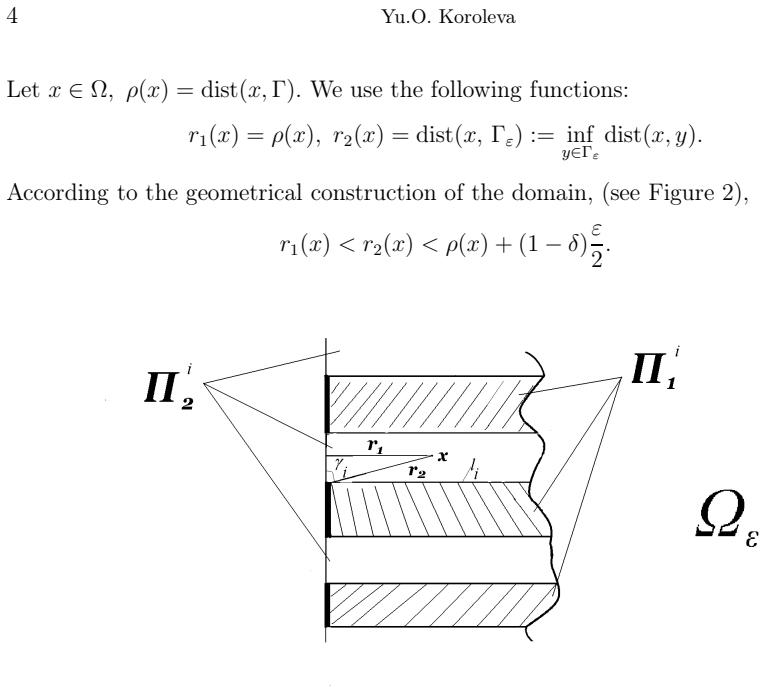
A new weighted Hardy-type inequality for functions from the Sobolev space $W_{p}^{1}$ is proved. It is assumed that functions vanish on small alternating pieces of the boundary. The proved inequality generalizes the classical known weighted Hardy-type inequalities.
Editorial analysis
A structured set of objections, weighed in public.
Referee Report
Summary. The manuscript proves a new weighted Hardy-type inequality for functions in the Sobolev space W_p^1 that vanish on small alternating pieces of the boundary (with positive measure but small total length). The result is obtained by decomposing the domain into subdomains where the classical weighted Hardy inequality applies, followed by summation with controlled constants, under standard Muckenhoupt-type conditions on the weights. This is presented as a generalization of the classical weighted Hardy inequalities without additional domain regularity assumptions beyond those needed for the trace theorem.
Significance. If the result holds, the inequality extends the classical theory to functions satisfying only partial vanishing conditions on the boundary, which is relevant for applications to elliptic PDEs with mixed boundary conditions. The proof relies on standard decomposition techniques and does not introduce hidden uniformity assumptions, providing a direct and robust generalization that preserves the parameter-free character of the classical case where applicable.
minor comments (1)
- The abstract is concise but omits the precise statement of the inequality, the exact conditions on the weights, and the measure of the boundary pieces; a slightly expanded abstract would improve readability for readers in the field.
Simulated Author's Rebuttal
We thank the referee for the positive assessment of our manuscript and the recommendation to accept. The referee's summary correctly identifies the main result as a generalization of the classical weighted Hardy inequality to functions in W^1_p that vanish only on alternating boundary segments of small total measure.
Circularity Check
No significant circularity; direct proof from classical results
full rationale
The paper establishes the weighted Hardy-type inequality through a standard domain decomposition into subdomains aligned with the alternating vanishing boundary segments, followed by direct application of the classical weighted Hardy inequality on each piece and summation with explicit constant control. The weights obey the usual Muckenhoupt conditions from the classical theory, and no additional domain assumptions beyond trace theorem requirements are used. This construction relies on external, independently known inequalities rather than any self-definition, fitted-parameter renaming, or load-bearing self-citation chain. The result is therefore self-contained against external benchmarks.
Axiom & Free-Parameter Ledger
Reference graph
Works this paper leans on
-
[1]
G. A. Chechkin, Yu. O. Koroleva and L. -E. Persson, On the precise asymptotics of the constant in the Friedrich‘s inequality for functions, vanishing on the part of the boundary with microin- homogeneous structure. J. Inequal. Appl. (2007), Article ID 34138, 13 pages
2007
-
[2]
G. A. Chechkin, Yu. O. Koroleva, A. Meidell and L. -E. Pers son, On the Friedrichs inequality in a domain perforated nonperiodically along the boundary. Homoge nization procedure. Asymptotics in parabolic problems. Russ. J. Math. Phys., 16 (2009), no.1, 1–16
2009
-
[3]
Gilbarg and N
D. Gilbarg and N. Trudinger, Elliptic Partial Differenrial Equations of Second Order. Springer- Verlag, 1983
1983
-
[4]
Hajlasz, Pointwise Hardy inequalities Proc
P. Hajlasz, Pointwise Hardy inequalities Proc. Amer. Math. Soc. 127 (1999), 417–423
1999
-
[5]
Hardy, J.E
G.H. Hardy, J.E. Littlewood and G. P ´olya, Inequalities. Cambridge Mathematical Library (Reprint of the 1952 edition ed.). Cambridge University Pre ss, Cambridge, 1988
1952
-
[6]
I. S. Kac and M. G. Krein, Criteria for discreteness of the spectrum of a singular string. Izv. Vyss. Uchebn. Zaved. Mat. Suppl. 2 (1958), 136–153.[in Russian]
1958
-
[7]
Kinnunen and R
J. Kinnunen and R. Korte, Characterizations for Hardy‘s Inequality. Around the Research of Vladimir Maz’ya, International Mathematical Series Suppl . 11 (2010), 239–254
2010
-
[8]
Kokilashvili, A
V. Kokilashvili, A. Meskhi and L.-E. Persson, Weighted Norm Inequalities For Integral Trans- forms With Product Kernals. Nova Science Publishers Inc, United States, 2009
2009
-
[9]
Yu. O. Koroleva, On the weighted Hardy-type inequality in a fixed domain for fu nctions vanishing on the part of the boundary, Math. Inequal. Appl. 14 (2011), no.3, 543–553
2011
-
[10]
Kufner, Weighted Sobolev Spaces
A. Kufner, Weighted Sobolev Spaces. John Wiley and Sons, 1985
1985
-
[11]
Kufner, L
A. Kufner, L. Maligranda and L.-E. Persson, The Hardy Inequality. About its History and some Related Results. Vydavetelsky Servis Publishing House, Pilsen, 2007
2007
-
[12]
Kufner and L.-E
A. Kufner and L.-E. Persson, Weighted Inequalities of Hardy Type. World Scientific, New Jersey- London-Singapore-Hong Kong, 2003
2003
-
[13]
V. G. Maz’ja, Sobolev spaces. Translated from the Russian by T. O. Shaposhnikova. Springe r Series in Soviet Mathematics. Springer-Verlag, Berlin, 19 85
-
[14]
Neˇ cas, Sur une m´ ethode pour r´ esourde les ´ equations aux d´ eriv´ ees partielle du type elliptique, voisine de la variationelle
J. Neˇ cas, Sur une m´ ethode pour r´ esourde les ´ equations aux d´ eriv´ ees partielle du type elliptique, voisine de la variationelle. Ann. Scuola Norm. Sup. Pisa 16 (1962), 305–362
1962
-
[15]
Opic and A
B. Opic and A. Kufner, Hardy-Type Inequalities. Longman, Harlow, 1990
1990
-
[16]
Ziemer, Weakly Differentiable Functions
W. Ziemer, Weakly Differentiable Functions. Graduate Texts in Mathematics 120, Springer- Verlag, 1989
1989
-
[17]
Wannebo, Hardy Inequalities and Imbedding in Domains Generalizing C0,λ Domains
A. Wannebo, Hardy Inequalities and Imbedding in Domains Generalizing C0,λ Domains. Proc. Amer. Math. Soc., 122 (1994), 1181–1190. On the Weighted Hardy Type Inequality for Functions from W 1 p Vanishing on Small Parts of the Boundary11 Yulia Koroleva Moscow Tikhonov Institute of Electronics and Mathematics, HSE National Research University, Moscow Tallins...
1994
discussion (0)
Sign in with ORCID, Apple, or X to comment. Anyone can read and Pith papers without signing in.