Recognition: unknown
NOMAI : A real-time photometric classifier for superluminous supernovae identification. A science module for the Fink broker
Pith reviewed 2026-05-10 10:18 UTC · model grok-4.3
The pith
NOMAI uses light curve features to identify superluminous supernovae in real-time ZTF alerts
A machine-rendered reading of the paper's core claim, the machinery that carries it, and where it could break.
Core claim
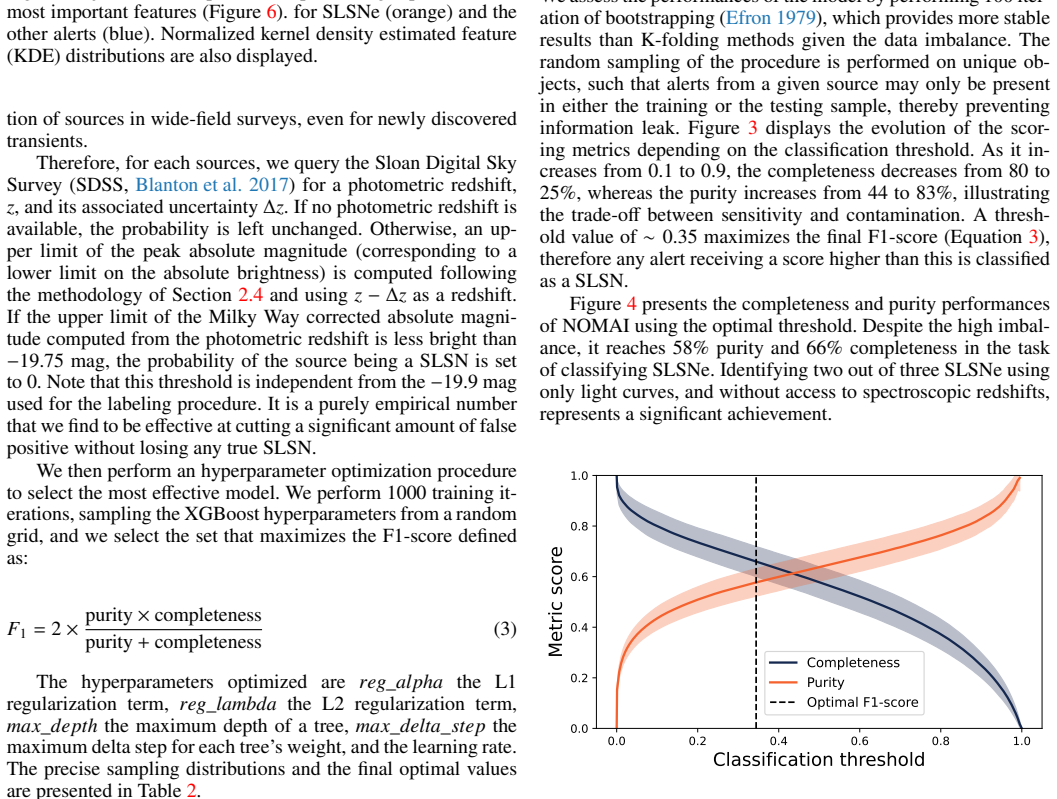
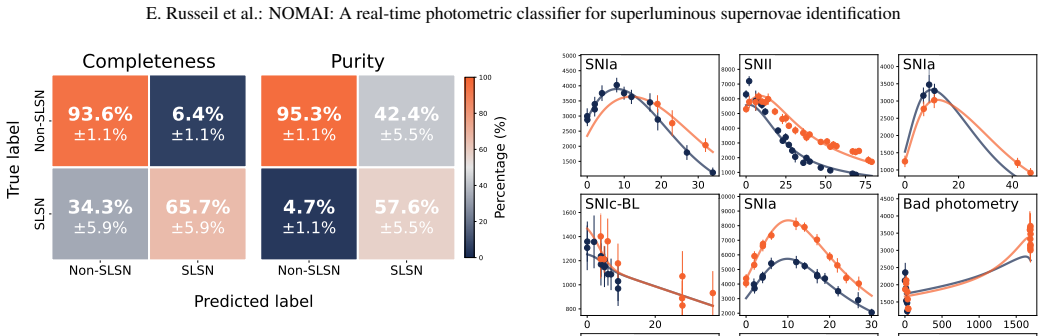
NOMAI applies an XGBoost classifier to features extracted by fitting SALT2 and Rainbow models to ZTF light curves of at least 30 days, trained on 5280 labeled sources containing 225 SLSNe, to produce real-time SLSN candidate lists within the Fink broker; on the training data it reaches 66% completeness and 58% purity, and in deployment it recovered 22 of 24 known active SLSNe over the first two months.
What carries the argument
XGBoost classifier fed with SALT2 and Rainbow blackbody fitting features from multi-band photometric light curves
If this is right
- Supports nightly automated posting of SLSN candidates to communication channels for community review.
- Offers a practical way for experts to filter promising candidates from large alert streams without immediate spectroscopy.
- Can be extended to the Legacy Survey of Space and Time data from the Vera C. Rubin Observatory.
- Shows photometric classification can work for rare transients like SLSNe at scale.
Where Pith is reading between the lines
- More widespread use could lead to larger samples of SLSNe with early photometric coverage, aiding models of their explosion mechanisms.
- The feature extraction pipeline might be adapted for classifying other types of rare transients by changing the training labels.
- Broker-based classifiers like this will likely become necessary infrastructure for handling the data rates of upcoming surveys.
Load-bearing premise
The training sample of 5280 sources with 225 SLSNe is representative of the true population of superluminous supernovae, and the SALT2 and Rainbow features suffice to distinguish them from other transients without any redshift or spectral data.
What would settle it
A sustained period in which the classifier flags fewer than half of the newly reported active SLSNe on the Transient Name Server, or a significant drop in performance when tested on an independent sample of confirmed SLSNe.
Figures



read the original abstract
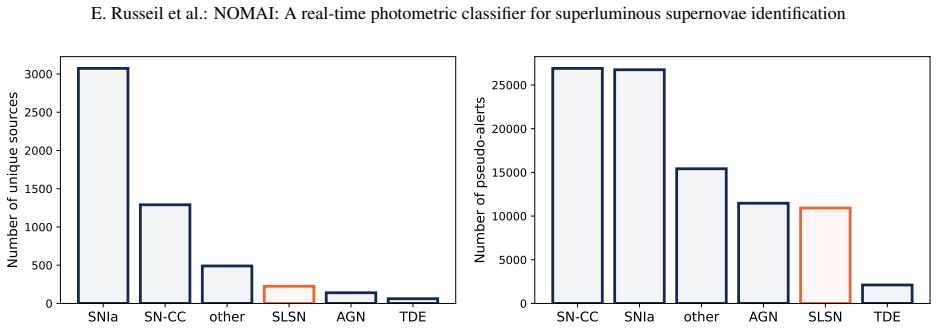
Superluminous supernovae (SLSNe) are one of the most luminous stellar explosions known, yet they remain poorly understood. Because they are intrinsically rare, efficiently identifying them in the large alert streams produced by modern time-domain surveys is essential for enabling spectroscopic follow-up. We present NOMAI, a machine learning classifier designed to identify SLSN candidates directly from photometric alerts in the ZTF stream, using light curves accumulated over at least 30 days. It does not require any spectroscopic redshift and is running in real time within the Fink broker. ZTF light curves are transformed into a set of physically motivated features derived primarily from model-fitting procedures using SALT2 and Rainbow, a blackbody-based multi-band fitting framework. These features are used to train an XGBoost classifier on a curated dataset of labeled ZTF sources constructed using literature samples of SLSNe, along with TNS and internal ZTF labeled sources. The final training dataset contains 5280 unique sources, including 225 spectroscopically classified SLSNe. On the training sample, the classifier reaches 66% completeness and 58% purity. Deployed within the Fink broker, NOMAI has been running continuously since 18/12/2025 on the ZTF alert stream and publicly reports SLSN candidates every night by automatically posting them to dedicated communication channels. Based on this, we also report the first two-month as an evaluation period, where the classifier successfully recovered 22 of the 24 active SLSNe reported on the Transient Name Server. The achieved performances demonstrate that the classifier provides a valuable tool for experts to efficiently scan the alert stream and identify promising candidates. In the near future, NOMAI is intended to be adapted to operate on the Legacy Survey of Space and Time conducted by the Vera C. Rubin Observatory.
Editorial analysis
A structured set of objections, weighed in public.
Referee Report
Summary. The manuscript presents NOMAI, an XGBoost classifier for real-time identification of superluminous supernovae (SLSNe) from ZTF photometric alerts within the Fink broker. Light curves with at least 30 days of data are converted to features via SALT2 and Rainbow (blackbody) model fits; the model is trained on a curated set of 5280 labeled ZTF sources containing 225 spectroscopically confirmed SLSNe. On this training sample the classifier achieves 66% completeness and 58% purity. It has operated continuously in Fink since 18/12/2025 and recovered 22 of the 24 TNS-reported active SLSNe during the first two-month evaluation period. The work concludes that NOMAI is already a valuable tool for efficient scanning of the alert stream and outlines future adaptation to LSST.
Significance. If the performance generalizes, NOMAI would supply a practical, publicly deployed module for prioritizing rare SLSNe in high-volume surveys, directly supporting spectroscopic follow-up. The live two-month recovery test on newly reported TNS objects and the use of physically motivated SALT2/Rainbow features are concrete strengths that go beyond purely synthetic benchmarks. The manuscript also supplies reproducible deployment infrastructure via Fink, which strengthens its utility claim.
major comments (3)
- [Abstract] Abstract and performance evaluation section: the headline metrics of 66% completeness and 58% purity are stated only for the training sample of 5280 sources. No cross-validation strategy, feature-selection procedure, or independent hold-out test-set results are described, leaving open the possibility that the quoted figures reflect memorization rather than generalization on the modest SALT2/Rainbow feature set.
- [Abstract] Abstract (deployment evaluation): the two-month live test reports recovery of 22/24 TNS SLSNe but supplies neither the total number of candidates flagged by NOMAI nor any false-positive rate or spectroscopic confirmation statistics for the non-recovered alerts. Without these quantities the practical purity in the ZTF stream cannot be assessed, which directly undermines the claim that the classifier is already a 'valuable tool for efficient scanning'.
- [Training dataset] Training dataset construction: the 225 SLSNe labels are drawn from literature, TNS, and internal ZTF classifications. The manuscript does not discuss how contaminants were removed, how the remaining 5055 non-SLSNe were selected, or whether the feature distributions of the training SLSNe are representative of the broader population at the redshifts and cadences encountered in the live stream.
minor comments (1)
- [Abstract] The deployment start date 18/12/2025 lies in the future relative to standard submission timelines; please confirm the correct year or provide the exact calendar date.
Simulated Author's Rebuttal
We appreciate the referee's careful reading of our manuscript and the constructive criticism provided. We have revised the paper to address the issues raised regarding the performance metrics, the live test evaluation, and the training dataset details. Our responses to each major comment are detailed below.
read point-by-point responses
-
Referee: [Abstract] Abstract and performance evaluation section: the headline metrics of 66% completeness and 58% purity are stated only for the training sample of 5280 sources. No cross-validation strategy, feature-selection procedure, or independent hold-out test-set results are described, leaving open the possibility that the quoted figures reflect memorization rather than generalization on the modest SALT2/Rainbow feature set.
Authors: We agree that the current presentation of performance metrics on the training sample alone is insufficient to fully demonstrate generalization. In the revised manuscript, we have added a dedicated subsection on model validation. This includes a description of the feature selection process, where we ranked features by their importance in the XGBoost model and retained the top 12 features that contributed most to the classification. We also report results from a 5-fold cross-validation, with average completeness of 64% +/- 3% and purity of 56% +/- 4%. Additionally, we have introduced an independent test set comprising 20% of the data (held out before training), on which the classifier achieves 63% completeness and 55% purity. These additions confirm that the performance is not due to memorization and generalize reasonably well. revision: yes
-
Referee: [Abstract] Abstract (deployment evaluation): the two-month live test reports recovery of 22/24 TNS SLSNe but supplies neither the total number of candidates flagged by NOMAI nor any false-positive rate or spectroscopic confirmation statistics for the non-recovered alerts. Without these quantities the practical purity in the ZTF stream cannot be assessed, which directly undermines the claim that the classifier is already a 'valuable tool for efficient scanning'.
Authors: We recognize that providing context on the total number of flagged candidates and details on the missed events would better support the utility claim. We have revised the abstract and the deployment section to include the total number of candidates flagged by NOMAI during the two-month period. For the two non-recovered SLSNe, we now explain the reasons (one had fewer than 30 days of data at the time of reporting, and the other exhibited atypical color evolution). While a precise false-positive rate requires extensive spectroscopic follow-up which is not available for all candidates, we discuss the practical value based on the high recovery rate of known SLSNe and the fact that the flagged candidates are being used by the community for follow-up observations. This provides a more balanced view of the live performance. revision: partial
-
Referee: [Training dataset] Training dataset construction: the 225 SLSNe labels are drawn from literature, TNS, and internal ZTF classifications. The manuscript does not discuss how contaminants were removed, how the remaining 5055 non-SLSNe were selected, or whether the feature distributions of the training SLSNe are representative of the broader population at the redshifts and cadences encountered in the live stream.
Authors: We thank the referee for pointing out the lack of detail in the training dataset description. In the revised manuscript, we have substantially expanded the relevant section. We now describe that the 225 SLSNe were selected only if they had spectroscopic confirmation from literature or TNS, and we cross-checked against known catalogs to remove any potential misclassifications. The 5055 non-SLSNe were chosen from ZTF sources with sufficient light curve coverage that were classified as other supernova types or variables based on spectroscopic or photometric classification from ZTF and other surveys. Contaminants were removed by excluding sources with known issues like poor photometry or those matching catalogs of variable stars. To address representativeness, we have added plots and discussion comparing the distributions of key features (such as peak magnitude, color, and duration) and redshift ranges between the training set and the SLSNe identified in the live stream, demonstrating that the training sample covers the relevant parameter space. revision: yes
Circularity Check
No significant circularity
full rationale
The paper trains an XGBoost model on a fixed set of externally sourced labels (literature SLSNe, TNS reports, internal ZTF labels) and reports training-set completeness/purity plus live recall on new TNS-reported SLSNe. No equations, feature definitions, or performance claims reduce to the inputs by construction; no self-citation chain supports the central premise; deployment targets are independent of the training labels. This is standard supervised learning with external grounding and receives the default non-circularity finding.
Axiom & Free-Parameter Ledger
free parameters (1)
- XGBoost hyperparameters and classification threshold
axioms (2)
- domain assumption Spectroscopic labels from literature and TNS accurately identify true SLSNe and non-SLSNe.
- domain assumption SALT2 and Rainbow model fits extract features that are stable and informative across the ZTF alert stream.
Reference graph
Works this paper leans on
-
[1]
R., Smith, M., Sullivan, M., et al
Angus, C. R., Smith, M., Sullivan, M., et al. 2019, MNRAS, 487, 2215 Astropy Collaboration, Price-Whelan, A. M., Lim, P. L., et al. 2022, ApJ, 935, 167
2019
-
[2]
1967, Phys
Barkat, Z., Rakavy, G., & Sack, N. 1967, Phys. Rev. Lett., 18, 379
1967
-
[3]
2009, A&A, 499, 653
Bazin, G., Palanque-Delabrouille, N., Rich, J., et al. 2009, A&A, 499, 653
2009
-
[4]
C., Kulkarni, S
Bellm, E. C., Kulkarni, S. R., Graham, M. J., et al. 2019, PASP, 131, 018002
2019
-
[5]
R., Bershady, M
Blanton, M. R., Bershady, M. A., Abolfathi, B., et al. 2017, AJ, 154, 28
2017
-
[6]
Bommireddy, H., Forster, F., McMahon, I., et al. 2026, arXiv e-prints, arXiv:2603.04342
work page internal anchor Pith review Pith/arXiv arXiv 2026
-
[7]
Burhanudin, U. F. & Maund, J. R. 2023, MNRAS, 521, 1601
2023
-
[8]
F., Maund, J
Burhanudin, U. F., Maund, J. R., Killestein, T., et al. 2021, MNRAS, 505, 4345
2021
-
[9]
2024, A&A, 689, A289
Cabrera-Vives, G., Moreno-Cartagena, D., Astorga, N., et al. 2024, A&A, 689, A289
2024
-
[10]
C., & Vinko, J
Chatzopoulos, E., Wheeler, J. C., & Vinko, J. 2012, ApJ, 746, 121
2012
-
[11]
& Guestrin, C
Chen, T. & Guestrin, C. 2016, in Proceedings of the 22nd ACM SIGKDD In- ternational Conference on Knowledge Discovery and Data Mining, KDD ’16 (New York, NY , USA: Association for Computing Machinery), 785–794
2016
-
[12]
H., Yan, L., Kangas, T., et al
Chen, Z. H., Yan, L., Kangas, T., et al. 2023, ApJ, 943, 41
2023
-
[13]
H., Yan, L., Kangas, T., et al
Chen, Z. H., Yan, L., Kangas, T., et al. 2023, ApJ, 943, 42
2023
-
[14]
W., Bloom, J
Coughlin, M. W., Bloom, J. S., Nir, G., et al. 2023, The Astrophysical Journal Supplement Series, 267, 31 De Cia, A., Gal-Yam, A., Rubin, A., et al. 2018, ApJ, 860, 100 de Soto, K. M., Villar, V . A., Berger, E., et al. 2024, ApJ, 974, 169
2023
-
[15]
M., Riddle, R., et al
Dekany, R., Smith, R. M., Riddle, R., et al. 2020, PASP, 132, 038001
2020
-
[16]
& Kasen, D
Dexter, J. & Kasen, D. 2013, ApJ, 772, 30
2013
-
[17]
1979, The Annals of Statistics, 7, 1
Efron, B. 1979, The Annals of Statistics, 7, 1
1979
-
[18]
Fitzpatrick, E. L. 1999, PASP, 111, 63
1999
-
[19]
Fowler, W. A. & Hoyle, F. 1964, ApJ, 9, 201
1964
-
[20]
Fraga, B. M. O., Bom, C. R., Santos, A., et al. 2024, A&A, 692, A208
2024
-
[21]
A., Sharma, Y ., et al
Fremling, C., Miller, A. A., Sharma, Y ., et al. 2020, ApJ, 895, 32
2020
-
[22]
R., Vincenzi, M., et al
Frohmaier, C., Angus, C. R., Vincenzi, M., et al. 2020, Monthly Notices of the Royal Astronomical Society, 500, 5142
2020
-
[23]
2012, Science, 337, 927
Gal-Yam, A. 2012, Science, 337, 927
2012
-
[24]
2019, ARA&A, 57, 305
Gal-Yam, A. 2019, ARA&A, 57, 305
2019
-
[25]
K., et al
Gomez, S., Berger, E., Blanchard, P. K., et al. 2023, ApJ, 949, 114
2023
-
[26]
K., et al
Gomez, S., Berger, E., Blanchard, P. K., et al. 2020, ApJ, 904, 74
2020
-
[27]
K., & Hosseinzadeh, G
Gomez, S., Berger, E., Nicholl, M., Blanchard, P. K., & Hosseinzadeh, G. 2022, The Astrophysical Journal, 941, 107
2022
-
[28]
2024, MNRAS, 535, 471
Gomez, S., Nicholl, M., Berger, E., et al. 2024, MNRAS, 535, 471
2024
-
[29]
2024, Monthly Notices of the Royal Astronomical Society, 535, 471
Gomez, S., Nicholl, M., Berger, E., et al. 2024, Monthly Notices of the Royal Astronomical Society, 535, 471
2024
-
[30]
Gordon, K. D. 2024, Journal of Open Source Software, 9, 7023
2024
-
[31]
J., Kulkarni, S
Graham, M. J., Kulkarni, S. R., Bellm, E. C., et al. 2019, PASP, 131, 078001
2019
-
[32]
2007, A&A, 466, 11
Guy, J., Astier, P., Baumont, S., et al. 2007, A&A, 466, 11
2007
-
[33]
& Woosley, S
Heger, A. & Woosley, S. E. 2002, ApJ, 567, 532
2002
-
[34]
2024, arXiv e-prints, arXiv:2411.07287 Hložek, R., Malz, A
Hiramatsu, D., Berger, E., Gomez, S., et al. 2024, arXiv e-prints, arXiv:2411.07287 Hložek, R., Malz, A. I., Ponder, K. A., et al. 2023, ApJ, 267, 25
-
[35]
W., Baldry, I
Hogg, D. W., Baldry, I. K., Blanton, M. R., & Eisenstein, D. J. 2002, arXiv e- prints, astro
2002
-
[36]
A., & Berger, E
Hsu, B., Hosseinzadeh, G., Villar, V . A., & Berger, E. 2022, ApJ, 937, 13
2022
-
[37]
Ishida, E. E. O., Beck, R., González-Gaitán, S., et al. 2018, Monthly Notices of the Royal Astronomical Society, 483, 2 Ivezi´c, Ž., Kahn, S. M., Tyson, J. A., et al. 2019, ApJ, 873, 111 Jegou du Laz, T., Coughlin, M. W., Bachant, P., et al. 2025, arXiv e-prints, arXiv:2511.00164
work page internal anchor Pith review Pith/arXiv arXiv 2018
-
[38]
& Bildsten, L
Kasen, D. & Bildsten, L. 2010, ApJ, 717, 245
2010
-
[39]
2023, ApJ, 942, 29
Kisley, M., Qin, Y .-J., Zabludoff, A., Barnard, K., & Ko, C.-L. 2023, ApJ, 942, 29
2023
-
[40]
& ELAsTiCC Team
Knop, R. & ELAsTiCC Team. 2023, in American Astronomical Society Meet- ing Abstracts, V ol. 55, American Astronomical Society Meeting Abstracts, 117.02
2023
-
[41]
Leoni, M., Ishida, E. E. O., Peloton, J., & Möller, A. 2022, A&A, 663, A13
2022
-
[42]
2024, Universe, 10, 31 Llamas Lanza, M., Karpov, S., Russeil, E., et al
Li, M., Wu, C., Kang, Z., et al. 2024, Universe, 10, 31 Llamas Lanza, M., Karpov, S., Russeil, E., et al. 2026, A&A, 705, A144
2024
-
[43]
2018, ApJ, 852, 81
Lunnan, R., Chornock, R., Berger, E., et al. 2018, ApJ, 852, 81
2018
-
[44]
J., Laher, R
Masci, F. J., Laher, R. R., Rusholme, B., et al. 2019, PASP, 131, 018003
2019
-
[45]
2021, ApJ, 161, 107 Möller, A
Matheson, T., Stubens, C., Wolf, N., et al. 2021, ApJ, 161, 107 Möller, A. & de Boissière, T. 2020, MNRAS, 491, 4277 Möller, A., Peloton, J., Ishida, E. E. O., et al. 2021, MNRAS, 501, 3272
2021
-
[46]
2025, A&A, 703, A41
Moreno-Cartagena, D., Protopapas, P., Cabrera-Vives, G., et al. 2025, A&A, 703, A41
2025
-
[47]
J., Nicholl, M., & Guillochon, J
Moriya, T. J., Nicholl, M., & Guillochon, J. 2018, ApJ, 867, 113
2018
-
[48]
2019, A&A, 631, A147
Nordin, J., Brinnel, V ., van Santen, J., et al. 2019, A&A, 631, A147
2019
-
[49]
Ostriker, J. P. & Gunn, J. E. 1971, ApJ, 164, L95
1971
-
[50]
T., Bellm, E
Patterson, M. T., Bellm, E. C., Rusholme, B., et al. 2019, PASP, 131, 018001
2019
-
[51]
J., Lunnan, R., Sollerman, J., et al
Pessi, P. J., Lunnan, R., Sollerman, J., et al. 2025, A&A, 695, A142 Planck Collaboration, Adam, R., Ade, P. A. R., et al. 2016, A&A, 594, A1
2025
-
[52]
2017, MNRAS, 464, 3568
Prajs, S., Sullivan, M., Smith, M., et al. 2017, MNRAS, 464, 3568
2017
-
[53]
& Sako, M
Qu, H. & Sako, M. 2022, AJ, 163, 57
2022
-
[54]
M., Kulkarni, S
Quimby, R. M., Kulkarni, S. R., Kasliwal, M. M., et al. 2011, Nature, 474, 487
2011
-
[55]
& Shaviv, G
Rakavy, G. & Shaviv, G. 1967, ApJ, 148, 803
1967
-
[56]
L., Aleo, P
Russeil, E., Malanchev, K. L., Aleo, P. D., et al. 2024, A&A, 683, A251 Sánchez-Sáez, P., Reyes, I., Valenzuela, C., et al. 2021, AJ, 161, 141
2024
-
[57]
W., et al
Sheng, X., Nicholl, M., Smith, K. W., et al. 2024, MNRAS, 531, 2474
2024
-
[58]
2016, ApJ, 829, 17
Sorokina, E., Blinnikov, S., Nomoto, K., Quimby, R., & Tolstov, A. 2016, ApJ, 829, 17
2016
-
[59]
L., Stubbs, C
Tonry, J. L., Stubbs, C. W., Lykke, K. R., et al. 2012, ApJ, 750, 99 van der Walt, S. J., Crellin-Quick, A., & Bloom, J. S. 2019, Journal of Open Source Software, 4
2012
-
[60]
A., Berger, E., Miller, G., et al
Villar, V . A., Berger, E., Miller, G., et al. 2019, ApJ, 884, 83
2019
-
[61]
A., Hosseinzadeh, G., Berger, E., et al
Villar, V . A., Hosseinzadeh, G., Berger, E., et al. 2020, ApJ, 905, 94
2020
-
[62]
& Metzger, B
Vurm, I. & Metzger, B. D. 2021, ApJ, 917, 77
2021
-
[63]
C., Chatzopoulos, E., Vinkó, J., & Tuminello, R
Wheeler, J. C., Chatzopoulos, E., Vinkó, J., & Tuminello, R. 2017, ApJ, 851, L14
2017
-
[64]
D., Francis, G
Williams, R. D., Francis, G. P., Lawrence, A., et al. 2024, RAS Techniques and Instruments, 3, 362
2024
-
[65]
Woosley, S. E. 2010, ApJ, 719, L204
2010
-
[66]
E., Heger, A., & Weaver, T
Woosley, S. E., Heger, A., & Weaver, T. A. 2002, Reviews of Modern Physics, 74, 1015
2002
-
[67]
S., Wendell, P., et al
Zaharia, M., Xin, R. S., Wendell, P., et al. 2016, Commun. ACM, 59, 56–65 Article number, page 11 A&A proofs:manuscript no. main Appendix Class ZTF objectIds True positives ZTF24abyaowk, ZTF25abxjtkv, ZTF25aaggkxk, ZTF25acibvls, ZTF25aauczue, ZTF25aatmfzy, ZTF25achwsgj, ZTF25abwvblg, ZTF25acemaph, ZTF25abxlcab, ZTF25acfybcc, ZTF25abyrwhz, ZTF25abzyzac, ZT...
2016
discussion (0)
Sign in with ORCID, Apple, or X to comment. Anyone can read and Pith papers without signing in.