Recognition: unknown
Nonlinear dynamics of information overload: Impact on source localization in complex networks
Pith reviewed 2026-05-10 09:15 UTC · model grok-4.3
The pith
Information overload reduces the effectiveness of locating information sources in complex networks and reverses the impact of network density.
A machine-rendered reading of the paper's core claim, the machinery that carries it, and where it could break.
Core claim
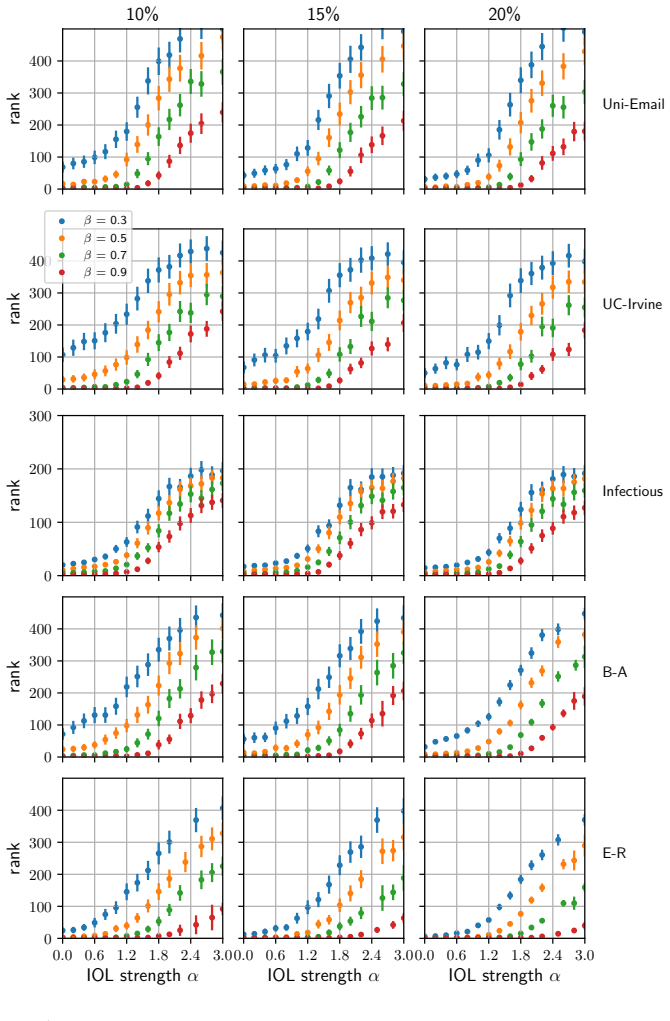
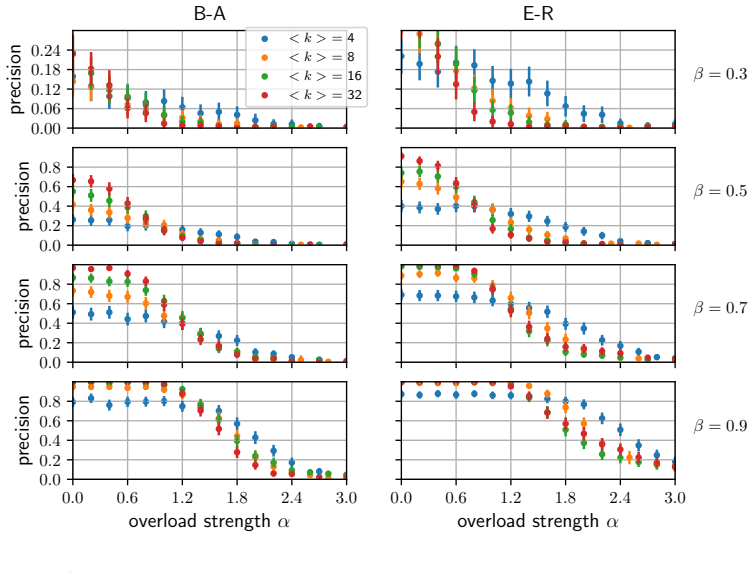
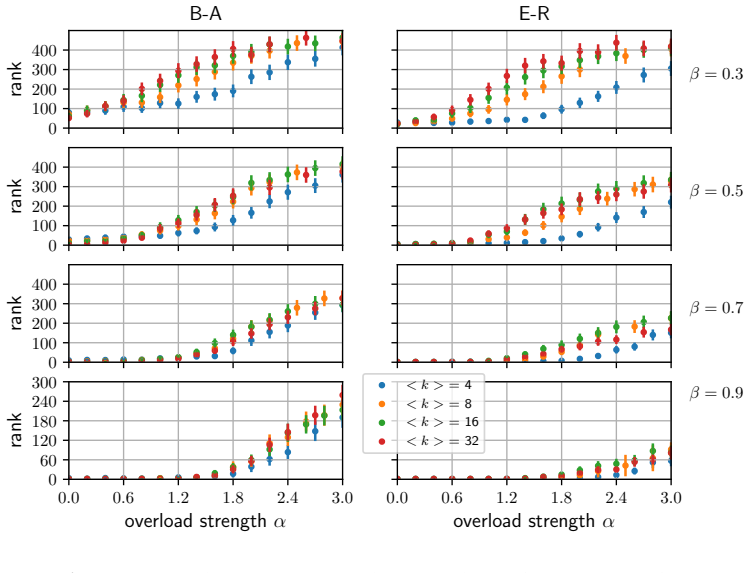
The authors employ the Generalized Fractional Susceptible-Infected-Recovered model with an information overload parameter α to simulate information propagation on complex networks. They then utilize Pearson's correlation algorithm to localize the source and observe that localization quality declines with increasing α and rises with the spreading rate β. Comparisons reveal superior performance in synthetic networks over real-world ones, with Erdős-Rényi graphs more robust to overload than Barabási-Albert graphs. Critically, the effect of average degree inverts: higher density aids localization at low overload but lowers it at high overload, marking a departure from conventional epidemic sp
What carries the argument
Generalized Fractional Susceptible-Infected-Recovered (GFSIR) model incorporating information overload via parameter α, paired with Pearson's correlation for source identification in the simulated spreading process.
If this is right
- Localization effectiveness decreases as the overload parameter α increases.
- Localization effectiveness increases as the spreading rate β increases.
- Erdős-Rényi networks exhibit greater resilience to information overload compared to Barabási-Albert networks.
- Under negligible overload, networks with higher average degree allow better source localization.
- Under strong overload, networks with lower average degree allow better source localization.
Where Pith is reading between the lines
- Approaches to detect misinformation origins may require adjusting for current overload levels rather than assuming denser networks always help.
- The density reversal suggests that overload alters spreading patterns in ways that retain source signals better in less connected structures.
- Future work could examine whether real social media data during high-traffic events confirms the simulated reversal in localization performance.
Load-bearing premise
The GFSIR model with its overload parameter α provides a faithful representation of real information overload effects during spreading, and Pearson's correlation serves as a robust method for source localization independent of overload intensity.
What would settle it
Empirical measurement of localization accuracy using Pearson correlation on real social network data collected during events with documented high versus low information overload, checking specifically whether denser subgraphs show poorer performance only in high-overload cases.
Figures



read the original abstract
Source localization in complex networks is a rapidly advancing field with numerous real-world applications, including determining the source of misinformation. In this work, we model information spread across several real-world and synthetic complex networks using our Generalized Fractional Susceptible-Infected-Recovered (GFSIR) model, which incorporates the information overload (IOL) phenomenon. Then, we use Pearson's correlation algorithm to identify information sources in these networks and investigate how information overload affects localization quality. Numerical simulations have shown that localization effectiveness decreases with the parameter $\alpha$, which controls the strength of the IOL, and increases with the spreading rate $\beta$. Our comparison across various topologies reveals that localization is generally more effective in synthetic structures, with Erd\H{o}s-R\'{e}nyi networks exhibiting greater resilience to IOL than Barab\'{a}si-Albert models. Furthermore, we identified a critical reversal in the impact of network density: while a higher average degree enhances localization when IOL is negligible, less dense networks perform better under strong overload. This phenomenon represents a significant departure from the behavior observed in standard epidemic models.
Editorial analysis
A structured set of objections, weighed in public.
Referee Report
Summary. The manuscript models information propagation on real-world and synthetic networks using a Generalized Fractional Susceptible-Infected-Recovered (GFSIR) model that incorporates an information-overload parameter α. Source localization is performed via Pearson correlation, and the authors report that localization accuracy declines with increasing α, rises with spreading rate β, is generally higher on synthetic topologies (with ER graphs more resilient than BA), and exhibits a reversal in the effect of average degree: denser networks aid localization at low α but hinder it at high α, in contrast to standard SIR behavior.
Significance. If the reported reversal and α/β dependence are robust, the work identifies a qualitative change in localization performance induced by overload that is absent from classical epidemic models. This has potential implications for misinformation tracking and network-based inference under realistic cognitive constraints. The use of multiple real and synthetic topologies and the explicit comparison to the α=0 limit are strengths.
major comments (2)
- [§4] §4 (Numerical results) and the associated figures: the density-reversal claim is central yet rests on simulations whose exact parameter ranges, number of realizations, network sizes, and statistical significance tests for the reversal are not stated. Without these, it is impossible to assess whether the crossover is an artifact of the chosen α/β grid or of finite-size effects.
- [§2] The GFSIR formulation (presumably §2): the precise manner in which the fractional order and the overload parameter α modify the infection term is not written out explicitly. Because the reversal is attributed to the nonlinear overload dynamics, the governing equations must be displayed so that readers can verify the mechanism.
minor comments (2)
- [Figures] Figure captions and axis labels should explicitly state the value of α at which the density reversal occurs and the number of Monte-Carlo runs used for each data point.
- [§3] The Pearson-correlation localization procedure is referenced but its implementation details (e.g., time-window length, normalization) are not given; a short algorithmic box or pseudocode would improve reproducibility.
Simulated Author's Rebuttal
We thank the referee for the constructive comments and the positive assessment of the potential implications of our work. We address the two major comments point by point below and will revise the manuscript to incorporate the requested clarifications.
read point-by-point responses
-
Referee: [§4] §4 (Numerical results) and the associated figures: the density-reversal claim is central yet rests on simulations whose exact parameter ranges, number of realizations, network sizes, and statistical significance tests for the reversal are not stated. Without these, it is impossible to assess whether the crossover is an artifact of the chosen α/β grid or of finite-size effects.
Authors: We agree that additional methodological details are necessary to establish the robustness of the density-reversal result. In the revised manuscript we will expand §4 to explicitly report the full simulation protocol: the precise ranges and discretization of α and β, the number of independent realizations performed for each network and parameter combination, the sizes of all synthetic and real-world networks employed, and the statistical tests (including p-values) used to confirm the significance of the observed crossover. These additions will allow readers to verify that the reversal is not an artifact of the chosen grid or finite-size effects. revision: yes
-
Referee: [§2] The GFSIR formulation (presumably §2): the precise manner in which the fractional order and the overload parameter α modify the infection term is not written out explicitly. Because the reversal is attributed to the nonlinear overload dynamics, the governing equations must be displayed so that readers can verify the mechanism.
Authors: We concur that the explicit governing equations are required for readers to trace the origin of the nonlinear effects. Although the GFSIR model is introduced in §2, the revised manuscript will display the full set of fractional-order differential equations, with the infection term written out to show precisely how the fractional derivative and the overload parameter α enter the dynamics. This will make the mechanism responsible for the reported reversal transparent. revision: yes
Circularity Check
No significant circularity in simulation-based claims
full rationale
The paper's central results derive from numerical simulations of the GFSIR model (with independent parameters α for overload strength and β for spreading rate) applied to various networks, followed by Pearson correlation-based source localization. Observed trends (decreasing effectiveness with α, increasing with β, and density reversal under high α) are direct outputs of varying these inputs and measuring outcomes, with no reduction of any prediction to a fitted parameter by construction, no self-definitional equations, and no load-bearing self-citations or uniqueness theorems invoked. The model and localization method are presented as given tools whose behavior is explored empirically rather than derived internally in a circular manner.
Axiom & Free-Parameter Ledger
free parameters (2)
- α
- β
axioms (2)
- domain assumption GFSIR model captures nonlinear information overload dynamics
- domain assumption Pearson's correlation algorithm identifies sources from observed spread patterns
Reference graph
Works this paper leans on
-
[1]
IEEE Transactions on Knowledge and Data Engineering 37, 4620–4634
Generalized Local Prominence for Source De- tection in Real-World Rumor Networks. IEEE Transactions on Knowledge and Data Engineering 37, 4620–4634. doi:10.1109/TKDE.2025.3567282. Anderson, R.M., May, R.M.,
-
[2]
2003.The computation factory: de Prony’s project for making tables in the 1790s
Infectious diseases of humans: dynamics and control. Oxford University Press doi:10.1093/oso/9780198545996. 001.0001. 21 Artime, O., Grassia, M., De Domenico, M., Gleeson, J.P., Makse, H.A., Mangioni, G., Perc, M., Radicchi, F.,
-
[3]
Journal of Information Science 35, 180–191
The dark side of information: overload, anx- iety and other paradoxes and pathologies. Journal of Information Science 35, 180–191. doi:10.1177/0165551508095781. Bawden, D., Robinson, L.,
-
[4]
Oxford Research Encyclopedia of Physics , publisher =
Information Overload: An Introduction. Oxford University Press. doi:10.1093/acrefore/9780190228637.013
-
[5]
Com- plex networks: Structure and dynamics. Physics Reports 424, 175–308. doi:10.1016/j.physrep.2005.10.009. Ding, R., Ujang, N., Hamid, H.B., Manan, M.S.A., Li, R., Albadareen, S.S.M., Nochian, A., Wu, J.,
-
[6]
Networks and Spatial Eco- nomics 19, 1281–1317
Application of Complex Networks Theory in Urban Traffic Network Researches. Networks and Spatial Eco- nomics 19, 1281–1317. doi:10.1007/s11067-019-09466-5. Dong, Y., Huo, L., Perc, M., Boccaletti, S.,
-
[7]
doi:10.1038/s42005-025-02181-3. Eppler, M.J., Mengis, J.,
-
[8]
Competing for attention in social media under information overload con- ditions. PLOS ONE 10, e0126090. doi:10.1371/journal.pone.0126090. Fr¸ aszczak, D.,
-
[9]
Fu, L., Shen, Z.S., Wang, W.X., Fan, Y., Di, Z.R.,
doi:10.3390/e27090948. Fu, L., Shen, Z.S., Wang, W.X., Fan, Y., Di, Z.R.,
-
[10]
Multi-source lo- calization on complex networks with limited observers. EPL 113, 18006. doi:10.1209/0295-5075/113/18006. 22 Fu, S., Li, H., Liu, Y., Pirkkalainen, H., Salo, M.,
-
[11]
Informa- tion Processing and Management 57, 102307
Social media over- load, exhaustion, and use discontinuance: Examining the effects of infor- mation overload, system feature overload, and social overload. Informa- tion Processing and Management 57, 102307. doi:10.1016/j.ipm.2020. 102307. Gajewski, L.G., Paluch, R., Suchecki, K., Sulik, A., Szymanski, B.K., Ho lyst, J.A.,
-
[12]
Journal of Theoretical Biology 595, 111955
The eco-evolutionary dynamics of two strategic species: From the predator-prey to the innocent-spreader rumor model. Journal of Theoretical Biology 595, 111955. doi:10.1016/ j.jtbi.2024.111955. Goffman, W., Newill, V.A.,
-
[13]
doi:10.1103/PhysRevE.68. 065103. Guo, Z., Zhou, Y., Zhou, J.,
-
[14]
Chaos, Solitons & Frac- tals 208, 118091
Robustness of interdependent directed hy- pergraphs with completely connected component. Chaos, Solitons & Frac- tals 208, 118091. doi:https://doi.org/10.1016/j.chaos.2026.118091. He, Q., Yan, X., Fang, H., Chen, L., Zhang, J.,
-
[15]
IEEE Trans- actions on Networking 34, 626–637
Tracing Epidemic Source of Dynamic Network Based on Graph Neural Network. IEEE Trans- actions on Networking 34, 626–637. doi:10.1109/TON.2025.3603678. Ho lyst, J.A., Mayr, P., Thelwall, M., Frommholz, I., Havlin, S., Sela, A., Kenett, Y.N., Helic, D., Rehar, A., Maˇ cek, S.R., Kazienko, P., Kaj- danowicz, T., Biecek, P., Szymanski, B.K., Sienkiewicz, J.,
-
[16]
Nature Human Behaviour 8, 402–403
Protect our environment from information overload. Nature Human Behaviour 8, 402–403. doi:10.1038/s41562-024-01833-8. 23 Hu, W., Ai, J.,
-
[17]
Heterogeneous Network Rumor Propagation Consider- ing Forgetting and Hot Topic Effects, in: 2025 IEEE International Annual Conference on Complex Systems and Intelligent Science (CSIS-IAC), pp. 1–6. doi:10.1109/CSIS-IAC65538.2025.11162047. Huang, D.w., Wu, W., Bi, J., Li, J., Gan, C., Zhou, W., 2025a. Timeliness- aware rumor sources identification in commu...
-
[18]
Journal of Theoretical Biology 271, 166–180
What’s in a crowd? Analysis of face-to-face behavioral networks. Journal of Theoretical Biology 271, 166–180. doi:10.1016/j.jtbi.2010. 11.033. Ji, P., Ye, J., Mu, Y., Lin, W., Tian, Y., Hens, C., Perc, M., Tang, Y., Sun, J., Kurths, J.,
-
[19]
Signal propagation in complex networks. Physics Reports 1017, 1–96. doi:10.1016/j.physrep.2023.03.005. Jiang, J., Wen, S., Yu, S., Xiang, Y., Zhou, W.,
-
[20]
IEEE Communications Surveys & Tutorials 19, 465–481
Identifying propaga- tion sources in networks: State-of-the-art and comparative studies. IEEE Communications Surveys & Tutorials 19, 465–481. doi:10.1109/comst. 2016.2615098. Kaufhold, M.A., Bayer, M., Reuter, C.,
-
[21]
Rapid relevance classification of social media posts in disasters and emergencies:
Rapid relevance classification of social media posts in disasters and emergencies: A system and evaluation featuring active, incremental and online learning. Information Processing and Management 57, 102132. doi:10.1016/j.ipm.2019.102132. Kermack, W.O., McKendrick, A.G.,
-
[22]
A contribution to the mathe- matical theory of epidemics. Proceedings of the Royal Society of London. Series A, Containing Papers of a Mathematical and Physical Character 115, 700–721. doi:10.1098/rspa.1927.0118. 24 Kunegis, J.,
-
[23]
KONECT: the Koblenz network collection, in: Proceed- ings of the 22nd International Conference on World Wide Web, Asso- ciation for Computing Machinery, New York, NY, USA. p. 1343–1350. doi:10.1145/2487788.2488173. Lin, F., Chen, X., Cheng, E.W.,
-
[24]
Information Processing and Management 59, 103013
Contextualized impacts of an info- demic on vaccine hesitancy: The moderating role of socioeconomic and cultural factors. Information Processing and Management 59, 103013. doi:10.1016/j.ipm.2022.103013. Lin, J.H., Primicerio, K., Squartini, T., Decker, C., Tessone, C.J.,
-
[25]
Lightning network: a second path towards centralisation of the bitcoin economy*. New Journal of Physics 22, 083022. doi:10.1088/1367-2630/ aba062. Lordan, O., Sallan, J.M.,
-
[26]
Lu, Y., Wei, P., Li, J., Li, Q., Zhang, X.,
doi:10.1371/journal.pone.0242875. Lu, Y., Wei, P., Li, J., Li, Q., Zhang, X.,
-
[27]
Chaos, Solitons & Fractals 200, 116950
Source identification in social networks based on graph transformer. Chaos, Solitons & Fractals 200, 116950. doi:10.1016/j.chaos.2025.116950. Moadab, A., Kordi, G., Paydar, M.M., Divsalar, A., Hajiaghaei-Keshteli, M.,
-
[28]
Expert Systems with Applications 227, 120334
Designing a sustainable-resilient-responsive supply chain net- work considering uncertainty in the COVID-19 era. Expert Systems with Applications 227, 120334. doi:10.1016/j.eswa.2023.120334. Opsahl, T., Panzarasa, P.,
-
[29]
Social Networks 31(3), 155–163 (2009) https://doi.org/10.1016/j.socnet.2009.02.002
Clustering in weighted networks. Social Networks 31, 155–163. doi:10.1016/j.socnet.2009.02.002. Paluch, R., Lu, X., Suchecki, K., Szyma´ nski, B.K., Ho lyst, J.A.,
-
[30]
Pinto, P.C., Thiran, P., Vetterli, M.,
doi:10.1038/s41598-018-20546-3. Pinto, P.C., Thiran, P., Vetterli, M.,
-
[31]
Information overload in the information age: a review of the literature from business administration, business psychology, and re- lated disciplines with a bibliometric approach and framework development. Business Research 12, 479–522. doi:10.1007/s40685-018-0069-z. 25 Rogers, P., Puryear, R., Root, J.,
-
[32]
Accessed: 2026-03-
Infobesity: The en- emy of good decisions.https://www.bain.com/insights/ infobesity-the-enemy-of-good-decisions/. Accessed: 2026-03-
2026
-
[33]
Rumors in a network: Who’s the culprit? IEEE Transactions on Information Theory 57, 5163–5181. doi:10.1109/tit. 2011.2158885. Shelke, S., Attar, V.,
work page doi:10.1109/tit 2011
-
[34]
Source detection of rumor in social network – a review. Online Social Networks and Media 9, 30–42. doi:10.1016/j. osnem.2018.12.001. Sun, M., Zhang, H., Kang, H., Zhu, G., Fu, X.,
work page doi:10.1016/j 2018
-
[35]
Journal of Mathematical Biology 74, 1263–1298
Epidemic spreading on adaptively weighted scale-free networks. Journal of Mathematical Biology 74, 1263–1298. doi:10.1007/s00285-016-1057-6. Tian, S., Li, S., Gu, Q.,
-
[36]
International Review of Financial Analysis 90, 102913
Measurement and contagion modelling of systemic risk in china’s financial sectors: Evidence for functional data analysis and complex network. International Review of Financial Analysis 90, 102913. doi:10.1016/j.irfa.2023.102913. Vosoughi, S., Roy, D., Aral, S.,
-
[37]
The spread of true and false news online. Science 359, 1146–1151. doi:10.1126/science.aap9559. Wan, P., Wang, X., Pang, G., Wang, L., Min, G.,
-
[38]
Ex- pert Systems with Applications 213, 119239
A novel rumor detection with multi-objective loss functions in online social networks. Ex- pert Systems with Applications 213, 119239. doi:10.1016/j.eswa.2022. 119239. Wurman, R.S.,
-
[39]
Physica A: Statistical Mechanics and its Applications 527, 121267
Identifying the diffusion source in complex networks with limited ob- servers. Physica A: Statistical Mechanics and its Applications 527, 121267. doi:10.1016/j.physa.2019.121267. Zhu, K., Ying, L.,
-
[40]
IEEE/ACM Transactions on Networking 24, 408–421
Information Source Detection in the SIR Model: A Sample-Path-Based Approach. IEEE/ACM Transactions on Networking 24, 408–421. doi:10.1109/TNET.2014.2364972. 26 Zhu, P., Cheng, L., Gao, C., Wang, Z., Li, X.,
-
[41]
IEEE Transactions on Network Science and Engineering 9, 1853–1865
Locating multi-sources in social networks with a low infection rate. IEEE Transactions on Network Science and Engineering 9, 1853–1865. doi:10.1109/tnse.2022.3153968. 27
discussion (0)
Sign in with ORCID, Apple, or X to comment. Anyone can read and Pith papers without signing in.