Recognition: unknown
STEP-Parts: Geometric Partitioning of Boundary Representations for Large-Scale CAD Processing
Pith reviewed 2026-05-10 10:05 UTC · model grok-4.3
The pith
STEP-Parts extracts geometric instance partitions from raw CAD B-Reps by merging same-primitive faces under near-tangent continuity, producing labels that stay fixed across any triangulation.
A machine-rendered reading of the paper's core claim, the machinery that carries it, and where it could break.
Core claim
STEP-Parts is a toolchain that partitions B-Reps into geometric instances by merging adjacent faces sharing the same analytic primitive type and satisfying a near-tangent continuity criterion; the partitions transfer to any tessellated carrier through retained face correspondence and remain invariant under changes in triangulation.
What carries the argument
The merging rule that combines B-Rep faces only when they share an analytic primitive type and exhibit near-tangent dihedral angles, applied directly to intrinsic topology before any meshing.
If this is right
- Part boundaries extracted this way remain identical regardless of the meshing algorithm or resolution chosen later.
- The full pipeline labels roughly 180,000 ABC models in under six hours on ordinary CPU hardware.
- The labels supply consistent supervision for combined reconstruction-and-segmentation networks and for point-based learning backbones.
- The method supplies both a geometric reference standard and instance metadata for any downstream CAD learning task.
Where Pith is reading between the lines
- The same merging logic could be applied to other B-Rep exchange formats that expose analytic surface types.
- Models trained on these labels may exhibit lower sensitivity to mesh quality variations when deployed on real CAD data.
- Large collections of consistently labeled CAD models become feasible without manual annotation or mesh-dependent heuristics.
Load-bearing premise
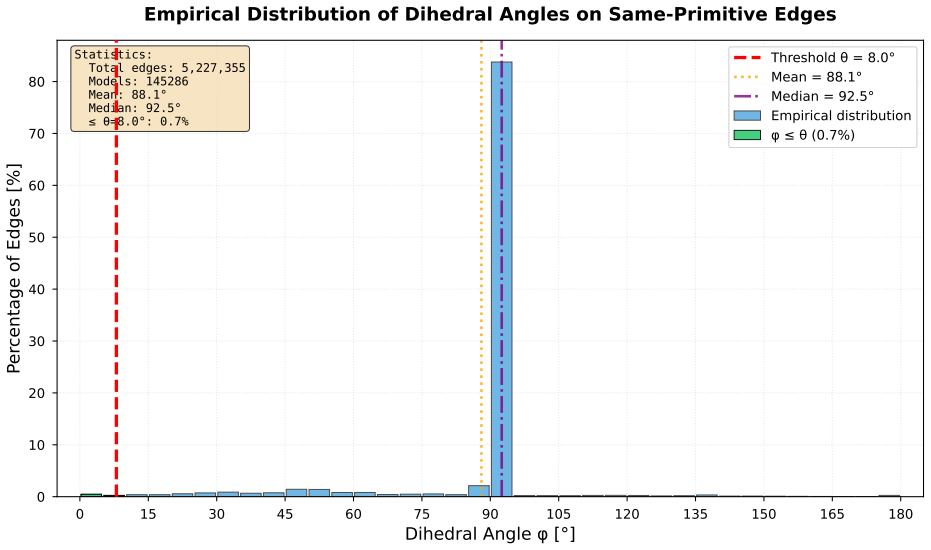
That faces sharing the same analytic type and meeting the near-tangent criterion form meaningful geometric instances, and that the strong bimodality of same-primitive dihedral angles makes the continuity threshold insensitive.
What would settle it
A controlled test showing that the same STEP model, when converted to meshes with substantially different triangle densities or algorithms, yields visibly shifted part boundaries after label transfer would disprove the claimed stability.
Figures




read the original abstract
Many CAD learning pipelines discretize Boundary Representations (B-Reps) into triangle meshes, discarding analytic surface structure and topological adjacency and thereby weakening consistent instance-level analysis. We present STEP-Parts, a deterministic CAD-to-supervision toolchain that extracts geometric instance partitions directly from raw STEP B-Reps and transfers them to tessellated carriers through retained source-face correspondence, yielding instance labels and metadata for downstream learning and evaluation. The construction merges adjacent B-Rep faces only when they share the same analytic primitive type and satisfy a near-tangent continuity criterion. On ABC, same-primitive dihedral angles are strongly bimodal, yielding a threshold-insensitive low-angle regime for part extraction. Because the partition is defined on intrinsic B-Rep topology rather than on a particular triangulation, the resulting boundaries remain stable under changes in tessellation. Applied to the DeepCAD subset of ABC, the pipeline processes approximately 180{,}000 models in under six hours on a consumer CPU. We release code and precomputed labels, and show that STEP-Parts serves both as a tessellation-robust geometric reference and as a useful supervision source in two downstream probes: an implicit reconstruction--segmentation network and a dataset-level point-based backbone.
Editorial analysis
A structured set of objections, weighed in public.
Referee Report
Summary. The paper introduces STEP-Parts, a deterministic pipeline to extract geometric instance partitions directly from raw STEP B-Reps. Adjacent faces are merged only if they share the same analytic primitive type and satisfy a near-tangent continuity criterion; labels are transferred to tessellated carriers via retained source-face correspondence. On the ABC dataset the authors report strong bimodality in same-primitive dihedral angles, which they interpret as defining a threshold-insensitive low-angle regime. The resulting partitions are claimed to be stable under changes in tessellation, to scale to ~180k DeepCAD models in under six hours on a consumer CPU, and to provide useful supervision in two downstream probes (implicit reconstruction-segmentation and a point-based backbone). Code and precomputed labels are released.
Significance. If the partitions prove reliable and the threshold choice robust, the work supplies a practical, topology-driven source of instance-level supervision that avoids mesh-dependent artifacts. The open release of labels for a large corpus and the emphasis on deterministic, tessellation-stable output are concrete strengths that could benefit multiple CAD learning pipelines.
major comments (3)
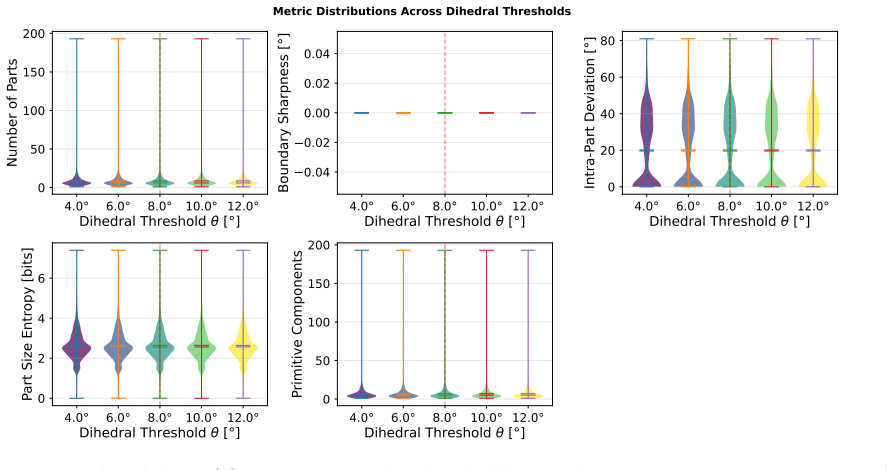
- [Dihedral-angle analysis and threshold selection (likely §3.2–3.3 or §4.1)] The central claim that the low-angle regime is threshold-insensitive rests on aggregate bimodality of same-primitive dihedral angles across ABC. No per-model histograms, variance statistics, or ablation tables (e.g., partition stability or downstream metrics for cutoffs at 5°, 10°, 15°) are presented. Without these, it remains possible that the observed bimodality is an artifact of pooling heterogeneous models and that small threshold shifts materially alter the extracted instances.
- [Downstream probe results (likely §5)] The assertion that STEP-Parts labels constitute 'useful supervision' in the implicit reconstruction-segmentation network and the point-based backbone is stated without any quantitative metrics, baseline comparisons, or ablation against alternative partitioning schemes. This absence makes it impossible to assess whether the analytic-type-plus-continuity rule improves downstream performance or merely reproduces existing label quality.
- [Method and validation (likely §3 and §4)] No quantitative validation of partition quality is provided: there are no comparisons against human-annotated geometric instances, no error analysis on a held-out subset, and no assessment of how often the merging rule joins faces that should remain separate on semantic or manufacturing grounds. Such evidence is required to substantiate that the resulting connected components are meaningful geometric instances rather than an artifact of the chosen criteria.
minor comments (2)
- [Method description (§3)] The exact definition and numerical implementation of the 'near-tangent continuity criterion' (including the precise dihedral-angle threshold and any additional tolerance on surface normals) should be stated explicitly, preferably with a short pseudocode or equation.
- [Scalability experiments (§4.3)] Processing-time claims ('under six hours') would benefit from hardware specifications, average time per model, and a breakdown by model complexity to allow reproducibility.
Simulated Author's Rebuttal
We thank the referee for the constructive and detailed feedback on our manuscript. We address each major comment point by point below, indicating planned revisions where appropriate to strengthen the presentation of our geometric partitioning approach.
read point-by-point responses
-
Referee: [Dihedral-angle analysis and threshold selection (likely §3.2–3.3 or §4.1)] The central claim that the low-angle regime is threshold-insensitive rests on aggregate bimodality of same-primitive dihedral angles across ABC. No per-model histograms, variance statistics, or ablation tables (e.g., partition stability or downstream metrics for cutoffs at 5°, 10°, 15°) are presented. Without these, it remains possible that the observed bimodality is an artifact of pooling heterogeneous models and that small threshold shifts materially alter the extracted instances.
Authors: We agree that the aggregate histogram alone leaves room for the bimodality to be an artifact of model heterogeneity. In the revised manuscript we will add per-model histograms for a representative sample of ABC models, report variance statistics on dihedral angles within individual models, and include an ablation table that quantifies partition stability (number of parts, boundary consistency measured by face overlap) for dihedral thresholds of 5°, 10°, and 15°. These additions will directly demonstrate that the low-angle regime remains stable across small threshold variations. revision: yes
-
Referee: [Downstream probe results (likely §5)] The assertion that STEP-Parts labels constitute 'useful supervision' in the implicit reconstruction-segmentation network and the point-based backbone is stated without any quantitative metrics, baseline comparisons, or ablation against alternative partitioning schemes. This absence makes it impossible to assess whether the analytic-type-plus-continuity rule improves downstream performance or merely reproduces existing label quality.
Authors: We acknowledge that the current description of the downstream probes is primarily illustrative. We will expand the relevant section with concrete quantitative metrics (e.g., segmentation IoU for the implicit network and accuracy/F1 for the point-based backbone), direct comparisons against baselines such as unmerged face labels and simple geometric alternatives, and ablations that isolate the contribution of the continuity criterion. These results will allow readers to evaluate the supervision benefit more rigorously. revision: yes
-
Referee: [Method and validation (likely §3 and §4)] No quantitative validation of partition quality is provided: there are no comparisons against human-annotated geometric instances, no error analysis on a held-out subset, and no assessment of how often the merging rule joins faces that should remain separate on semantic or manufacturing grounds. Such evidence is required to substantiate that the resulting connected components are meaningful geometric instances rather than an artifact of the chosen criteria.
Authors: STEP-Parts defines geometric instances strictly via analytic primitive type and near-tangent continuity; it does not target semantic or manufacturing boundaries, for which consistent human annotations are unavailable in ABC/DeepCAD. We will add a quantitative error analysis on a held-out subset (over-/under-merging rates computed from geometric criteria) together with a manual inspection of a random sample and an explicit discussion of cases where geometric merges may diverge from semantic expectations. This provides validation within the geometric scope of the work. revision: partial
- Large-scale quantitative comparison against human-annotated geometric instances, as no such annotations exist for the ABC or DeepCAD datasets.
Circularity Check
No circularity: deterministic forward construction from B-Rep topology
full rationale
The paper presents a deterministic algorithmic procedure that merges adjacent B-Rep faces only when they share the same analytic primitive type and meet a near-tangent continuity test, with the threshold justified by an empirical observation of bimodality in dihedral angles on the ABC dataset. This is a one-way extraction pipeline from input topology and geometry to instance partitions; no equations, predictions, or first-principles results are shown to reduce to fitted parameters, self-definitions, or self-citation chains. The resulting labels are transferred via retained face correspondence, preserving independence from any downstream model. No load-bearing step collapses to its own inputs by construction.
Axiom & Free-Parameter Ledger
free parameters (1)
- near-tangent continuity threshold
axioms (1)
- domain assumption B-Rep faces carry analytic primitive types and topological adjacency information that can be queried directly from STEP data.
invented entities (1)
-
geometric instance partition
no independent evidence
Reference graph
Works this paper leans on
-
[1]
Ahmed Abdelreheem, Ivan Skorokhodov, Maks Ovsjanikov, and Peter Wonka. Satr: Zero-shot semantic segmentation of 3d shapes.Computing Research Repository (CoRR), abs/2304.04909,
-
[2]
doi: https://doi.org/10.1016/j.compind.2007.09.001
ISSN 0166-3615. doi: https://doi.org/10.1016/j.compind.2007.09.001. URL https://www.sciencedirect.com/ science/article/pii/S0166361507001327. Mangesh P. Bhandarkar and Rakesh Nagi. Step-based feature extraction from step geometry for agile manufacturing.Computers in Industry, 41(1):3–24,
-
[3]
doi: https: //doi.org/10.1016/S0166-3615(99)00040-8
ISSN 0166-3615. doi: https: //doi.org/10.1016/S0166-3615(99)00040-8. URL https://www.sciencedirect.com/science/ article/pii/S0166361599000408. Angel X. Chang, Thomas A. Funkhouser, Leonidas J. Guibas, Pat Hanrahan, Qi-Xing Huang, Zimo Li, Silvio Savarese, Manolis Savva, Shuran Song, Hao Su, Jianxiong Xiao, L. Yi, and Fisher 17 Yu. Shapenet: An information...
-
[4]
Minghao Chen, Roman Shapovalov, Iro Laina, Tom Monnier, Jianyuan Wang, David Novotný, and Andrea Vedaldi
URL https://api.semanticscholar.org/CorpusID:2554264. Minghao Chen, Roman Shapovalov, Iro Laina, Tom Monnier, Jianyuan Wang, David Novotný, and Andrea Vedaldi. Partgen: Part-level 3d generation and reconstruction with multi-view diffusion models.2025 IEEE/CVF Conference on Computer Vision and Pattern Recognition (CVPR), pages 5881–5892,
2025
-
[5]
doi: https://doi.org/10.1016/j.cad.2022.103226
ISSN 0010-4485. doi: https://doi.org/10.1016/j.cad.2022.103226. URL https: //www.sciencedirect.com/science/article/pii/S0010448522000240. Yongkang Dai, Xiaoshui Huang, Yunpeng Bai, Hao Guo, Hongping Gan, Ling Yang, and Yilei Shi. Brepformer: Transformer-based b-rep geometric feature recognition.Proceedings of the 2025 International Conference on Multimedi...
-
[6]
Objaverse: A universe of annotated 3d objects
URL https://api.semanticscholar. org/CorpusID:277667051. Matt Deitke, Dustin Schwenk, Jordi Salvador, Luca Weihs, Oscar Michel, Eli VanderBilt, Ludwig Schmidt, Kiana Ehsani, Aniruddha Kembhavi, and Ali Farhadi. Objaverse: A universe of annotated 3d objects.arXiv preprint arXiv:2212.08051,
-
[7]
Joint neural sdf reconstruction and semantic segmentation for cad models.ArXiv, abs/2510.03837,
Shen Fan and Przemyslaw Musialski. Joint neural sdf reconstruction and semantic segmentation for cad models.ArXiv, abs/2510.03837,
-
[8]
Nafiseh Izadyar, Sai Chandra Madduri, and Teseo Schneider
URLhttps://api.semanticscholar.org/CorpusID: 281843048. Nafiseh Izadyar, Sai Chandra Madduri, and Teseo Schneider. Better step, a format and dataset for boundary representation.ArXiv, abs/2506.05417,
-
[9]
URL https://api.semanticscholar. org/CorpusID:279244873. Alexander Kirillov, Eric Mintun, Nikhila Ravi, Hanzi Mao, Chloe Rolland, Laura Gustafson, Tete Xiao, Spencer Whitehead, Alexander C. Berg, Wan-Yen Lo, Piotr Dollár, and Ross Girshick. Segment anything.arXiv:2304.02643,
work page internal anchor Pith review arXiv
-
[10]
URLhttps://arxiv.org/abs/2506.05573. Minghua Liu, Mikaela Angelina Uy, Donglai Xiang, Hao Su, Sanja Fidler, Nicholas Sharp, and Jun Gao. Partfield: Learning 3d feature fields for part segmentation and beyond.ArXiv, abs/2504.11451,
-
[11]
Chang, L
Kaichun Mo, Shilin Zhu, Angel X. Chang, L. Yi, Subarna Tripathi, Leonidas J. Guibas, and Hao Su. Partnet: A large-scale benchmark for fine-grained and hierarchical part-level 3d object understanding.2019 IEEE/CVF Conference on Computer Vision and Pattern Recognition (CVPR), pages 909–918,
2019
-
[13]
SAM 2: Segment Anything in Images and Videos
URL https://arxiv.org/abs/2408.00714. George Tang, William Zhao, Logan Ford, David Benhaim, and Paul Zhang. Segment any mesh: Zero-shot mesh part segmentation via lifting segment anything 2 to 3d.ArXiv, abs/2408.13679,
work page internal anchor Pith review arXiv
-
[14]
URLhttps://api.semanticscholar.org/CorpusID:271957592. Karl D. D. Willis, Yewen Pu, Jieliang Luo, Hang Chu, Tao Du, Joseph G. Lambourne, Armando Solar-Lezama, and Wojciech Matusik. Fusion 360 gallery: A dataset and environment for programmatic cad construction from human design sequences.ACM Transactions on Graphics (TOG), 40(4), 2021a. Karl DD Willis, Pr...
-
[15]
Point transformer v3: Simpler, faster, stronger.2024 IEEE/CVF Conference on Computer Vision and Pattern Recognition (CVPR), pages 4840–4851,
Xiaoyang Wu, Li Jiang, Peng-Shuai Wang, Zhijian Liu, Xihui Liu, Yu Qiao, Wanli Ouyang, Tong He, and Hengshuang Zhao. Point transformer v3: Simpler, faster, stronger.2024 IEEE/CVF Conference on Computer Vision and Pattern Recognition (CVPR), pages 4840–4851,
2024
-
[16]
Sampart3d: Segment any part in 3d objects.arXiv preprint arXiv:2411.07184, 2024
URL https://api.semanticscholar.org/CorpusID:266335894. Yunhan Yang, Yukun Huang, Yuanchen Guo, Liangjun Lu, Xiaoyang Wu, Edmund Y. Lam, Yan-Pei Cao, and Xihui Liu. Sampart3d: Segment any part in 3d objects.ArXiv, abs/2411.07184,
-
[17]
doi: https://doi.org/ 10.1016/j.cagd.2024.102318
ISSN 0167-8396. doi: https://doi.org/ 10.1016/j.cagd.2024.102318. URL https://www.sciencedirect.com/science/article/pii/ S0167839624000529. Wang Zhao, Yanpei Cao, Jiale Xu, Yuejiang Dong, and Ying Shan. Assembler: Scalable 3d part assembly via anchor point diffusion.ArXiv, abs/2506.17074,
discussion (0)
Sign in with ORCID, Apple, or X to comment. Anyone can read and Pith papers without signing in.