Recognition: unknown
Flow of Truth: Proactive Temporal Forensics for Image-to-Video Generation
Pith reviewed 2026-05-10 11:02 UTC · model grok-4.3
The pith
Flow of Truth enables temporal tracing of forensic signatures in image-to-video generations by tracking pixel motion.
A machine-rendered reading of the paper's core claim, the machinery that carries it, and where it could break.
Core claim
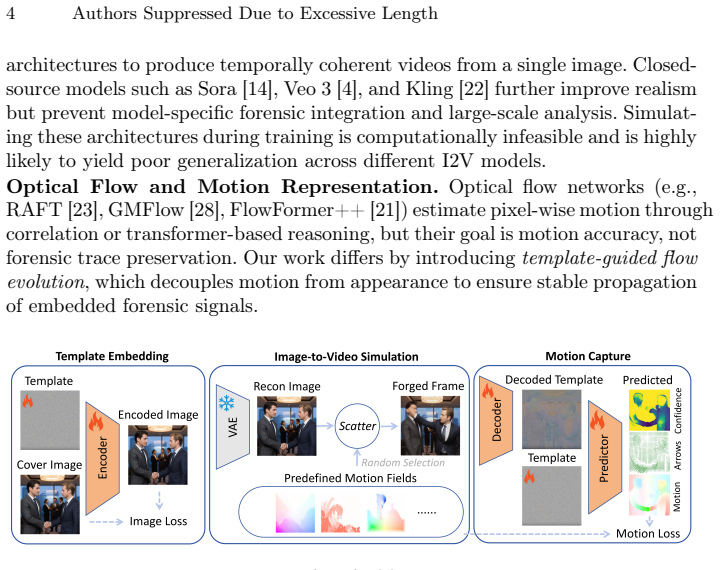
We present Flow of Truth, the first proactive framework focusing on temporal forensics in I2V generation. A key challenge lies in discovering a forensic signature that can evolve consistently with the generation process, which is inherently a creative transformation rather than a deterministic reconstruction. We innovatively redefine video generation as the motion of pixels through time rather than the synthesis of frames. Building on this view, we propose a learnable forensic template that follows pixel motion and a template-guided flow module that decouples motion from image content, enabling robust temporal tracing. Experiments show that Flow of Truth generalizes across commercial andopen
What carries the argument
The learnable forensic template that follows pixel motion and the template-guided flow module that decouples motion from content.
If this is right
- The method can be applied to videos generated by different I2V models without needing model-specific adjustments.
- Performance in temporal forensics tasks improves significantly over traditional spatial methods.
- Forensic signatures embedded this way remain traceable despite the creative changes during video synthesis.
- It shifts forensics from frame-by-frame analysis to motion-based tracing.
Where Pith is reading between the lines
- Similar motion-following templates might be useful for detecting alterations in other dynamic content like 3D animations or live streams.
- This reframing of generation as flow could inspire new designs for proactive watermarks in generative AI systems.
- Integrating this with existing image forensics tools could create layered detection systems for multimedia.
Load-bearing premise
A forensic signature can evolve consistently even when the video generation involves creative, non-deterministic transformations of pixels.
What would settle it
Testing the framework on an I2V model with significantly different motion generation mechanics and checking if the temporal tracing still outperforms baselines.
Figures


read the original abstract
The rapid rise of image-to-video (I2V) generation enables realistic videos to be created from a single image but also brings new forensic demands. Unlike static images, I2V content evolves over time, requiring forensics to move beyond 2D pixel-level tampering localization toward tracing how pixels flow and transform throughout the video. As frames progress, embedded traces drift and deform, making traditional spatial forensics ineffective. To address this unexplored dimension, we present **Flow of Truth**, the first proactive framework focusing on temporal forensics in I2V generation. A key challenge lies in discovering a forensic signature that can evolve consistently with the generation process, which is inherently a creative transformation rather than a deterministic reconstruction. Despite this intrinsic difficulty, we innovatively redefine video generation as *the motion of pixels through time rather than the synthesis of frames*. Building on this view, we propose a learnable forensic template that follows pixel motion and a template-guided flow module that decouples motion from image content, enabling robust temporal tracing. Experiments show that Flow of Truth generalizes across commercial and open-source I2V models, substantially improving temporal forensics performance.
Editorial analysis
A structured set of objections, weighed in public.
Referee Report
Summary. The manuscript introduces Flow of Truth, the first proactive framework for temporal forensics in image-to-video (I2V) generation. It identifies the problem of forensic traces drifting and deforming across frames in generated videos and proposes redefining video generation as the motion of pixels through time. The core technical contributions are a learnable forensic template that follows pixel motion and a template-guided flow module that decouples motion from image content. Experiments are claimed to show generalization across commercial and open-source I2V models with substantial performance gains in temporal forensics.
Significance. If the framework's effectiveness and generalization are rigorously demonstrated, the work would advance digital forensics by addressing the temporal evolution of AI-generated content, an area that has received less attention than static-image tampering detection. The proactive embedding of an adaptive signature via motion modeling is a conceptually distinct approach from reactive post-generation detection methods. The emphasis on decoupling motion from content could have broader applicability in video analysis tasks, though the absence of detailed methods and results limits assessment of its immediate impact.
major comments (2)
- [Abstract] Abstract: The central claims of generalization across I2V models and 'substantially improving temporal forensics performance' are presented without any quantitative metrics, baselines, datasets, or ablation studies. This absence makes it impossible to evaluate whether the learnable forensic template and template-guided flow module deliver the asserted gains or merely restate the modeling assumptions.
- [Abstract] Abstract: The redefinition of I2V generation as 'the motion of pixels through time rather than the synthesis of frames' is positioned as enabling the forensic template, yet no description is given of how the template parameters are optimized, how the flow module is trained, or how consistency is enforced under the non-deterministic transformations inherent to generative models. Without these details the construction cannot be verified as load-bearing for the claimed robustness.
minor comments (1)
- [Abstract] Abstract: The phrase 'proactive framework focusing on temporal forensics' would benefit from a concise definition of 'proactive' (e.g., whether it involves embedding at generation time) to avoid ambiguity with existing watermarking literature.
Simulated Author's Rebuttal
We thank the referee for the constructive comments on our manuscript. We address each major comment below and will revise the abstract to better convey the quantitative evidence and methodological details already present in the full paper.
read point-by-point responses
-
Referee: [Abstract] Abstract: The central claims of generalization across I2V models and 'substantially improving temporal forensics performance' are presented without any quantitative metrics, baselines, datasets, or ablation studies. This absence makes it impossible to evaluate whether the learnable forensic template and template-guided flow module deliver the asserted gains or merely restate the modeling assumptions.
Authors: The abstract is intentionally concise and summarizes the core claims. The full manuscript (Sections 4 and 5) reports quantitative results, including performance metrics on multiple I2V models (both commercial and open-source), comparisons against baselines, evaluation on standard datasets, and ablation studies isolating the contributions of the forensic template and flow module. These demonstrate generalization and gains beyond the modeling assumptions. We will revise the abstract to incorporate key quantitative highlights (e.g., average improvements and dataset/model coverage) so the claims can be evaluated directly from the abstract. revision: yes
-
Referee: [Abstract] Abstract: The redefinition of I2V generation as 'the motion of pixels through time rather than the synthesis of frames' is positioned as enabling the forensic template, yet no description is given of how the template parameters are optimized, how the flow module is trained, or how consistency is enforced under the non-deterministic transformations inherent to generative models. Without these details the construction cannot be verified as load-bearing for the claimed robustness.
Authors: The abstract introduces the conceptual redefinition as motivation. The full manuscript details the implementation in Section 3: the forensic template is optimized end-to-end via a composite loss that includes reconstruction, motion consistency, and forensic fidelity terms; the template-guided flow module is trained with a motion-decoupling objective using optical-flow supervision and adversarial consistency constraints; robustness to non-deterministic generative transformations is enforced through stochastic augmentation during training and a temporal consistency regularizer. We will revise the abstract to include a brief clause referencing these optimization and training procedures (or point to Section 3) to make the load-bearing nature of the redefinition verifiable from the abstract. revision: yes
Circularity Check
No significant circularity detected
full rationale
The paper introduces Flow of Truth as a new proactive framework by explicitly redefining I2V generation as pixel motion through time (an enabling modeling choice) and proposing a learnable forensic template plus template-guided flow module to decouple motion from content. No equations, fitted parameters, or self-citation chains appear in the abstract or described construction that would reduce any prediction or result to an input by definition. The central claim of improved temporal forensics is presented as an empirical generalization across models rather than a tautological fit, and the acknowledged difficulty of signatures surviving creative transformations is treated as an open challenge rather than smuggled in via prior self-work. The derivation chain is therefore self-contained against external benchmarks.
Axiom & Free-Parameter Ledger
free parameters (1)
- learnable forensic template parameters
axioms (1)
- domain assumption Video generation can be redefined as the motion of pixels through time rather than the synthesis of frames.
invented entities (2)
-
Learnable forensic template
no independent evidence
-
Template-guided flow module
no independent evidence
Reference graph
Works this paper leans on
-
[1]
In: 2010 2nd International Conference on Image Processing Theory, Tools and Applications
Almohammad, A., Ghinea, G.: Stego image quality and the reliability of psnr. In: 2010 2nd International Conference on Image Processing Theory, Tools and Applications. pp. 215–220. IEEE (2010)
2010
-
[2]
In: Proceedings of the IEEE/CVF conference on computer vision and pattern recognition
Bui, T., Agarwal, S., Yu, N., Collomosse, J.: Rosteals: Robust steganography us- ing autoencoder latent space. In: Proceedings of the IEEE/CVF conference on computer vision and pattern recognition. pp. 933–942 (2023)
2023
-
[3]
Butler, D.J., Wulff, J., Stanley, G.B., Black, M.J.: A naturalistic open source movie for optical flow evaluation. In: A. Fitzgibbon et al. (Eds.) (ed.) European Conf. on Computer Vision (ECCV). pp. 611–625. Part IV, LNCS 7577, Springer-Verlag (Oct 2012)
2012
-
[4]
DeepMind, G.: Veo.https://deepmind.google/veo/(2024), accessed: 2025-11-08
2024
-
[5]
In: Proceedings of the IEEE/CVF Conference on Computer Vision and Pattern Recognition (2024)
Dong, Q., Fu, Y.: Memflow: Optical flow estimation and prediction with memory. In: Proceedings of the IEEE/CVF Conference on Computer Vision and Pattern Recognition (2024)
2024
-
[6]
Smagt,P.,Cremers,D.,Brox,T.:Flownet:Learningopticalflowwithconvolutional networks
Dosovitskiy, A., Fischer, P., Ilg, E., Häusser, P., Hazırbaş, C., Golkov, V., v.d. Smagt,P.,Cremers,D.,Brox,T.:Flownet:Learningopticalflowwithconvolutional networks. In: IEEE International Conference on Computer Vision (ICCV) (2015), http://lmb.informatik.uni-freiburg.de/Publications/2015/DFIB15
2015
-
[7]
AnimateDiff: Animate Your Personalized Text-to-Image Diffusion Models without Specific Tuning
Guo, Y., Yang, C., Rao, A., Liang, Z., Wang, Y., Qiao, Y., Agrawala, M., Lin, D., Dai, B.: Animatediff: Animate your personalized text-to-image diffusion models without specific tuning. arXiv preprint arXiv:2307.04725 (2023)
work page internal anchor Pith review arXiv 2023
-
[8]
In: Euro- pean Conference on Computer Vision (ECCV) (2018),http://lmb.informatik
Ilg, E., Saikia, T., Keuper, M., Brox, T.: Occlusions, motion and depth boundaries with a generic network for disparity, optical flow or scene flow estimation. In: Euro- pean Conference on Computer Vision (ECCV) (2018),http://lmb.informatik. uni-freiburg.de/Publications/2018/ISKB18
2018
-
[9]
HunyuanVideo: A Systematic Framework For Large Video Generative Models
Kong, W., Tian, Q., Zhang, Z., Min, R., Dai, Z., Zhou, J., Xiong, J., Li, X., Wu, B., Zhang, J., et al.: Hunyuanvideo: A systematic framework for large video generative models. arXiv preprint arXiv:2412.03603 (2024)
work page internal anchor Pith review Pith/arXiv arXiv 2024
-
[10]
In: IEEE Conference on Computer Vision and Pattern Recognition(CVPR) (2020)
Liu, L., Zhang, J., He, R., Liu, Y., Wang, Y., Tai, Y., Luo, D., Wang, C., Li, J., Huang, F.: Learning by analogy: Reliable supervision from transformations for unsupervised optical flow estimation. In: IEEE Conference on Computer Vision and Pattern Recognition(CVPR) (2020)
2020
-
[11]
In: Proceedings of the AAAI Conference on Artificial Intelligence
Ma, Z., Fang, H., Yang, X., Chen, K., Zhang, W.: Ropass: Robust watermarking for partial screen-shooting scenarios. In: Proceedings of the AAAI Conference on Artificial Intelligence. vol. 39, pp. 19332–19339 (2025)
2025
-
[12]
In: Proceedings of the IEEE/CVF Conference on Computer Vision and Pattern Recognition
Mehl, L., Schmalfuss, J., Jahedi, A., Nalivayko, Y., Bruhn, A.: Spring: A high- resolutionhigh-detaildatasetandbenchmarkforsceneflow,opticalflowandstereo. In: Proceedings of the IEEE/CVF Conference on Computer Vision and Pattern Recognition. pp. 4981–4991 (2023) 16 Authors Suppressed Due to Excessive Length
2023
-
[13]
In: Conference on Computer Vision and Pattern Recognition (CVPR) (2015)
Menze, M., Geiger, A.: Object scene flow for autonomous vehicles. In: Conference on Computer Vision and Pattern Recognition (CVPR) (2015)
2015
-
[14]
OpenAI: Sora.https://openai.com/sora(2024), accessed: 2025-11-08
2024
-
[15]
DINOv2: Learning Robust Visual Features without Supervision
Oquab, M., Darcet, T., Moutakanni, T., Vo, H., Szafraniec, M., Khalidov, V., Fernandez, P., Haziza, D., Massa, F., El-Nouby, A., et al.: Dinov2: Learning robust visual features without supervision. arXiv preprint arXiv:2304.07193 (2023)
work page internal anchor Pith review Pith/arXiv arXiv 2023
-
[16]
SDXL: Improving Latent Diffusion Models for High-Resolution Image Synthesis
Podell, D., English, Z., Lacey, K., Blattmann, A., Dockhorn, T., Müller, J., Penna, J., Rombach, R.: Sdxl: Improving latent diffusion models for high-resolution image synthesis. arXiv preprint arXiv:2307.01952 (2023)
work page internal anchor Pith review arXiv 2023
-
[17]
Movie Gen: A Cast of Media Foundation Models
Polyak, A., Zohar, A., Brown, A., Tjandra, A., Sinha, A., Lee, A., Vyas, A., Shi, B., Ma, C.Y., Chuang, C.Y., et al.: Movie gen: A cast of media foundation models. arXiv preprint arXiv:2410.13720 (2024)
work page internal anchor Pith review arXiv 2024
-
[18]
In: International conference on machine learning
Radford, A., Kim, J.W., Hallacy, C., Ramesh, A., Goh, G., Agarwal, S., Sastry, G., Askell, A., Mishkin, P., Clark, J., et al.: Learning transferable visual models from natural language supervision. In: International conference on machine learning. pp. 8748–8763. PMLR (2021)
2021
-
[19]
High-Resolution Image Synthesis with Latent Diffusion Models
Rombach, R., Blattmann, A., Lorenz, D., Esser, P., Ommer, B.: High-resolution image synthesis with latent diffusion models. In: Proceedings of the IEEE/CVF conference on computer vision and pattern recognition. pp. 10684–10695 (2022), https://arxiv.org/abs/2112.10752
work page Pith review arXiv 2022
-
[20]
Procedia Computer Science185, 203–212 (2021)
Samanta, P., Jain, S.: Analysis of perceptual hashing algorithms in image manip- ulation detection. Procedia Computer Science185, 203–212 (2021)
2021
-
[21]
In: Proceedings of the IEEE/CVF Conference on Computer Vision and Pattern Recognition
Shi, X., Huang, Z., Li, D., Zhang, M., Cheung, K.C., See, S., Qin, H., Dai, J., Li, H.: Flowformer++: Masked cost volume autoencoding for pretraining optical flow estimation. In: Proceedings of the IEEE/CVF Conference on Computer Vision and Pattern Recognition. pp. 1599–1610 (2023)
2023
-
[22]
Technology, K.: Kling.https://klingai.com/(2024), accessed: 2025-11-08
2024
-
[23]
In: European conference on computer vision
Teed, Z., Deng, J.: Raft: Recurrent all-pairs field transforms for optical flow. In: European conference on computer vision. pp. 402–419. Springer (2020)
2020
-
[24]
Wan: Open and Advanced Large-Scale Video Generative Models
Wan, T., Wang, A., Ai, B., Wen, B., Mao, C., Xie, C.W., Chen, D., Yu, F., Zhao, H., Yang, J., et al.: Wan: Open and advanced large-scale video generative models. arXiv preprint arXiv:2503.20314 (2025)
work page internal anchor Pith review Pith/arXiv arXiv 2025
-
[25]
arXiv preprint arXiv:2506.21526 (2025)
Wang, Y., Deng, J.: Waft: Warping-alone field transforms for optical flow. arXiv preprint arXiv:2506.21526 (2025)
-
[26]
In: European Conference on Computer Vision
Wang, Y., Lipson, L., Deng, J.: Sea-raft: Simple, efficient, accurate raft for optical flow. In: European Conference on Computer Vision. pp. 36–54. Springer (2024)
2024
-
[27]
IEEE transactions on image processing 13(4), 600–612 (2004)
Wang, Z., Bovik, A.C., Sheikh, H.R., Simoncelli, E.P.: Image quality assessment: from error visibility to structural similarity. IEEE transactions on image processing 13(4), 600–612 (2004)
2004
-
[28]
In: Proceedings of the IEEE/CVF Conference on Computer Vision and Pattern Recognition
Xu, H., Zhang, J., Cai, J., Rezatofighi, H., Tao, D.: Gmflow: Learning optical flow via global matching. In: Proceedings of the IEEE/CVF Conference on Computer Vision and Pattern Recognition. pp. 8121–8130 (2022)
2022
-
[29]
In: 2025 IEEE/CVF Winter Conference on Applications of Computer Vision (WACV)
Xu, R., Hu, M., Lei, D., Li, Y., Lowe, D., Gorevski, A., Wang, M., Ching, E., Deng, A.: Invismark: Invisible and robust watermarking for ai-generated image provenance. In: 2025 IEEE/CVF Winter Conference on Applications of Computer Vision (WACV). pp. 909–918. IEEE (2025)
2025
-
[30]
In: Proceedings of the IEEE/CVF International Conference on Computer Vision
Zhang, L., Rao, A., Agrawala, M.: Adding conditional control to text-to-image diffusion models. In: Proceedings of the IEEE/CVF International Conference on Computer Vision. pp. 3836–3847 (2023) Abbreviated paper title 17
2023
-
[31]
In: Proceedings of the IEEE conference on computer vision and pattern recognition
Zhang, R., Isola, P., Efros, A.A., Shechtman, E., Wang, O.: The unreasonable effectiveness of deep features as a perceptual metric. In: Proceedings of the IEEE conference on computer vision and pattern recognition. pp. 586–595 (2018)
2018
-
[32]
In: Proceedings of the IEEE/CVF Conference on Computer Vision and Pattern Recognition
Zhang, X., Li, R., Yu, J., Xu, Y., Li, W., Zhang, J.: Editguard: Versatile image watermarking for tamper localization and copyright protection. In: Proceedings of the IEEE/CVF Conference on Computer Vision and Pattern Recognition. pp. 11964–11974 (2024)
2024
-
[33]
arXiv preprint arXiv:2412.01615 (2024)
Zhang, X., Tang, Z., Xu, Z., Li, R., Xu, Y., Chen, B., Gao, F., Zhang, J.: Omni- guard: Hybrid manipulation localization via augmented versatile deep image wa- termarking. arXiv preprint arXiv:2412.01615 (2024)
-
[34]
264/avc compression
Zhang, Y., Ni, J., Su, W., Liao, X.: A novel deep video watermarking framework with enhanced robustness to h. 264/avc compression. In: Proceedings of the 31st ACM International Conference on Multimedia. pp. 8095–8104 (2023)
2023
discussion (0)
Sign in with ORCID, Apple, or X to comment. Anyone can read and Pith papers without signing in.