Recognition: unknown
Data Engineering Patterns for Cross-System Reconciliation in Regulated Enterprises: Architecture, Anomaly Detection, and Governance
Pith reviewed 2026-05-10 08:37 UTC · model grok-4.3
The pith
The GERA Framework offers a four-layer architecture that integrates deterministic reconciliation, anomaly detection, semantic standardization, and security controls for data in regulated enterprises.
A machine-rendered reading of the paper's core claim, the machinery that carries it, and where it could break.
Core claim
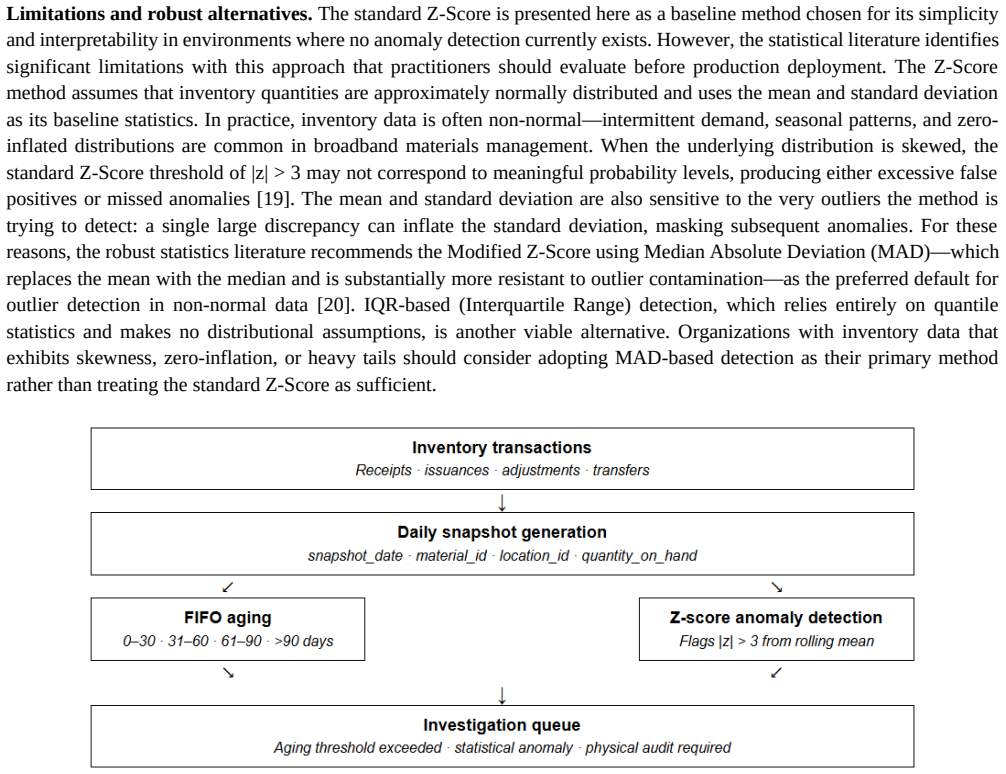
The paper's core claim is that the GERA Framework provides a practical, vendor-neutral methodology for cross-system data reconciliation in regulated settings. By layering ingestion, staging, core models, and semantic serving, it embeds deterministic matching, Z-Score based anomaly detection with alternatives, governed semantics, and NIST CSF 2.0 controls into one structure. This is positioned as a reference for practitioners based on experience in banking, broadband, and technology finance organizations.
What carries the argument
The GERA Framework, defined as a four-layer data architecture that unifies deterministic cross-system reconciliation with statistical anomaly detection, semantic standardization, and security governance to address data fragmentation in regulated enterprises.
If this is right
- Enterprises can implement consistent data reconciliation without relying on manual processes across billing, ERP, and reporting systems.
- Statistical anomaly detection can identify discrepancies in asset inventories and transactions in a governed way.
- Security and compliance controls aligned with NIST standards can be integrated directly into the data architecture.
- Semantic standardization can ensure consistent interpretation of data elements across organizational boundaries.
Where Pith is reading between the lines
- The framework's patterns might extend to other data-intensive sectors with similar interoperability challenges.
- Without disclosed datasets, independent testing could involve applying the described layers to public enterprise data examples.
- Adoption could influence how data platforms incorporate governance from the outset rather than as an add-on.
Load-bearing premise
The observed patterns in U.S. broadband operations and the author's experiences in three regulated environments will generalize to other organizations and produce measurable benefits without the need for controlled benchmarks or released datasets.
What would settle it
Observing whether organizations adopting the four-layer GERA patterns show reduced rates of data discrepancies or faster audit preparation compared to those using ad-hoc methods.
Figures

read the original abstract
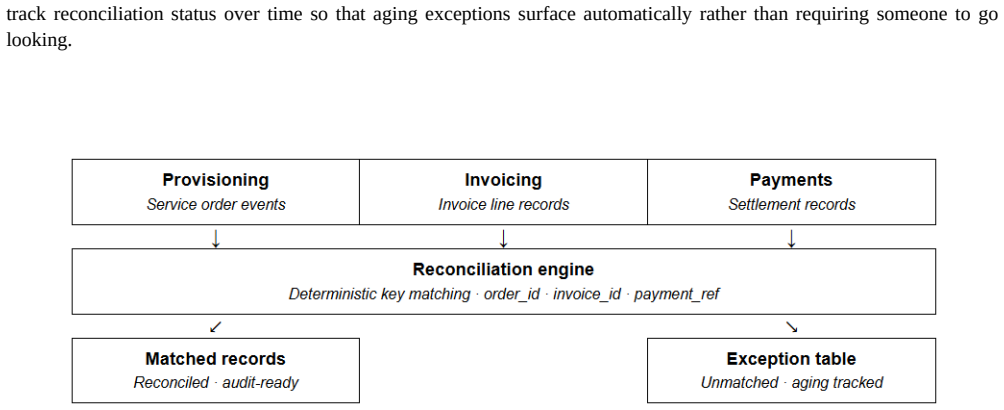
Regulated enterprises in the United States -- banks, telecommunications providers, large technology companies -- operate across heterogeneous systems that were rarely designed to interoperate. ERP platforms, billing engines, supply chain tools, and financial reporting infrastructure coexist within the same organization, but they do not talk to each other well. The resulting fragmentation produces familiar problems: transactions recorded in one system but unreconciled in another, asset inventories drifting from their systems of record, and audit-readiness that depends on manual effort. The PCAOB's 2024 inspection cycle put a number on the consequences: a 39% aggregate Part I.A deficiency rate across all inspected firms. This paper introduces the GERA Framework (Governed Enterprise Reconciliation Architecture) -- a vendor-neutral, four-layer data architecture that integrates deterministic cross-system reconciliation, statistical anomaly detection (baseline Z-Score with robust alternatives), governed semantic standardization, and NIST CSF 2.0-aligned security controls into a single methodology. The architecture spans four layers (ingestion, staging, core models, and semantic serving), following the multi-layer pattern now common in modern data platforms. The patterns are demonstrated through U.S. broadband operations -- where billing reconciliation, inventory aging, and governance are tightly coupled -- and draw on the author's implementation experience across three regulated enterprise environments: a regional bank, a national broadband provider, and a Fortune 500 technology company's central finance organization. This is a practitioner reference -- an architectural framework paper documenting field-tested patterns -- not a controlled experiment or benchmark study. No proprietary systems, datasets, or internal implementations are disclosed.
Editorial analysis
A structured set of objections, weighed in public.
Circularity Check
No significant circularity; descriptive methodology without derivations or self-referential claims
full rationale
The paper presents the GERA Framework as a descriptive, vendor-neutral four-layer architecture integrating deterministic reconciliation, anomaly detection, semantic standardization, and NIST CSF 2.0 controls. It explicitly frames itself as a practitioner reference based on field experience across three regulated environments and U.S. broadband operations, with no equations, fitted parameters, predictions, or load-bearing self-citations. The central claim is the existence and integration of the methodology itself, supported by high-level description rather than any derivation chain that could reduce to its inputs by construction. This is self-contained against external benchmarks as an architectural pattern document.
Axiom & Free-Parameter Ledger
axioms (2)
- domain assumption Heterogeneous enterprise systems produce unreconciled transactions, drifting inventories, and high manual audit effort.
- ad hoc to paper A four-layer architecture (ingestion, staging, core models, semantic serving) plus Z-score detection and NIST controls forms an effective integrated methodology.
invented entities (1)
-
GERA Framework
no independent evidence
Reference graph
Works this paper leans on
-
[1]
GB941 Main Revenue Assurance Guidebook,
TM Forum (Business Assurance Project), “GB941 Main Revenue Assurance Guidebook,” ver. 3.6.0, published Dec. 22, 2023, TM Forum Approved Feb. 9, 2024. [Online]. Available: https://www.tmforum.org/resources/guidebook/gb941-main-revenue-assurance- guidebook-v3-6-0/ (login required; accessed Apr. 6, 2026)
2023
-
[2]
What is Medallion Architecture?
Databricks Staff, “What is Medallion Architecture?” Databricks Blog, n.d. [Online]. Available: https://www.databricks.com/blog/what-is-medallion-architecture (accessed Apr. 6, 2026)
2026
-
[3]
High-Risk Series: Substantial Efforts Needed to Achieve Greater Progress on High-Risk Areas,
National Institute of Standards and Technology, “The NIST Cybersecurity Framework (CSF) 2.0,” NIST CSWP 29, Feb. 26, 2024. DOI: 10.6028/NIST.CSWP.29. [Online]. Available: https://doi.org/10.6028/NIST.CSWP.29 (accessed Apr. 6, 2026)
-
[4]
Broadband Programs: Agencies Need to Further Improve Their Data Quality and Coordination Efforts,
U.S. Government Accountability Office, “Broadband Programs: Agencies Need to Further Improve Their Data Quality and Coordination Efforts,” GAO-25-107207, Apr. 17, 2025 (publicly released Apr. 28, 2025). [Online]. Available: https://www.gao.gov/products/gao-25-107207 (accessed Apr. 6, 2026)
2025
-
[5]
TM Forum Revenue Assurance Survey Report 2017/18 Edition,
TM Forum, “TM Forum Revenue Assurance Survey Report 2017/18 Edition,” ver. 1.1, Mar. 29, 2018. [Online]. Available: https://www.tmforum.org/wp-content/uploads/2018/03/TMF_Revenue-Assurance_Survey_201718_v1_1.pdf (accessed Apr. 6, 2026)
2017
-
[6]
Revenue Assurance: A Strategic Imperative in Today’s Complex Business Landscape,
PwC, “Revenue Assurance: A Strategic Imperative in Today’s Complex Business Landscape,” Dec. 24, 2024. [Online]. Available: https://www.pwc.com/m1/en/publications/revenue-assurance-strategic-imperative-in-todays-complex-business-landscape.html (HTML) and https://www.pwc.com/m1/en/publications/documents/2024/pwc-revenue-assurance.pdf (PDF). Accessed: Apr. 6, 2026
2024
-
[7]
Broadband DATA Act
Broadband Deployment Accuracy and Technological Availability Act (“Broadband DATA Act”), Pub. L. No. 116–130, 134 Stat. 228, Mar. 23, 2020. [Online]. Available: https://www.govinfo.gov/app/details/PLAW-116publ130 (accessed Apr. 6, 2026)
2020
-
[8]
Establishing the Digital Opportunity Data Collection; Modernizing the FCC Form 477 Data Program,
Federal Communications Commission, “Establishing the Digital Opportunity Data Collection; Modernizing the FCC Form 477 Data Program,” Third Report and Order, FCC 21-20, adopted Jan. 13, 2021, released Jan. 19, 2021. [Online]. Available: https://docs.fcc.gov/public/attachments/fcc-21-20a1.pdf (accessed Apr. 6, 2026)
2021
-
[9]
2024 Section 706 Report,
Federal Communications Commission, “2024 Section 706 Report,” FCC 24-27, GN Docket No. 22-270, adopted Mar. 14, 2024, released Mar. 18, 2024. [Online]. Available: https://docs.fcc.gov/public/attachments/FCC-24-27A1.pdf (accessed Apr. 6, 2026)
2024
-
[10]
Semi-Annual Performance (Technical) Report v2.0 Form,
National Telecommunications and Information Administration, “Semi-Annual Performance (Technical) Report v2.0 Form,” BEAD Program, due Jan. 30, 2026, n.d. [Online]. Available: https://broadbandusa.ntia.gov/sites/default/files/2026-01/NTIA_BEAD_Semi- Annual_Technical_Report_v2.0_Form_01_26.pdf (accessed Apr. 6, 2026)
2026
-
[11]
TR131 Revenue Assurance Overview,
TM Forum (Revenue Management Project), “TR131 Revenue Assurance Overview,” ver. 2.4.1, team approved Apr. 13, 2012; date modified May 6, 2014 (archived; superseded by v2.5.0). [Online]. Available: https://www.tmforum.org/resources/technical-report/tr131-revenue-assurance-overview-v2-4-1/ (login required; accessed Apr. 6, 2026)
2012
-
[12]
IG1356 Data Architecture for AI-enabled Telecom Operations Whitepaper,
TM Forum (Modern Data Architecture project), “IG1356 Data Architecture for AI-enabled Telecom Operations Whitepaper,” ver. 2.0.0, team approved Mar. 1, 2024; published May 6, 2024; modified Jun. 10, 2024 (archived; superseded by v3.0.0). [Online]. Available: https://www.tmforum.org/resources/introductory-guide/ig1356-data-architecture-for-ai-enabled-telec...
2024
-
[13]
Reis and M
J. Reis and M. Housley, Fundamentals of Data Engineering: Plan and Build Robust Data Systems. Sebastopol, CA, USA: O’Reilly Media, Jun. 2022. ISBN: 9781098108304. [Online]. Available: O’Reilly or Google Books (accessed Apr. 6, 2026)
2022
-
[14]
Dehghani, Data Mesh: Delivering Data-Driven Value at Scale
Z. Dehghani, Data Mesh: Delivering Data-Driven Value at Scale. Sebastopol, CA, USA: O’Reilly Media, 2022. ISBN: 9781492092391. [Online]. Available: Google Books, https://books.google.com/books/about/Data_Mesh.html?id=M5J5zgEACAAJ (accessed Apr. 6, 2026). 13
2022
-
[15]
Kimball and M
R. Kimball and M. Ross, The Data Warehouse Toolkit: The Definitive Guide to Dimensional Modeling, 3rd ed. John Wiley & Sons, Jul. 2013. ISBN: 9781118530801. [Online]. Available: https://www.wiley.com/en-us/The+Data+Warehouse+Toolkit%2C+3rd+Edition-p-9781118530801 (accessed Apr. 6, 2026)
2013
-
[16]
dbt Semantic Layer,
dbt Labs, “dbt Semantic Layer,” dbt Developer Hub, last updated Apr. 2, 2026. [Online]. Available: https://docs.getdbt.com/docs/use-dbt-semantic-layer/dbt-sl (accessed Apr. 6, 2026)
2026
-
[17]
Open Semantic Interchange (OSI) Updates: Specification Now Live,
Snowflake, “Open Semantic Interchange (OSI) Updates: Specification Now Live,” Snowflake Blog, Jan. 27, 2026. [Online]. Available: https://www.snowflake.com/en/blog/open-semantic-interchanges-specs-finalized/ Also: OSI spec repository (Apache-2.0), https://github.com/open-semantic-interchange/OSI (accessed Apr. 6, 2026)
2026
-
[18]
NISTIR 8062: An Introduction to Privacy Engineering and Risk Management in Federal Systems,
National Institute of Standards and Technology, “NISTIR 8062: An Introduction to Privacy Engineering and Risk Management in Federal Systems,” Jan. 2017. [Online]. Available: https://nvlpubs.nist.gov/nistpubs/ir/2017/nist.ir.8062.pdf (accessed Apr. 6, 2026)
2017
-
[19]
Iglewicz and D
B. Iglewicz and D. C. Hoaglin, How to Detect and Handle Outliers, vol. 16, ASQC Basic References in Quality Control. Milwaukee, WI, USA: ASQC Quality Press, 1993 (print edition). ISBN: 087389247X (9780873892476). [Online]. Available: WorldCat or HathiTrust (accessed Apr. 6, 2026)
1993
-
[20]
C. Leys, C. Ley, O. Klein, P. Bernard, and L. Licata, “Detecting Outliers: Do Not Use Standard Deviation Around the Mean, Use Absolute Deviation Around the Median,” J. Exp. Soc. Psychol., vol. 49, no. 4, pp. 764–766, Jul. 2013. [Online]. DOI: 10.1016/j.jesp.2013.03.013. Available: https://doi.org/10.1016/j.jesp.2013.03.013 (accessed Apr. 6, 2026)
-
[21]
DAMA International, DAMA-DMBOK: Data Management Body of Knowledge, 2nd ed. Rev. Bradley Beach, NJ, USA: Technics Publications, 2017. ISBN: 9781634622349. [Online]. Available: Technics Publications (accessed Apr. 6, 2026)
2017
-
[22]
Data quality in ETL process: A preliminary study,
M. Souibgui, F. Atigui, S. Zammali, S. Cherfi, and S. Ben Yahia, “Data quality in ETL process: A preliminary study,” Procedia Computer Science, vol. 159, pp. 676–687, 2019. DOI: 10.1016/j.procs.2019.09.223
-
[23]
Self-adaptive statistical process control for anomaly detection in time series,
D. Zheng, F. Li, and T. Zhao, “Self-adaptive statistical process control for anomaly detection in time series,” Expert Systems with Applications, vol. 57, pp. 324–336, 2016. DOI: 10.1016/j.eswa.2016.03.029
-
[24]
The role of information governance in big data analytics driven innovation,
P. Mikalef, M. Boura, G. Lekakos, and J. Krogstie, “The role of information governance in big data analytics driven innovation,” Information & Management, vol. 57, no. 7, p. 103361, Nov. 2020. DOI: 10.1016/j.im.2020.103361
-
[25]
Implementation model of data analytics as a tool for improving internal audit processes,
R. Álvarez-Foronda, C. De-Pablos-Heredero, and J.-L. Rodríguez-Sánchez, “Implementation model of data analytics as a tool for improving internal audit processes,” Frontiers in Psychology, vol. 14, p. 1140972, 2023. DOI: 10.3389/fpsyg.2023.1140972
-
[26]
Spotlight: Staff Update on 2024 Inspection Activities,
Public Company Accounting Oversight Board, “Spotlight: Staff Update on 2024 Inspection Activities,” Mar. 31, 2025. [Online]. Available: https://pcaobus.org/documents/staff-update-2024-inspection-activities-spotlight.pdf (accessed Apr. 15, 2026)
2024
discussion (0)
Sign in with ORCID, Apple, or X to comment. Anyone can read and Pith papers without signing in.