Recognition: unknown
Las Cumbres Observatory Gravitational-Wave Follow-up in O3 and O4: Strengths and Weaknesses of a Rapid Response Galaxy Targeted Strategy
Pith reviewed 2026-05-10 10:00 UTC · model grok-4.3
The pith
A global rapid-response telescope network can start gravitational-wave follow-up within minutes and reach depths to detect kilonovae out to a median 250 megaparsecs, yet the galaxy-targeted strategy is far less efficient than predicted for
A machine-rendered reading of the paper's core claim, the machinery that carries it, and where it could break.
Core claim
The central claim is that while the rapid-response network begins observations within minutes and reaches depths sufficient to detect GW170817-like kilonovae out to a median distance of 250 megaparsecs, the galaxy-targeted follow-up strategy proved much less efficient in the third and fourth observing runs than originally predicted because the gravitational-wave localization areas were larger than assumed; therefore coordination among facilities that combine wide-field and rapid-response capabilities is required to achieve efficient and comprehensive follow-up.
What carries the argument
The galaxy-targeted follow-up strategy that selects and observes galaxies lying inside the gravitational-wave localization region, evaluated for speed, depth, and overall efficiency against the actual sizes of the localizations.
If this is right
- Rapid global networks deliver timely deep observations that can catch kilonovae at distances relevant to current gravitational-wave detections.
- Galaxy targeting alone covers too little of the localization volume when areas span hundreds of galaxies.
- Efficient follow-up therefore requires mixing wide-field surveys with targeted rapid-response observations.
- Comprehensive coverage of future gravitational-wave events depends on coordinated scheduling across different telescope classes.
Where Pith is reading between the lines
- Better localization from next-generation detectors could revive the efficiency of galaxy targeting without wide-field support.
- The same tension between localization size and targeting efficiency appears in other rapid transient searches and may call for similar hybrid strategies.
- Resource planning for upcoming runs should allocate telescope time to both wide-field and pointed instruments rather than relying on one mode.
Load-bearing premise
The assumption that gravitational-wave localization areas would be small enough for targeting individual galaxies to remain an efficient use of telescope time.
What would settle it
A measurement showing whether the fraction of the localization area actually imaged with the galaxy-targeted approach exceeds the fraction covered by wide-field imaging in a statistically large sample of events that have or lack detected counterparts.
Figures




read the original abstract
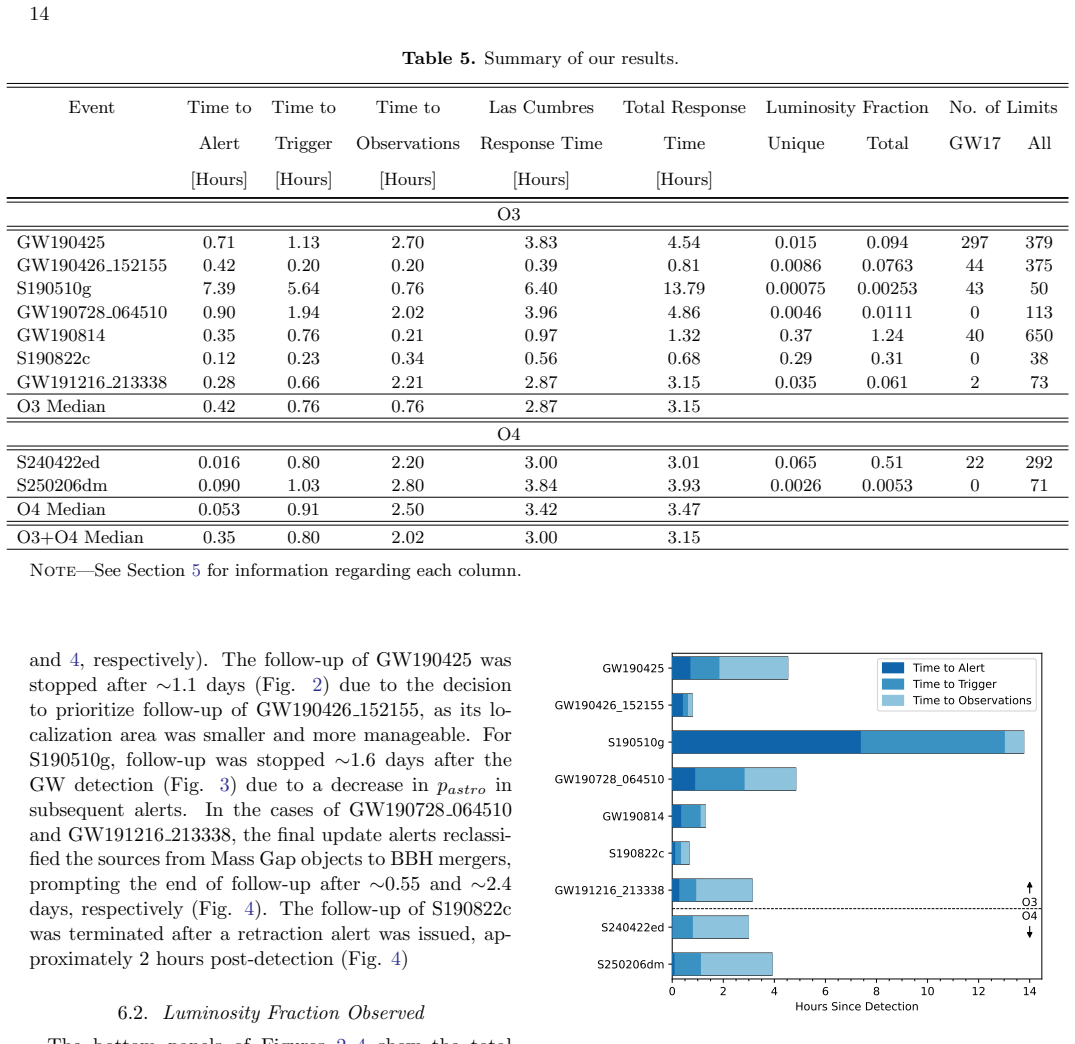
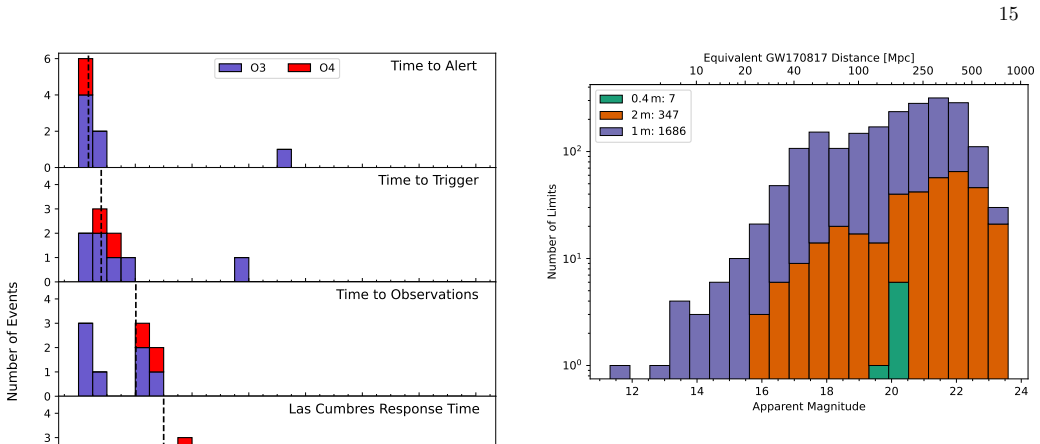
We present a summary of gravitational-wave (GW) follow-up using the Las Cumbres Observatory global network of telescopes during the third (O3) and fourth (O4) observing runs of the GW detectors. As in O2, we implemented the Gehrels et al. 2016 galaxy-targeted strategy. Here we test its efficacy in O3 and O4 and analyze the Las Cumbres Observatory response time and depth for nine GW alerts that showed a possibility of having an electromagnetic counterpart (GW190425, GW190426_152155, S190510g, GW190728_064510, GW190814, S190822c, GW191216_213338, S240422ed and S250206dm). We find that Las Cumbres Observatory is able to begin observations in response to GW alerts within minutes of the alert, with the observations being deep enough to detect possible GW170817-like kilonovae out to a median distance of 250 Mpc. In this sense a global rapid-response network of telescopes like Las Cumbres is an excellent GW follow-up facility. However, the galaxy-targeted follow-up strategy was much less efficient in O3 and O4 than originally predicted, given the larger than assumed GW localizations. We conclude that coordination between various facilities to include both wide-field and rapid-response capabilities is required to achieve efficient and comprehensive follow-up of GW events.
Editorial analysis
A structured set of objections, weighed in public.
Circularity Check
No significant circularity
full rationale
The manuscript is a purely observational report summarizing telescope response times, achieved limiting magnitudes, and coverage fractions for nine specific GW alerts. All quantitative claims (minutes-scale response, median 250 Mpc depth for GW170817-like events, reduced efficiency relative to Gehrels et al. 2016) are direct measurements or straightforward comparisons against an external prior prediction; no equations, parameter fits, derivations, or self-referential definitions appear. The cited Gehrels et al. 2016 strategy is an independent external reference whose assumptions are tested rather than presupposed. No load-bearing step reduces to a self-citation, fitted input renamed as prediction, or ansatz smuggled via citation.
Axiom & Free-Parameter Ledger
axioms (1)
- domain assumption GW events occur preferentially in galaxies, so galaxy-targeted searches are efficient when localizations are small.
Reference graph
Works this paper leans on
-
[1]
2017, PhRvL, 119, 161101, doi: 10.1103/PhysRevLett.119.161101
Abbott, B. P., Abbott, R., Abbott, T. D., et al. 2017, Phys. Rev. Lett., 119, 161101, doi: 10.1103/PhysRevLett.119.161101
-
[2]
Abbott, B. P., Abbott, R., Abbott, T. D., et al. 2017, ApJL, 848, L12, doi: 10.3847/2041-8213/aa91c9
-
[3]
Abbott, B. P., Abbott, R., Abbott, T. D., et al. 2019, Phys. Rev. X, 9, 031040, doi: 10.1103/PhysRevX.9.031040
-
[4]
Abbott, B. P., Abbott, R., Abbott, T. D., et al. 2020a, ApJL, 892, L3, doi: 10.3847/2041-8213/ab75f5
-
[5]
Abbott, R., Abbott, T. D., Abraham, S., et al. 2020b, ApJL, 896, L44, doi: 10.3847/2041-8213/ab960f —. 2021, Physical Review X, 11, 021053, doi: 10.1103/PhysRevX.11.021053
-
[6]
Abbott, R., Abbott, T. D., Acernese, F., et al. 2023, Physical Review X, 13, 041039, doi: 10.1103/PhysRevX.13.041039
-
[7]
2023, The Astrophysical Journal Supplement Series, 267, 29, doi: 10.3847/1538-4365/acdc9f
Abbott, R., Abe, H., Acernese, F., et al. 2023, The Astrophysical Journal Supplement Series, 267, 29, doi: 10.3847/1538-4365/acdc9f
-
[8]
Abbott, R., Abbott, T. D., Acernese, F., et al. 2024, PhRvD, 109, 022001, doi: 10.1103/PhysRevD.109.022001
-
[9]
2022, Galaxies, 10, 63, doi: 10.3390/galaxies10030063
Abe, H., Akutsu, T., Ando, M., et al. 2022, Galaxies, 10, 63, doi: 10.3390/galaxies10030063
-
[10]
2015, Classical and Quantum Gravity, 32, 024001, doi: 10.1088/0264-9381/32/2/024001
Acernese, F., Agathos, M., Agatsuma, K., et al. 2014, Classical and Quantum Gravity, 32, 024001, doi: 10.1088/0264-9381/32/2/024001
-
[11]
S., Ahumada, R., Almeida, A., et al
Aguado, D. S., Ahumada, R., Almeida, A., et al. 2019, ApJS, 240, 23, doi: 10.3847/1538-4365/aaf651
-
[12]
D., Margutti, R., Blanchard, P
Alexander, K. D., Margutti, R., Blanchard, P. K., et al. 2018, ApJL, 863, L18, doi: 10.3847/2041-8213/aad637
-
[13]
Andreoni, I., Ackley, K., Cooke, J., et al. 2017, PASA, 34, e069, doi: 10.1017/pasa.2017.65
-
[14]
2018, ApJL, 855, L23, doi: 10.3847/2041-8213/aab267
Arcavi, I. 2018, ApJL, 855, L23, doi: 10.3847/2041-8213/aab267
-
[15]
Arcavi, I., Hosseinzadeh, G., Howell, D. A., et al. 2017, Nature, 551, 64, doi: 10.1038/nature24291
-
[16]
Arcavi, I., McCully, C., Hosseinzadeh, G., et al. 2017, The Astrophysical Journal Letters, 848, L33, doi: 10.3847/2041-8213/aa910f Astropy Collaboration, Robitaille, T. P., Tollerud, E. J., et al. 2013, A&A, 558, A33, doi: 10.1051/0004-6361/201322068 Astropy Collaboration, Price-Whelan, A. M., Sip˝ ocz, B. M., et al. 2018, AJ, 156, 123, doi: 10.3847/1538-...
-
[17]
2014, ApJS, 210, 9, doi: 10.1088/0067-0049/210/1/9
Steward, L. 2014, ApJS, 210, 9, doi: 10.1088/0067-0049/210/1/9
-
[18]
Brown, T. M., Baliber, N., Bianco, F. B., et al. 2013, Publications of the Astronomical Society of the Pacific, 125, 1031, doi: 10.1086/673168
-
[19]
Buckley, D. A. H., Jha, S. W., Cooke, J., & Mogotsi, M. 2019, GRB Coordinates Network, 24205, 1
2019
-
[20]
Buckley, D. A. H., Andreoni, I., Barway, S., et al. 2018, MNRAS, 474, L71, doi: 10.1093/mnrasl/slx196
-
[21]
Bulla, M. 2019, MNRAS, 489, 5037, doi: 10.1093/mnras/stz2495
-
[22]
2019, GRB Coordinates Network, 24206, 1
Burke, J., Hiramatsu, D., Arcavi, I., et al. 2019, GRB Coordinates Network, 24206, 1
2019
-
[23]
Cannon, K., Caudill, S., Chan, C., et al. 2021, SoftwareX, 14, 100680, doi: 10.1016/j.softx.2021.100680
-
[24]
Classical and Quantum Gravity , keywords =
Chen, H.-Y., Holz, D. E., Miller, J., et al. 2021, Classical and Quantum Gravity, 38, 055010, doi: 10.1088/1361-6382/abd594
-
[25]
Science358, 1556 (2017) https://doi.org/10.1126/science.aap9811 arXiv:1710.05452 [astro- ph.HE]
Coulter, D. A., Foley, R. J., Kilpatrick, C. D., et al. 2017, Science, 358, 1556, doi: 10.1126/science.aap9811
-
[26]
Coulter, D. A., Kilpatrick, C. D., Jones, D. O., et al. 2024, arXiv e-prints, arXiv:2404.15441, doi: 10.48550/arXiv.2404.15441
-
[27]
Cowperthwaite, P. S., Berger, E., Villar, V. A., et al. 2017, ApJL, 848, L17, doi: 10.3847/2041-8213/aa8fc7 D´ alya, G., Galg´ oczi, G., Dobos, L., et al. 2018, MNRAS, 479, 2374, doi: 10.1093/mnras/sty1703
-
[28]
Davis, D., Areeda, J. S., Berger, B. K., et al. 2021, Classical and Quantum Gravity, 38, 135014, doi: 10.1088/1361-6382/abfd85 D´ ıaz, M. C., Macri, L. M., Garcia Lambas, D., et al. 2017, ApJL, 848, L29, doi: 10.3847/2041-8213/aa9060
-
[29]
Drout, M. R., Piro, A. L., Shappee, B. J., et al. 2017, Science, 358, 1570, doi: 10.1126/science.aaq0049
-
[30]
Evans, P. A., Cenko, S. B., Kennea, J. A., et al. 2017, Science, 358, 1565, doi: 10.1126/science.aap9580
-
[31]
The Astrophysical Journal , author =
Gehrels, N., Cannizzo, J. K., Kanner, J., et al. 2016, The Astrophysical Journal, 820, 136, doi: 10.3847/0004-637X/820/2/136
-
[32]
Ghirlanda, G., Salafia, O. S., Paragi, Z., et al. 2019, Science, 363, 968, doi: 10.1126/science.aau8815
-
[33]
2017, ApJL, 848, L14, doi: 10.3847/2041-8213/aa8f41
Goldstein, A., Veres, P., Burns, E., et al. 2017, ApJL, 848, L14, doi: 10.3847/2041-8213/aa8f41 20 G´ orski, K. M., Hivon, E., Banday, A. J., et al. 2005a, ApJ, 622, 759, doi: 10.1086/427976 —. 2005b, ApJ, 622, 759, doi: 10.1086/427976
-
[34]
Hallinan, G., Corsi, A., Mooley, K. P., et al. 2017, Science, 358, 1579, doi: 10.1126/science.aap9855
-
[35]
Hu, L., Wu, X., Andreoni, I., et al. 2017, Science Bulletin, 62, 1433, doi: 10.1016/j.scib.2017.10.006
-
[36]
Hunter, J. D. 2007, Computing in Science and Engineering, 9, 90, doi: 10.1109/MCSE.2007.55 IRSA. 2022, Galactic Dust Reddening and extinction, IPAC, doi: 10.26131/IRSA537
-
[37]
2019, GRB Coordinates Network, 24208, 1
Izzo, L., Carini, R., Benetti, S., et al. 2019, GRB Coordinates Network, 24208, 1
2019
-
[38]
2017, Nature, 551, 80, doi: 10.1038/nature24453
Ramirez-Ruiz, E. 2017, Nature, 551, 80, doi: 10.1038/nature24453
-
[39]
Kasliwal, M. M., Nakar, E., Singer, L. P., et al. 2017, Science, 358, 1559, doi: 10.1126/science.aap9455
-
[40]
M., Coughlin, M
Kasliwal, M. M., Coughlin, M. W., Bellm, E. C., et al. 2019, GRB Coordinates Network, 24191, 1
2019
-
[41]
Keinan, I., & Arcavi, I. 2025, ApJ, 985, 142, doi: 10.3847/1538-4357/adcba5
-
[42]
Kilpatrick, C. D., Coulter, D. A., Arcavi, I., et al. 2021, ApJ, 923, 258, doi: 10.3847/1538-4357/ac23c6 LIGO Scientific Collaboration, & Virgo Collaboration. 2019a, GRB Coordinates Network, 24168, 1 —. 2019b, GRB Coordinates Network, 24228, 1 —. 2019c, GRB Coordinates Network, 24237, 1 —. 2019d, GRB Coordinates Network, 24277, 1 —. 2019e, GRB Coordinates...
-
[43]
M., Gorbovskoy, E., Kornilov, V
Lipunov, V. M., Gorbovskoy, E., Kornilov, V. G., et al. 2017, ApJL, 850, L1, doi: 10.3847/2041-8213/aa92c0
-
[44]
2014, A&A, 570, A13, doi: 10.1051/0004-6361/201423496
Vauglin, I. 2014, A&A, 570, A13, doi: 10.1051/0004-6361/201423496
-
[45]
2021, ARA&A, 59, 155, doi: 10.1146/annurev-astro-112420-030742
Margutti, R., & Chornock, R. 2021, ARA&A, 59, 155, doi: 10.1146/annurev-astro-112420-030742
-
[46]
Margutti, R., Alexander, K. D., Xie, X., et al. 2018, ApJL, 856, L18, doi: 10.3847/2041-8213/aab2ad
-
[47]
McCully, C., Hiramatsu, D., Howell, D. A., et al. 2017, ApJL, 848, L32, doi: 10.3847/2041-8213/aa9111
-
[48]
2018, LCOGT/banzai: Initial Release, 0.9.4, Zenodo, doi: 10.5281/zenodo.1257560
McCully, C., Turner, M., Volgenau, N., et al. 2018, LCOGT/banzai: Initial Release, 0.9.4, Zenodo, doi: 10.5281/zenodo.1257560
-
[49]
Metzger, B. D. 2017, arXiv e-prints, arXiv:1710.05931, doi: 10.48550/arXiv.1710.05931
-
[50]
Mooley, K. P., Deller, A. T., Gottlieb, O., et al. 2018, Nature, 561, 355, doi: 10.1038/s41586-018-0486-3
-
[51]
Nakar, E. 2020, PhR, 886, 1, doi: 10.1016/j.physrep.2020.08.008
-
[52]
2020, in Society of Photo-Optical Instrumentation Engineers (SPIE) Conference Series, Vol
Narita, N., Fukui, A., Yamamuro, T., et al. 2020, in Society of Photo-Optical Instrumentation Engineers (SPIE) Conference Series, Vol. 11447, Ground-based and Airborne Instrumentation for Astronomy VIII, ed. C. J
2020
-
[53]
Evans, J. J. Bryant, & K. Motohara, 114475K, doi: 10.1117/12.2559947
-
[54]
2021, MNRAS, 505, 3016, doi: 10.1093/mnras/stab1523
Nicholl, M., Margalit, B., Schmidt, P., et al. 2021, MNRAS, 505, 3016, doi: 10.1093/mnras/stab1523
-
[55]
2019, GRB Coordinates Network, 24211, 1 Pˆ aris, I., Petitjean, P., Ross, N
Nicholl, M., Short, P., Anderson, J., et al. 2019, GRB Coordinates Network, 24211, 1 Pˆ aris, I., Petitjean, P., Ross, N. P., et al. 2017, A&A, 597, A79, doi: 10.1051/0004-6361/201527999
-
[56]
C., Kiran, B
Pavana, M., Anupama, G. C., Kiran, B. S., & Bhalerao, V. 2019, GRB Coordinates Network, 24200, 1
2019
-
[57]
A., et al
Pellegrino, C., Arcavi, I., Howell, D. A., et al. 2024, GRB Coordinates Network, 36480, 1 21
2024
-
[58]
A., Copperwheat, C
Perley, D. A., Copperwheat, C. M., & Taggart, K. L. 2019, GRB Coordinates Network, 24204, 1
2019
-
[59]
Pian, E., D’Avanzo, P., Benetti, S., et al. 2017, Nature, 551, 67, doi: 10.1038/nature24298
-
[60]
Pozanenko, A. S., Barkov, M. V., Minaev, P. Y., et al. 2018, ApJL, 852, L30, doi: 10.3847/2041-8213/aaa2f6
-
[61]
Savchenko, V., Ferrigno, C., Kuulkers, E., et al. 2017, ApJL, 848, L15, doi: 10.3847/2041-8213/aa8f94
-
[62]
, year = 1976, month = jan, volume =
Schechter, P. 1976, ApJ, 203, 297, doi: 10.1086/154079
-
[63]
Schlafly, E. F., & Finkbeiner, D. P. 2011, ApJ, 737, 103, doi: 10.1088/0004-637X/737/2/103
work page internal anchor Pith review doi:10.1088/0004-637x/737/2/103 2011
-
[64]
Seaman, R., Williams, R., Allan, A., et al. 2011, Sky Event Reporting Metadata Version 2.0, IVOA Recommendation 11 July 2011, doi: 10.5479/ADS/bib/2011ivoa.spec.0711S
-
[65]
Shappee, B. J., Simon, J. D., Drout, M. R., et al. 2017, Science, 358, 1574, doi: 10.1126/science.aaq0186
-
[66]
Skrutskie, M. F., Cutri, R. M., Stiening, R., et al. 2006, AJ, 131, 1163, doi: 10.1086/498708
-
[67]
J., Chen, T.-W., Jerkstrand, A., et al
Smartt, S. J., Chen, T. W., Jerkstrand, A., et al. 2017, Nature, 551, 75, doi: 10.1038/nature24303
-
[68]
Soares-Santos, M., Holz, D. E., Annis, J., et al. 2017, ApJL, 848, L16, doi: 10.3847/2041-8213/aa9059
-
[69]
Tanvir, N. R., Levan, A. J., Gonz´ alez-Fern´ andez, C., et al. 2017, ApJL, 848, L27, doi: 10.3847/2041-8213/aa90b6 The LIGO Scientific Collaboration, the Virgo Collaboration, the KAGRA Collaboration, et al. 2025, arXiv e-prints, arXiv:2508.18082, doi: 10.48550/arXiv.2508.18082
-
[70]
Troja, E., Piro, L., van Eerten, H., et al. 2017, Nature, 551, 71, doi: 10.1038/nature24290
-
[71]
2017, PASJ, 69, 101, doi: 10.1093/pasj/psx118
Utsumi, Y., Tanaka, M., Tominaga, N., et al. 2017, PASJ, 69, 101, doi: 10.1093/pasj/psx118
-
[72]
Valenti, S., Howell, D. A., Stritzinger, M. D., et al. 2016, MNRAS, 459, 3939, doi: 10.1093/mnras/stw870
-
[73]
2017, The Astrophysical Journal Letters, 848, L24, doi: 10.3847/2041-8213/aa8edf
Valenti, S., Sand, D. J., Yang, S., et al. 2017, ApJL, 848, L24, doi: 10.3847/2041-8213/aa8edf van der Walt, S., Colbert, S. C., & Varoquaux, G. 2011, Computing in Science and Engineering, 13, 22, doi: 10.1109/MCSE.2011.37
-
[74]
Virtanen, P., Gommers, R., Oliphant, T. E., et al. 2020, Nature Methods, 17, 261, doi: 10.1038/s41592-019-0686-2
-
[75]
White, D. J., Daw, E. J., & Dhillon, V. S. 2011, Classical and Quantum Gravity, 28, 085016, doi: 10.1088/0264-9381/28/8/085016
-
[76]
J., Fraser, M., et al
Wiersema, K., Levan, A. J., Fraser, M., et al. 2019, GRB Coordinates Network, 24209, 1
2019
-
[77]
D., Tohuvavohu, A., Arcavi, I., et al
Wyatt, S. D., Tohuvavohu, A., Arcavi, I., et al. 2020, ApJ, 894, 127, doi: 10.3847/1538-4357/ab855e
discussion (0)
Sign in with ORCID, Apple, or X to comment. Anyone can read and Pith papers without signing in.