Recognition: unknown
Motif-based filtrations for persistent homology: A framework for graph isomorphism and property prediction
Pith reviewed 2026-05-10 08:36 UTC · model grok-4.3
The pith
Cycle-density filtrations based on motif densities enable persistent homology to distinguish non-isomorphic graphs nearly perfectly and achieve strong performance on real-world graph property prediction.
A machine-rendered reading of the paper's core claim, the machinery that carries it, and where it could break.
Core claim
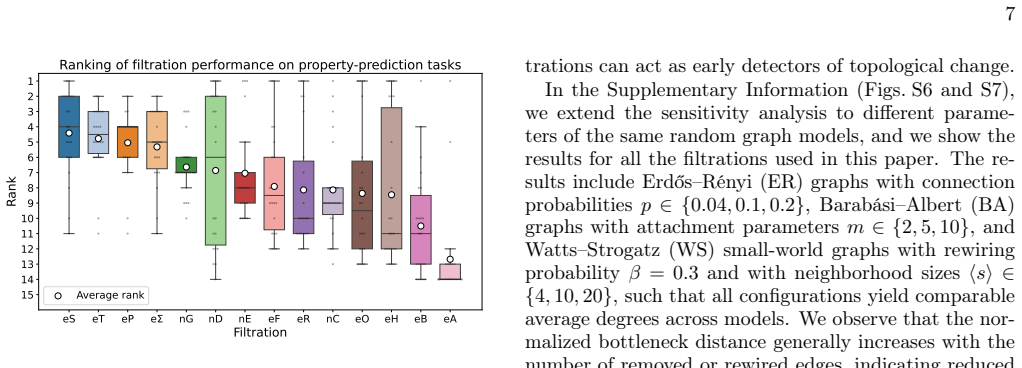
Our cycle-density filtrations distinguish non-isomorphic graphs perfectly or nearly perfectly across four demanding graph families, many of which exhibit symmetries. We outperform curvature-based, degree-based, and Vietoris--Rips filtrations, and match or exceed the accuracy of egonet-distance methods while incurring a lower computational cost.
Load-bearing premise
That weighting edges by densities of triangles, chordless squares, and chordless pentagons produces filtrations whose persistence diagrams are sufficiently discriminative for the tested isomorphism instances and property prediction tasks without requiring additional validation on broader graph classes.
Figures

read the original abstract
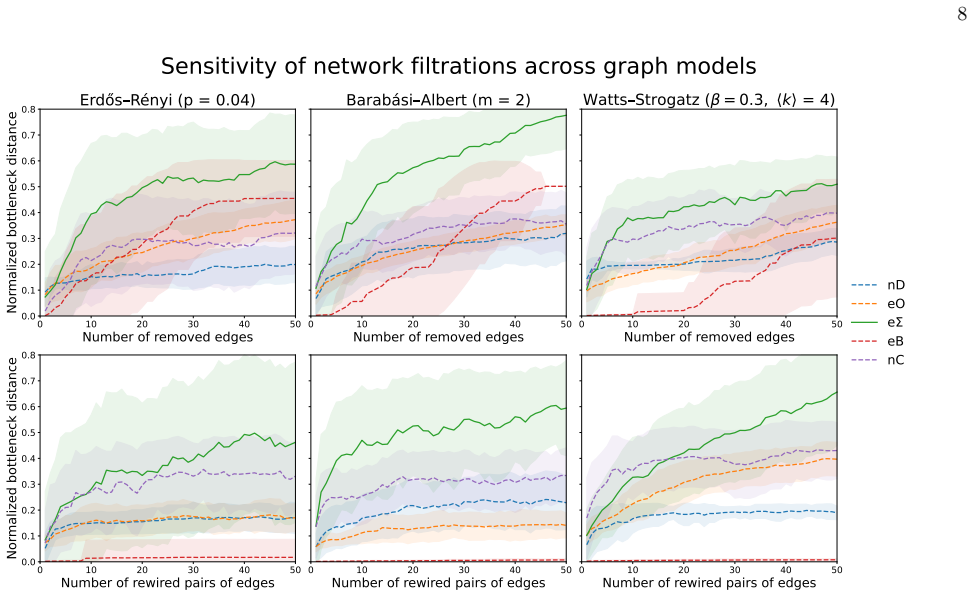
Determining whether two graphs are isomorphic is a fundamental problem with practical applications in areas such as molecular chemistry or social network analysis, yet it remains a challenging task, with exact solutions often being computationally expensive. We address this task using persistent homology built on motif-based filtrations of graphs, a method from topological data analysis that summarizes the shape of data by tracking the persistence of structural features along filtrations. Specifically, we use edge-weighting schemes based on the densities of triangles, chordless squares, and chordless pentagons, which have been shown to be effective for detecting network dimensionality. Our cycle-density filtrations distinguish non-isomorphic graphs perfectly or nearly perfectly across four demanding graph families, many of which exhibit symmetries. We outperform curvature-based, degree-based, and Vietoris--Rips filtrations, and match or exceed the accuracy of egonet-distance methods while incurring a lower computational cost. The expressive power of our filtrations goes beyond isomorphism testing: because they capture rich structural information from graphs, they consistently achieve top performance on property prediction tasks using real-world data, and exhibit high sensitivity to edge rewiring and removal. Together, these findings establish cycle-density filtrations as an effective and computationally tractable framework for graph comparison and characterization, bridging topological data analysis and network science.
Editorial analysis
A structured set of objections, weighed in public.
Referee Report
Summary. The paper proposes motif-based (cycle-density) filtrations for persistent homology on graphs, where edges are weighted by local densities of triangles, chordless 4-cycles, and chordless 5-cycles. It claims these filtrations yield persistence diagrams that distinguish non-isomorphic graphs perfectly or nearly perfectly across four demanding families (many with symmetries), outperforming curvature-based, degree-based, and Vietoris-Rips filtrations while matching or exceeding egonet-distance methods at lower cost. The same filtrations are reported to achieve top performance on real-world graph property prediction tasks and to be highly sensitive to edge rewiring and removal.
Significance. If the empirical results generalize beyond the four tested families, the framework would supply a computationally tractable topological method that injects motif information into graph filtrations, potentially useful for isomorphism testing and network characterization. The reported outperformance on selected isomorphism instances and property-prediction benchmarks constitutes a concrete empirical contribution, but the absence of theoretical injectivity guarantees or tests on standard hard instances (e.g., strongly regular graphs) keeps the significance at the level of a promising proof-of-concept rather than a general method.
major comments (3)
- [Experimental results on graph isomorphism] The isomorphism experiments report perfect or near-perfect separation on four families but neither identify those families against standard hard instances (strongly regular graphs, distance-regular graphs, or the nauty test suite) nor supply a proof that the motif-density map induces an injective function on isomorphism classes. This leaves open whether the observed discrimination is an artifact of the chosen examples.
- [Property prediction experiments] The manuscript supplies no details on exact datasets, baseline implementations, statistical tests, controls for post-hoc choices, or failure cases for the cycle-density filtrations, undermining the claim that they 'consistently achieve top performance' on property prediction.
- [Methods and discussion] No analysis is given of the (unspecified) cases in which the filtrations fail to separate graphs, nor is there an argument that the persistence diagrams are sufficiently discriminative without additional validation on broader graph classes.
minor comments (2)
- [Filtration construction] Notation for the three motif densities and the resulting edge-weight functions should be introduced with explicit formulas rather than descriptive prose only.
- [Figures] Figure captions for persistence diagrams should state the exact graph families and number of instances shown.
Axiom & Free-Parameter Ledger
axioms (2)
- standard math Standard definitions and stability properties of persistent homology
- domain assumption Effectiveness of triangle, square, and pentagon densities for capturing network structure
Reference graph
Works this paper leans on
-
[1]
is the best-performing distance in discriminating between different network topologies, outperforming all other methods, while for directed networks, DGCD-129
-
[2]
An alternative line of work focuses on egonet-based representations, which summarize local network struc- ture around each node
led to an optimal performance. An alternative line of work focuses on egonet-based representations, which summarize local network struc- ture around each node. In [17], Piccardi proposed an alignment-free network comparison method based on dis- tributions of egonet features, including normalized de- gree, clustering coefficient, and egonet persistence. He...
-
[3]
Degree filtration (denoted bynD):v7→deg(v)
-
[4]
Filtration based on Ollivier–Ricci curvature [7] (de- noted byeO). We assign weight−1to nodes and κ(u, v) = 1−W 1(µα u, µα v ) to edges, whereW 1 denotes the first Wasserstein distance [43] andµ α u,µ α v are probability measures based on a lazy random walk in the graph: µα i (j) = αifj=i, (1−α)/deg(i)ifi∼j, 0otherwise, whereαis as a smoothing par...
-
[5]
We setv7→ −1 and(u, v)7→4−deg(u)−deg(v) + 3|N(u)∩N(v)|, whereN(u)andN(v)denote the neighborhoods of uandv, respectively
Filtration based on the augmented Forman–Ricci curvature [42] (denoted byeF). We setv7→ −1 and(u, v)7→4−deg(u)−deg(v) + 3|N(u)∩N(v)|, whereN(u)andN(v)denote the neighborhoods of uandv, respectively
-
[6]
Vietoris–Rips filtration (denoted bym V), where distance is given by the shortest-path length be- tween nodes [44]. This filtration is neither deter- mined by node weights nor by edge weights, but the parameter value associated with each simplex σin the Vietoris–Rips complex is the distance value at whichσappears
-
[7]
Filtration assigning to each edge the density of tri- angles (denoted byeT), computed by Eq. 1
-
[8]
Filtration assigning to each edge the density of chordless squares (denoted byeS)
-
[9]
Filtration assigning to each edge the density of chordless pentagons (denoted byeP)
-
[10]
Filtration assigning to each edge the sum of densi- ties of triangles, squares, and pentagons (denoted byeΣ)
-
[11]
2, wheredi andd j are the degrees of nodesiandj: R(eij) = 1p didj ,(2) 10
Filtration assigning to each edge the Randić con- nectivity index [13] (denoted byeR), which is de- fined as shown in Eq. 2, wheredi andd j are the degrees of nodesiandj: R(eij) = 1p didj ,(2) 10
-
[12]
The harmonic index of a graphGis the sum of weights2/(du +d v)of all edges(u, v)ofG, whered u denotes the degree of a nodeuinG
Filtration that assigns to each edge the weights used to compute the harmonic index [14] (denoted byeH). The harmonic index of a graphGis the sum of weights2/(du +d v)of all edges(u, v)ofG, whered u denotes the degree of a nodeuinG
-
[13]
Filtration that assigns to each edge a variant of the repulsion-attraction rule [15] (denoted byeA): RA(eij) = di +d j +d idj 1 +|N(i)∩N(j)| ,(3) whered i andd j denote the degrees of nodesiandj, and|N(i)∩N(j)|is the number of common neigh- bors between them
-
[14]
Filtration assigning to each edge its betweenness centrality [15] (denoted byeB). The betweenness centrality of an edgeeij is computed as cB(eij) = X s,t∈N σ(s, t|e ij) σ(s, t) ,(4) whereNis the set of nodes,σ(s, t)is the number of shortest paths betweensandt, andσ(s, t|e ij) is the number of those paths passing througheij
-
[15]
If T(v)is the number of triangles containing a node vandd v is the degree ofv, then the clustering coefficient [16] isC(v) = 2T(v)/(d v(dv −1))
Clustering coefficient filtration (denoted bynC). If T(v)is the number of triangles containing a node vandd v is the degree ofv, then the clustering coefficient [16] isC(v) = 2T(v)/(d v(dv −1))
-
[16]
The egonetE i of nodeiis the subgraph on nodes {i} ∪N(i), whereN(i)is the set of neighbors ofi [17]. The egonet filtration (denoted bynE) as- signs to each node the egonet persistence, defined for undirected and unweighted networks by p(i) = P j∈Ei mint jP j∈Ei(mint j +m ext j ) ,(5) wherem int j andm ext j denote the internal and ex- ternal degrees ofjin...
-
[17]
Graphlets [18] are small, connected, non-isomor- phic subgraphs. An orbit is a distinct node position withinagraphlet, defineduptoautomorphism. For each nodev, we compute its Graphlet Degree Vec- tor (GDV), whose entries count how many timesv participates in each orbit. The graphlet-based fil- tration (denoted bynG) assigns tovthe following score, whereii...
-
[18]
Akutsu and H
T. Akutsu and H. Nagamochi, Computational and struc- tural biotechnology journal5, e201302004 (2013)
2013
-
[19]
Merkys, A
A. Merkys, A. Vaitkus, A. Grybauskas, A. Konovalovas, M. Quirós, and S. Gražulis, Journal of cheminformatics 15, 25 (2023)
2023
-
[20]
Sangkaran, A
T. Sangkaran, A. Abdullah, N. JhanJhi, and M. Supra- maniam, International Journal of Computer Science and Network Security19, 85 (2019)
2019
-
[21]
Ballester and B
R. Ballester and B. Rieck, Proceedings of Machine Learn- ing Research269, 42:1 (2025), Third Learning on Graphs Conference, LoG 2024
2025
-
[22]
Almagro, M
P. Almagro, M. Boguñá, and M. A. Serrano, Nature Communications13, 6096 (2022)
2022
-
[23]
A. F. Marcús, R. Jankowski, M. Vila-Miñana, C. Casacu- berta, and M. Serrano, Nature Communications (2026)
2026
-
[24]
Ollivier, Comptes Rendus Mathematique345, 643 (2007)
Y. Ollivier, Comptes Rendus Mathematique345, 643 (2007)
2007
-
[25]
Y. Lin, L. Lu, and S.-T. Yau, Tohoku Math. J.63, 605 (2011)
2011
-
[26]
Jost and S
J. Jost and S. Liu, Discrete & Computational Geometry 51, 300 (2014)
2014
-
[27]
R. P. Sreejith, K. Mohanraj, J. Jost, E. Saucan, and A. Samal, Journal of Statistical Mechanics: Theory and Experiment6, 063206 (2016)
2016
-
[28]
Sandhu, T
R. Sandhu, T. Georgiou, E. Reznik, L. Zhu, I. Kolesov, Y. Senbabaoglu, and A. Tannenbaum, Scientific Reports 14, 12323 (2015)
2015
-
[29]
Fesser, S
L. Fesser, S. Serrano de Haro Iváñez, K. Devriendt, M. Weber, and R. Lambiotte, Journal of Physics: Com- plexity5, 035010 (2024)
2024
-
[30]
Randic, Journal of the American Chemical Society 97, 6609 (1975)
M. Randic, Journal of the American Chemical Society 97, 6609 (1975)
1975
-
[31]
Fajtlowicz, Congr
S. Fajtlowicz, Congr. Numer.60, 187 (1987)
1987
-
[32]
Muscoloni, J
A. Muscoloni, J. M. Thomas, S. Ciucci, G. Bianconi, and C. V. Cannistraci, Nature Communications8, 1615 (2017)
2017
-
[33]
D. J. Watts and S. H. Strogatz, Nature393, 440 (1998)
1998
-
[34]
Piccardi, Scientific Reports13, 14657 (2023)
C. Piccardi, Scientific Reports13, 14657 (2023)
2023
-
[35]
Sarajlić, N
A. Sarajlić, N. Malod-Dognin, Ö. N. Yaveroğlu, and N. Pržulj, Scientific Reports6, 35098 (2016)
2016
-
[36]
Tantardini, F
M. Tantardini, F. Ieva, L. Tajoli, and C. Piccardi, Scien- tific Reports9, 17557 (2019)
2019
-
[37]
Hartle, B
H. Hartle, B. Klein, S. McCabe, A. Daniels, G. St-Onge, C. Murphy, and L. Hébert-Dufresne, Proceedings of the Royal Society A476, 20190744 (2020)
2020
-
[38]
Ö. N. Yaveroğlu, N. Malod-Dognin, D. Davis, Z. Lev- najic, V. Janjic, R. Karapandza, A. Stojmirovic, and N. Pržulj, Scientific Reports4, 4547 (2014)
2014
-
[39]
Weisfeiler and A
B. Weisfeiler and A. Leman, Nauchno-Technicheskaya In- formatsia9, 12 (1968)
1968
-
[40]
Morris, M
C. Morris, M. Ritzert, M. Fey, W. L. Hamilton, J. E. Lenssen, G. Rattan, and M. Grohe, inProceedings of the AAAI Conference on Artificial Intelligence(2019), vol. 33, pp. 4602–4609
2019
-
[41]
Molina-Abril, M
H. Molina-Abril, M. Morón-Fernández, M. Benito- Marimón, F. Díaz-del Río, and P. Real, Applied Mathe- matics and Computation485, 128989 (2025)
2025
-
[42]
Hajij, E
M. Hajij, E. Munch, and P. Rosen, in2020 International Conference on Intelligent Data Science Technologies and Applications (IDSTA)(IEEE, 2020), pp. 110–114
2020
-
[43]
A. Calissano and E. Lasalle, arXiv preprint arXiv:2512.24327 (2025)
-
[44]
arXiv preprint arXiv:1812.09764 , year=
B. Rieck, M. Togninalli, C. Bock, M. Moor, M. Horn, T. Gumbsch, and K. Borgwardt, arXiv preprint arXiv:1812.09764 (2018)
-
[45]
Carrière, F
M. Carrière, F. Chazal, Y. Ike, T. Lacombe, M. Royer, and Y. Umeda, inInternational Conference on Artificial Intelligence and Statistics(PMLR, 2020), pp. 2786–2796
2020
- [46]
-
[47]
McKay,Collection of strongly-regular graphs, URL https://users.cecs.anu.edu.au/~bdm/data/graphs
B. McKay,Collection of strongly-regular graphs, URL https://users.cecs.anu.edu.au/~bdm/data/graphs. html
-
[48]
Wang and M
Y. Wang and M. Zhang, inProceedings of the 41st International Conference on Machine Learning(2024), ICML’24
2024
-
[49]
W. Hu, M. Fey, M. Zitnik, Y. Dong, H. Ren, B. Liu, M. Catasta, and J. Leskovec, Advances in Neural Infor- mation Processing Systems33, 22118 (2020)
2020
-
[50]
Adams, T
H. Adams, T. Emerson, M. Kirby, R. Neville, C. Pe- terson, P. Shipman, S. Chepushtanova, E. Hanson, F. Motta, and L. Ziegelmeier, Journal of Machine Learn- ing Research18, 1 (2017)
2017
-
[51]
Bause, F
F. Bause, F. Jogl, P. Indri, T. Drucks, D. Penz, N. M. Kriege, T. Gärtner, P. Welke, and M. Thiessen, Transac- tions on Machine Learning Research (2025), ISSN 2835- 8856
2025
-
[52]
Barabási and R
A.-L. Barabási and R. Albert, science286, 509 (1999)
1999
-
[53]
Erdős and A
P. Erdős and A. Rényi, Publ. Math. Debrecen6, 18 (1959)
1959
-
[54]
Morris, Y
C. Morris, Y. Lipman, H. Maron, B. Rieck, N. M. Kriege, M.Grohe, M.Fey, andK.Borgwardt, JournalofMachine Learning Research24, 1 (2023)
2023
-
[55]
P. A. Papp and R. Wattenhofer, inProceedings of the International Conference on Machine Learning (ICML) (PMLR, 2022), vol. 162 ofProceedings of Machine Learn- ing Research, pp. 17323–17345
2022
-
[56]
N. H. May, B. Krishnamoorthy, and P. Gambill, La Matematica3, 1486 (2024)
2024
-
[57]
Edelsbrunner and J
H. Edelsbrunner and J. Harer,Computational Topology: An Introduction(American Mathematical Society, Prov- idence, RI, 2010), ISBN 978-0-8218-4925-5
2010
-
[58]
T. K. Dey, T. Hou, and S. Parsa, inAlgorithms and Data Structures (WADS 2023)(Springer, Cham, 2023), vol. 14079 ofLecture Notes in Computer Science
2023
-
[59]
Samal, R
A. Samal, R. P. Sreejith, J. Gu, S. Liu, E. Saucan, and J. Jost, Scientific Reports8, 8650 (2018)
2018
-
[60]
Y.Mileyko, S.Mukherjee, andJ.Harer, InverseProblems 27, 124007 (2011)
2011
-
[61]
Adams and B
H. Adams and B. Coskunuzer, SIAM Journal on Applied Algebra and Geometry6, 685 (2022)
2022
-
[62]
Piccardi, PLoS ONE6, e27028 (2011)
C. Piccardi, PLoS ONE6, e27028 (2011)
2011
-
[63]
Brinkmann, K
G. Brinkmann, K. Coolsaet, J. Goedgebeur, and H.Mélot, DiscreteAppliedMathematics161, 311(2013), ISSN 0166-218X
2013
-
[64]
García-Marco and K
I. García-Marco and K. Knauer, European Journal of Combinatorics125, 104108 (2025), ISSN 0195-6698
2025
-
[65]
Coolsaet, S
K. Coolsaet, S. D’hondt, and J. Goedgebeur, Discrete Applied Mathematics325, 97 (2023)
2023
-
[66]
J.-Y. Cai, M. Fürer, and N. Immerman, Combinatorica 12, 389 (1992)
1992
-
[67]
Motif-based filtrations for persistent homology: A framework for graph isomorphism and property prediction
The GUDHI Project,GUDHI Library: Simplicial Com- plexes and Persistent Homology, GUDHI Project (2021), https://gudhi.inria.fr. Supplementary Information for “Motif-based filtrations for persistent homology: A framework for graph isomorphism and property prediction” Meritxell Vila-Miñana,1 Robert Jankowski,2, 3, 4 Aina Ferrà Marcús,5 Rubén Ballester,5 M. Á...
2021
-
[68]
Wang and M
Y. Wang and M. Zhang, inProceedings of the 41st International Conference on Machine Learning , ICML’24 (2024)
2024
-
[69]
W. Hu, M. Fey, M. Zitnik, Y. Dong, H. Ren, B. Liu, M. Catasta, and J. Leskovec, Advances in Neural Information Processing Systems 33, 22118 (2020)
2020
-
[70]
Ballester and B
R. Ballester and B. Rieck, Proceedings of Machine Learning Research269, 42:1 (2025), Third Learning on Graphs Confer- ence, LoG 2024
2025
discussion (0)
Sign in with ORCID, Apple, or X to comment. Anyone can read and Pith papers without signing in.