Technically Love: The Evolution of Human-AI Romance Discourse on Reddit
Pith reviewed 2026-05-15 14:34 UTC · model grok-4.3
The pith
Reddit discussions of AI romance have drifted from personal intimacy to governance and technical concerns.
A machine-rendered reading of the paper's core claim, the machinery that carries it, and where it could break.
Core claim
Analysis of 3,383 Reddit posts reveals significant topic drift in human-AI romance discourse, with discussions moving away from positive intimate relationships toward platform governance, technical issues, and real-world consequences.
What carries the argument
Topic modeling combined with temporal statistical analysis on a curated set of self-disclosed companion AI posts, used to detect and quantify shifts in dominant themes across years.
If this is right
- Companion AI design should incorporate stronger governance tools and technical safeguards as user priorities shift.
- Platform operators may need updated policies to handle discussions of real-world relationship outcomes.
- Regulatory approaches to AI companions could gain relevance as public framing moves from personal experience to systemic issues.
- Developers might benefit from monitoring forum trends to anticipate user concerns about long-term effects.
Where Pith is reading between the lines
- The observed drift may signal rising public awareness of AI limitations that early users overlooked.
- Similar topic shifts could occur in other online spaces discussing emerging technologies.
- Longitudinal forum analysis offers one way to forecast when new tech transitions from novelty to regulated domain.
- Design teams could treat Reddit patterns as an early signal for features addressing external consequences.
Load-bearing premise
The 3,383 selected Reddit posts accurately reflect the broader evolution of public discourse on human-AI romance without major selection or reporting biases.
What would settle it
A follow-up study that expands the dataset beyond Reddit or re-runs the topic modeling with different parameters and finds no consistent movement toward governance and technical themes would undermine the drift finding.
Figures


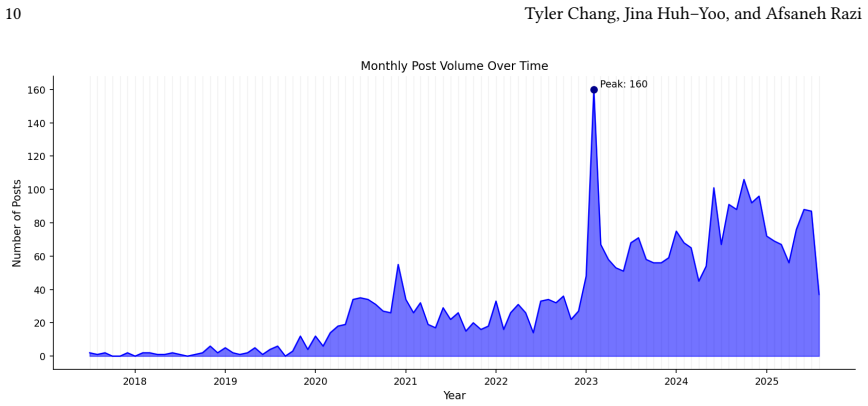

read the original abstract
Human-AI romantic relationships are increasingly common, yet little is understood about how public discourse around them emerges and shifts over time. Prior research has examined user experiences and ethical concerns, but lacks longitudinal analyses of user-initiated public discussions. We address this gap by analyzing a high-precision dataset of 3,383 self-disclosed romantic companion AI posts from Reddit (2017-2025), using topic modeling and temporal statistical analysis to identify dominant themes and their evolution over time. We find significant topic drift, with discussions moving away from positive intimate relationships toward platform governance, technical issues, and real-world consequences. These shifts highlight a transition in how human-AI romance is framed-moving from private experiences to technical mediation and regulation-with implications for the design and governance of companion AI systems.
Editorial analysis
A structured set of objections, weighed in public.
Referee Report
Summary. The paper analyzes a high-precision dataset of 3,383 self-disclosed Reddit posts on romantic companion AI (2017-2025) via topic modeling and temporal statistical analysis, claiming significant topic drift away from positive intimate relationships toward platform governance, technical issues, and real-world consequences, with implications for companion AI design and governance.
Significance. If the dataset accurately captures discourse evolution and the topic modeling is robust, the work provides a valuable longitudinal, data-driven complement to existing qualitative studies on human-AI romance, documenting a shift from private experiences to technical and regulatory framing that could inform future AI ethics and platform policy.
major comments (2)
- [Abstract and Methods] Abstract and Methods: No details are provided on topic model parameters (e.g., number of topics, LDA hyperparameters, coherence scores, or validation procedures such as human coding or stability checks), which directly affects the reliability of the claimed topic drift.
- [Data Collection and Results] Data Collection and Results: The central claim of genuine topic drift rests on the 3,383-post self-disclosed dataset without reported checks for selection bias, coverage of neutral/positive discussions, or adjustment for Reddit demographic/platform changes over 2017-2025; this leaves open the possibility that the shift is an artifact of posting incentives or visibility rather than underlying discourse evolution.
minor comments (1)
- [Data Collection] Clarify the exact data collection cutoff date within 2025 and any subreddit filters used, as these affect temporal comparability.
Simulated Author's Rebuttal
We thank the referee for the constructive feedback, which highlights important areas for strengthening the transparency and robustness of our analysis. We address each major comment below and indicate planned revisions.
read point-by-point responses
-
Referee: [Abstract and Methods] Abstract and Methods: No details are provided on topic model parameters (e.g., number of topics, LDA hyperparameters, coherence scores, or validation procedures such as human coding or stability checks), which directly affects the reliability of the claimed topic drift.
Authors: We agree that the Methods section requires additional detail on the topic modeling process to support evaluation of the topic drift results. In the revised manuscript we will expand the Methods section with a full description of the LDA parameters, including the number of topics, hyperparameters, coherence scores, and validation steps such as human coding of a post sample and stability checks across runs. revision: yes
-
Referee: [Data Collection and Results] Data Collection and Results: The central claim of genuine topic drift rests on the 3,383-post self-disclosed dataset without reported checks for selection bias, coverage of neutral/positive discussions, or adjustment for Reddit demographic/platform changes over 2017-2025; this leaves open the possibility that the shift is an artifact of posting incentives or visibility rather than underlying discourse evolution.
Authors: We acknowledge the concern about potential selection bias and the absence of explicit checks for coverage or platform changes. Our dataset was intentionally filtered for high-precision self-disclosure to focus on authentic user-initiated romance discourse. In revision we will add an explicit limitations subsection in the Discussion that addresses selection effects, under-representation of neutral content, and Reddit's evolving user base and algorithms, supported by citations to relevant platform studies. We will also note that the temporal regression models already incorporate time-period controls. Full new empirical bias audits would require broader data collection outside the current scope, so the revision focuses on transparent discussion rather than additional experiments. revision: partial
Circularity Check
No circularity: purely empirical data-driven analysis
full rationale
The paper conducts a longitudinal empirical study by collecting a high-precision Reddit dataset of 3,383 posts and applying standard topic modeling plus temporal statistical analysis. No equations, derivations, fitted parameters, or self-citations are used to generate the central claims about topic drift. The findings rest directly on the observed data patterns rather than reducing to any input by construction, satisfying the self-contained criterion.
Axiom & Free-Parameter Ledger
Reference graph
Works this paper leans on
-
[1]
Muyideen Dele Adewale and Umaina Ibrahim Muhammad. 2025. From Virtual Companions to Forbidden Attractions: The Seductive Rise of Artificial Intelligence Love, Loneliness, and Intimacy—A Systematic Review.Journal of Technology in Behavioral Science(July 2025). https: //doi.org/10.1007/s41347-025-00549-4
-
[2]
Eugene Agichtein and Luis Gravano. 2000. Snowball: Extracting relations from large plain-text collections. InProceedings of the fifth ACM conference on Digital libraries. 85–94
work page 2000
-
[3]
Yoav Benjamini and Yosef Hochberg. 1995. Controlling the false discovery rate: a practical and powerful approach to multiple testing.Journal of the Royal statistical society: series B (Methodological)57, 1 (1995), 289–300
work page 1995
-
[4]
Nick Bostrom and Eliezer Yudkowsky. 2018. The ethics of artificial intelligence. InArtificial intelligence safety and security. Chapman and Hall/CRC, 57–69
work page 2018
-
[5]
James J Bradac. 1983. The language of lovers, flovers, and friends: Communicating in social and personal relationships.Journal of Language and Social Psychology2, 2-3-4 (1983), 141–162
work page 1983
-
[6]
Mark Anthony Camilleri. 2024. Artificial intelligence governance: Ethical considerations and implications for social responsibility.Expert systems 41, 7 (2024), e13406
work page 2024
-
[7]
Tyler Chang, Joseph J Trybala, Sharon Bassan, and Afsaneh Razi. 2025. Opaque Transparency: Gaps and Discrepancies in the Report of Social Media Harms. InProceedings of the Extended Abstracts of the CHI Conference on Human Factors in Computing Systems (CHI EA ’25). Association for Computing Machinery, New York, NY, USA, Article 424, 12 pages. https://doi.o...
-
[8]
Xiongzhi Chen and Sanat K Sarkar. 2020. On Benjamini–Hochberg procedure applied to mid p-values.Journal of Statistical Planning and Inference 205 (2020), 34–45
work page 2020
- [9]
- [10]
-
[11]
Glen Coppersmith, Mark Dredze, and Craig Harman. 2014. Quantifying mental health signals in Twitter. InProceedings of the workshop on computational linguistics and clinical psychology: From linguistic signal to clinical reality. 51–60
work page 2014
- [12]
-
[13]
Munmun De Choudhury, Michael Gamon, Scott Counts, and Eric Horvitz. 2013. Predicting depression via social media. InProceedings of the international AAAI conference on web and social media, Vol. 7. 128–137
work page 2013
-
[14]
Louise Deleger, Qi Li, Todd Lingren, Megan Kaiser, Katalin Molnar, Laura Stoutenborough, Michal Kouril, Keith Marsolo, Imre Solti, et al. 2012. Building gold standard corpora for medical natural language processing tasks. InAMIA Annual Symposium Proceedings, Vol. 2012. 144
work page 2012
-
[15]
Iliana Depounti, Paula Saukko, and Simone Natale. 2022. Ideal technologies, ideal women: AI and gender imaginaries in Redditors’ discussions on the Replika bot girlfriend.Media, Culture & Society45, 4 (2022), 720–736. https://doi.org/10.1177/01634437221119021
-
[16]
Ray Djufril, Jessica R. Frampton, and Silvia Knobloch-Westerwick. 2025. Love, marriage, pregnancy: Commitment processes in romantic relationships with AI chatbots.Computers in Human Behavior: Artificial Humans4 (May 2025), 100155. https://doi.org/10.1016/j.chbah.2025.100155
-
[17]
Robert L. Duran and Lynne Kelly. 2017. Knapp’s Model of Relational Development in the Digital Age.Iowa Journal of Communication49, 1 (2017), 22–45. https://scholarworks.uni.edu/ijc/vol49/iss1/5
work page 2017
-
[18]
N. Döring, T. Le, L. M. Vowels, et al. 2025. The Impact of Artificial Intelligence on Human Sexuality: A Five-Year Literature Review 2020–2024. Current Sexual Health Reports17 (2025), 4. https://doi.org/10.1007/s11930-024-00397-y
-
[19]
A Shaji George, AS Hovan George, T Baskar, and Digvijay Pandey. 2023. The allure of artificial intimacy: Examining the appeal and ethics of using generative AI for simulated relationships.Partners Universal International Innovation Journal1, 6 (2023), 132–147
work page 2023
-
[20]
Clare Grogan, Jackie Kay, and María Pérez-Ortiz. 2025. AI Will Always Love You: Studying Implicit Biases in Romantic AI Companions. https: //doi.org/10.48550/arXiv.2502.20231 arXiv:2502.20231 [cs]. Manuscript submitted to ACM 22 Tyler Chang, Jina Huh–Yoo, and Afsaneh Razi
-
[21]
Rose E Guingrich and Michael S. A. Graziano. 2025. Chatbots as Social Companions: How People Perceive Consciousness, Human Likeness, and Social Health Benefits in Machines. InOxford Intersections: AI in Society, Philipp Hacker (Ed.). Oxford Academic. https://doi.org/10.1093/ 9780198945215.003.0011 Oxford, online edition
work page 2025
-
[22]
Thilo Hagendorff. 2020. The Ethics of AI Ethics: An Evaluation of Guidelines.Minds and Machines30, 1 (March 2020), 99–120. https://doi.org/10. 1007/s11023-020-09517-8
work page 2020
-
[23]
Replika removing erotic role-play is like grand theft auto removing guns or cars
Kenneth R Hanson and Hannah Bolthouse. 2024. “Replika removing erotic role-play is like grand theft auto removing guns or cars”: Reddit discourse on artificial intelligence chatbots and sexual technologies.Socius10 (2024), 23780231241259627
work page 2024
-
[24]
Marti A Hearst. 1992. Automatic acquisition of hyponyms from large text corpora. InCOLING 1992 volume 2: The 14th international conference on computational linguistics
work page 1992
-
[25]
2025.AI Romance and Misogyny: A Speech Act Analysis
A G Holdier and Kelly Weirich. 2025.AI Romance and Misogyny: A Speech Act Analysis. Oxford University PressOxford. https://doi.org/10.1093/ 9780198945215.003.0074
work page 2025
-
[26]
Jamie Jana Jocher and Roland Verwiebe. 2026. “Forever and Always, My Love”: Emotions in Human–AI Romantic Relationship Building and Breakup With Generative AI Chatbot Replika.Social Media+ Society12, 1 (2026), 20563051251408917
work page 2026
-
[27]
Ayanna Julien. 2023. Knapp’s Relationship Model. https://www.ebsco.com/research-starters/psychology/knapps-relationship-model#full-article [Accessed 04-03-2026]
work page 2023
-
[28]
Emily J. Kahlow. 2024. Beyond the Surface: Reddit’s Anonymity Facilitates Deeper Disclosure Compared to Facebook.International Journal of Cyber Behavior, Psychology and Learning14, 1 (2024). https://doi.org/10.4018/IJCBPL.343629
-
[29]
KTA Sandeeshwara Kasturiratna and Andree Hartanto. 2025. Attachment to Artificial Intelligence: Development of the AI Attachment Scale, Construct Validation, and the Psychological Mechanisms of Human–AI Attachment.Computers in Human Behavior Reports(2025), 100912
work page 2025
-
[30]
Maria Kędzierska, Mikołaj Spytek, Marcelina Kurek, Jan Sawicki, Maria Ganzha, and Marcin Paprzycki. 2023. Topic modeling applied to Reddit posts. InInternational Conference on Big Data Analytics. Springer, 17–44
work page 2023
-
[31]
Mark L. Knapp. 1978.Social Intercourse: From greeting to goodbye. Allyn and Bacon
work page 1978
-
[32]
MARK L Knapp and Anita L Vangelisti. 2005. Relationship stages: A communication perspective.Interpersonal communication and human relationships(2005), 36–49
work page 2005
-
[33]
Jun-Bin Koh. 2023. “Date me date me”: AI chatbot interactions as a resource for the online construction of masculinity.Discourse, Context & Media 52 (2023), 100681. https://doi.org/10.1016/j.dcm.2023.100681
-
[34]
Amanda Lagerkvist. 2024. Yearning for a You: Faith, doubt and relational expectancy in existential communication with chatbots in a world on edge. MedieKultur: Journal of media and communication research40, 76 (Aug. 2024), 10–30. https://doi.org/10.7146/mk.v40i76.141132 Number: 76
-
[35]
Huiqian Lai. 2025. Can LLMs Talk ’Sex’? Exploring How AI Models Handle Intimate Conversations. https://doi.org/10.48550/arXiv.2506.05514 arXiv:2506.05514 [cs]
-
[36]
Minha Lee, Lily Frank, Yvonne De Kort, and Wijnand IJsselsteijn. 2022. Where is Vincent? Expanding our emotional selves with AI. InProceedings of the 4th Conference on Conversational User Interfaces(Glasgow, United Kingdom)(CUI ’22). Association for Computing Machinery, New York, NY, USA, Article 19, 11 pages. https://doi.org/10.1145/3543829.3543835
-
[37]
Jindong Leo-Liu. 2023. Loving a “defiant” AI companion? The gender performance and ethics of social exchange robots in simulated intimate interactions.Computers in Human Behavior141 (2023), 107620. https://doi.org/10.1016/j.chb.2022.107620
-
[38]
Han Li and Renwen Zhang. 2024. Finding love in algorithms: Deciphering the emotional contexts of close encounters with AI chatbots.Journal of Computer-Mediated Communication29, 5 (2024)
work page 2024
-
[39]
Tony Liao, Debriunna Porter, and Elizabeth Rodwell. 2023. Artificial love: Revolutions in how AI and AR embodied romantic chatbots can move through relationship stages.AoIR Selected Papers of Internet Research(2023)
work page 2023
-
[40]
Tony Liao, Elizabeth Rodwell, and Debriunna Porter. 2024. Media frames, AI romantic relationships, and the perspectives of people in relationships; mapping and comparing news media themes with user perspectives.Information, Communication & Society27, 12 (Sept. 2024), 2314–2332. https://doi.org/10.1080/1369118x.2024.2420031
-
[41]
N. Liberati. 2022. Digital Intimacy in China and Japan.Human Studies46 (2022), 389–403. https://doi.org/10.1007/s10746-022-09631-9
-
[42]
Siyu Ma and Mayu Koike. 2025. Becoming human: How perceived anthropomorphism and authenticity influence romantic attractiveness of chat agents.International Journal of Human–Computer Interaction41, 22 (2025), 14162–14175
work page 2025
-
[43]
K. Malfacini. 2025. The impacts of companion AI on human relationships: risks, benefits, and design considerations.AI & Society(2025). https://doi.org/10.1007/s00146-025-02318-6 Advance online publication
-
[44]
B. Maples, M. Cerit, A. Vishwanath, et al. 2024. Loneliness and suicide mitigation for students using GPT3-enabled chatbots.npj Mental Health Research3 (2024), 4. https://doi.org/10.1038/s44184-023-00047-6
-
[45]
Bradford Wilcox, and Kelsey Kaye
Brian Mark, W. Bradford Wilcox, and Kelsey Kaye. 2024.Counterfeit Connections: The Rise of AI Romantic Companions. Technical Report. Wheatley Institute and Institute for Family Studies. https://brightspotcdn.byu.edu/a6/a1/c3036cf14686accdae72a4861dd1/counterfeit-connections-report.pdf Accessed: 2025-08-25
work page 2024
-
[46]
Match.com. 2024. Singles in America. https://www.singlesinamerica.com/ Annual study on the attitudes and behaviors of single Americans. Accessed: 2025-08-25
work page 2024
-
[47]
Mike Mintz, Steven Bills, Rion Snow, and Dan Jurafsky. 2009. Distant supervision for relation extraction without labeled data. InProceedings of the Joint Conference of the 47th Annual Meeting of the ACL and the 4th International Joint Conference on Natural Language Processing of the AFNLP. Manuscript submitted to ACM Technically Love 23 1003–1011
work page 2009
-
[48]
Noelia Muñoz-Fernández, Virginia Sánchez-Jiménez, María-Luisa Rodríguez-deArriba, Lydia Nacimiento-Rodríguez, Paz Elipe, and Rosario Del Rey
-
[49]
https://doi.org/10.1002/ab.22069
Traditional and Cyber Dating Violence among Adolescents: Profiles, Prevalence, and Short-Term Associations with Peer Violence.Aggressive Behavior49, 3 (2023), 261–273. https://doi.org/10.1002/ab.22069
- [50]
-
[51]
Mohammad Namvarpour and Afsaneh Razi. 2024. Uncovering Contradictions in Human-AI Interactions: Lessons Learned from User Reviews of Replika. InCompanion Publication of the 2024 Conference on Computer-Supported Cooperative Work and Social Computing (CSCW Companion ’24). Association for Computing Machinery, New York, NY, USA, 579–586. https://doi.org/10.11...
-
[52]
Mohammad (Matt) Namvarpour, Harrison Pauwels, and Afsaneh Razi. 2025. AI-induced sexual harassment: Investigating Contextual Characteristics and User Reactions of Sexual Harassment by a Companion Chatbot. arXiv preprint arXiv:2504.04299. https://doi.org/10.48550/arXiv.2504.04299 Accepted for publication at CSCW 2025
-
[53]
Shuyi Pan and Yi Mou. 2024. Constructing the meaning of human–<scp>AI</scp> romantic relationships from the perspectives of users dating the social chatbot Replika.Personal Relationships31, 4 (Sept. 2024), 1090–1112. https://doi.org/10.1111/pere.12572
-
[54]
Elliot Panek, Connor Hollenbach, Jinjie Yang, and Tyler Rhodes. 2017. Growth and inequality of participation in online communities: A longitudinal analysis. InProceedings of the 8th International Conference on Social Media & Society. 1–5
work page 2017
-
[55]
Patrick Pantel and Marco Pennacchiotti. 2006. Espresso: Leveraging generic patterns for automatically harvesting semantic relations. InProceedings of the 21st international conference on computational linguistics and 44th annual meeting of the Association for Computational Linguistics. 113–120
work page 2006
-
[56]
Pat Pataranutaporn, Sheer Karny, Chayapatr Archiwaranguprok, Constanze Albrecht, Auren R. Liu, and Pattie Maes. 2025. "My Boyfriend is AI": A Computational Analysis of Human-AI Companionship in Reddit’s AI Community. https://doi.org/10.48550/ARXIV.2509.11391
-
[57]
I’m not experienced. . . please send advice
Morgan E PettyJohn, Kyla M Cary, Erin Nolen, and Toni A Gallegos. 2025. “I’m not experienced. . . please send advice”: teens seeking information and advice about sexual behaviors on Reddit.The Journal of Sex Research62, 7 (2025), 1186–1197
work page 2025
-
[58]
Elizabeth Pleasants, Ndola Prata, Ushma D Upadhyay, Cassondra Marshall, and Coye Cheshire. 2025. Using Natural Language Processing to Describe the Use of an Online Community for Abortion During 2022: Dynamic Topic Modeling Analysis of Reddit Posts.JMIR infodemiology5, 1 (2025), e72771
work page 2025
-
[59]
Vaidyeswaran Rajaraman. 2023. From ELIZA to ChatGPT: history of human-computer conversation.Resonance28, 6 (2023), 889–905
work page 2023
-
[60]
Alexander Ratner, Stephen H Bach, Henry Ehrenberg, Jason Fries, Sen Wu, and Christopher Ré. 2017. Snorkel: Rapid training data creation with weak supervision. InProceedings of the VLDB endowment. International conference on very large data bases, Vol. 11. 269
work page 2017
-
[61]
Shivani Reddy P, Aaron John, and Shaurya Kaushik. 2025. AI As Romantic Companion- an Ethical Dilemma. (2025). https://doi.org/10.2139/ssrn. 5106936
-
[62]
Tsameret Ricon. 2024. How chatbots perceive sexting by adolescents.Computers in Human Behavior: Artificial Humans2, 1 (Jan. 2024), 100068. https://doi.org/10.1016/j.chbah.2024.100068
-
[63]
Tsameret Ricon. 2025. AI and Adolescent Relationships: Bridging emotional intelligence and practical guidance.Computers in Human Behavior Reports19 (2025), 100752. https://doi.org/10.1016/j.chbr.2025.100752
-
[64]
Ellen Riloff. 1996. Automatically generating extraction patterns from untagged text. InProceedings of the national conference on artificial intelligence. 1044–1049
work page 1996
-
[65]
Ellen Riloff, Rosie Jones, et al. 1999. Learning dictionaries for information extraction by multi-level bootstrapping. InAAAI/IAAI. 474–479
work page 1999
-
[66]
Ellen Riloff and Janyce Wiebe. 2003. Learning extraction patterns for subjective expressions. InProceedings of the 2003 conference on Empirical methods in natural language processing. 105–112
work page 2003
-
[67]
Katherine Rodger and Evelyn F Field. 2025. You and I plus AI: A qualitative exploration of replika in the context of human relationships.The Canadian Journal of Human Sexuality34, 3 (2025), 398–411
work page 2025
-
[68]
Renee Shelby, Shalaleh Rismani, Kathryn Henne, AJung Moon, Negar Rostamzadeh, Paul Nicholas, N’Mah Yilla-Akbari, Jess Gallegos, Andrew Smart, Emilio Garcia, and Gurleen Virk. 2023. Sociotechnical Harms of Algorithmic Systems: Scoping a Taxonomy for Harm Reduction. InProceedings of the 2023 AAAI/ACM Conference on AI, Ethics, and Society (AIES ’23). Associa...
-
[69]
Jo Stuthridge. 2010. Script or scripture.Life scripts: A transactional analysis of unconscious relational patterns(2010), 73–100
work page 2010
-
[70]
William B Swann Jr and JK Bosson. 2008. Identity negotiation.Handbook of personality: Theory and research448 (2008)
work page 2008
-
[71]
Michael Thelen and Ellen Riloff. 2002. A bootstrapping method for learning semantic lexicons using extraction pattern contexts. InProceedings of the 2002 conference on empirical methods in natural language processing (EMNLP 2002). 214–221
work page 2002
-
[72]
Stella Ting-Toomey. 2005. Identity negotiation theory: Crossing cultural boundaries.Theorizing about intercultural communication387 (2005)
work page 2005
-
[73]
Pat Treusch. 2020. Re-reading ELIZA: Human–machine Interaction as cognitive sense-ability. InFeminist Technoecologies. Routledge, 61–76
work page 2020
-
[74]
Sezai Tunca. 2025. Tracing the evolving discourse of sexual technology: A longitudinal analysis of emotional, ethical, and technological narratives on Reddit.Sociology Compass19, 8 (2025), 1–12. https://doi.org/10.1111/soc4.70110
-
[75]
Jan-Peter Voß, Adrian Smith, and John Grin. 2009. Designing long-term policy: rethinking transition management.Policy sciences42, 4 (2009), 275–302. Manuscript submitted to ACM 24 Tyler Chang, Jina Huh–Yoo, and Afsaneh Razi
work page 2009
-
[76]
Skyler Wang and Marco Dehnert. 2026. On-Demand Intimacy: The Sociotechnical Appeal of AI Companions.Social Media+ Society12, 1 (2026), 20563051251410394
work page 2026
-
[77]
Xuetong Wang, Ching Christie Pang, and Pan Hui. 2025. ‘My Dataset of Love’: A Preliminary Mixed-Method Exploration of Human-AI Romantic Relationships.Proc. ACM Hum.-Comput. Interact.9, 7, Article CSCW351 (Oct. 2025), 34 pages. https://doi.org/10.1145/3757532
-
[78]
Joseph Weizenbaum. 1966. ELIZA—a computer program for the study of natural language communication between man and machine.Commun. ACM9, 1 (1966), 36–45
work page 1966
-
[79]
Brian J Willoughby, Jason S. Carroll, Carson R. Dover, and Rebekah H. Hakala. 2025. Counterfeit Connections: The Rise of Romantic AI Compan- ions and AI Sexualized Media Among the Rising Generation. https://brightspotcdn.byu.edu/a6/a1/c3036cf14686accdae72a4861dd1/counterfeit- connections-report.pdf
work page 2025
-
[80]
Lars Wissler, Mohammed Almashraee, Dagmar Monett Díaz, and Adrian Paschke. 2014. The Gold Standard in Corpus Annotation.IEEE GSC21 (2014)
work page 2014
discussion (0)
Sign in with ORCID, Apple, or X to comment. Anyone can read and Pith papers without signing in.