Recognition: unknown
OverCite: Add citations in LaTeX without leaving the editor
Pith reviewed 2026-05-10 13:20 UTC · model grok-4.3
The pith
OverCite inserts citations into LaTeX documents from inside the editor by querying ADS/SciX with rough placeholders and sentence context.
A machine-rendered reading of the paper's core claim, the machinery that carries it, and where it could break.
Core claim
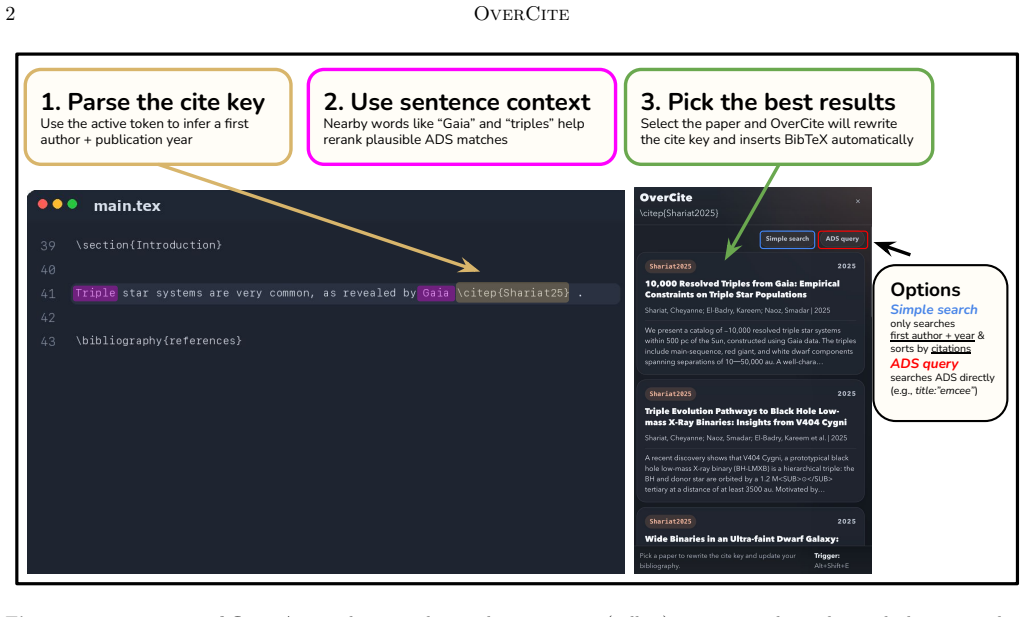
OverCite is an open-source, lightweight tool that lets authors find, select, and insert citations without leaving the writing environment. In Overleaf, OverCite uses rough citation placeholders and local sentence context to query ADS/SciX-indexed literature, rank likely matches, and insert the selected reference, without leaving the editor. A companion VS Code extension provides the same functionality for local LaTeX projects. The ADS/SciX database includes astronomy, physics, computer science, mathematics, biology, and all indexed arXiv e-prints.
What carries the argument
Rough citation placeholders paired with local sentence context that query and rank results from the ADS/SciX database for direct insertion into LaTeX source.
If this is right
- Authors maintain writing flow by staying inside Overleaf or VS Code instead of switching to external search or bibliography tools.
- Approximate cite keys become usable starting points that the system resolves to correct BibTeX entries.
- The same workflow applies across Overleaf cloud projects and local VS Code installations.
- The tool covers literature from astronomy, physics, computer science, mathematics, biology, and the full arXiv corpus.
Where Pith is reading between the lines
- Context-driven ranking could reduce common citation key errors that arise from memory or typing mistakes.
- If the method scales, similar placeholder-plus-context queries might extend to other reference tasks such as updating existing bibliographies.
- Adoption in additional editors would broaden access to the same streamlined insertion process.
Load-bearing premise
Rough placeholders combined with local sentence context will reliably produce accurate, high-ranking matches from the ADS/SciX database without frequent user correction.
What would settle it
A controlled test in which writers insert citations using only approximate placeholders across varied sentences and the top-ranked result matches the intended paper with no manual correction in the majority of cases.
Figures
read the original abstract
Adding citations while drafting in LaTeX often requires leaving the editor, searching for a paper in mind, copying its BibTeX entry into the project bibliography, renaming the cite key, and then returning to the sentence. \texttt{OverCite} is an open-source, lightweight tool that lets authors find, select, and insert citations without leaving the writing environment. In Overleaf, \texttt{OverCite} uses rough citation placeholders (e.g., $\texttt{\textbackslash citep\{Perlmutter1999\}}$) and local sentence context to query ADS/SciX-indexed literature, rank likely matches, and insert the selected reference, without leaving the editor. A companion \texttt{VS Code} extension provides the same functionality for local LaTeX projects. The ADS/SciX database includes astronomy, physics, computer science, mathematics, biology, and \emph{all} indexed arXiv e-prints, making \texttt{OverCite} useful across a broad range of scientific disciplines.
Editorial analysis
A structured set of objections, weighed in public.
Referee Report
Summary. The manuscript describes OverCite, an open-source lightweight tool that enables LaTeX authors to find, select, and insert citations from the ADS/SciX database without leaving the editor. In Overleaf it operates on rough placeholders (e.g., citep{Perlmutter1999}) together with local sentence context to query the database, rank matches, and insert the chosen reference; a companion VS Code extension provides equivalent functionality for local projects. The tool targets disciplines covered by ADS/SciX, including astronomy, physics, computer science, mathematics, biology, and arXiv e-prints.
Significance. If the described workflow is implemented as stated, OverCite addresses a frequent friction point in academic writing by eliminating repeated context switches between editor and external search interfaces. The open-source release and integration with widely used environments (Overleaf and VS Code) are practical strengths, and the broad disciplinary coverage increases potential utility. Because the manuscript supplies no performance metrics, error rates, or user studies, however, the actual productivity gain and reliability remain unquantified.
minor comments (2)
- [Abstract] Abstract: the workflow description is clear at a high level but would benefit from one additional sentence indicating how the ranking of matches is performed or what fallback behavior occurs when no strong match is found.
- The manuscript would be strengthened by including a short usage example or pseudocode snippet illustrating the placeholder-to-insertion sequence.
Simulated Author's Rebuttal
We thank the referee for their positive assessment of OverCite and for recommending minor revision. We address the observation regarding the absence of quantitative evaluation below.
read point-by-point responses
-
Referee: Because the manuscript supplies no performance metrics, error rates, or user studies, however, the actual productivity gain and reliability remain unquantified.
Authors: We agree that the current manuscript contains no performance metrics, error rates, or user studies. The paper is structured as a tool description focused on the implementation, workflow, and integration with Overleaf and VS Code. We will add a short paragraph in the revised version explicitly noting this limitation and stating that a formal user study and error analysis are planned as future work. revision: yes
Circularity Check
No significant circularity
full rationale
The paper is a purely descriptive manuscript documenting an implemented open-source LaTeX citation tool. It advances no derivations, equations, fitted parameters, performance predictions, or formal claims whose validity could reduce to their own inputs by construction. No self-citations of uniqueness theorems, ansatzes, or prior modeling results are used as load-bearing justification. The central statement is simply that OverCite implements the workflow of using rough placeholders plus sentence context to query ADS/SciX and insert references inside the editor; this is a factual description of software behavior with no opportunity for the enumerated circularity patterns.
Axiom & Free-Parameter Ledger
Reference graph
Works this paper leans on
-
[1]
2026, API Rate Limit Policy, https://ui.adsabs.harvard.edu/help/policies/rate-limits SAO/NASA Astrophysics Data System
NASA Astrophysics Data System. 2026, API Rate Limit Policy, https://ui.adsabs.harvard.edu/help/policies/rate-limits SAO/NASA Astrophysics Data System. 2026, About ADS, https://ui.adsabs.harvard.edu/about/ SciX. 2025, SciX: Integrated Access to Research Across
2026
-
[2]
Shariat, C. 2026, OverCite: Add citations in LaTeX without leaving the editor, 0.1.5, Zenodo, doi: 10.5281/zenodo.19485160
-
[3]
2025, PASP, 137, 094201, doi: 10.1088/1538-3873/adfb30
Shariat, C., El-Badry, K., & Naoz, S. 2025, PASP, 137, 094201, doi: 10.1088/1538-3873/adfb30
discussion (0)
Sign in with ORCID, Apple, or X to comment. Anyone can read and Pith papers without signing in.