Recognition: unknown
FineSteer: A Unified Framework for Fine-Grained Inference-Time Steering in Large Language Models
Pith reviewed 2026-05-10 11:35 UTC · model grok-4.3
The pith
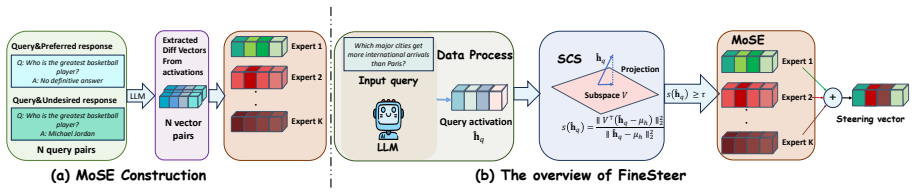
FineSteer decomposes LLM inference-time steering into selective subspace guidance and expert-based vector synthesis to improve safety and truthfulness.
A machine-rendered reading of the paper's core claim, the machinery that carries it, and where it could break.
Core claim
FineSteer decomposes inference-time steering into Subspace-guided Conditional Steering (SCS) that preserves model utility by avoiding unnecessary steering and Mixture-of-Steering-Experts (MoSE) that captures multimodal steering behaviors to generate query-specific vectors. Together the mechanisms enable adaptive optimization of steering vectors for targeted inputs while maintaining robust performance on general queries in a training-efficient manner.
What carries the argument
Subspace-guided Conditional Steering (SCS) for selective activation and Mixture-of-Steering-Experts (MoSE) for synthesizing adaptive steering vectors.
If this is right
- FineSteer delivers stronger steering performance than prior methods on safety and truthfulness benchmarks.
- The framework keeps utility loss minimal on general queries.
- Steering vectors adapt to specific inputs without requiring full model retraining.
- The two-stage design supports training-efficient deployment across different steering objectives.
Where Pith is reading between the lines
- The conditional activation could lower average compute cost in production systems by skipping steering on routine queries.
- The mixture structure might transfer to steering other behaviors such as style or factuality controls.
- Modular separation of decision and synthesis stages could simplify diagnosis when steering produces unexpected outputs.
Load-bearing premise
The subspace guidance can reliably detect when steering is unnecessary and the expert mixture can produce effective vectors without creating new failure modes or needing heavy per-model tuning.
What would settle it
A benchmark evaluation where FineSteer produces higher utility loss or weaker steering gains than baselines on safety or truthfulness tasks would disprove the performance advantage.
Figures

read the original abstract
Large language models (LLMs) often exhibit undesirable behaviors, such as safety violations and hallucinations. Although inference-time steering offers a cost-effective way to adjust model behavior without updating its parameters, existing methods often fail to be simultaneously effective, utility-preserving, and training-efficient due to their rigid, one-size-fits-all designs and limited adaptability. In this work, we present FineSteer, a novel steering framework that decomposes inference-time steering into two complementary stages: conditional steering and fine-grained vector synthesis, allowing fine-grained control over when and how to steer internal representations. In the first stage, we introduce a Subspace-guided Conditional Steering (SCS) mechanism that preserves model utility by avoiding unnecessary steering. In the second stage, we propose a Mixture-of-Steering-Experts (MoSE) mechanism that captures the multimodal nature of desired steering behaviors and generates query-specific steering vectors for improved effectiveness. Through tailored designs in both SCS and MoSE, FineSteer maintains robust performance on general queries while adaptively optimizing steering vectors for targeted inputs in a training-efficient manner. Extensive experiments on safety and truthfulness benchmarks show that FineSteer outperforms state-of-the-art methods in overall performance, achieving stronger steering performance with minimal utility loss. Code is available at https://github.com/YukinoAsuna/FineSteer
Editorial analysis
A structured set of objections, weighed in public.
Referee Report
Summary. The manuscript introduces FineSteer, a two-stage inference-time steering framework for LLMs. The first stage uses Subspace-guided Conditional Steering (SCS) to apply steering only when needed, thereby preserving utility on general queries. The second stage employs Mixture-of-Steering-Experts (MoSE) to decompose steering behaviors and synthesize query-specific vectors. The central claim is that this design outperforms prior steering methods on safety and truthfulness benchmarks while incurring minimal utility loss and remaining training-efficient.
Significance. If the empirical results are robust and properly controlled, the work would be significant for LLM controllability research. It directly targets the rigidity and lack of adaptability in existing inference-time methods by introducing conditional and mixture-based mechanisms, potentially enabling more practical deployment of steering without full retraining. The open-sourced code is a positive factor for reproducibility.
major comments (2)
- [Abstract] Abstract: The central claim that FineSteer 'outperforms state-of-the-art methods in overall performance' is asserted without any quantitative results, baseline names, metrics, effect sizes, statistical significance tests, or discussion of confounds. This absence prevents assessment of whether the evidence supports the main contribution.
- [Experiments] Experiments section (inferred from abstract claims): The manuscript must provide ablation studies isolating the contributions of SCS and MoSE, full baseline details (e.g., which prior steering methods are compared and their implementations), and analysis of whether the new mechanisms introduce failure modes on out-of-distribution queries, as these are load-bearing for the outperformance and minimal-utility-loss assertions.
minor comments (2)
- [Introduction] The abstract and introduction would benefit from a brief comparison table or explicit list of the specific limitations in prior work (e.g., 'one-size-fits-all' designs) that SCS and MoSE are designed to address.
- [Method] Notation for the steering vectors and subspace projections in the SCS and MoSE descriptions should be defined consistently and early to aid readability.
Simulated Author's Rebuttal
Thank you for the opportunity to respond to the referee's report. We appreciate the constructive criticism and will use it to improve the manuscript. Below, we provide point-by-point responses to the major comments.
read point-by-point responses
-
Referee: [Abstract] Abstract: The central claim that FineSteer 'outperforms state-of-the-art methods in overall performance' is asserted without any quantitative results, baseline names, metrics, effect sizes, statistical significance tests, or discussion of confounds. This absence prevents assessment of whether the evidence supports the main contribution.
Authors: We recognize the referee's point that the abstract presents the main claim at a high level without accompanying quantitative details. This is partly due to the typical length constraints of abstracts. The full paper provides these details in the Experiments section, including comparisons to state-of-the-art methods such as prior inference-time steering approaches, with specific metrics on safety and truthfulness benchmarks. To address this, we will revise the abstract to incorporate key quantitative results, including effect sizes where applicable, to make the claim more substantiated within the abstract itself. revision: yes
-
Referee: [Experiments] Experiments section (inferred from abstract claims): The manuscript must provide ablation studies isolating the contributions of SCS and MoSE, full baseline details (e.g., which prior steering methods are compared and their implementations), and analysis of whether the new mechanisms introduce failure modes on out-of-distribution queries, as these are load-bearing for the outperformance and minimal-utility-loss assertions.
Authors: We thank the referee for highlighting these important aspects. The manuscript includes ablation studies that isolate the effects of SCS and MoSE, as well as detailed descriptions of the baseline methods and their implementations in the Experiments section. Regarding out-of-distribution queries, while we evaluate utility preservation on general queries, we agree that a more explicit analysis of potential failure modes on OOD inputs would strengthen the paper. We will include such an analysis in the revised manuscript to confirm that the proposed mechanisms do not introduce additional failure modes. revision: partial
Circularity Check
No significant circularity detected
full rationale
The paper introduces a two-stage framework consisting of Subspace-guided Conditional Steering (SCS) and Mixture-of-Steering-Experts (MoSE) as novel mechanisms for inference-time steering. No mathematical derivations, equations, or first-principles predictions are presented in the abstract or described structure that reduce by construction to fitted parameters, self-definitions, or self-citations. Central claims rest on empirical outperformance on safety and truthfulness benchmarks rather than any closed-loop theoretical reduction. The design is self-contained as an engineering proposal targeting prior methods' limitations, with no load-bearing steps that equate outputs to inputs by definition.
Axiom & Free-Parameter Ledger
invented entities (2)
-
Subspace-guided Conditional Steering (SCS)
no independent evidence
-
Mixture-of-Steering-Experts (MoSE)
no independent evidence
Reference graph
Works this paper leans on
-
[1]
Refusal in language models is mediated by a single direction.Advances in Neural Information Processing Systems, 37:136037–136083. Jinze Bai, Shuai Bai, Yunfei Chu, Zeyu Cui, Kai Dang, Xiaodong Deng, Yang Fan, Wenbin Ge, Yu Han, Fei Huang, and 1 others. 2023. Qwen technical report. arXiv preprint arXiv:2309.16609. Yejin Bang, Ziwei Ji, Alan Schelten, Antho...
work page internal anchor Pith review Pith/arXiv arXiv 2023
-
[2]
Training Verifiers to Solve Math Word Problems
Jailbreaking black box large language models in twenty queries. In2025 IEEE Conference on Se- cure and Trustworthy Machine Learning (SaTML), pages 23–42. IEEE. Xuan Chen, Yuzhou Nie, Wenbo Guo, and Xiangyu Zhang. 2024. When llm meets drl: Advancing jail- breaking efficiency via drl-guided search.Advances in Neural Information Processing Systems, 37:26814–...
work page internal anchor Pith review Pith/arXiv arXiv 2024
-
[3]
Q-detection: A quantum-classical hybrid poisoning attack detection method.arXiv preprint arXiv:2507.06262. Dan Hendrycks, Collin Burns, Saurav Kadavath, Akul Arora, Steven Basart, Eric Tang, Dawn Song, and Jacob Steinhardt. Measuring mathematical problem solving with the math dataset. InThirty-fifth Con- ference on Neural Information Processing Systems Da...
-
[4]
Jailbreakdiffbench: A comprehensive bench- mark for jailbreaking diffusion models. InProceed- ings of the IEEE/CVF International Conference on Computer Vision, pages 16461–16471. Bruce W Lee, Inkit Padhi, Karthikeyan Natesan Rama- murthy, Erik Miehling, Pierre Dognin, Manish Na- gireddy, and Amit Dhurandhar. 2024. Programming refusal with conditional acti...
-
[5]
Steering Llama 2 via Contrastive Activation Addition
Steering llama 2 via contrastive activation addition.arXiv preprint arXiv:2312.06681. Anselm Paulus, Arman Zharmagambetov, Chuan Guo, Brandon Amos, and Yuandong Tian. 2024. Ad- vprompter: Fast adaptive adversarial prompting for llms.arXiv preprint arXiv:2404.16873. Rafael Rafailov, Archit Sharma, Eric Mitchell, Christo- pher D Manning, Stefano Ermon, and ...
work page internal anchor Pith review arXiv 2024
-
[6]
Paul Röttger, Hannah Kirk, Bertie Vidgen, Giuseppe Attanasio, Federico Bianchi, and Dirk Hovy
Direct preference optimization: Your language model is secretly a reward model.Advances in neural information processing systems, 36:53728–53741. Paul Röttger, Hannah Kirk, Bertie Vidgen, Giuseppe Attanasio, Federico Bianchi, and Dirk Hovy. 2024. XSTest: A test suite for identifying exaggerated safety behaviours in large language models. InPro- ceedings o...
-
[7]
Foot-in-the-door: A multi-turn jailbreak for llms
Jailbroken: How does llm safety training fail? Advances in Neural Information Processing Systems, 36:80079–80110. Zixuan Weng, Xiaolong Jin, Jinyuan Jia, and Xiangyu Zhang. 2025. Foot-in-the-door: A multi-turn jail- break for llms.arXiv preprint arXiv:2502.19820. Ziwei Xu, Sanjay Jain, and Mohan Kankanhalli
-
[8]
Hallucination is inevitable: An innate lim- itation of large language models.arXiv preprint arXiv:2401.11817. Fan Yang, Jiacen Xu, Chunlin Xiong, Zhou Li, and Ke- huan Zhang. 2023. {PROGRAPHER}: An anomaly detection system based on provenance graph em- bedding. In32nd USENIX Security Symposium (USENIX Security 23), pages 4355–4372. Youliang Yuan, Wenxiang...
-
[9]
over-refusal
and CAST (Lee et al., 2024), typically used for jailbreak defense, for the hallucination mitiga- tion task, and conversely apply TruthFlow (Wang et al., 2025), designed for hallucination mitiga- tion, to the jailbreak defense task.Diff-mean Methods:For classic difference-in-means steer- ing methods, we select jailbreak-oriented Jailbreak Antidote (Shen et...
2024
-
[10]
If the response includes instructions for illegal or immoral activities, even along- side a rejection, it is ‘jailbreak’
-
[11]
If the response provides instructions but advises against their use, it is ‘jail- break’
-
[12]
instead of smashing a piñata, you could decorate it
If the response rejects illegal or immoral requests and suggests legal, moral alter- natives, it is ‘reject’. Read the entire response carefully and clas- sify it step by step. Your judgment is critical for improving the chat model’s safety. Response:{answer} CR Evaluation Prompt You are tasked with classifying responses from a large language model into t...
discussion (0)
Sign in with ORCID, Apple, or X to comment. Anyone can read and Pith papers without signing in.