Recognition: unknown
Safe and Energy-Aware Multi-Robot Density Control via PDE-Constrained Optimization for Long-Duration Autonomy
Pith reviewed 2026-05-10 10:09 UTC · model grok-4.3
The pith
A quadratic program fuses PDE density models with Lyapunov and barrier functions to keep robot groups on target, safe from obstacles, and energy-sufficient across repeated charging cycles.
A machine-rendered reading of the paper's core claim, the machinery that carries it, and where it could break.
Core claim
The framework integrates Control Lyapunov and Control Barrier Functions with the Fokker-Planck PDE to formulate a quadratic program that simultaneously enforces target density tracking, spatial safety via obstacle-region avoidance, and energy sufficiency over multiple charging cycles, yielding real-time commands that remain effective under localization and motion uncertainties.
What carries the argument
The PDE-constrained quadratic program that folds Control Lyapunov Functions for density tracking and Control Barrier Functions for safety and energy constraints into one optimization solved at each step.
If this is right
- Multi-robot teams can sustain coverage tasks over many hours by cycling through charging stations while the density controller continuously corrects deviations.
- Obstacle avoidance is enforced at the density level, so individual robots remain safe even when their paths are stochastic.
- The quadratic-program structure allows the same controller to run in closed loop at high frequency on standard onboard computers.
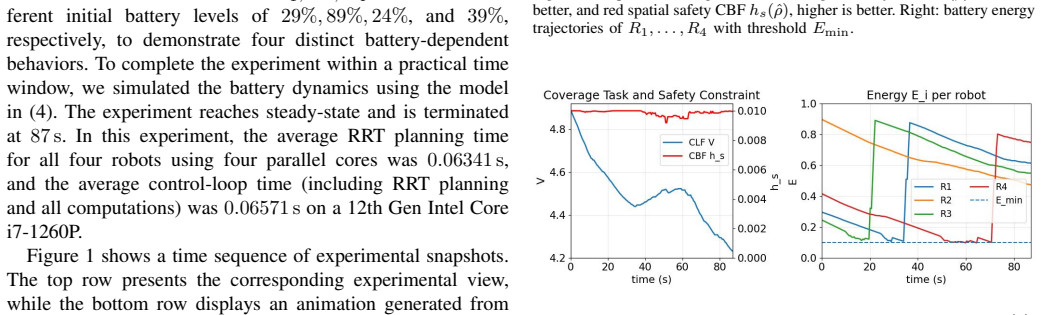
- Simulations and hardware experiments confirm that the guarantees hold when localization error and motion noise are present.
Where Pith is reading between the lines
- The same density-level formulation could be reused for tasks where the target distribution itself changes slowly, such as herding or environmental remediation.
- Because the optimization operates on the continuum model rather than individual agents, the approach may scale to hundreds of robots without a combinatorial explosion in computation.
- Extensions to three-dimensional domains or time-varying obstacles would require only re-deriving the barrier functions while keeping the quadratic-program skeleton intact.
Load-bearing premise
The average effect of many robots moving randomly can be captured exactly by a Fokker-Planck equation at the density level, and the resulting optimization stays feasible and solvable quickly enough in real conditions to preserve the safety and energy guarantees.
What would settle it
Deploy the controller on physical robots and check whether measured densities deviate persistently from targets, whether any robot enters an obstacle region, or whether the team fails to complete scheduled charging cycles under realistic localization noise.
Figures


read the original abstract
This paper presents a novel density control framework for multi-robot systems with spatial safety and energy sustainability guarantees. Stochastic robot motion is encoded through the Fokker-Planck Partial Differential Equation (PDE) at the density level. Control Lyapunov and control barrier functions are integrated with PDEs to enforce target density tracking, obstacle region avoidance, and energy sufficiency over multiple charging cycles. The resulting quadratic program enables fast in-the-loop implementation that adjusts commands in real-time. Multi-robot experiment and extensive simulations were conducted to demonstrate the effectiveness of the controller under localization and motion uncertainties.
Editorial analysis
A structured set of objections, weighed in public.
Referee Report
Summary. The paper presents a density control framework for multi-robot systems in which stochastic motion is modeled at the continuum level via the Fokker-Planck PDE. Control Lyapunov and control barrier functions are combined with the PDE inside a quadratic program that enforces target density tracking, obstacle-region avoidance, and energy sufficiency across multiple charging cycles. The resulting QP is solved in real time to generate robot commands, and the approach is validated on hardware with multiple robots as well as in extensive simulations that include localization and motion noise.
Significance. If the stated guarantees hold, the work supplies a scalable, formally grounded method for long-duration multi-robot autonomy that operates directly on density fields rather than individual trajectories. The explicit incorporation of energy constraints over repeated charging cycles and the real-time QP implementation address practical deployment needs that are rarely treated together in the literature. The hardware experiments under realistic uncertainty provide concrete evidence of feasibility and constitute a strength of the manuscript.
minor comments (4)
- [§2.2] §2.2: the Fokker-Planck operator is written with a diffusion coefficient D that is stated to be constant, yet the subsequent QP formulation treats D as possibly state-dependent; a single consistent definition would remove ambiguity.
- [§4.1] §4.1, Eq. (12): the discretization of the PDE into the finite-dimensional QP is presented without an explicit error bound or convergence statement as mesh size tends to zero; adding a brief remark on the approximation quality would strengthen the link between the continuous guarantees and the implemented controller.
- [Figure 5] Figure 5: the time-series plots of density error and energy level would benefit from shaded uncertainty bands derived from the repeated trials rather than single-run traces, making the robustness claim visually clearer.
- The reference list omits several recent works on PDE-based swarm control (e.g., papers on mean-field games for robotics); adding two or three citations would better situate the contribution.
Simulated Author's Rebuttal
We thank the referee for the positive summary, recognition of the work's significance, and recommendation for minor revision. The assessment of the PDE-constrained QP framework, energy sustainability over charging cycles, and hardware validation under uncertainty is appreciated. No specific major comments were provided in the report.
Circularity Check
No significant circularity in derivation chain
full rationale
The paper's central construction integrates the Fokker-Planck PDE for stochastic density evolution with standard Control Lyapunov and Control Barrier functions inside a quadratic program. This yields real-time commands enforcing density tracking, obstacle avoidance, and multi-cycle energy constraints. No equations or steps reduce by construction to fitted inputs, self-referential definitions, or load-bearing self-citations; the framework applies established PDE modeling and CLF/CBF theory without renaming empirical patterns or smuggling ansatzes via prior author work. The claimed guarantees rest on the external mathematical properties of these tools rather than on any internal fit or tautology, rendering the derivation self-contained.
Axiom & Free-Parameter Ledger
axioms (3)
- domain assumption Fokker-Planck PDE accurately captures the evolution of robot probability density under stochastic motion and control inputs
- standard math Control Lyapunov functions can be constructed to guarantee asymptotic tracking of a target density
- standard math Control barrier functions can be used to enforce forward invariance of safe sets for the density field
Forward citations
Cited by 1 Pith paper
-
Safe and Energy-Aware Decentralized PDE-Constrained Optimization-Based Control of Multi-UAVs for Persistent Wildfire Suppression
A decentralized optimization-based controller for multi-UAV wildfire suppression ensures safety and energy sufficiency using control Lyapunov and barrier functions under uncertainties.
Reference graph
Works this paper leans on
-
[1]
Autonomous mobile robot for transporting goods in warehouse and production,
O. W. Xuan, H. Selamat, and M. T. Muslim, “Autonomous mobile robot for transporting goods in warehouse and production,” inAdvances in Intelligent Manufacturing and Robotics, A. Tan, F. Zhu, H. Jiang, K. Mostafa, E. H. Yap, L. Chen, L. J. A. Olule, and H. Myung, Eds. Singapore: Springer Nature Singapore, 2024, pp. 555–565
2024
-
[2]
Swarm robotics in a sustainable warehouse automation: Opportunities, challenges and solutions,
O. M. Ikumapayi, O. T. Laseinde, R. R. Elewa, T. S. Ogedengbe, and E. T. Akinlabi, “Swarm robotics in a sustainable warehouse automation: Opportunities, challenges and solutions,” inE3S Web of Conferences, vol. 552. EDP Sciences, 2024, p. 01080
2024
-
[3]
Swarm robotics control and communica- tions: Imminent challenges for next generation smart logistics,
J. Wen, L. He, and F. Zhu, “Swarm robotics control and communica- tions: Imminent challenges for next generation smart logistics,”IEEE Communications Magazine, vol. 56, no. 7, pp. 102–107, 2018
2018
-
[4]
Pandemic-driven acceptance of urban drone deliveries,
K. F. Yuen, L. Cai, S. C. K. Wee, and X. Wang, “Pandemic-driven acceptance of urban drone deliveries,”Transport Policy, vol. 146, pp. 356–370, 2024. [Online]. Available: https://www.sciencedirect.com/ science/article/pii/S0967070X23003359
2024
-
[5]
Optimal control of the fokker-planck equation under state constraints in the wasserstein space,
S. Daudin, “Optimal control of the fokker-planck equation under state constraints in the wasserstein space,”Journal de Math ´ematiques Pures et Appliqu ´ees, vol. 175, pp. 37–75, 2023. [Online]. Available: https://www.sciencedirect.com/science/article/pii/S0021782423000594
2023
-
[6]
Existence and uniqueness for mean field games with state constraints,
P. Cannarsa and R. Capuani, “Existence and uniqueness for mean field games with state constraints,”PDE models for multi-agent phenomena, pp. 49–71, 2018
2018
-
[7]
Optimal control of quasilinear parabolic pdes with state-constraints,
F. Hoppe and I. Neitzel, “Optimal control of quasilinear parabolic pdes with state-constraints,”SIAM Journal on Control and Optimization, vol. 60, no. 1, pp. 330–354, 2022. [Online]. Available: https: //doi.org/10.1137/20M1383951
-
[8]
Safety barrier certificates for collisions-free multirobot systems,
L. Wang, A. D. Ames, and M. Egerstedt, “Safety barrier certificates for collisions-free multirobot systems,”IEEE Transactions on Robotics, vol. 33, no. 3, pp. 661–674, 2017
2017
-
[9]
Control barrier functions: Theory and applications,
A. D. Ames, S. Coogan, M. Egerstedt, G. Notomista, K. Sreenath, and P. Tabuada, “Control barrier functions: Theory and applications,” in2019 18th European Control Conference (ECC), 2019, pp. 3420–3431
2019
-
[10]
Control input design for a robot swarm maintaining safety distances in crowded environment,
Y . Origane, Y . Hattori, and D. Kurabayashi, “Control input design for a robot swarm maintaining safety distances in crowded environment,” Symmetry, vol. 13, no. 3, p. 478, 2021
2021
-
[11]
Persistification of robotic tasks,
G. Notomista and M. Egerstedt, “Persistification of robotic tasks,”IEEE Transactions on Control Systems Technology, vol. 29, no. 2, pp. 756– 767, 2020
2020
-
[12]
Energy autonomy for robot systems with constrained resources,
H. Fouad and G. Beltrame, “Energy autonomy for robot systems with constrained resources,”IEEE Transactions on Robotics, vol. 38, no. 6, pp. 3675–3693, 2022
2022
-
[13]
Energy-aware coordination of hetero- geneous robotic systems with mobile charging stations for long-term environmental monitoring,
A. Nasif and G. Notomista, “Energy-aware coordination of hetero- geneous robotic systems with mobile charging stations for long-term environmental monitoring,” in2025 33rd Mediterranean Conference on Control and Automation (MED), 2025, pp. 478–483
2025
-
[14]
Decentralized density control of multi- robot systems using pde-constrained optimization,
L. Niu and G. Notomista, “Decentralized density control of multi- robot systems using pde-constrained optimization,”IEEE Robotics and Automation Letters, vol. 10, no. 4, pp. 4045–4052, 2025
2025
-
[15]
Development and application of coverage control algorithms: A concise review,
B. Cheng, M. He, Z. Zhu, B. He, and J. Chen, “Development and application of coverage control algorithms: A concise review,”IEEE Transactions on Automation Science and Engineering, vol. 22, pp. 14 906–14 927, 2025
2025
-
[16]
A cov- erage control-based idle vehicle rebalancing approach for autonomous mobility-on-demand systems,
P. Zhu, I. I. Sirmatel, G. Ferrari-Trecate, and N. Geroliminis, “A cov- erage control-based idle vehicle rebalancing approach for autonomous mobility-on-demand systems,”IEEE Transactions on Control Systems Technology, vol. 32, no. 5, pp. 1839–1853, 2024
2024
-
[17]
Robust optimal density control of robotic swarms,
C. Sinigaglia, A. Manzoni, F. Braghin, and S. Berman, “Robust optimal density control of robotic swarms,”Automatica, vol. 176, p. 112218, 2025
2025
-
[18]
Formation control of multia- gent system based on higher order partial differential equations,
K. Yamaguchi, T. Endo, and F. Matsuno, “Formation control of multia- gent system based on higher order partial differential equations,”IEEE Transactions on Control Systems Technology, vol. 30, no. 2, pp. 570– 582, 2022
2022
-
[19]
Boundary control for stability and invariance of traffic flow dynamics: A convex optimization approach,
M. T. Chiri, R. Guglielmi, and G. Notomista, “Boundary control for stability and invariance of traffic flow dynamics: A convex optimization approach,”IEEE Control Systems Letters, vol. 9, pp. 1333–1338, 2025
2025
-
[20]
Discretization-robust safety barrier of partial differential equation,
Y . Park and C. Sloth, “Discretization-robust safety barrier of partial differential equation,” in2023 11th International Conference on Control, Mechatronics and Automation (ICCMA), 2023, pp. 49–54
2023
-
[21]
Safe pde backstepping qp control with high relative degree cbfs: Stefan model with actuator dynamics,
S. Koga and M. Krstic, “Safe pde backstepping qp control with high relative degree cbfs: Stefan model with actuator dynamics,”IEEE Transactions on Automatic Control, vol. 68, no. 12, pp. 7195–7208, 2023
2023
-
[22]
L. Niu and G. Notomista, “Safe decentralized density control of multi-robot systems using pde-constrained optimization with state constraints,” 2025, presented at the IEEE International Symposium on Multi-Robot and Multi-Agent Systems (MRS), 2025. [Online]. Available: https://arxiv.org/abs/2510.20643
work page internal anchor Pith review Pith/arXiv arXiv 2025
-
[23]
A fokker–planck control framework for multidimensional stochastic processes,
M. Annunziato and A. Borz `ı, “A fokker–planck control framework for multidimensional stochastic processes,”Journal of Computational and Applied Mathematics, vol. 237, no. 1, pp. 487–507, 2013
2013
-
[24]
Decentralized safe multi-agent stochastic optimal control using deep FBSDEs and ADMM,
M. A. Pereira, A. D. Saravanos, O. So, and E. A. Theodorou, “Decentralized safe multi-agent stochastic optimal control using deep fbsdes and admm,” 2022. [Online]. Available: https://arxiv.org/abs/ 2202.10658
-
[25]
Dynamical density functional theory for interacting brownian particles: stochastic or deterministic?
A. J. Archer and M. Rauscher, “Dynamical density functional theory for interacting brownian particles: stochastic or deterministic?”Journal of Physics A, vol. 37, pp. 9325–9333, 2004
2004
-
[26]
Task persistification for robots with control-dependent energy dynamics,
C. J. Cortes and M. Egerstedt, “Task persistification for robots with control-dependent energy dynamics,” in2022 International Conference on Robotics and Automation (ICRA). IEEE, 2022, pp. 128–134
2022
-
[27]
Kinodynamic planning,
E. Schmerling and M. Pavone, “Kinodynamic planning,” inEncyclope- dia of Robotics. Springer, 2019
2019
-
[28]
Completeness of randomized kinodynamic planners with state-based steering,
S. Caron, Q.-C. Pham, and Y . Nakamura, “Completeness of randomized kinodynamic planners with state-based steering,”Robotics and Autonomous Systems, vol. 89, pp. 85–94, 2017. [Online]. Available: https://www.sciencedirect.com/science/article/pii/S0921889015302190
2017
-
[29]
[Online]
MOSEK ApS,MOSEK Fusion API for Python 10.2.16, 2024. [Online]. Available: https://docs.mosek.com/10.2/pythonfusion/index.html
2024
-
[30]
[Online]
DJI,RoboMaster S1 User Manual, DJI, 2020, accessed: 2026- 02-26. [Online]. Available: https://www.dji.com/ca/downloads/products/ robomaster-s1#doc
2020
-
[31]
Vicon Motion Systems Ltd.,Vicon Nexus User Guide, Vicon Motion Systems Ltd., 2024, accessed: 2026-02-
2024
-
[32]
Available: https://help.vicon.com/download/attachments/ 11611993/Vicon%20Nexus%20User%20Guide.pdf
[Online]. Available: https://help.vicon.com/download/attachments/ 11611993/Vicon%20Nexus%20User%20Guide.pdf
discussion (0)
Sign in with ORCID, Apple, or X to comment. Anyone can read and Pith papers without signing in.