Recognition: unknown
Dark solitons in nonlinear Su-Schrieffer-Heeger lattices
Pith reviewed 2026-05-10 07:58 UTC · model grok-4.3
The pith
Dark solitons in nonlinear SSH lattices maintain intensity dips unaffected by the linear band structure.
A machine-rendered reading of the paper's core claim, the machinery that carries it, and where it could break.
Core claim
The paper finds that dark solitons in nonlinear SSH lattices, whether in the bulk or at edges and in semi-infinite or finite gaps, always keep their intensity dip intact and independent of the original linear lattice's band structure. Although generally dynamically unstable, certain types become linearly stable when intracell coupling greatly exceeds intercell coupling.
What carries the argument
Dark soliton solutions on the nonlinear SSH lattice with constant nonzero background and intensity dip, whose profile is set by the balance between Kerr nonlinearity and the lattice couplings.
If this is right
- The intensity dip of dark solitons is preserved across different gap positions and locations in the lattice.
- Linear stability is achieved specifically when intracell coupling dominates over intercell coupling.
- Dark solitons can be realized both in the bulk and at the edges of the lattice.
- The preservation of the dip holds regardless of the specific type of dark soliton identified.
Where Pith is reading between the lines
- If the dip preservation is general, it may apply to other nonlinear topological lattices beyond SSH.
- Experimentally, this could allow designing intensity-modulating solitons in photonic structures where band structure effects are minimized.
- Further study could examine how changing the nonlinearity type affects the dip preservation.
Load-bearing premise
The discrete lattice model with Kerr nonlinearity accurately represents the physical system; different nonlinearities or dominant continuous effects could alter the stability and gap placements.
What would settle it
A numerical simulation or experiment in which the intensity dip of a dark soliton visibly changes when the linear coupling parameters are varied while keeping the nonlinearity fixed.
Figures





read the original abstract
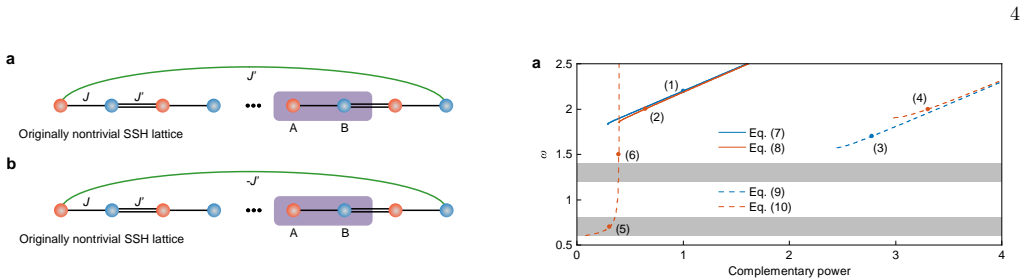
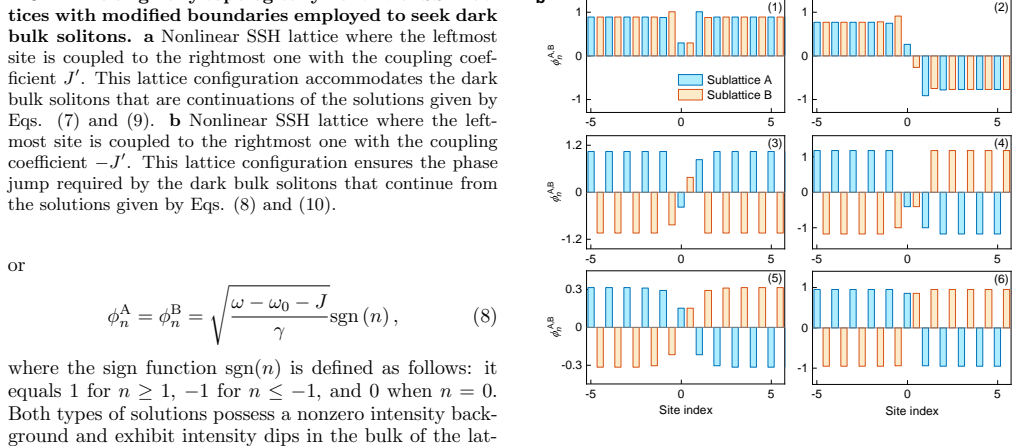
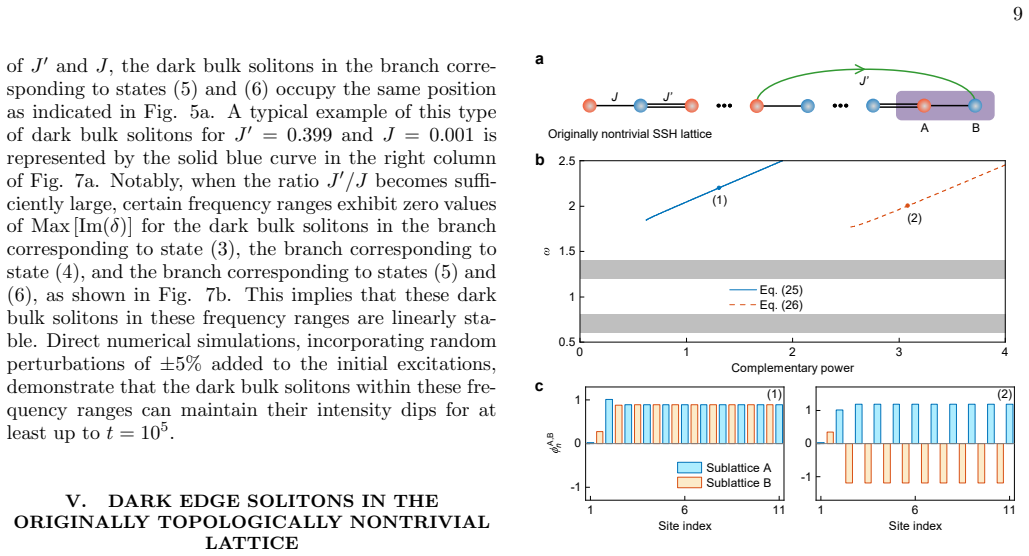
The introduction of nonlinearities into lattices with topological band structures has led to the discovery of various types of solitons. The Su-Schrieffer-Heeger (SSH) lattice, as the most fundamental topological model, has been extended into the nonlinear regime. In particular, nonlinear edge states and bulk solitons exhibiting intensity humps against a zero background have been extensively studied in nonlinear SSH lattices. In this paper, we systematically investigate dark solitons in nonlinear SSH lattices. These dark solitons maintain a nonzero and constant background, featuring intensity dips either in the bulk of the lattice or at its edges, and residing spectrally in the semi-infinite gap or the middle finite gap. Regardless of the specific type of dark soliton, the intensity dip remains wellpreserved and is not affected by the band structure of the original linear lattice. Although the dark solitons we have identified are generally dynamically unstable across a broad range of parameters, several types exhibit linear stability when the intracell coupling is much larger than the intercell coupling. Our findings may provide valuable insights for the exploration of novel types of solitons in nonlinear topological lattices.
Editorial analysis
A structured set of objections, weighed in public.
Referee Report
Summary. The manuscript numerically investigates dark solitons in nonlinear Su-Schrieffer-Heeger (SSH) lattices with Kerr nonlinearity. These solitons feature a nonzero constant background with intensity dips located either in the bulk or at the edges, residing in the semi-infinite gap or the middle finite gap. The central claims are that the intensity dip remains well preserved and is independent of the linear band structure for all identified types, and that while most such solitons are dynamically unstable, several types exhibit linear stability when the intracell coupling is much larger than the intercell coupling.
Significance. If the numerical constructions and stability results hold under scrutiny, the work extends prior studies of bright solitons and nonlinear edge states in SSH lattices to the dark-soliton regime. The reported parameter window for linear stability and the claimed decoupling of the dip depth from the linear spectrum could provide useful benchmarks for experiments in photonic lattices or related discrete nonlinear systems.
major comments (2)
- [Results and Methods] The abstract and results sections present existence, gap location, and stability findings from numerical continuation and linearization without any reported error bars, grid-convergence tests, or explicit values for the discretization step and iteration tolerances; this absence makes it impossible to gauge the quantitative reliability of the intensity-dip preservation claim and the stability window.
- [Results] The statement that the intensity dip 'is not affected by the band structure of the original linear lattice' is presented as a general numerical observation, yet no explicit comparison (e.g., varying the linear coupling ratio while holding nonlinearity fixed and tracking dip depth) or supporting figure is referenced; without this, the claim risks being an artifact of the chosen parameter slices.
minor comments (2)
- [Abstract] The abstract contains the typographical error 'wellpreserved' (should be 'well preserved').
- [Introduction and Results] Notation for the intracell and intercell couplings (presumably t1 and t2 or similar) should be defined at first use and kept consistent throughout the text and figures.
Simulated Author's Rebuttal
We thank the referee for the positive assessment of our manuscript and the constructive comments, which help improve the clarity and rigor of the numerical results. We address each major comment point by point below.
read point-by-point responses
-
Referee: [Results and Methods] The abstract and results sections present existence, gap location, and stability findings from numerical continuation and linearization without any reported error bars, grid-convergence tests, or explicit values for the discretization step and iteration tolerances; this absence makes it impossible to gauge the quantitative reliability of the intensity-dip preservation claim and the stability window.
Authors: We agree that providing explicit numerical details will strengthen the manuscript. In the revised version we will add a short paragraph in the Methods section specifying the lattice size (typically 101 sites with periodic or open boundaries as appropriate), the continuation step size in the propagation constant, the Newton iteration tolerance (10^{-10}), and the eigenvalue solver precision. We have performed grid-convergence checks by doubling the lattice size and confirming that soliton profiles, dip depths, and stability eigenvalues remain unchanged to within 10^{-8}; these tests will be summarized in the text. Although formal error bars are not applicable to deterministic stationary solutions, the reported convergence criteria will allow readers to assess reliability. revision: yes
-
Referee: [Results] The statement that the intensity dip 'is not affected by the band structure of the original linear lattice' is presented as a general numerical observation, yet no explicit comparison (e.g., varying the linear coupling ratio while holding nonlinearity fixed and tracking dip depth) or supporting figure is referenced; without this, the claim risks being an artifact of the chosen parameter slices.
Authors: The observation that the dip depth remains constant was obtained by examining multiple soliton families across the semi-infinite and finite gaps for several values of the coupling ratio. To make this explicit and eliminate any concern about parameter selection, we will insert a new panel (or inset) in the appropriate results figure that plots dip depth versus the intracell-to-intercell coupling ratio at fixed nonlinearity strength. The accompanying text will briefly describe the procedure and confirm the independence from the linear band structure. revision: yes
Circularity Check
No significant circularity
full rationale
The paper reports numerical construction of dark soliton profiles via the stationary nonlinear SSH equations, followed by linear stability analysis through eigenvalue computation and direct dynamical simulations. These steps are standard computational procedures whose outputs (soliton shapes, stability windows, intensity dip preservation) are not forced by construction from fitted parameters or prior self-citations. No load-bearing step reduces to a self-definition, renamed ansatz, or uniqueness theorem imported from the authors' own prior work. The central claims are presented as direct results of the numerics rather than analytic derivations that presuppose their own conclusions.
Axiom & Free-Parameter Ledger
Reference graph
Works this paper leans on
-
[1]
C. L. Kane and E. J. Mele, Quantum Spin Hall Effect in Graphene, Phys. Rev. Lett. 95, 226801 (2005)
2005
-
[2]
K¨ onig, S
M. K¨ onig, S. Wiedmann, C. Br¨ une, A. Roth, H. Buh- mann, L. W. Molenkamp, X.-L. Qi, and S.-C. Zhang, Quantum Spin Hall Insulator State in HgTe Quantum Wells, Science 318, 766 (2007)
2007
-
[3]
M. Z. Hasan and C. L. Kane, Colloquium: Topological insulators, Rev. Mod. Phys. 82, 3045 (2010)
2010
-
[4]
Qi and S.-C
X.-L. Qi and S.-C. Zhang, Topological insulators and superconductors, Rev. Mod. Phys. 83, 1057 (2011)
2011
-
[5]
Tang and X
F. Tang and X. Wan, Group-theoretical study of band nodes and the emanating nodal structures in crystalline materials, Quantum Front. 3, 14 (2024)
2024
-
[6]
G.-Q. Zhao, S. Li, W. B. Rui, C. M. Wang, H.-Z. Lu, and X. C. Xie, 3D quantum Hall effect in a topological nodal-ring semimetal, Quantum Front. 2, 22 (2023)
2023
-
[7]
F. Zhan, R. Chen, Z. Ning, D.-S. Ma, Z. Wang, D.- H. Xu, and R. Wang, Perspective: Floquet engineering topological states from effective models towards realistic materials, Quantum Front. 3, 21 (2024)
2024
-
[8]
G. Ma, M. Xiao, and C. T. Chan, Topological phases in acoustic and mechanical systems, Nat. Rev. Phys. 1, 281 (2019)
2019
-
[9]
H. Xue, Y. Yang, and B. Zhang, Topological acoustics, Nat. Rev. Mater. 7, 974 (2022). 14
2022
-
[10]
Z.-K. Lin, Q. Wang, Y. Liu, H. Xue, B. Zhang, Y. Chong, and J.-H. Jiang, Topological phenomena at de- fects in acoustic, photonic and solid-state lattices, Nat. Rev. Phys. 5, 483 (2023)
2023
-
[11]
T. Shah, C. Brendel, V. Peano, and F. Marquardt, Colloquium: Topologically protected transport in engi- neered mechanical systems, Rev. Mod. Phys. 96, 021002 (2024)
2024
-
[12]
Y. Liu, K. Li, W. Liu, Z. Zhang, Y. Cheng, and X. Liu, Observation of chiral Landau levels in two-dimensional acoustic system, Quantum Front. 3, 26 (2024)
2024
-
[13]
W. Zhu, W. Deng, Y. Liu, J. Lu, H.-X. Wang, Z.-K. Lin, X. Huang, J.-H. Jiang, and Z. Liu, Topological phononic metamaterials, Rep. Prog. Phys. 86, 106501 (2023)
2023
-
[14]
N. R. Cooper, J. Dalibard, and I. B. Spielman, Topo- logical bands for ultracold atoms, Rev. Mod. Phys. 91, 015005 (2019)
2019
-
[15]
Goldman, J
N. Goldman, J. C. Budich, and P. Zoller, Topological quantum matter with ultracold gases in optical lattices, Nature Phys. 12, 639 (2016)
2016
-
[16]
M. C. Rechtsman, J. M. Zeuner, Y. Plotnik, Y. Lumer, D. Podolsky, F. Dreisow, S. Nolte, M. Segev, and A. Szameit, Photonic Floquet topological insulators, Na- ture 496, 196 (2013)
2013
-
[17]
Ozawa, H
T. Ozawa, H. M. Price, A. Amo, N. Goldman, M. Hafezi, L. Lu, M. C. Rechtsman, D. Schuster, J. Simon, O. Zilberberg, and I. Carusotto, Topological Photonics, Rev. Mod. Phys. 91, 015006 (2019)
2019
-
[18]
M. Kim, Z. Jacob, and J. Rho, Recent advances in 2D, 3D and higher-order topological photonics, Light: Sci- ence & Applications 9, 1 (2020)
2020
-
[19]
Yang, J.-S
M. Yang, J.-S. Xu, C.-F. Li, and G.-C. Guo, Simulat- ing topological materials with photonic synthetic dimen- sions in cavities, Quantum Front. 1, 10 (2022)
2022
-
[20]
Liu, G.-G
J.-W. Liu, G.-G. Liu, and B. Zhang, Three-dimensional Topological Photonic Crystals (Invited Review), PIER 181, 99 (2024)
2024
-
[21]
Z. Guo, Y. Wang, S. Ke, X. Su, J. Ren, and H. Chen, 1D Photonic Topological Insulators Composed of Split Ring Resonators: A Mini Review, Advanced Physics Research 2300125 (2023)
2023
-
[22]
H. Yang, L. Song, Y. Cao, and P. Yan, Circuit real- ization of topological physics, Physics Reports 1093, 1 (2024)
2024
-
[23]
Sahin, M
H. Sahin, M. B. A. Jalil, and C. H. Lee, Topolectri- cal circuits—Recent experimental advances and devel- opments, APL Electronic Devices 1, 021503 (2025)
2025
-
[24]
R. Li, B. Lv, H. Tao, J. Shi, Y. Chong, B. Zhang, and H. Chen, Ideal type-II Weyl points in topological circuits, National Science Review 8, nwaa192 (2021)
2021
-
[25]
S. A. Hassani Gangaraj, C. Valagiannopoulos, and F. Monticone, Topological scattering resonances at ul- tralow frequencies, Phys. Rev. Research 2, 023180 (2020)
2020
-
[26]
Smirnova, D
D. Smirnova, D. Leykam, Y. Chong, and Y. Kivshar, Nonlinear topological photonics, Appl. Phys. Rev. 7, 021306 (2020)
2020
-
[27]
Szameit and M
A. Szameit and M. C. Rechtsman, Discrete nonlinear topological photonics, Nat. Phys. 20, 905 (2024)
2024
-
[28]
M. J. Ablowitz, C. W. Curtis, and Y.-P. Ma, Linear and nonlinear traveling edge waves in optical honeycomb lat- tices, Phys. Rev. A 90, 023813 (2014)
2014
-
[29]
Lumer, M
Y. Lumer, M. C. Rechtsman, Y. Plotnik, and M. Segev, Instability of bosonic topological edge states in the pres- ence of interactions, Phys. Rev. A 94, 021801 (2016)
2016
-
[30]
Y. V. Kartashov and D. V. Skryabin, Modulational in- stability and solitary waves in polariton topological in- sulators, Optica 3, 1228 (2016)
2016
-
[31]
Y. V. Kartashov and D. V. Skryabin, Bistable Topolog- ical Insulator with Exciton-Polaritons, Phys. Rev. Lett. 119, 253904 (2017)
2017
-
[32]
Tuloup, R
T. Tuloup, R. W. Bomantara, C. H. Lee, and J. Gong, Nonlinearity induced topological physics in momentum space and real space, Phys. Rev. B 102, 115411 (2020)
2020
-
[33]
M. Guo, S. Xia, N. Wang, D. Song, Z. Chen, and J. Yang, Weakly nonlinear topological gap solitons in Su- Schrieffer-Heeger photonic lattices, Opt. Lett. 45, 6466 (2020)
2020
-
[34]
Pernet, P
N. Pernet, P. St-Jean, D. D. Solnyshkov, G. Malpuech, N. C. Zambon, Q. Fontaine, B. Real, O. Jamadi, A. Lemaˆ ıtre, M. Morassi, L. L. Gratiet, T. Baptiste, A. Harouri, I. Sagnes, A. Amo, S. Ravets, and J, Bloch, Gap solitons in a one-dimensional driven-dissipative topological lattice, Nat. Phys. 18, 678 (2022)
2022
-
[35]
Y. V. Kartashov et al., Observation of Edge Solitons in Topological Trimer Arrays, Phys. Rev. Lett. 128, 093901 (2022)
2022
-
[36]
Ma and H
Y.-P. Ma and H. Susanto, Topological edge solitons and their stability in a nonlinear Su-Schrieffer-Heeger model, Phys. Rev. E 104, 054206 (2021)
2021
-
[37]
R. Li, X. Kong, W. Wang, Y. Wang, Y. Jia, H. Tao, P. Li, Y. Liu, and B. A. Malomed, Observation of edge solitons and transitions between them in a trimer circuit lattice, Commun. Phys. 8, 342 (2025)
2025
-
[38]
Leykam and Y
D. Leykam and Y. D. Chong, Edge Solitons in Nonlinear-Photonic Topological Insulators, Phys. Rev. Lett. 117, 143901 (2016)
2016
-
[39]
S. K. Ivanov, Y. V. Kartashov, A. Szameit, L. Torner, and V. V. Konotop, Vector Topological Edge Solitons in Floquet Insulators, ACS Photonics 7, 735 (2020)
2020
-
[40]
Zhang, R
Z. Zhang, R. Wang, Y. Zhang, Y. V. Kartashov, F. Li, H. Zhong, H. Guan, K. Gao, F. Li, Y. Zhang, and M. Xiao, Observation of edge solitons in photonic graphene, Nat. Commun. 11, 1902 (2020)
1902
-
[41]
Mukherjee and M
S. Mukherjee and M. C. Rechtsman, Observation of Uni- directional Solitonlike Edge States in Nonlinear Floquet Topological Insulators, Phys. Rev. X 11, 041057 (2021)
2021
-
[42]
S. K. Ivanov, Y. V. Kartashov, M. Heinrich, A. Sza- meit, L. Torner, and V. V. Konotop, Topological dipole Floquet solitons, Phys. Rev. A 103, 053507 (2021)
2021
-
[43]
Z. Shi, M. Zuo, H. Li, D. Preece, Y. Zhang, and Z. Chen, Topological Edge States and Solitons on a Dynamically Tunable Domain Wall of Two Opposing Helical Waveg- uide Arrays, ACS Photonics 8, 1077 (2021)
2021
-
[44]
Ezawa, Nonlinearity-induced chiral solitonlike edge states in Chern systems, Phys
M. Ezawa, Nonlinearity-induced chiral solitonlike edge states in Chern systems, Phys. Rev. B 106, 195423 (2022)
2022
-
[45]
M. S. Kirsch, Y. Zhang, M. Kremer, L. J. Maczewsky, S. K. Ivanov, Y. V. Kartashov, L. Torner, D. Bauer, A. Szameit, and M. Heinrich, Nonlinear second-order pho- tonic topological insulators, Nat. Phys. 17, 995 (2021)
2021
-
[46]
Lumer, Y
Y. Lumer, Y. Plotnik, M. C. Rechtsman, and M. Segev, Self-Localized States in Photonic Topological Insula- tors, Phys. Rev. Lett. 111, 243905 (2013)
2013
-
[47]
D. D. Solnyshkov, O. Bleu, B. Teklu, and G. Malpuech, Chirality of Topological Gap Solitons in Bosonic Dimer Chains, Phys. Rev. Lett. 118, 023901 (2017). 15
2017
-
[48]
A. N. Poddubny and D. A. Smirnova, Ring Dirac soli- tons in nonlinear topological systems, Phys. Rev. A 98, 013827 (2018)
2018
-
[49]
D. A. Smirnova, L. A. Smirnov, D. Leykam, and Y. S. Kivshar, Topological Edge States and Gap Solitons in the Nonlinear Dirac Model, Laser & Photonics Reviews 13, 1900223 (2019)
2019
-
[50]
J. L. Marzuola, M. Rechtsman, B. Osting, and M. Ban- dres, Bulk soliton dynamics in bosonic topological insu- lators, arXiv:1904.10312 (2019)
work page internal anchor Pith review Pith/arXiv arXiv 1904
-
[51]
Mukherjee and M
S. Mukherjee and M. C. Rechtsman, Observation of Flo- quet solitons in a topological bandgap, Science 368, 856 (2020)
2020
-
[52]
R. Li, X. Kong, D. Hang, G. Li, H. Hu, H. Zhou, Y. Jia, P. Li, and Y. Liu, Topological bulk solitons in a nonlinear photonic Chern insulator, Commun. Phys. 5, 275 (2022)
2022
-
[53]
Zangeneh-Nejad and R
F. Zangeneh-Nejad and R. Fleury, Nonlinear Second- Order Topological Insulators, Phys. Rev. Lett. 123, 053902 (2019)
2019
-
[54]
Hohmann, T
H. Hohmann, T. Hofmann, T. Helbig, S. Imhof, H. Brand, L. K. Upreti, A. Stegmaier, A. Fritzsche, T. M¨ uller, U. Schwingenschl¨ ogl, C. H. Lee, M. Greiter, L. W. Molenkamp, T. Kießling, and R.Thomale, Observa- tion of Cnoidal Wave Localization in Nonlinear Topolec- tric Circuits, Phys. Rev. Research 5, L012041 (2023)
2023
-
[55]
Hadad, A
Y. Hadad, A. B. Khanikaev, and A. Al` u, Self-induced topological transitions and edge states supported by nonlinear staggered potentials, Phys. Rev. B 93, 155112 (2016)
2016
-
[56]
Hadad, J
Y. Hadad, J. C. Soric, A. B. Khanikaev, and A. Al` u, Self-induced topological protection in nonlinear circuit arrays, Nat. Electron. 1, 178 (2018)
2018
-
[57]
Wang, L.-J
Y. Wang, L.-J. Lang, C. H. Lee, B. Zhang, and Y. D. Chong, Topologically enhanced harmonic generation in a nonlinear transmission line metamaterial, Nat. Com- mun. 10, 1102 (2019)
2019
-
[58]
S. Kruk, A. Poddubny, D. Smirnova, L. Wang, A. Slobozhanyuk, A. Shorokhov, I. Kravchenko, B. Luther- Davies, and Y. Kivshar, Nonlinear light generation in topological nanostructures, Nature Nanotech. 14, 2 (2019)
2019
-
[59]
Shang, Y
C. Shang, Y. Zheng, and B. A. Malomed, Weyl solitons in three-dimensional optical lattices, Phys. Rev. A 97, 043602 (2018)
2018
-
[60]
B. Ren, H. Wang, V. O. Kompanets, Y. V. Kartashov, Y. Li, and Y. Zhang, Dark topological valley Hall edge solitons, Nanophotonics 10, 3559 (2021)
2021
-
[61]
S. K. Ivanov and Y. V. Kartashov, Floquet valley Hall edge solitons, Chaos, Solitons & Fractals 186, 115239 (2024)
2024
-
[62]
Y.-L. Tao, N. Dai, Y.-B. Yang, Q.-B. Zeng, and Y. Xu, Hinge solitons in three-dimensional second-order topo- logical insulators, New J. Phys. 22, 103058 (2020)
2020
- [63]
-
[64]
Huang, A
C. Huang, A. V. Kireev, Y. Jiang, V. O. Kompanets, C. Shang, Y. V. Kartashov, S. A. Zhuravitskii, N. N. Skryabin, I. V. Dyakonov, A. A. Kalinkin, S. P. Ku- lik, F. Ye, and V. N. Zadkov, Observation of nonlinear higher-order topological insulators with unconventional boundary truncations, Commun. Phys. 8, 451 (2025)
2025
-
[65]
R. Li, W. Wang, Y. Jia, Y. Liu, P. Li, and B. A. Malomed, Nonlinear quadrupole topological insulators, Chaos, Solitons and Fractals 207, 118044 (2026)
2026
-
[66]
D. A. Dobrykh, A. V. Yulin, A. P. Slobozhanyuk, A. N. Poddubny, and Yu. S. Kivshar, Nonlinear Control of Electromagnetic Topological Edge States, Phys. Rev. Lett. 121, 163901 (2018)
2018
-
[67]
Ezawa, Nonlinearity-induced transition in the non- linear Su-Schrieffer-Heeger model and a nonlinear higher-order topological system, Phys
M. Ezawa, Nonlinearity-induced transition in the non- linear Su-Schrieffer-Heeger model and a nonlinear higher-order topological system, Phys. Rev. B 104, 235420 (2021)
2021
-
[68]
S. Xia, D. Juki´ c, N. Wang, D. Smirnova, L. Smirnov, L. Tang, D. Song, A. Szameit, D. Leykam, J. Xu, Z. Chen, and H. Buljan, Nontrivial coupling of light into a defect: the interplay of nonlinearity and topology, Light Sci. Appl. 9, 147 (2020)
2020
-
[69]
S. Xia, D. Kaltsas, D. Song, I. Komis, J. Xu, A. Szameit, H. Buljan, K. G. Makris, and Z. Chen, Nonlinear tuning of PT symmetry and non-Hermitian topological states, Science 372, 72 (2021)
2021
-
[70]
Z. Hu, D. Bongiovanni, D. Juki´ c, E. Jajti´ c, S. Xia, D. Song, J. Xu, R. Morandotti, H. Buljan, and Z. Chen, Nonlinear control of photonic higher-order topological bound states in the continuum, Light Sci. Appl. 10, 164 (2021)
2021
-
[71]
J¨ org, M
C. J¨ org, M. J¨ urgensen, S. Mukherjee, and M. C. Rechts- man, Optical control of topological end states via soliton formation in a 1D lattice, Nanophotonics 14, 769 (2025)
2025
-
[72]
Bongiovanni, D
D. Bongiovanni, D. Juki´ c, Z. Hu, F. Luni´ c, Y. Hu, D. Song, R. Morandotti, Z. Chen, and H. Buljan, Dynam- ically Emerging Topological Phase Transitions in Non- linear Interacting Soliton Lattices, Phys. Rev. Lett. 127, 184101 (2021)
2021
-
[73]
Bai, J.-Z
K. Bai, J.-Z. Li, T.-R. Liu, L. Fang, D. Wan, and M. Xiao, Arbitrarily Configurable Nonlinear Topolog- ical Modes, Phys. Rev. Lett. 133, 116602 (2024)
2024
-
[74]
Sahin, H
H. Sahin, H. Akg¨ un, Z. B. Siu, S. M. Rafi-Ul-Islam, J. F. Kong, M. B. A. Jalil, and C. H. Lee, Protected Chaos in a Topological Lattice, Advanced Science 12, e03216 (2025)
2025
-
[75]
K. Sone, M. Ezawa, Z. Gong, T. Sawada, N. Yosh- ioka, and T. Sagawa, Transition from the topological to the chaotic in the nonlinear Su-Schrieffer-Heeger model, Nat. Commun. 16, 422 (2025)
2025
-
[76]
K. Sone, M. Ezawa, Y. Ashida, N. Yoshioka, and T. Sagawa, Nonlinearity-induced topological phase transi- tion characterized by the nonlinear Chern number, Nat. Phys. 20, 1164 (2024)
2024
-
[77]
J¨ urgensen, S
M. J¨ urgensen, S. Mukherjee, and M. C. Rechtsman, Quantized nonlinear Thouless pumping, Nature 596, 63 (2021)
2021
-
[78]
Q. Fu, P. Wang, Y. V. Kartashov, V. V. Konotop, and F. Ye, Nonlinear Thouless Pumping: Solitons and Transport Breakdown, Phys. Rev. Lett. 128, 154101 (2022)
2022
-
[79]
J¨ urgensen and M
M. J¨ urgensen and M. C. Rechtsman, Chern Number Governs Soliton Motion in Nonlinear Thouless Pumps, Phys. Rev. Lett. 128, 113901 (2022)
2022
-
[80]
Mostaan, F
N. Mostaan, F. Grusdt, and N. Goldman, Quantized topological pumping of solitons in nonlinear photonics and ultracold atomic mixtures, Nat. Commun. 13, 5997 (2022)
2022
discussion (0)
Sign in with ORCID, Apple, or X to comment. Anyone can read and Pith papers without signing in.