Recognition: unknown
Neuromorphic Parameter Estimation for Power Converter Health Monitoring Using Spiking Neural Networks
Pith reviewed 2026-05-10 08:07 UTC · model grok-4.3
The pith
Spiking neural networks estimate power converter parameters more accurately than standard networks while projecting 270 times lower energy use on neuromorphic hardware.
A machine-rendered reading of the paper's core claim, the machinery that carries it, and where it could break.
Core claim
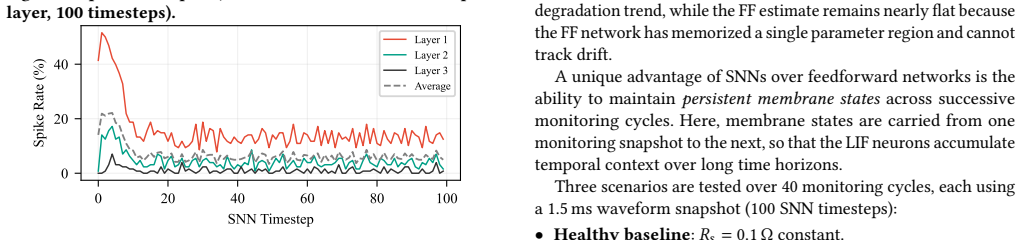
A three-layer leaky integrate-and-fire spiking neural network, trained by decoupling its unrolled dynamics from a differentiable ODE solver that enforces physics consistency, reduces lumped resistance estimation error from 25.8 percent to 10.2 percent on an EMI-corrupted buck converter benchmark. The same architecture projects a roughly 270-fold energy reduction on neuromorphic hardware, maintains 93 percent spike sparsity, and detects abrupt faults through a 5.5 percentage-point increase in spike rate.
What carries the argument
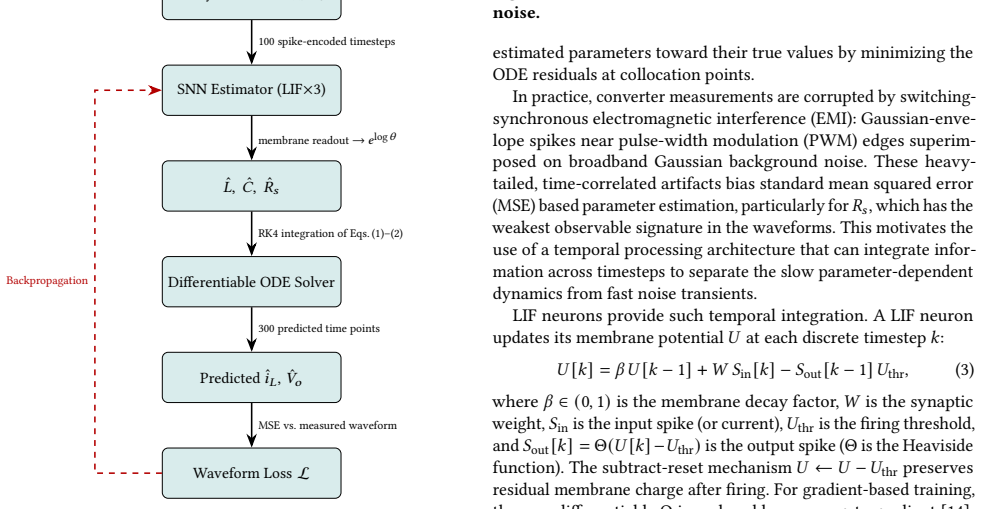
A three-layer leaky integrate-and-fire spiking neural network whose persistent membrane states carry slow degradation information, trained by separating the spiking loop from an ODE-based physics loss.
If this is right
- Parameter estimates fall inside the plus or minus 10 percent manufacturing tolerance of real passive components.
- Persistent membrane potentials enable continuous tracking of gradual component degradation without extra computation.
- An abrupt jump in spike rate flags sudden faults such as component failure.
- 93 percent spike sparsity makes the model suitable for always-on deployment on chips like Loihi 2.
Where Pith is reading between the lines
- The same decoupling technique could be applied to parameter estimation in other noisy sensor-rich systems such as motor drives or battery packs.
- If the energy projections hold on real hardware, continuous converter monitoring becomes feasible in battery-powered or remote industrial installations.
- Persistent state tracking might generalize to event-driven fault isolation across multiple converter topologies.
Load-bearing premise
That separating the spiking dynamics from the ODE physics loss during training produces parameter estimates that stay unbiased and fully consistent with the circuit model.
What would settle it
Running the trained spiking network on physical converter hardware under measured EMI levels and checking whether resistance estimates remain within 10 percent error while actual power draw on neuromorphic silicon matches the projected 270-fold reduction.
Figures




read the original abstract
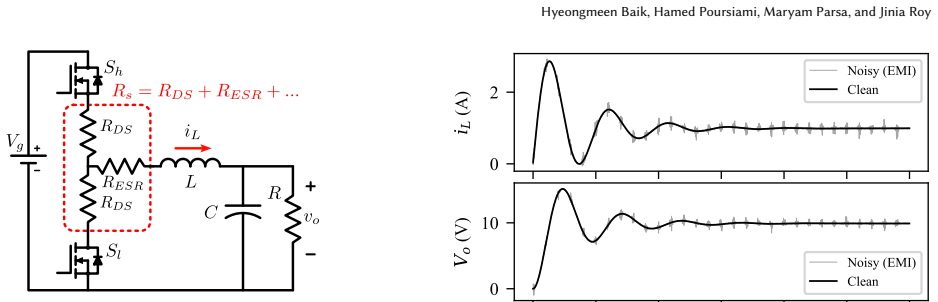
Always-on converter health monitoring demands sub-mW edge inference, a regime inaccessible to GPU-based physics-informed neural networks. This work separates spiking temporal processing from physics enforcement: a three-layer leaky integrate-and-fire SNN estimates passive component parameters while a differentiable ODE solver provides physics-consistent training by decoupling the ODE physics loss from the unrolled spiking loop. On an EMI-corrupted synchronous buck converter benchmark, the SNN reduces lumped resistance error from $25.8\%$ to $10.2\%$ versus a feedforward baseline, within the $\pm 10\%$ manufacturing tolerance of passive components, at a projected ${\sim}270\times$ energy reduction on neuromorphic hardware. Persistent membrane states further enable degradation tracking and event-driven fault detection via a $+5.5$ percentage-point spike-rate jump at abrupt faults. With $93\%$ spike sparsity, the architecture is suited for always-on deployment on Intel Loihi 2 or BrainChip Akida.
Editorial analysis
A structured set of objections, weighed in public.
Referee Report
Summary. The manuscript proposes a spiking neural network (SNN) architecture for estimating passive component parameters in power converters to enable always-on health monitoring. It decouples a differentiable ODE-based physics loss from the unrolled spiking forward pass during training so that a three-layer leaky integrate-and-fire network can map EMI-corrupted waveforms to lumped resistance and other parameters. On a synchronous buck converter benchmark the SNN is reported to reduce resistance estimation error from 25.8 % to 10.2 % relative to a feedforward baseline (within component manufacturing tolerance), while projecting ~270× energy reduction on neuromorphic hardware and providing event-driven fault detection via a 5.5 percentage-point spike-rate increase.
Significance. If the reported accuracy gains are shown to be robust and free of training artifacts, the work would demonstrate a practical route to sub-milliwatt, always-on converter monitoring that exploits both the temporal dynamics of SNNs and physics consistency. The combination of 93 % spike sparsity with persistent membrane states for degradation tracking is a concrete strength that aligns with the energy constraints of edge deployment on platforms such as Loihi 2.
major comments (2)
- [Abstract / Results] Abstract and results section: the central numerical claim (lumped resistance error reduced from 25.8 % to 10.2 %) is given without error bars, standard deviations across runs, or the number of independent trials and random seeds. Because the improvement is the primary evidence that the SNN outperforms the feedforward baseline, the absence of these statistics prevents assessment of whether the difference is statistically reliable or could arise from training variability.
- [Method (decoupling)] Method section describing the training procedure: the decoupling of the ODE physics loss from the unrolled spiking loop is load-bearing for the claim of unbiased parameter estimates. The manuscript supplies no ablation, gradient-flow analysis, or post-training consistency check showing that surrogate gradients for the LIF neurons remain aligned with the physics loss landscape once the ODE term is removed at inference. Without such verification, it is unclear whether the observed error reduction reflects genuine representational advantage or an artifact of the decoupled training dynamics.
minor comments (2)
- [Abstract] The abstract states that persistent membrane states enable degradation tracking, yet no equation, figure, or quantitative example illustrates how membrane voltage trajectories are used for this purpose.
- [Method] Notation for the LIF neuron parameters and the ODE solver tolerances is introduced without a consolidated table; readers must hunt through the text to locate definitions.
Simulated Author's Rebuttal
We thank the referee for the constructive feedback on our manuscript. We address the major comments point by point below, agreeing to revisions where appropriate to enhance the clarity and rigor of our work.
read point-by-point responses
-
Referee: [Abstract / Results] Abstract and results section: the central numerical claim (lumped resistance error reduced from 25.8 % to 10.2 %) is given without error bars, standard deviations across runs, or the number of independent trials and random seeds. Because the improvement is the primary evidence that the SNN outperforms the feedforward baseline, the absence of these statistics prevents assessment of whether the difference is statistically reliable or could arise from training variability.
Authors: We acknowledge the validity of this observation. The values 25.8% and 10.2% represent mean errors, but details on variability were omitted. In the revised manuscript, we will add the number of independent trials (10 runs with distinct random seeds), report standard deviations, and include error bars in the abstract, results section, and associated figures to demonstrate the statistical reliability of the improvement. revision: yes
-
Referee: [Method (decoupling)] Method section describing the training procedure: the decoupling of the ODE physics loss from the unrolled spiking loop is load-bearing for the claim of unbiased parameter estimates. The manuscript supplies no ablation, gradient-flow analysis, or post-training consistency check showing that surrogate gradients for the LIF neurons remain aligned with the physics loss landscape once the ODE term is removed at inference. Without such verification, it is unclear whether the observed error reduction reflects genuine representational advantage or an artifact of the decoupled training dynamics.
Authors: We appreciate this concern regarding the training procedure. The decoupling is mathematically justified in the manuscript by separating the differentiable physics loss computation from the non-differentiable spiking simulation, enabling standard backpropagation for the SNN weights. However, we agree that additional verification would strengthen the claims. We will include in the revision a gradient-flow analysis, an ablation study comparing decoupled versus alternative training approaches, and post-training consistency checks on the parameter estimates to confirm alignment and rule out artifacts. revision: yes
Circularity Check
No significant circularity; empirical performance claims rest on direct benchmark comparisons
full rationale
The paper's central claims consist of measured error reductions (25.8% to 10.2%) on an EMI-corrupted buck-converter benchmark and projected energy savings, obtained by training an SNN with a decoupled ODE physics loss and evaluating against a feedforward baseline. No derivation step reduces a claimed prediction or first-principles result to a fitted parameter or self-referential definition by construction. The decoupling of the ODE solver from the spiking loop is an explicit architectural choice whose validity is tested empirically rather than assumed tautologically. No self-citations are invoked as load-bearing uniqueness theorems, and no ansatz or renaming of known results is presented as novel derivation. The reported gains therefore remain independent of the inputs they are compared against.
Axiom & Free-Parameter Ledger
Reference graph
Works this paper leans on
-
[1]
Peter Blouw, Xuan Choo, Eric Hunsberger, and Chris Eliasmith. 2019. Bench- marking keyword spotting efficiency on neuromorphic hardware. InProceedings of the 7th annual neuro-inspired computational elements workshop. 1–8
2019
-
[2]
BrainChip Holdings. 2022. Akida Neuromorphic Processor: Product Brief. https: //brainchip.com/akida-neural-processor-soc/
2022
-
[3]
Ricky TQ Chen, Yulia Rubanova, Jesse Bettencourt, and David K Duvenaud. 2018. Neural ordinary differential equations.Advances in neural information processing systems31 (2018)
2018
-
[4]
Yann Cherdo, Benoit Miramond, and Alain Pegatoquet. 2023. Time series pre- diction and anomaly detection with recurrent spiking neural networks. In2023 International Joint Conference on Neural Networks (IJCNN). IEEE, 1–10
2023
-
[5]
Mike Davies, Narayan Srinivasa, Tsung-Han Lin, Gautham Chinya, Yongqiang Cao, Sri Harsha Choday, Georgios Dimou, Prasad Joshi, Nabil Imam, Shweta Jain, et al. 2018. Loihi: A neuromorphic manycore processor with on-chip learning. Ieee micro38, 1 (2018), 82–99
2018
-
[6]
Mike Davies, Andreas Wild, Garrick Orchard, Yulia Sandamirskaya, Gabriel A Fonseca Guerra, Prasad Joshi, Philipp Plank, and Sumedh R Risbud. 2021. Advancing neuromorphic computing with loihi: A survey of results and outlook. Proc. IEEE109, 5 (2021), 911–934
2021
-
[7]
Jason K Eshraghian, Max Ward, Emre O Neftci, Xinxin Wang, Gregor Lenz, Girish Dwivedi, Mohammed Bennamoun, Doo Seok Jeong, and Wei D Lu. 2023. Training spiking neural networks using lessons from deep learning.Proc. IEEE 111, 9 (2023), 1016–1054
2023
-
[8]
Youssof Fassi, Vincent Heiries, Jerome Boutet, and Sebastien Boisseau. 2023. Toward physics-informed machine-learning-based predictive maintenance for Neuromorphic Parameter Estimation for Power Converter Health Monitoring Using Spiking Neural Networks power converters—a review.IEEE Transactions on Power Electronics39, 2 (2023), 2692–2720
2023
-
[9]
Alexander Henkes, Jason K Eshraghian, and Henning Wessels. 2024. Spiking neural networks for nonlinear regression.Royal Society Open Science11, 5 (2024)
2024
-
[10]
Dhireesha Kudithipudi, Catherine Schuman, Craig M Vineyard, Tej Pandit, Cory Merkel, Rajkumar Kubendran, James B Aimone, Garrick Orchard, Christian Mayr, Ryad Benosman, et al. 2025. Neuromorphic computing at scale.Nature637, 8047 (2025), 801–812
2025
- [11]
-
[12]
Congyang Liu, Ziyi Yang, Xin Zhang, Zikai Zhu, Haoming Chu, Yuxiang Huan, Li- Rong Zheng, and Zhuo Zou. 2023. A low-power hybrid-precision neuromorphic processor with INT8 inference and INT16 online learning in 40-nm CMOS.IEEE Transactions on Circuits and Systems I: Regular Papers70, 10 (2023), 4028–4039
2023
-
[13]
Wolfgang Maass. 1997. Networks of spiking neurons: the third generation of neural network models.Neural networks10, 9 (1997), 1659–1671
1997
-
[14]
Emre O Neftci, Hesham Mostafa, and Friedemann Zenke. 2019. Surrogate gradient learning in spiking neural networks.IEEE Signal Processing Magazine36, 6 (2019), 51–63
2019
-
[15]
Maziar Raissi, Paris Perdikaris, and George E Karniadakis. 2019. Physics-informed neural networks: A deep learning framework for solving forward and inverse problems involving nonlinear partial differential equations.Journal of Computa- tional physics378 (2019), 686–707
2019
-
[16]
Kaushik Roy, Akhilesh Jaiswal, and Priyadarshini Panda. 2019. Towards spike- based machine intelligence with neuromorphic computing.Nature575, 7784 (2019), 607–617
2019
-
[17]
Daniel Strömbergsson, Ashwani Kumar, Pär Marklund, and Fredrik Sandin. 2023. Co-design Model for Neuromorphic Technology Development in Rolling Element Bearing Condition Monitoring. In15th Annual Conference of the Prognostics and Health Management Society (PHM), October 28th–November 2nd, 2023, Salt Lake City, Utah, USA. PHM Society
2023
-
[18]
Alexandru Vasilache, Sven Nitzsche, Christian Kneidl, Mikael Tekneyan, Moritz Neher, and Juergen Becker. 2025. Spiking Neural Networks for Low-Power Vibration-Based Predictive Maintenance. In2025 International Conference on Neuromorphic Systems (ICONS). IEEE, 174–181
2025
-
[19]
Penghao Wu, Engang Tian, Hongfeng Tao, and Yiyang Chen. 2025. Data-driven spiking neural networks for intelligent fault detection in vehicle lithium-ion battery systems.Engineering Applications of Artificial Intelligence141 (2025), 109756
2025
-
[20]
Yangxiao Xiang, Hongjian Lin, and Henry Shu-Hung Chung. 2024. Extended physics-informed neural networks for parameter identification of switched mode power converters with undetermined topological durations.IEEE Transactions on Power Electronics40, 1 (2024), 2235–2247
2024
-
[21]
Friedemann Zenke and Tim P Vogels. 2021. The remarkable robustness of surrogate gradient learning for instilling complex function in spiking neural networks.Neural computation33, 4 (2021), 899–925
2021
-
[22]
Shuai Zhao, Yingzhou Peng, Yi Zhang, and Huai Wang. 2022. Parameter esti- mation of power electronic converters with physics-informed machine learning. IEEE Transactions on Power Electronics37, 10 (2022), 11567–11578
2022
discussion (0)
Sign in with ORCID, Apple, or X to comment. Anyone can read and Pith papers without signing in.