Recognition: unknown
Enhancing Discrete Particle Swarm Optimization for Hypergraph-Modeled Influence Maximization
Pith reviewed 2026-05-10 07:47 UTC · model grok-4.3
The pith
An enhanced discrete particle swarm optimizer with two-layer approximation selects more effective influential seeds on hypergraphs than baseline methods.
A machine-rendered reading of the paper's core claim, the machinery that carries it, and where it could break.
Core claim
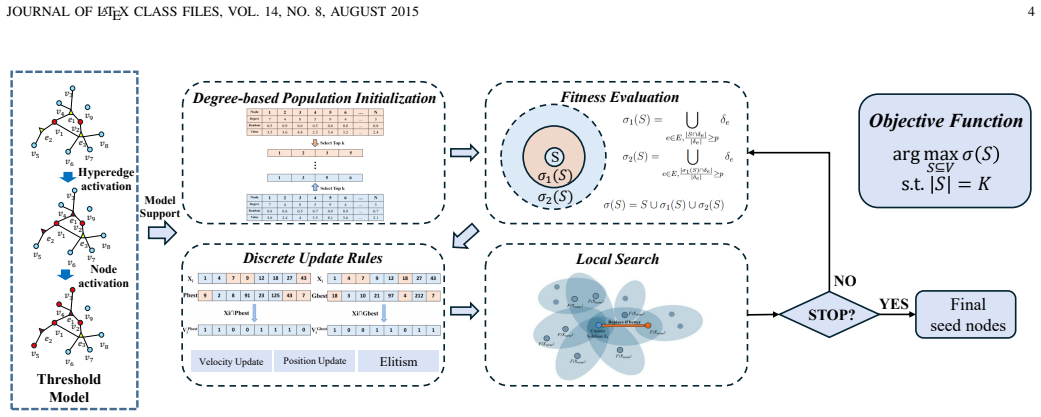
The authors establish that their discrete particle swarm optimization algorithm, equipped with a two-layer local influence approximation for fitness evaluation, a degree-based initialization strategy, specialized velocity and position update rules, and an integrated local search, identifies seed sets that achieve higher influence spread under the threshold model on hypergraphs and outperforms baseline methods on both synthetic and real-world instances.
What carries the argument
Two-layer local influence approximation that evaluates a seed set's spread by first estimating node-level activation probabilities and then aggregating contributions across hyperedges in the threshold model.
If this is right
- The method scales to larger hypergraphs by avoiding repeated full cascade simulations.
- Degree-based initialization and local search together improve the quality of final seed selections.
- The approach works on both generated hypergraphs and empirical ones drawn from real systems.
- It yields higher influence spread than standard baselines under the same threshold diffusion rule.
Where Pith is reading between the lines
- The local approximation could be tested on other diffusion rules such as the independent cascade model to check transferability.
- The swarm encoding of seed selections might extend to related hypergraph problems like community detection or resource allocation.
- If the approximation error remains small, the technique lowers the barrier to applying influence maximization in group-interaction settings such as team formation or collaborative filtering.
Load-bearing premise
The two-layer local influence approximation accurately captures the cascading dynamics of the threshold model on hypergraphs without needing full simulations.
What would settle it
Running many full Monte Carlo simulations of the threshold model on a small hypergraph and checking whether the two-layer approximation produces statistically matching influence spread values for the same seed sets.
Figures



read the original abstract
Influence maximization (IM) is a fundamental problem in complex network analysis, with a wide range of real-world applications. To date, existing approaches to influential node identification in IM have predominantly relied on standard graphs, failing to capture higher-order intrinsic interactions embedded in many real-world systems. Hypergraphs can be employed to better capture higher-order interactions. However, using hypergraphs may lead to an excessively large search space and increased complexity in modeling cascading dynamics, making it challenging to accurately identify influential nodes. Therefore, in this study, we propose a new hypergraph-modeled IM method, based on the Discrete Particle Swarm Optimization algorithm and the threshold model. In the proposed method, a particle (i.e., a candidate solution) represents the selection information of seed nodes, and the fitness function is designed to accurately and efficiently evaluate the influence of seed nodes via a two-layer local influence approximation. We also propose a degree-based initialization strategy to improve the quality of initial solutions and develop rules for updating particles' velocity and position, incorporated with a local search to drive particles toward better solutions. Experimental results demonstrate that the proposed method outperforms baseline methods on both synthetic and real-world hypergraphs. In addition, ablation studies validate the effectiveness of both the local search and the initialization strategies.
Editorial analysis
A structured set of objections, weighed in public.
Referee Report
Summary. The paper proposes a discrete particle swarm optimization (DPSO) algorithm for influence maximization on hypergraphs under the linear threshold model. Candidate seed sets are represented as particles; a two-layer local influence approximation serves as the fitness function to estimate spread without full cascade simulations. The method adds a degree-based initialization strategy and local search rules for velocity/position updates. Experiments on synthetic and real-world hypergraphs report outperformance over baselines, with ablation studies confirming the value of initialization and local search.
Significance. If the two-layer approximation is shown to be a faithful proxy for full threshold cascades, the work supplies a practical heuristic for a computationally hard problem on higher-order networks. The explicit incorporation of hyperedge structure, the degree-based initialization, and the ablation validation are concrete strengths that could be built upon for scalable IM algorithms.
major comments (2)
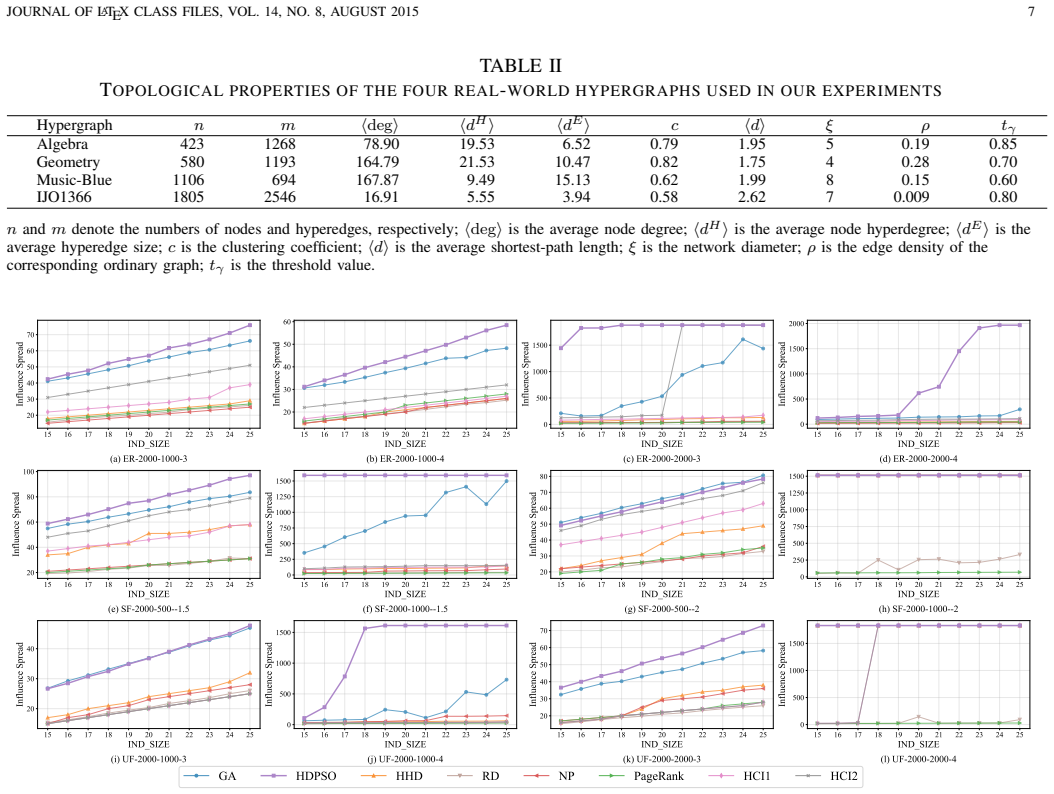
- [Method description of the fitness function and experimental results section] The central empirical claim (outperformance on synthetic and real hypergraphs) rests on the two-layer local influence approximation serving as a reliable fitness function. No quantitative validation—such as correlation coefficients, mean absolute error, or side-by-side comparison of approximated vs. full Monte-Carlo spread values—is reported for the hypergraphs used in the experiments. This leaves open the possibility that the PSO is optimizing a surrogate whose ranking of seed sets diverges from the true objective.
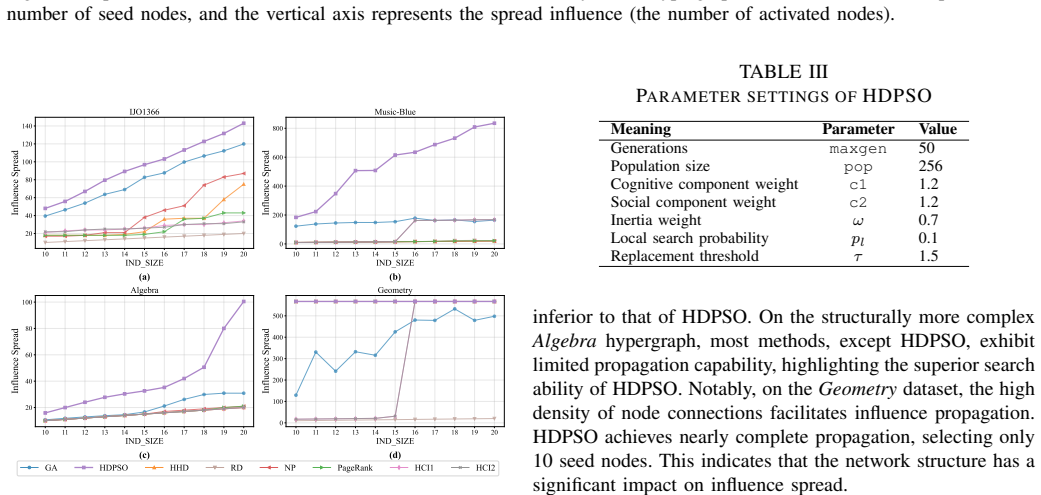
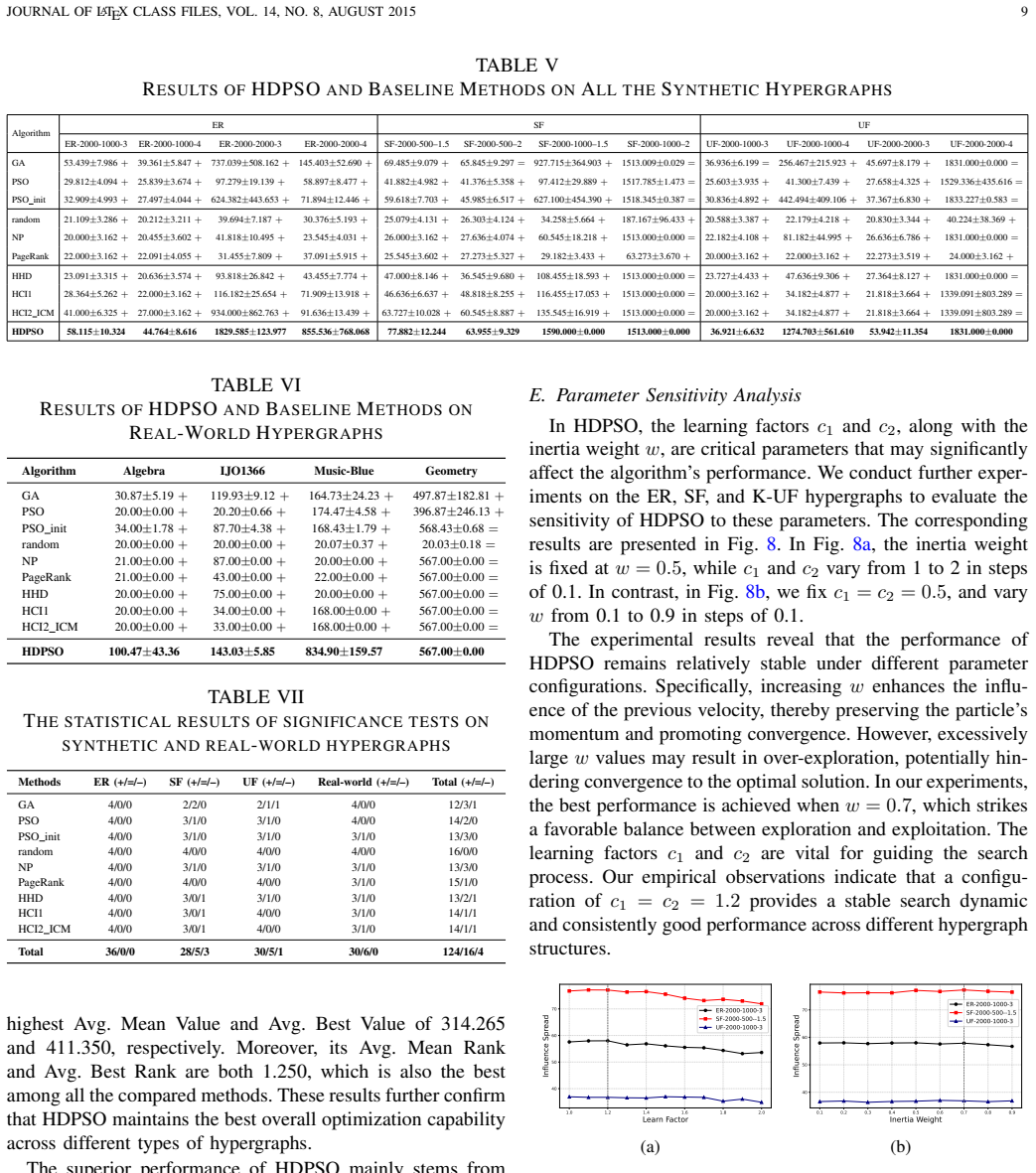
- [Abstract and experimental evaluation] The abstract and results claim outperformance, yet supply no numerical metrics (e.g., influence spread values, standard deviations, or exact baseline names and parameter settings). Without these, it is impossible to judge effect sizes or reproducibility of the reported superiority.
minor comments (2)
- [Algorithmic details] The description of the velocity and position update rules would benefit from an explicit pseudocode listing or numbered steps to clarify how the local search is interleaved with standard DPSO operators.
- [Experimental setup] Hypergraph statistics (number of nodes, hyperedges, average hyperedge size, etc.) for the real-world datasets should be tabulated for context when interpreting the results.
Simulated Author's Rebuttal
We thank the referee for the thoughtful and constructive comments on our manuscript. We address each major comment below and will incorporate revisions to strengthen the validation of the fitness function and the reporting of experimental results.
read point-by-point responses
-
Referee: [Method description of the fitness function and experimental results section] The central empirical claim (outperformance on synthetic and real hypergraphs) rests on the two-layer local influence approximation serving as a reliable fitness function. No quantitative validation—such as correlation coefficients, mean absolute error, or side-by-side comparison of approximated vs. full Monte-Carlo spread values—is reported for the hypergraphs used in the experiments. This leaves open the possibility that the PSO is optimizing a surrogate whose ranking of seed sets diverges from the true objective.
Authors: We agree that explicit quantitative validation of the two-layer local influence approximation against full Monte-Carlo simulations would increase confidence in the surrogate. In the revised manuscript we will add a dedicated subsection (under Experimental Results) that reports Pearson correlation coefficients, mean absolute errors, and scatter plots comparing the approximated spread values to those from 10,000-run Monte-Carlo simulations on a representative subset of both synthetic and real-world hypergraphs. This will directly address the concern about possible divergence in ranking. revision: yes
-
Referee: [Abstract and experimental evaluation] The abstract and results claim outperformance, yet supply no numerical metrics (e.g., influence spread values, standard deviations, or exact baseline names and parameter settings). Without these, it is impossible to judge effect sizes or reproducibility of the reported superiority.
Authors: We acknowledge that the current abstract and results section lack the numerical detail needed for assessing effect sizes and reproducibility. In the revised version we will (i) update the abstract to include concrete average influence-spread values with standard deviations for the proposed method and all baselines, and (ii) expand the experimental evaluation section with full tables listing exact baseline names, parameter settings, and means ± standard deviations over 30 independent runs on each dataset. revision: yes
Circularity Check
No circularity: algorithmic proposal with empirical validation
full rationale
The paper proposes a Discrete Particle Swarm Optimization algorithm for influence maximization on hypergraphs under the threshold model. Core elements include particle encoding of seed sets, a two-layer local influence approximation as the fitness function, degree-based initialization, velocity/position update rules, and a local search operator. These are presented as constructive algorithmic choices, with performance assessed via direct experiments on synthetic and real-world hypergraphs plus ablation studies. No equations, predictions, or central claims reduce by construction to fitted parameters, self-definitions, or self-citation chains; the approximation is introduced as a heuristic surrogate and evaluated empirically rather than derived from the results it produces.
Axiom & Free-Parameter Ledger
free parameters (1)
- PSO hyperparameters (inertia weight, cognitive/social coefficients)
axioms (1)
- domain assumption Threshold model governs influence spread on hypergraphs
Reference graph
Works this paper leans on
-
[1]
Technology adoption in online social networks,
G. Peng and J. Mu, “Technology adoption in online social networks,” Journal of product innovation management, vol. 28, no. s1, pp. 133–145, 2011
2011
-
[2]
Interpersonal communication in social networking sites: An investigation in the framework of uses and gratifica- tion theory,
A. T. Eginli and N. O. Tas, “Interpersonal communication in social networking sites: An investigation in the framework of uses and gratifica- tion theory,”Online Journal of Communication and Media Technologies, vol. 8, no. 2, pp. 81–104, 2018
2018
-
[3]
Twenty years of social media marketing: A systematic review, integrative framework, and future research agenda,
S. Bartoloni and C. Ancillai, “Twenty years of social media marketing: A systematic review, integrative framework, and future research agenda,” International Journal of Management Reviews, vol. 26, no. 3, pp. 435– 457, 2024
2024
-
[4]
Influence maximization on temporal networks: a review,
E. Yanchenko, T. Murata, and P. Holme, “Influence maximization on temporal networks: a review,”Applied Network Science, vol. 9, no. 1, p. 16, 2024
2024
-
[5]
Maximizing the spread of influence through a social network,
D. Kempe, J. Kleinberg, and ´E. Tardos, “Maximizing the spread of influence through a social network,” inProceedings of the ninth ACM SIGKDD international conference on Knowledge discovery and data mining, 2003, pp. 137–146
2003
-
[6]
Influence maximization based on threshold models in hypergraphs,
R. Zhang, X. Qu, Q. Zhang, X. Xu, and S. Pei, “Influence maximization based on threshold models in hypergraphs,”Chaos: An Interdisciplinary Journal of Nonlinear Science, 2024
2024
-
[7]
Influence maximization on large-scale mobile social network: a divide-and-conquer method,
G. Song, X. Zhou, Y . Wang, and K. Xie, “Influence maximization on large-scale mobile social network: a divide-and-conquer method,”IEEE Transactions on Parallel and Distributed Systems, vol. 26, no. 5, pp. 1379–1392, 2014
2014
-
[8]
A survey on influence maximization in a social network,
S. Banerjee, M. Jenamani, and D. K. Pratihar, “A survey on influence maximization in a social network,”Knowledge and Information Systems, vol. 62, no. 9, pp. 3417–3455, 2020
2020
-
[9]
Outbreak minimization vs influence maximization: an optimization framework,
C.-H. Cheng, Y .-H. Kuo, and Z. Zhou, “Outbreak minimization vs influence maximization: an optimization framework,”BMC Medical Informatics and Decision Making, vol. 20, no. 1, p. 266, 2020
2020
-
[10]
Social influence maximization under em- pirical influence models,
S. Aral and P. S. Dhillon, “Social influence maximization under em- pirical influence models,”Nature human behaviour, vol. 2, no. 6, pp. 375–382, 2018
2018
-
[11]
Recent advances in information diffusion and influence maximization in complex social networks,
H. Zhang, S. Mishra, M. T. Thai, J. Wu, and Y . Wang, “Recent advances in information diffusion and influence maximization in complex social networks,”Opportunistic Mobile Social Networks, vol. 37, no. 1.1, p. 37, 2014
2014
-
[12]
Influence maximization based on network motifs in mobile social networks,
X. Zhang, L. Xu, and Z. Xu, “Influence maximization based on network motifs in mobile social networks,”IEEE Transactions on Network Science and Engineering, vol. 9, no. 4, pp. 2353–2363, 2022
2022
-
[13]
Online processing algorithms for influence maximization,
J. Tang, X. Tang, X. Xiao, and J. Yuan, “Online processing algorithms for influence maximization,” inProceedings of the 2018 international conference on management of data, 2018, pp. 991–1005
2018
-
[14]
A survey on influence maximization: From an ml-based combinatorial optimization,
Y . Li, H. Gao, Y . Gao, J. Guo, and W. Wu, “A survey on influence maximization: From an ml-based combinatorial optimization,”ACM Transactions on Knowledge Discovery from Data, vol. 17, no. 9, pp. 1–50, 2023
2023
-
[15]
Influence max- imization in social networks using graph embedding and graph neural network,
S. Kumar, A. Mallik, A. Khetarpal, and B. S. Panda, “Influence max- imization in social networks using graph embedding and graph neural network,”Information Sciences, vol. 607, pp. 1617–1636, 2022
2022
-
[16]
Smg: Fast scalable greedy algorithm for influence maximization in social networks,
M. Heidari, M. Asadpour, and H. Faili, “Smg: Fast scalable greedy algorithm for influence maximization in social networks,”Physica A: Statistical Mechanics and its Applications, vol. 420, pp. 124–133, 2015
2015
-
[17]
Influence maximization on social graphs: A survey,
Y . Li, J. Fan, Y . Wang, and K.-L. Tan, “Influence maximization on social graphs: A survey,”IEEE Transactions on Knowledge and Data Engineering, vol. 30, no. 10, pp. 1852–1872, 2018
2018
-
[18]
Networks beyond pairwise interactions: Structure and dynamics,
F. Battiston, G. Cencetti, I. Iacopini, V . Latora, M. Lucas, A. Patania, J.-G. Young, and G. Petri, “Networks beyond pairwise interactions: Structure and dynamics,”Physics reports, vol. 874, pp. 1–92, 2020
2020
-
[19]
Social contagion models on hypergraphs,
G. F. de Arruda, G. Petri, and Y . Moreno, “Social contagion models on hypergraphs,”Physical Review Research, vol. 2, no. 2, p. 023032, 2020
2020
-
[20]
Social influence maximization in hypergraph in social networks,
J. Zhu, J. Zhu, S. Ghosh, W. Wu, and J. Yuan, “Social influence maximization in hypergraph in social networks,”IEEE Transactions on Network Science and Engineering, vol. 6, no. 4, pp. 801–811, 2018
2018
-
[21]
Social influence maximization in hypergraphs,
A. Antelmi, G. Cordasco, C. Spagnuolo, and P. Szufel, “Social influence maximization in hypergraphs,”Entropy, vol. 23, no. 7, p. 796, 2021
2021
-
[22]
Influence maximization in hypergraphs: A self- optimizing algorithm based on electrostatic field,
S. Li and X. Li, “Influence maximization in hypergraphs: A self- optimizing algorithm based on electrostatic field,”Chaos, Solitons & Fractals, vol. 174, p. 113888, 2023
2023
-
[23]
Hedv-greedy: An advanced algorithm for influence maximization in hypergraphs,
H. Wang, Q. Pan, and J. Tang, “Hedv-greedy: An advanced algorithm for influence maximization in hypergraphs,”Mathematics, vol. 12, no. 7, p. 1041, 2024
2024
-
[24]
Particle swarm optimization,
J. Kennedy and R. Eberhart, “Particle swarm optimization,” inProceed- ings of ICNN’95-international conference on neural networks, vol. 4. ieee, 1995, pp. 1942–1948
1995
-
[25]
Community- based influence maximization for viral marketing,
H. Huang, H. Shen, Z. Meng, H. Chang, and H. He, “Community- based influence maximization for viral marketing,”Applied Intelligence, vol. 49, no. 6, pp. 2137–2150, 2019
2019
-
[26]
Substantial undocumented infection facilitates the rapid dissemination of novel coronavirus (sars-cov-2),
R. Li, S. Pei, B. Chen, Y . Song, T. Zhang, W. Yang, and J. Shaman, “Substantial undocumented infection facilitates the rapid dissemination of novel coronavirus (sars-cov-2),”Science, vol. 368, no. 6490, pp. 489– 493, 2020. JOURNAL OF LATEX CLASS FILES, VOL. 14, NO. 8, AUGUST 2015 11
2020
-
[27]
A faster algorithm for betweenness centrality,
U. Brandes, “A faster algorithm for betweenness centrality,”Journal of mathematical sociology, vol. 25, no. 2, pp. 163–177, 2001
2001
-
[28]
Ranking of closeness centrality for large-scale social networks,
K. Okamoto, W. Chen, and X.-Y . Li, “Ranking of closeness centrality for large-scale social networks,” inInternational workshop on frontiers in algorithmics. Springer, 2008, pp. 186–195
2008
-
[29]
The anatomy of a large-scale hypertextual web search engine,
S. Brin and L. Page, “The anatomy of a large-scale hypertextual web search engine,”Computer networks and ISDN systems, vol. 30, no. 1-7, pp. 107–117, 1998
1998
-
[30]
An efficient adaptive degree-based heuristic algorithm for influence maximization in hyper- graphs,
M. Xie, X.-X. Zhan, C. Liu, and Z.-K. Zhang, “An efficient adaptive degree-based heuristic algorithm for influence maximization in hyper- graphs,”Information Processing & Management, vol. 60, no. 2, p. 103161, 2023
2023
-
[31]
Celf++ optimizing the greedy algorithm for influence maximization in social networks,
A. Goyal, W. Lu, and L. V . Lakshmanan, “Celf++ optimizing the greedy algorithm for influence maximization in social networks,” inProceedings of the 20th international conference companion on World wide web, 2011, pp. 47–48
2011
-
[32]
Influence maximization in social networks based on discrete particle swarm optimization,
M. Gong, J. Yan, B. Shen, L. Ma, and Q. Cai, “Influence maximization in social networks based on discrete particle swarm optimization,” Information Sciences, vol. 367, pp. 600–614, 2016
2016
-
[33]
Maximizing the spread of influence via the collective intelligence of discrete bat algorithm,
J. Tang, R. Zhang, Y . Yao, Z. Zhao, P. Wang, H. Li, and J. Yuan, “Maximizing the spread of influence via the collective intelligence of discrete bat algorithm,”Knowledge-Based Systems, vol. 160, pp. 88–103, 2018
2018
-
[34]
A discrete shuffled frog-leaping algorithm to identify influential nodes for influence maximization in social networks,
J. Tang, R. Zhang, P. Wang, Z. Zhao, L. Fan, and X. Liu, “A discrete shuffled frog-leaping algorithm to identify influential nodes for influence maximization in social networks,”Knowledge-Based Systems, vol. 187, p. 104833, 2020
2020
-
[35]
Abem: An adaptive agent-based evolutionary approach for influence maximization in dynamic social networks,
W. Li, Y . Hu, C. Jiang, S. Wu, Q. Bai, and E. Lai, “Abem: An adaptive agent-based evolutionary approach for influence maximization in dynamic social networks,”Applied Soft Computing, vol. 136, p. 110062, 2023
2023
-
[36]
Betweenness computation in the single graph representation of hypergraphs,
R. Puzis, M. Purohit, and V . Subrahmanian, “Betweenness computation in the single graph representation of hypergraphs,”Social networks, vol. 35, no. 4, pp. 561–572, 2013
2013
-
[37]
X. Qu, W. Pei, Y . Yang, X. Xu, R. Zhang, and Q. Zhang, “Influence maximization in hypergraphs using a genetic algorithm with new ini- tialization and evaluation methods,”arXiv preprint arXiv:2405.09185, 2024
-
[38]
Hyper-imrank: Ranking-based influence max- imization for hypergraphs,
A. MA and A. Rajkumar, “Hyper-imrank: Ranking-based influence max- imization for hypergraphs,” inProceedings of the 5th Joint International Conference on Data Science & Management of Data (9th ACM IKDD CODS and 27th COMAD), 2022, pp. 100–104
2022
-
[39]
Threshold- limited spreading in social networks with multiple initiators,
P. Singh, S. Sreenivasan, B. K. Szymanski, and G. Korniss, “Threshold- limited spreading in social networks with multiple initiators,”Scientific reports, vol. 3, no. 1, p. 2330, 2013
2013
-
[40]
Influence of opinion leaders on dynamics and diffusion of network public opinion,
Z. Wei and H. Ming-sheng, “Influence of opinion leaders on dynamics and diffusion of network public opinion,” in2013 international confer- ence on management science and engineering 20th annual conference proceedings. IEEE, 2013, pp. 139–144
2013
-
[41]
A discrete binary version of the particle swarm algorithm,
J. Kennedy and R. C. Eberhart, “A discrete binary version of the particle swarm algorithm,” in1997 IEEE International conference on systems, man, and cybernetics. Computational cybernetics and simulation, vol. 5. ieee, 1997, pp. 4104–4108
1997
-
[42]
A modified particle swarm optimizer,
Y . Shi and R. Eberhart, “A modified particle swarm optimizer,” in1998 IEEE international conference on evolutionary computation proceed- ings. IEEE world congress on computational intelligence (Cat. No. 98TH8360). IEEE, 1998, pp. 69–73
1998
-
[43]
Searching for superspreaders of information in real-world social me- dia,
S. Pei, L. Muchnik, J. S. Andrade, Jr, Z. Zheng, and H. A. Makse, “Searching for superspreaders of information in real-world social me- dia,”Scientific reports, vol. 4, no. 1, p. 5547, 2014. Qianshi Wangis pursuing a Bachelor’s degree at International School of Information Science & En- gineering, Dalian University of Technology. His re- search interests ...
2014
discussion (0)
Sign in with ORCID, Apple, or X to comment. Anyone can read and Pith papers without signing in.