Recognition: unknown
PISP: Projected-Space Inference of Stellar Parameters
Pith reviewed 2026-05-10 08:11 UTC · model grok-4.3
The pith
Projecting spectra into an orthonormal basis before optimization improves accuracy of stellar temperature and abundance estimates.
A machine-rendered reading of the paper's core claim, the machinery that carries it, and where it could break.
Core claim
PISP constructs an orthonormal basis via PCA or the active-subspace method and optimizes the projection coefficients for stellar parameters either at a user-specified dimensionality or with L1 regularization for adaptive selection. Across four strategy combinations and two inference implementations, this projected-space approach reduces the standard deviation of differences between inferred and reference values for multiple parameters on both synthetic and real data, outperforming direct optimization in the original spectral space.
What carries the argument
Orthonormal basis from PCA or active subspaces, with Non-L1 fixed-dimensionality or L1-regularized coefficient optimization in the projected space.
If this is right
- PCA-L1 reduces error scatter by at least 0.01 dex for 12 of 20 abundances in synthetic data, with larger gains for several elements.
- PCA-Non-L1 lowers effective temperature error by more than 30 K and improves 9 of 17 abundances in observed APOGEE spectra.
- Some PISP configurations deliver roughly 4 times faster inference while maintaining or improving accuracy.
- The accuracy gains appear across both fully connected and residual neural network emulators.
Where Pith is reading between the lines
- The same projection step could be tested on spectra from other instruments to check if similar error reductions occur outside APOGEE.
- If the basis selection proves robust, the method might shorten the time needed to build parameter catalogs for next-generation surveys.
- One could explore whether active-subspace bases outperform PCA when the underlying parameter sensitivities vary strongly with wavelength.
Load-bearing premise
The chosen orthonormal projection captures all information needed for parameter recovery without introducing new systematic biases from the dimensionality reduction itself.
What would settle it
Applying both baseline and all PISP variants to a new independent set of spectra and spectra and finding no reduction in error scatter for any parameter or strategy would show the projection does not improve inference.
Figures






read the original abstract
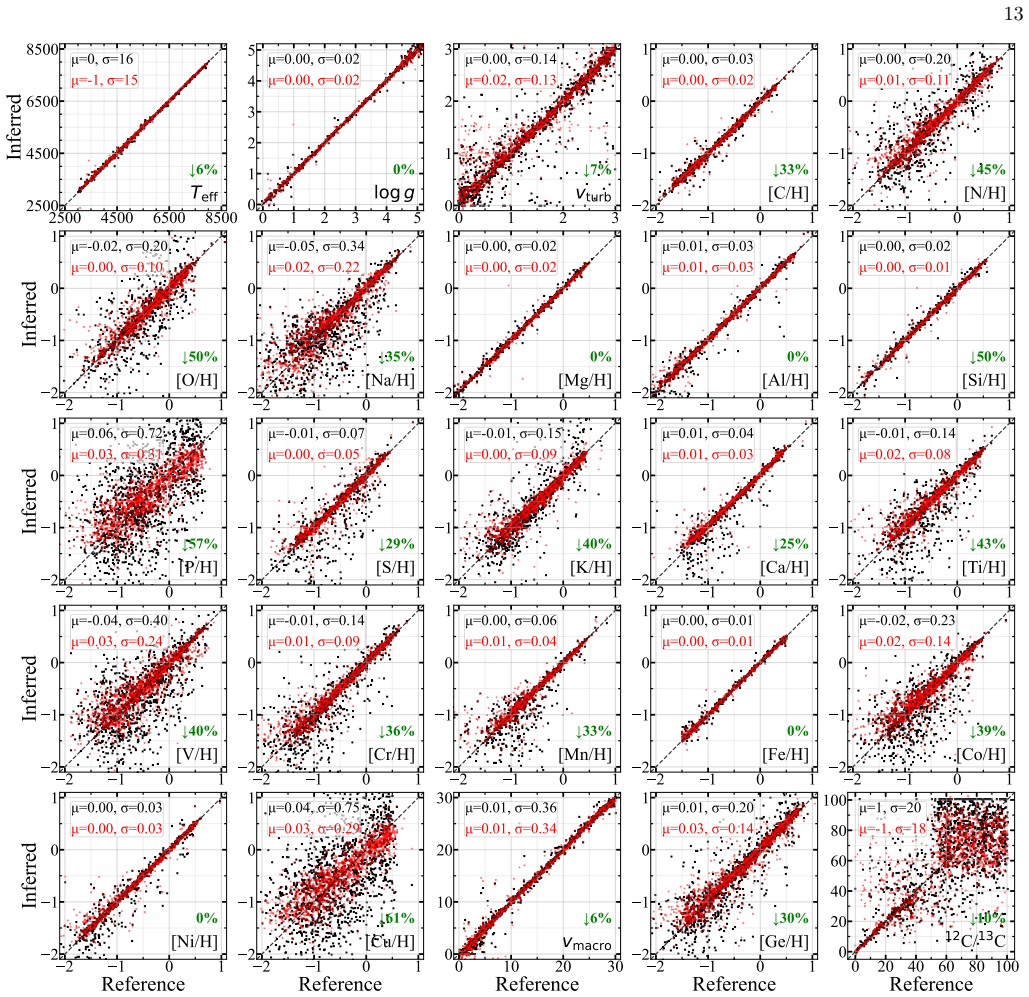
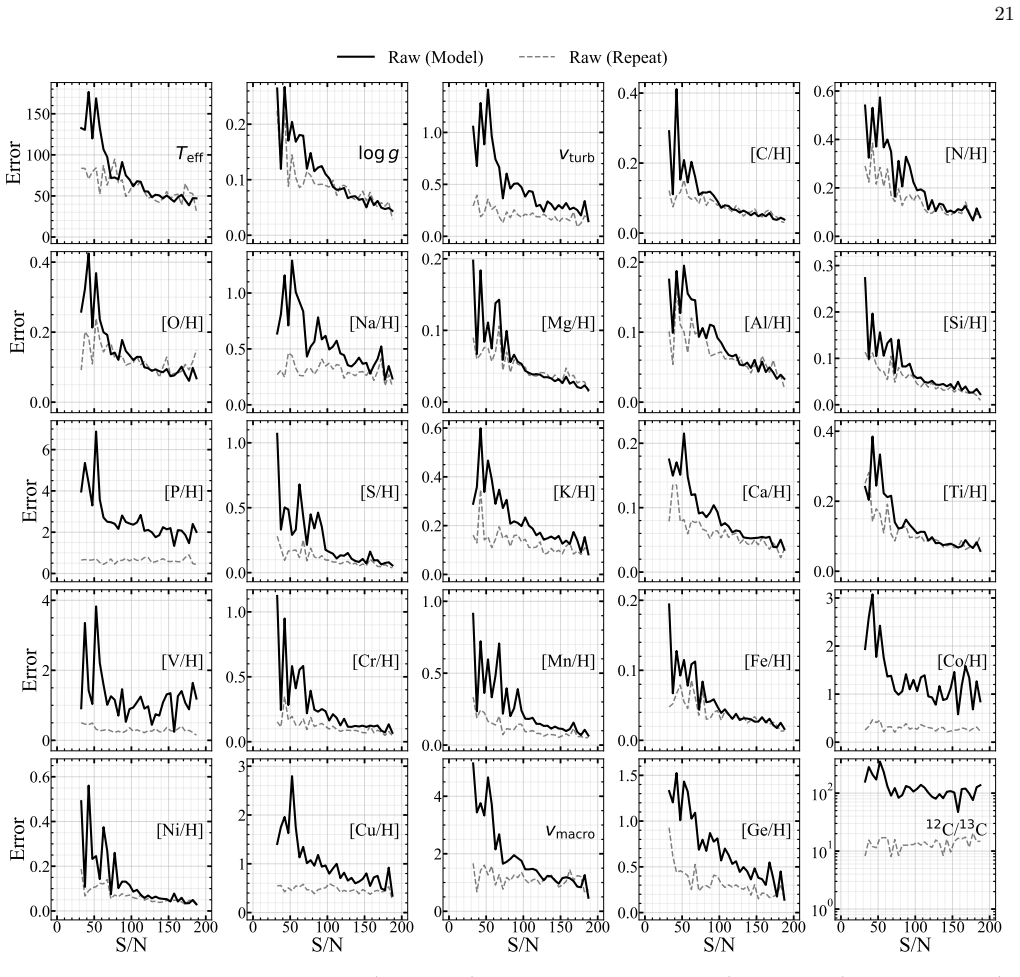
To improve the accuracy and efficiency of high-dimensional stellar parameter inference in large spectroscopic datasets, we propose a projection-assisted parameter-inference framework -- Projected-Space Inference of Stellar Parameters (PISP). PISP constructs an orthonormal basis and optimizes in the projected space, reducing the impact of parameter correlations on inference. The basis is constructed using either principal component analysis (PCA) or the active-subspace (AS) method and is combined with two inference strategies -- Non-L1, which optimizes the projection coefficients for a user-specified projected dimensionality, and L1, which introduces L1 regularization in the full projected space to adaptively select projection directions -- yielding four strategies: PCA-Non-L1, AS-Non-L1, PCA-L1, and AS-L1. For different computational scenarios, we implement two versions: PISP-CurveFit for fast single-spectrum inference and PISP-Adam for large-scale GPU-parallel inference. Using a fully connected neural network and a residual network as spectral emulators, we evaluate PISP on Kurucz synthetic spectra and on $722{,}896$ APOGEE DR$17$ observed spectra. Compared to the baseline strategy, PISP improves inference accuracy for multiple parameters across all emulator-optimizer combinations. In synthetic data, PCA-L1 performs best, reducing the standard deviation of differences ($\sigma(\Delta)$) by at least $0.01$ dex for $12$ of $20$ elemental abundances, with [N/H], [O/H], [Na/H], [Co/H], [P/H], [V/H], [Cu/H] showing $0.05$--$0.72$ dex reductions. In observed data, PCA-Non-L1 reduces $\sigma(\Delta)$ by $>30$ K for effective temperature and by at least $0.01$ dex for $9$ of $17$ elemental abundances, with [O/H], [Na/H], [V/H] showing $0.05$--$0.20$ dex reductions, while achieving a $\sim$$4\times$ efficiency gain, slightly outperforming PCA-L1.
Editorial analysis
A structured set of objections, weighed in public.
Referee Report
Summary. The paper introduces PISP, a projection-based framework for stellar parameter inference from spectra. It constructs an orthonormal basis via PCA or active subspaces, then applies either fixed-dimensionality (Non-L1) or L1-regularized optimization in the projected space. Four variants are tested with neural network emulators (fully connected and residual) on Kurucz synthetic spectra and 722,896 APOGEE DR17 spectra, claiming consistent reductions in σ(Δ) versus an unprojected baseline plus efficiency gains.
Significance. If the accuracy gains prove robust and free of projection-induced bias, PISP could meaningfully improve both precision and throughput for high-dimensional inference on large spectroscopic surveys. The reported ~4× efficiency improvement and gains on real APOGEE data are practically relevant.
major comments (2)
- [Abstract / Results] The central claim that PISP improves accuracy rests on reductions in σ(Δ). On observed APOGEE data, however, Δ is measured against an external catalog rather than ground truth; this metric cannot detect mean systematic offsets that the projection step might introduce (e.g., by discarding low-variance but parameter-informative directions). Synthetic-data results partially mitigate this, but the observed-data conclusions require additional bias diagnostics.
- [Abstract] No information is provided on baseline implementation details, number of optimization runs, statistical significance testing of the reported σ(Δ) differences, or cross-validation procedures. Without these, it is difficult to judge whether the claimed improvements (e.g., ≥0.01 dex for 12/20 abundances in synthetic data) are reliable or could arise from post-hoc selection.
minor comments (1)
- The four strategy names (PCA-Non-L1, AS-Non-L1, PCA-L1, AS-L1) are introduced in the abstract but would benefit from a concise table or diagram early in the methods section for quick reference.
Simulated Author's Rebuttal
We thank the referee for the constructive and detailed review. The comments highlight important aspects of metric interpretation and experimental reproducibility. We address each major comment below and will revise the manuscript to incorporate the suggested improvements.
read point-by-point responses
-
Referee: [Abstract / Results] The central claim that PISP improves accuracy rests on reductions in σ(Δ). On observed APOGEE data, however, Δ is measured against an external catalog rather than ground truth; this metric cannot detect mean systematic offsets that the projection step might introduce (e.g., by discarding low-variance but parameter-informative directions). Synthetic-data results partially mitigate this, but the observed-data conclusions require additional bias diagnostics.
Authors: We agree that σ(Δ) captures scatter but not potential mean biases that could arise if the projection discards informative directions. In the synthetic experiments (where ground truth is known), the mean differences (Δ) for PISP variants remain small and comparable to or smaller than the baseline, with no evidence of introduced systematics. For the APOGEE results, we will add explicit reporting of mean(Δ) alongside σ(Δ) for all parameters in the revised manuscript. This will allow readers to verify the absence of projection-induced offsets and strengthen the observed-data claims. revision: yes
-
Referee: [Abstract] No information is provided on baseline implementation details, number of optimization runs, statistical significance testing of the reported σ(Δ) differences, or cross-validation procedures. Without these, it is difficult to judge whether the claimed improvements (e.g., ≥0.01 dex for 12/20 abundances in synthetic data) are reliable or could arise from post-hoc selection.
Authors: We acknowledge that these details are essential for assessing robustness. The revised manuscript will expand the Methods and Experiments sections to specify: (i) the exact baseline implementation (unprojected optimization with identical emulator and optimizer settings), (ii) the number of random initializations or optimization runs performed per spectrum, (iii) the statistical tests used to evaluate σ(Δ) differences (e.g., paired Wilcoxon or bootstrap confidence intervals), and (iv) the cross-validation procedure for training the neural-network emulators. These additions will demonstrate that the reported gains are not the result of post-hoc selection. revision: yes
Circularity Check
No significant circularity; empirical gains are measured against an independent baseline
full rationale
The paper defines PISP as a projection framework (PCA/AS basis + L1/Non-L1 optimization) and reports empirical accuracy gains on held-out synthetic spectra and APOGEE observations relative to an unprojected baseline. No equation or result is shown to equal its own fitted inputs by construction; the reported σ(Δ) reductions are external performance metrics, not tautological re-expressions of the projection step itself. The method description is self-contained and does not rely on self-citations for its central claims.
Axiom & Free-Parameter Ledger
free parameters (1)
- projected dimensionality
axioms (1)
- domain assumption Stellar spectra variations lie approximately in a low-dimensional linear subspace that can be recovered by PCA or active-subspace methods.
Reference graph
Works this paper leans on
-
[1]
thebibliography [1] 20pt to REFERENCES 6pt =0pt -12pt 10pt plus 3pt =0pt =0pt =1pt plus 1pt =0pt =0pt -12pt =13pt plus 1pt =20pt =13pt plus 1pt \@M =10000 =-1.0em =0pt =0pt 0pt =0pt =1.0em @enumiv\@empty 10000 10000 `\.\@m \@noitemerr \@latex@warning Empty `thebibliography' environment \@ifnextchar \@reference \@latexerr Missing key on reference command E...
-
[2]
Abdi, H., & Williams, L. J. 2010, WIREs Computational Statistics, 2, 433, 10.1002/wics.101
-
[3]
2022, ApJS, 259, 35, doi: 10.3847/1538-4365/ac4414
Abdurro'uf , Accetta , K., Aerts , C., et al. 2022, , 259, 35, 10.3847/1538-4365/ac4414
-
[4]
F., Argudo-Fern´ andez, M., et al
Almeida , A., Anderson , S. F., Argudo-Fern \'a ndez , M., et al. 2023, , 267, 44, 10.3847/1538-4365/acda98
-
[5]
2022, in Parallel Problem Solving from Nature -- PPSN XVII, ed
Antonov, K., Raponi, E., Wang, H., & Doerr, C. 2022, in Parallel Problem Solving from Nature -- PPSN XVII, ed. G. Rudolph, A. V. Kononova, H. Aguirre, P. Kerschke, G. Ochoa, & T. Tu s ar (Cham: Springer International Publishing), 118--131, 10.1007/978-3-031-14714-2_9
-
[6]
Asplund , M., Grevesse , N., Sauval , A. J., & Scott , P. 2009, , 47, 481, 10.1146/annurev.astro.46.060407.145222
-
[7]
Bensby , T., Feltzing , S., & Oey , M. S. 2014, , 562, A71, 10.1051/0004-6361/201322631
-
[8]
Blanton , M. R., Bershady , M. A., Abolfathi , B., et al. 2017, , 154, 28, 10.3847/1538-3881/aa7567
-
[9]
2024, Neural Computation, 36, 2446, 10.1162/neco_a_01708
Boyar, O., & Takeuchi, I. 2024, Neural Computation, 36, 2446, 10.1162/neco_a_01708
-
[10]
Branch , M. A., Coleman , T. F., & Li , Y. 1999, SIAM Journal on Scientific Computing, 21, 1, 10.1137/S1064827595289108
-
[11]
Buder , S., Asplund , M., Duong , L., et al. 2018, , 478, 4513, 10.1093/mnras/sty1281
-
[12]
2021, MNRAS, 506, 150, doi: 10.1093/mnras/stab1242
Buder , S., Sharma , S., Kos , J., et al. 2021, , 506, 150, 10.1093/mnras/stab1242
-
[13]
Publications of the Astronomical Society of Australia , author =
Buder , S., Kos , J., Wang , X. E., et al. 2025, , 42, e051, 10.1017/pasa.2025.26
-
[14]
A lim- ited memory algorithm for bound constrained op- timization,
Byrd , R. H., Lu , P., Nocedal , J., & Zhu , C. 1995, SIAM Journal on Scientific Computing, 16, 1190, 10.1137/0916069
-
[15]
Casey , A. R., Lattanzio , J. C., Aleti , A., et al. 2019, , 887, 73, 10.3847/1538-4357/ab4fea
-
[16]
Chu, J., Park, J., Lee, S., & Kim, H. J. 2024, in Advances in Neural Information Processing Systems, ed. A. Globerson, L. Mackey, D. Belgrave, A. Fan, U. Paquet, J. Tomczak, & C. Zhang, Vol. 37 (Curran Associates, Inc.), 68258--68286, 10.52202/079017-2180
-
[17]
Coleman, T. F., & Li, Y. 1996, SIAM Journal on Optimization, 6, 418, 10.1137/0806023
-
[18]
Constantine , P. G., Dow , E., & Wang , Q. 2014, SIAM Journal on Scientific Computing, 36, A1500, 10.1137/130916138
-
[19]
2012, Research in Astronomy and Astrophysics, 12, 1197, doi: 10.1088/1674-4527/12/9/003
Cui , X.-Q., Zhao , Y.-H., Chu , Y.-Q., et al. 2012, Research in Astronomy and Astrophysics, 12, 1197, 10.1088/1674-4527/12/9/003
-
[20]
De Silva , G. M., Freeman , K. C., Bland-Hawthorn , J., et al. 2015, , 449, 2604, 10.1093/mnras/stv327
-
[21]
Data Release 1 of the Dark Energy Spectroscopic Instrument
DESI Collaboration , Abdul-Karim , M., Adame , A. G., et al. 2025, arXiv e-prints, arXiv:2503.14745, 10.48550/arXiv.2503.14745
work page internal anchor Pith review doi:10.48550/arxiv.2503.14745 2025
-
[22]
Gaia Collaboration , Vallenari , A., Brown , A. G. A., et al. 2023, , 674, A1, 10.1051/0004-6361/202243940
-
[23]
E., Allende Prieto , C., Holtzman , J
Garc \' a P \'e rez , A. E., Allende Prieto , C., Holtzman , J. A., et al. 2016, , 151, 144, 10.3847/0004-6256/151/6/144
-
[24]
Griffith , E. J., Hogg , D. W., Hasselquist , S., et al. 2025, , 169, 280, 10.3847/1538-3881/adc07f
-
[25]
Griffith , E. J., Weinberg , D. H., Buder , S., et al. 2022, , 931, 23, 10.3847/1538-4357/ac5826
-
[26]
Harris , C. R., Millman , K. J., van der Walt , S. J., et al. 2020, , 585, 357, 10.1038/s41586-020-2649-2
-
[27]
Hotelling, H. 1933, Journal of Educational Psychology, 24, 417, 10.1037/h0071325
-
[28]
Imig , J., Holtzman , J. A., Yan , R., et al. 2022, , 163, 56, 10.3847/1538-3881/ac3ca7
-
[29]
Adam: A Method for Stochastic Optimization
Kingma , D. P., & Ba , J. 2014, arXiv e-prints, arXiv:1412.6980, 10.48550/arXiv.1412.6980
work page internal anchor Pith review Pith/arXiv arXiv doi:10.48550/arxiv.1412.6980 2014
-
[30]
2020, in Advances in Neural Information Processing Systems, ed
Letham, B., Calandra, R., Rai, A., & Bakshy, E. 2020, in Advances in Neural Information Processing Systems, ed. H. Larochelle, M. Ranzato, R. Hadsell, M. Balcan, & H. Lin, Vol. 33 (Curran Associates, Inc.), 1546--1558. https://proceedings.neurips.cc/paper_files/paper/2020/file/10fb6cfa4c990d2bad5ddef4f70e8ba2-Paper.pdf
2020
-
[31]
2022, , 163, 153, 10.3847/1538-3881/ac4d97
Liang , J., Bu , Y., Tan , K., et al. 2022, , 163, 153, 10.3847/1538-3881/ac4d97
-
[32]
2026, , 996, 97, 10.3847/1538-4357/ae1446
Liang , J.-C., Li , Y.-B., Luo , A.-L., et al. 2026, , 996, 97, 10.3847/1538-4357/ae1446
-
[33]
L., Zhao, Y.-H., Zhao, G., et al
Luo , A.-L., Zhao , Y.-H., Zhao , G., et al. 2015, Research in Astronomy and Astrophysics, 15, 1095, 10.1088/1674-4527/15/8/002
-
[34]
Majewski , S. R., Schiavon , R. P., Frinchaboy , P. M., et al. 2017, , 154, 94, 10.3847/1538-3881/aa784d
-
[35]
L., Sharma , S., Buder , S., et al
Martell , S. L., Sharma , S., Buder , S., et al. 2017, , 465, 3203, 10.1093/mnras/stw2835
-
[36]
2022, in Advances in Neural Information Processing Systems, ed
Maus, N., Jones, H., Moore, J., et al. 2022, in Advances in Neural Information Processing Systems, ed. S. Koyejo, S. Mohamed, A. Agarwal, D. Belgrave, K. Cho, & A. Oh, Vol. 35 (Curran Associates, Inc.), 34505--34518, 10.52202/068431-2500
-
[37]
Mead , J., De La Garza Evia , R., & Ness , M. K. 2025, , 994, 52, 10.3847/1538-4357/ae0b64
-
[38]
2021, arXiv e-prints, arXiv:2105.03687, 10.48550/arXiv.2105.03687
Mei , Y., & Wang , H. 2021, arXiv e-prints, arXiv:2105.03687, 10.48550/arXiv.2105.03687
-
[39]
Mor \'e , J. J. 1978, in Lecture Notes in Mathematics, Berlin Springer Verlag, Vol. 630, 105--116, 10.1007/BFb0067700
-
[40]
2024, arXiv e-prints, arXiv:2401.02735, 10.48550/arXiv.2401.02735
Musayeva , K., & Binois , M. 2024, arXiv e-prints, arXiv:2401.02735, 10.48550/arXiv.2401.02735
-
[41]
2015, ApJ, 808, 16, doi: 10.1088/0004-637X/808/1/16 O’Briain, T., Ting, Y.-S., Fabbro, S., et al
Ness , M., Hogg , D. W., Rix , H.-W., Ho , A. Y. Q., & Zasowski , G. 2015, , 808, 16, 10.1088/0004-637X/808/1/16
-
[42]
Ness , M. K., Wheeler , A. J., McKinnon , K., et al. 2022, , 926, 144, 10.3847/1538-4357/ac4754
-
[43]
Nissen , P. E., & Gustafsson , B. 2018, , 26, 6, 10.1007/s00159-018-0111-3
-
[44]
Nocedal, J., & Wright, S. J. 2006, Numerical optimization (Springer New York), 10.1007/978-0-387-40065-5
-
[45]
2021, , 906, 130, 10.3847/1538-4357/abca96
O'Briain , T., Ting , Y.-S., Fabbro , S., et al. 2021, , 906, 130, 10.3847/1538-4357/abca96
-
[46]
2019, in Advances in Neural Information Processing Systems, ed
Paszke, A., Gross, S., Massa, F., et al. 2019, in Advances in Neural Information Processing Systems, ed. H. Wallach, H. Larochelle, A. Beygelzimer, F. d Alch\' e -Buc, E. Fox, & R. Garnett, Vol. 32 (Curran Associates, Inc.). https://proceedings.neurips.cc/paper_files/paper/2019/file/bdbca288fee7f92f2bfa9f7012727740-Paper.pdf
2019
-
[47]
2011, Journal of Machine Learning Research, 12, 2825
Pedregosa, F., Varoquaux, G., Gramfort, A., et al. 2011, Journal of Machine Learning Research, 12, 2825. http://jmlr.org/papers/v12/pedregosa11a.html
2011
-
[48]
Piskunov , N., & Valenti , J. A. 2017, , 597, A16, 10.1051/0004-6361/201629124
-
[49]
Pretsch, L., Arsenyev, I., Raponi, E., & Duddeck, F. 2024, in Volume 12D: Turbomachinery — Multidisciplinary Design Approaches, Optimization, and Uncertainty Quantification; Radial Turbomachinery Aerodynamics; Unsteady Flows in Turbomachinery, GT2024 (American Society of Mechanical Engineers), 10.1115/gt2024-121848
-
[50]
Ram \' rez , I., & Allende Prieto , C. 2011, , 743, 135, 10.1088/0004-637X/743/2/135
-
[51]
2020, in Parallel Problem Solving from Nature -- PPSN XVI, ed
Raponi, E., Wang, H., Bujny, M., Boria, S., & Doerr, C. 2020, in Parallel Problem Solving from Nature -- PPSN XVI, ed. T. B \"a ck, M. Preuss, A. Deutz, H. Wang, C. Doerr, M. Emmerich, & H. Trautmann (Cham: Springer International Publishing), 169--183, 10.1007/978-3-030-58112-1_12
-
[52]
Recio-Blanco , A., de Laverny , P., Palicio , P. A., et al. 2023, , 674, A29, 10.1051/0004-6361/202243750
-
[53]
2025, , 980, 66, 10.3847/1538-4357/ad9b99
R \'o \.z a \'n ski , T., Ting , Y.-S., & Jab o \'n ska , M. 2025, , 980, 66, 10.3847/1538-4357/ad9b99
-
[54]
V., Bizyaev, D., Cunha, K., et al
Smith , V. V., Bizyaev , D., Cunha , K., et al. 2021, , 161, 254, 10.3847/1538-3881/abefdc
-
[55]
Steinmetz , M., Zwitter , T., Siebert , A., et al. 2006, , 132, 1645, 10.1086/506564
-
[56]
2019, ApJ, 879, 69, doi: 10.3847/1538-4357/ab2331
Ting , Y.-S., Conroy , C., Rix , H.-W., & Cargile , P. 2019, , 879, 69, 10.3847/1538-4357/ab2331
-
[57]
Ting , Y.-S., & Weinberg , D. H. 2022, , 927, 209, 10.3847/1538-4357/ac5023
-
[58]
Tripp, A., Daxberger, E., & Hern\' a ndez-Lobato, J. M. 2020, in Advances in Neural Information Processing Systems, ed. H. Larochelle, M. Ranzato, R. Hadsell, M. Balcan, & H. Lin, Vol. 33 (Curran Associates, Inc.), 11259--11272. https://proceedings.neurips.cc/paper_files/paper/2020/file/81e3225c6ad49623167a4309eb4b2e75-Paper.pdf
2020
-
[59]
A., & Piskunov , N
Valenti , J. A., & Piskunov , N. 1996, , 118, 595
1996
-
[60]
2024, joblib/joblib: 1.4.2 , 1.4.2, Zenodo, 10.5281/zenodo.14915602
Varoquaux , G., Grisel , O., Est \`e ve , L., et al. 2024, joblib/joblib: 1.4.2 , 1.4.2, Zenodo, 10.5281/zenodo.14915602
-
[61]
Virtanen , P., Gommers , R., Oliphant , T. E., et al. 2020, Nature Medicine, 17, 261, 10.1038/s41592-019-0686-2
-
[62]
Voglis , C., & Lagaris , I. E. 2004, in WSEAS International Conference on Applied Mathematics, Corfu, Greece. https://www.wseas.us/e-library/conferences/corfu2004/papers/488-317.pdf
2004
-
[63]
Vugrin , K. W., Swiler , L. P., Roberts , R. M., Stucky-Mack , N. J., & Sullivan , S. P. 2007, Water Resources Research, 43, W03423, 10.1029/2005WR004804
-
[64]
2016, Journal of Artificial Intelligence Research, 55, 361, 10.1613/jair.4806
Wang, Z., Hutter, F., Zoghi, M., Matheson, D., & De Feitas, N. 2016, Journal of Artificial Intelligence Research, 55, 361, 10.1613/jair.4806
-
[65]
Weinberg , D. H., Holtzman , J. A., Hasselquist , S., et al. 2019, , 874, 102, 10.3847/1538-4357/ab07c7
-
[66]
Weinberg , D. H., Holtzman , J. A., Johnson , J. A., et al. 2022, , 260, 32, 10.3847/1538-4365/ac6028
-
[67]
2019, ApJS, 245, 34, doi: 10.3847/1538-4365/ab5364
Xiang , M., Ting , Y.-S., Rix , H.-W., et al. 2019, , 245, 34, 10.3847/1538-4365/ab5364
-
[68]
SEGUE: A Spectroscopic Survey of 240,000 stars with g=14-20
Yanny , B., Rockosi , C., Newberg , H. J., et al. 2009, , 137, 4377, 10.1088/0004-6256/137/5/4377
-
[69]
Zhang , X., Green , G. M., & Rix , H.-W. 2023, , 524, 1855, 10.1093/mnras/stad1941
-
[70]
Research in Astronomy and Astrophysics , year = 2012, month = jul, volume =
Zhao , G., Zhao , Y.-H., Chu , Y.-Q., Jing , Y.-P., & Deng , L.-C. 2012, Research in Astronomy and Astrophysics, 12, 723, 10.1088/1674-4527/12/7/002
-
[71]
and Lu, Peihuang and Nocedal, Jorge , title =
Zhu, C., Byrd, R. H., Lu, P., & Nocedal, J. 1997, ACM Trans. Math. Softw., 23, 550–560, 10.1145/279232.279236
discussion (0)
Sign in with ORCID, Apple, or X to comment. Anyone can read and Pith papers without signing in.