Recognition: unknown
Masures associated with split Kac--Moody groups over valued fields
Pith reviewed 2026-05-10 07:22 UTC · model grok-4.3
The pith
A masure is constructed for any split Kac-Moody group over a valued field and shown to obey the authors' simplified axiomatic.
A machine-rendered reading of the paper's core claim, the machinery that carries it, and where it could break.
Core claim
We construct the masure associated with a split Kac-Moody group over a valued field, and we prove that it satisfies our axiomatic. The construction follows the pattern used for Bruhat-Tits buildings but adapts the building blocks to the Kac-Moody root system and the valuation on the ground field, producing a space equipped with apartments, facets, and a group action that respects the simplified axioms.
What carries the argument
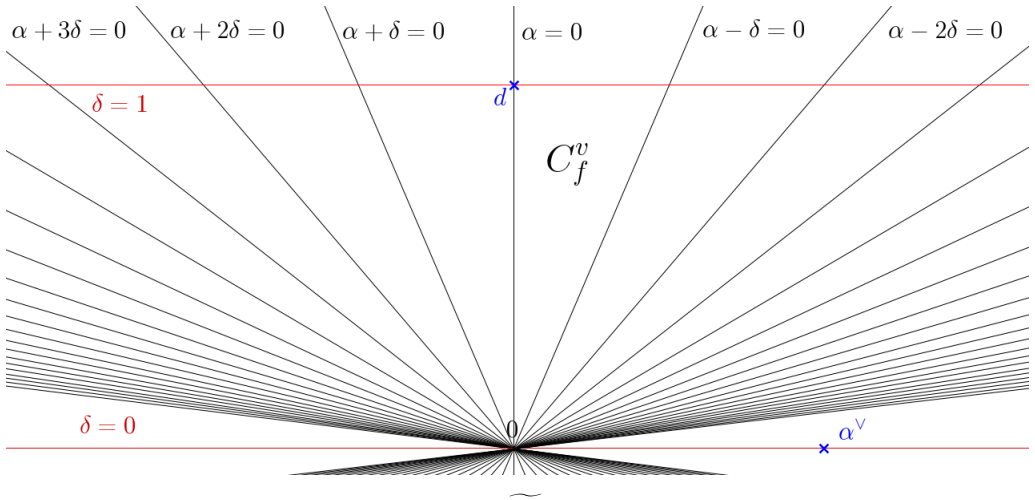
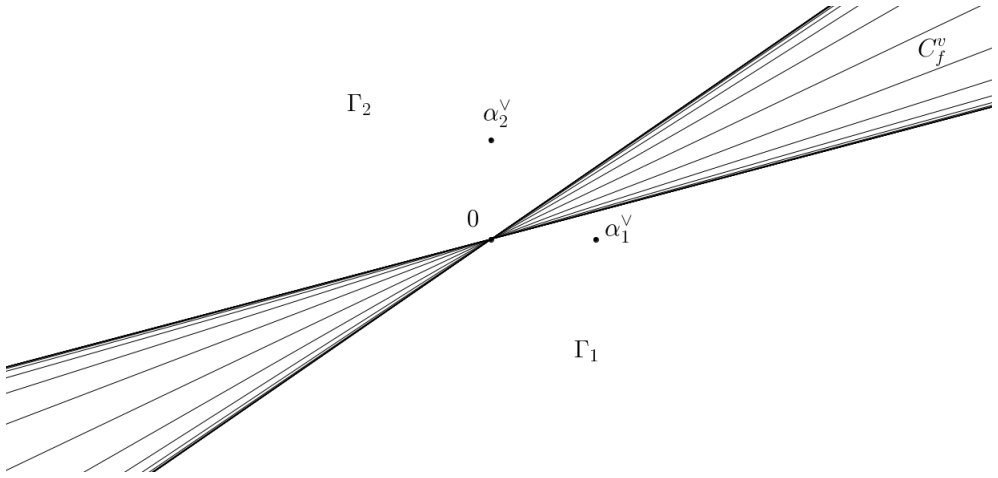
The masure itself, a generalization of a Bruhat-Tits building consisting of apartments and facets on which the Kac-Moody group acts with prescribed stabilizers.
If this is right
- The group admits a well-defined action on the masure with stabilizers that can be described in terms of parahoric subgroups.
- Any representation or cohomology theory previously studied on Bruhat-Tits buildings extends in principle to these masures.
- The simplified axiomatic becomes a practical checklist for verifying future constructions of similar spaces.
Where Pith is reading between the lines
- The same construction technique may extend to non-split Kac-Moody groups once the axioms are checked in that setting.
- Low-rank examples such as affine Kac-Moody groups over local fields should allow direct computation of the masure to test its metric properties.
- The masure may serve as a model space for studying twin buildings or other related geometric objects in the same algebraic setting.
Load-bearing premise
The simplified axiomatic captures enough of the original Rousseau axioms that any object satisfying the simplified version still behaves as a usable geometric model for the group.
What would settle it
An explicit split Kac-Moody group over a valued field whose constructed space violates one of the simplified axioms, such as the existence of a unique apartment containing any two given points.
Figures




read the original abstract
Masures are generalizations of Bruhat-Tits buildings adapted to the study of Kac--Moody groups over valued fields. They were introduced by Gaussent and Rousseau in 2007. Rousseau defined an axiomatic for these object and we simplified it. In this paper, which is mainly expository, we construct the masure associated with a split Kac--Moody group over a valued field, and we prove that it satisfies our axiomatic.
Editorial analysis
A structured set of objections, weighed in public.
Referee Report
Summary. The manuscript, which is primarily expository, constructs the masure associated to a split Kac-Moody group over a valued field and verifies that the resulting object satisfies a simplified axiomatic for masures introduced by the authors (a simplification of Rousseau's original axiomatic). The central claim is that this explicit construction meets the listed axioms, providing a concrete realization in the split case.
Significance. If the verification holds, the paper supplies a self-contained reference for the masure construction in the split setting, which may aid researchers working with Kac-Moody groups over valued fields by clarifying the geometric structure through an accessible axiomatic framework. The explicit construction and direct verification against the authors' axioms constitute a concrete contribution to the literature.
minor comments (2)
- The abstract states that the authors simplified Rousseau's axiomatic but does not indicate in which section the equivalence (or sufficiency) of the simplified version for the purposes of the construction is established; adding a brief pointer would improve readability.
- Notation for the valued field and the root datum is introduced without a dedicated preliminary subsection; a short table or list of standing assumptions would help readers track the data throughout the verification.
Simulated Author's Rebuttal
We thank the referee for their positive assessment of the manuscript, for recognizing its expository value as a self-contained reference, and for recommending minor revision. The report does not raise any specific major comments or point to particular issues with the construction or the verification of the axioms. We have therefore prepared a revised version addressing any minor editorial or presentational improvements we identified during our own review.
Circularity Check
No significant circularity: explicit construction verified against simplified axiomatic
full rationale
The paper is expository and presents a direct construction of the masure for a split Kac-Moody group over a valued field, followed by a verification that this object satisfies the authors' simplified axiomatic (itself derived from Rousseau's 2007 definition). No equations reduce the result to a fitted parameter, self-definition, or prior self-citation chain; the central claim is an explicit build-and-check against listed axioms, with the simplification framed as a deliberate expository choice rather than a load-bearing premise that forces the outcome. The derivation remains self-contained against external benchmarks.
Axiom & Free-Parameter Ledger
Reference graph
Works this paper leans on
- [1]
-
[2]
[AVM10] Peter Abramenko and Hendrik Van Maldeghem, Intersections of apartments, J
[AH19] Ramla Abdellatif and Auguste Hébert, Completed Iwahori-Hecke algebras and parahoric Heckealgebras for Kac-Moody groups overlocal fields, Journal de l’École polytechnique — Mathématiques6 (2019), 79–118 (en). [AVM10] Peter Abramenko and Hendrik Van Maldeghem, Intersections of apartments, J. Comb. Theory, Ser. A117 (2010), no. 4, 440–453 (English). [...
2019
-
[3]
Lie Theory33 (2023), no
MR 2508056 [BG23] Tristan Bozec and Stéphane Gaussent, Mirković-vilonenpolytopes and masures, J. Lie Theory33 (2023), no. 3, 719–746 (English). [BGR16] Nicole Bardy-Panse, Stéphane Gaussent, and Guy Rousseau, Iwahori-Hecke algebras for Kac-Moody groups overlocal fields, Pacific J. Math.285 (2016), no. 1, 1–61. MR 3554242 [BK11] Alexander Braverman and Dav...
2023
-
[4]
[Lie groups and Lie algebras. Chapters 4, 5 and 6]. MR 647314 [Bou06] , Éléments de mathématique. Groupes et algèbres de Lie. Chapitres 2 et 3, reprint of the 1972 original ed., Berlin: Springer, 2006 (French). [Bou07] , Élémentsdemathématique.Groupes etalgèbresdeLie.Chapitre1, reprint of the 1972 original ed., Berlin: Springer, 2007 (French). [BPHR25] Ni...
-
[5]
Engler and Alexander Prestel, Valued fields, Springer Monogr
MR 1851337 [EP05] Antonio J. Engler and Alexander Prestel, Valued fields, Springer Monogr. Math., Berlin: Springer, 2005 (English). [Gar78] Howard Garland, The arithmetic theory of loop algebras, J. Algebra53 (1978), 480–551 (English). [Gar95] H. Garland, A Cartan decomposition for p-adic loop groups, Math. Ann. 302 (1995), no. 1, 151–175. MR 1329451 [GI6...
-
[6]
Millson, A path model for geodesics in Euclidean buildings and its applications to representation theory, Groups Geom
[KM08] Michael Kapovich and John J. Millson, A path model for geodesics in Euclidean buildings and its applications to representation theory, Groups Geom. Dyn. 2 (2008), no. 3, 405–480. MR 2415306 (2009d:20069) [KP85] V. G. Kac and D. H. Peterson, Defining relations of certain infinite dimensional groups, Élie Cartan et les mathématiques d’aujourd’hui, Th...
2008
-
[7]
Monogr., vol
[KP23] Tasho Kaletha and Gopal Prasad, Bruhat-tits theory.A new approach, New Math. Monogr., vol. 44, Cambridge: Cambridge University Press, 2023 (English). [Kum02] Shrawan Kumar, Kac-Moody groups, their flagvarietiesand representationtheory, Progress in Mathematics, vol. 204, Birkhäuser Boston, Inc., Boston, MA,
2023
-
[8]
Math., Zürich: European Mathematical Society (EMS), 2018 (English)
MR 1923198 [Mar18] Timothée Marquis, An introduction to Kac-Moody groups overfields, EMS Textb. Math., Zürich: European Mathematical Society (EMS), 2018 (English). [Mat89] Olivier Mathieu, Construction d’ungroupe de Kac-Moody et applications, Com- positio Math.69 (1989), no. 1, 37–60. MR 986812 [Mit85] David Mitzman, IntegralbasesforaffineLiealgebrasandth...
-
[9]
[Mut19] Dinakar Muthiah, Double-affine Kazhdan-Lusztig polynomials via masures, arXiv preprint arXiv:1910.13694 (2019). [Par00] Anne Parreau, Immeubles affines: construction par les normes, Crystallographic Groups and Their Generalizations: Workshop, Katholieke Universiteit Leuven Campus Kortrijk, Belgium, May 26-28, 1999, vol. 262, American Mathematical ...
-
[10]
Incidence Geom.20 (2023), no
[Par23] , Affine buildings: construction by norms and study of isometries, Innov. Incidence Geom.20 (2023), no. 2-3, 471–517 (English). [Rém02] Bertrand Rémy, Groupes de Kac-Moody déployés et presque déployés, Astérisque (2002), no. 277, viii+348. MR 1909671 [Rou06] Guy Rousseau, Kac-Moody groups split over a local field, microaffine buildings, Compos. Ma...
2023
-
[11]
Rédigé avec la collaboration de Hyman Bass, Astérisque, vol
MR 0215886 [Ser77] , Arbres, amalgames, SL2. Rédigé avec la collaboration de Hyman Bass, Astérisque, vol. 46, Société Mathématique de France (SMF), Paris, 1977 (French). [Ser80] , Trees. Transl. from the French by John Stillwell, Berlin-Heidelberg-New York: Springer-Verlag. IX, 142 p. DM 48.00; $ 28.40 (1980).,
1977
-
[12]
[Ste16] Robert Steinberg, Lectures on Chevalley groups, Univ
[Ser01] , Complex semi-simple lie algebras, translated from the french by ga jones, reprint of the 1987 edition, Springer Monographs in Mahematics, Springer Verlag, Berlin (2001). [Ste16] Robert Steinberg, Lectures on Chevalley groups, Univ. Lect. Ser., vol. 66, Provi- dence, RI: American Mathematical Society (AMS), 2016 (English). [Tit87] Jacques Tits, U...
1987
discussion (0)
Sign in with ORCID, Apple, or X to comment. Anyone can read and Pith papers without signing in.