Recognition: unknown
The Amazing Stability of Flow Matching
Pith reviewed 2026-05-10 08:34 UTC · model grok-4.3
The pith
Flow matching models preserve sample quality and diversity after randomly pruning half the training images.
A machine-rendered reading of the paper's core claim, the machinery that carries it, and where it could break.
Core claim
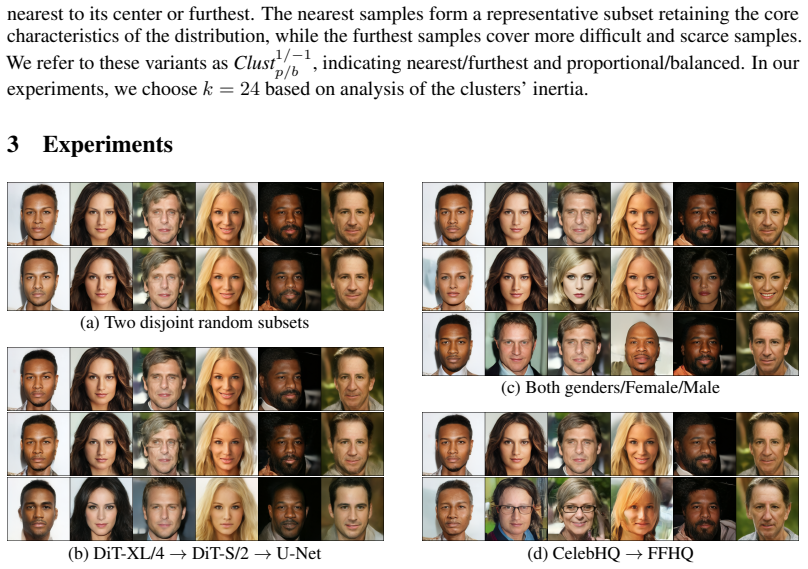
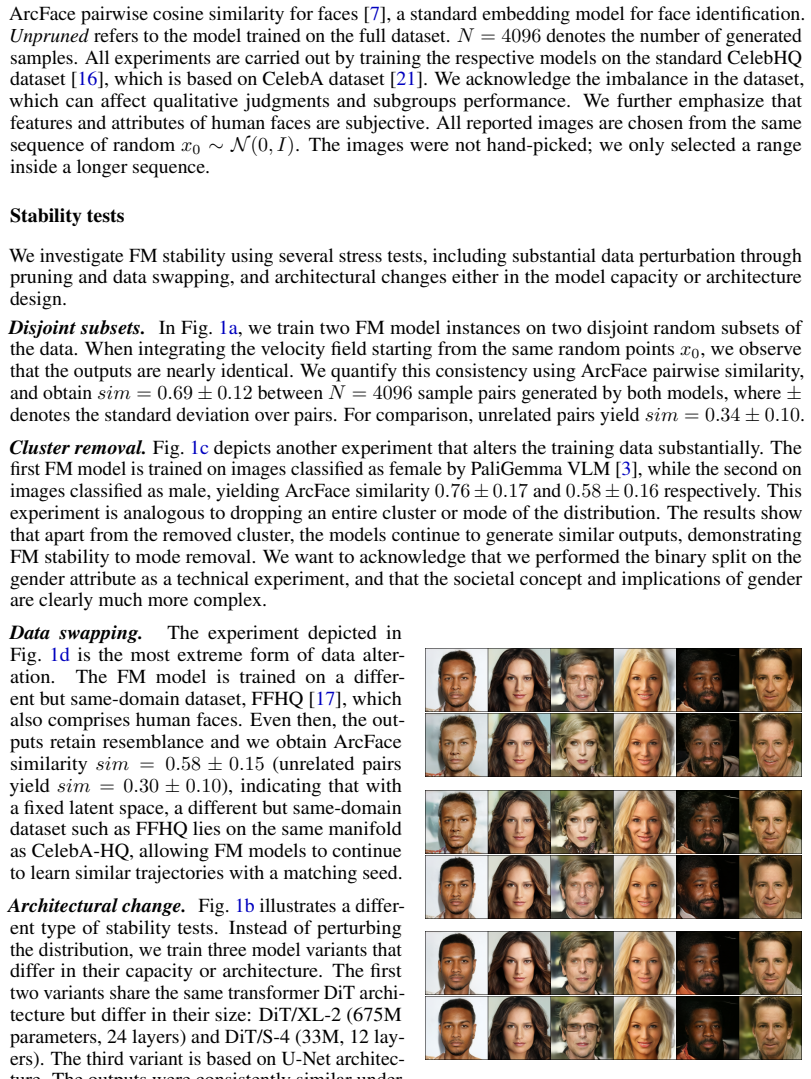
Flow-matching models exhibit strong stability in practice: pruning 50% of the CelebA-HQ dataset preserves the quality and diversity of generated samples, while samples generated by models trained on the full and pruned dataset map to visually similar outputs for a given seed. Similar stability holds when the architecture or training configuration is changed, maintaining the latent representation under these perturbations as well.
What carries the argument
Flow matching, the continuous-time generative process that learns a velocity field to map noise to data, which in the experiments maintains consistent output distributions and latent mappings despite large reductions in training data or architectural shifts.
Load-bearing premise
Random pruning of half the CelebA-HQ images leaves the underlying data distribution close enough to the original that quality and diversity metrics still apply, and visual similarity of outputs for fixed seeds is enough to show the latent representation has been preserved.
What would settle it
A substantial drop in FID or other quality/diversity metrics after 50% pruning, or a clear visual mismatch between images produced by full-data and pruned-data models when using identical random seeds.
Figures
read the original abstract
The success of deep generative models in generating high-quality and diverse samples is often attributed to particular architectures and large training datasets. In this paper, we investigate the impact of these factors on the quality and diversity of samples generated by \emph{flow-matching} models. Surprisingly, in our experiments on CelebA-HQ dataset, flow matching remains stable even when pruning 50\% of the dataset. That is, the quality and diversity of generated samples are preserved. Moreover, pruning impacts the latent representation only slightly, that is, samples generated by models trained on the full and pruned dataset map to visually similar outputs for a given seed. We observe similar stability when changing the architecture or training configuration, such that the latent representation is maintained under these changes as well. Our results quantify just how strong this stability can be in practice, and help explain the reliability of flow-matching models under various perturbations.
Editorial analysis
A structured set of objections, weighed in public.
Referee Report
Summary. The paper claims that flow-matching models exhibit strong empirical stability on the CelebA-HQ dataset: even after pruning 50% of the training data, the quality and diversity of generated samples remain preserved. It further asserts that pruning affects the latent representation only slightly, as evidenced by visually similar outputs for fixed seeds from models trained on the full versus pruned datasets. Analogous stability is reported under changes to model architecture or training configuration, which the authors argue helps explain the reliability of flow-matching models under perturbations.
Significance. If the empirical observations hold under rigorous scrutiny, the results would be significant for the field of generative modeling. They would demonstrate that flow matching is unusually robust to substantial data reduction and to variations in architecture/training, potentially reducing the need for massive datasets in practice and providing a practical explanation for observed reliability. The work is purely observational and would benefit from quantitative validation to elevate its impact.
major comments (3)
- [Abstract] Abstract: The central claim that pruning 'impacts the latent representation only slightly' rests solely on the statement that samples for a given seed are 'visually similar.' No quantitative metrics (LPIPS, SSIM, latent cosine similarity, etc.), statistical tests across multiple seeds, or comparison to intra-model variability are reported, making it impossible to assess whether the similarity exceeds training noise.
- [Abstract] Abstract: The pruning procedure, evaluation metrics for quality/diversity, number of independent runs, and controls for confounding factors (e.g., random seeds, training hyperparameters) are not described. Without these details the reported preservation of quality and diversity cannot be reproduced or verified.
- [Abstract] Abstract: The assumption that random 50% pruning preserves the data distribution sufficiently for quality/diversity metrics to remain meaningful is untested; no analysis of distribution shift (MMD, coverage, or similar) is provided, which is load-bearing for interpreting the stability result.
minor comments (1)
- [Abstract] Abstract: The title uses informal language ('Amazing Stability'); a more precise title would better suit a technical manuscript.
Simulated Author's Rebuttal
We thank the referee for the careful reading and constructive comments. We agree that the current presentation would benefit from additional quantitative support, clearer experimental details, and validation of the pruning assumption. We outline specific revisions below.
read point-by-point responses
-
Referee: [Abstract] Abstract: The central claim that pruning 'impacts the latent representation only slightly' rests solely on the statement that samples for a given seed are 'visually similar.' No quantitative metrics (LPIPS, SSIM, latent cosine similarity, etc.), statistical tests across multiple seeds, or comparison to intra-model variability are reported, making it impossible to assess whether the similarity exceeds training noise.
Authors: We acknowledge that the evidence presented for the effect on latent representations is qualitative. In the revised manuscript we will add quantitative metrics (LPIPS, SSIM, and latent-space cosine similarity) computed over multiple fixed seeds, together with statistical comparisons against intra-model variability obtained from repeated training runs with different random seeds. These additions will allow readers to judge whether the observed similarity exceeds typical training stochasticity. revision: yes
-
Referee: [Abstract] Abstract: The pruning procedure, evaluation metrics for quality/diversity, number of independent runs, and controls for confounding factors (e.g., random seeds, training hyperparameters) are not described. Without these details the reported preservation of quality and diversity cannot be reproduced or verified.
Authors: The full manuscript contains the pruning procedure (uniform random subsampling to 50 %), the quality and diversity metrics (FID together with recall-based diversity), and the training configuration. Nevertheless, we agree these elements are insufficiently summarized for quick verification. We will expand the abstract with a concise methods paragraph and insert a table listing the number of independent runs, random-seed controls, and key hyperparameters. revision: partial
-
Referee: [Abstract] Abstract: The assumption that random 50% pruning preserves the data distribution sufficiently for quality/diversity metrics to remain meaningful is untested; no analysis of distribution shift (MMD, coverage, or similar) is provided, which is load-bearing for interpreting the stability result.
Authors: We accept that an explicit check on distribution shift strengthens the interpretation. In the revision we will report MMD and coverage statistics between the original and pruned CelebA-HQ training sets, confirming that the random 50 % subsample does not introduce a detectable shift that would invalidate the quality/diversity comparisons. revision: yes
Circularity Check
No circularity: purely observational empirical results
full rationale
The paper reports experimental outcomes from training flow-matching models on full vs. pruned CelebA-HQ datasets and varying architectures/configurations. No equations, derivations, fitted parameters, or self-referential definitions appear in the abstract or described content. All claims rest on direct observations of sample quality, diversity, and visual similarity for fixed seeds, which are independent measurements rather than reductions to inputs by construction. No load-bearing steps reduce to self-citation chains or ansatzes.
Axiom & Free-Parameter Ledger
Forward citations
Cited by 1 Pith paper
-
Exploring and Exploiting Stability in Latent Flow Matching
Latent Flow Matching models exhibit inherent stability to data reduction and model shrinkage due to the flow matching objective, enabling reduced-dataset training and two-stage inference with over 2x speedup while pre...
Reference graph
Works this paper leans on
-
[1]
Lumiere: A space-time diffusion model for video generation
Omer Bar-Tal, Hila Chefer, Omer Tov, Charles Herrmann, Roni Paiss, Shiran Zada, Ariel Ephrat, Junhwa Hur, Guanghui Liu, Amit Raj, et al. Lumiere: A space-time diffusion model for video generation. InSIGGRAPH Asia 2024 Conference Papers, pages 1–11, 2024
2024
-
[2]
Quentin Bertrand, Anne Gagneux, Mathurin Massias, and Rémi Emonet. On the closed-form of flow matching: Generalization does not arise from target stochasticity.arXiv preprint arXiv:2506.03719, 2025
-
[3]
PaliGemma: A versatile 3B VLM for transfer
Lucas Beyer, Andreas Steiner, André Susano Pinto, Alexander Kolesnikov, Xiao Wang, Daniel Salz, Maxim Neumann, Ibrahim Alabdulmohsin, Michael Tschannen, Emanuele Bugliarello, et al. Paligemma: A versatile 3b vlm for transfer.arXiv preprint arXiv:2407.07726, 2024
work page internal anchor Pith review arXiv 2024
-
[4]
Align your latents: High-resolution video synthesis with latent diffusion models
Andreas Blattmann, Robin Rombach, Huan Ling, Tim Dockhorn, Seung Wook Kim, Sanja Fidler, and Karsten Kreis. Align your latents: High-resolution video synthesis with latent diffusion models. InProceedings of the IEEE/CVF conference on computer vision and pattern recognition, pages 22563–22575, 2023
2023
-
[5]
Data pruning in generative diffusion models
Rania Briq, Jiangtao Wang, and Stefan Kesselheim. Data pruning in generative diffusion models. arXiv preprint arXiv:2411.12523, 2024
-
[6]
Diffusion schrödinger bridge with applications to score-based generative modeling.Advances in neural information processing systems, 34:17695–17709, 2021
Valentin De Bortoli, James Thornton, Jeremy Heng, and Arnaud Doucet. Diffusion schrödinger bridge with applications to score-based generative modeling.Advances in neural information processing systems, 34:17695–17709, 2021
2021
-
[7]
Arcface: Additive angular margin loss for deep face recognition
Jiankang Deng, Jia Guo, Xue Niannan, and Stefanos Zafeiriou. Arcface: Additive angular margin loss for deep face recognition. InCVPR, 2019
2019
-
[8]
An Image is Worth 16x16 Words: Transformers for Image Recognition at Scale
Alexey Dosovitskiy. An image is worth 16x16 words: Transformers for image recognition at scale.arXiv preprint arXiv:2010.11929, 2020
work page internal anchor Pith review Pith/arXiv arXiv 2010
-
[9]
Scaling rectified flow trans- formers for high-resolution image synthesis
Patrick Esser, Sumith Kulal, Andreas Blattmann, Rahim Entezari, Jonas Müller, Harry Saini, Yam Levi, Dominik Lorenz, Axel Sauer, Frederic Boesel, et al. Scaling rectified flow trans- formers for high-resolution image synthesis. InForty-first international conference on machine learning, 2024
2024
-
[10]
How do flow matching models memorize and generalize in sample data subspaces?, 2024
Weiguo Gao and Ming Li. How do flow matching models memorize and generalize in sample data subspaces?arXiv preprint arXiv:2410.23594, 2024
-
[11]
Stability of entropic optimal transport and schrödinger bridges.Journal of Functional Analysis, 283(9):109622, 2022
Promit Ghosal, Marcel Nutz, and Espen Bernton. Stability of entropic optimal transport and schrödinger bridges.Journal of Functional Analysis, 283(9):109622, 2022
2022
-
[12]
Gans trained by a two time-scale update rule converge to a local nash equilibrium.Advances in neural information processing systems, 30, 2017
Martin Heusel, Hubert Ramsauer, Thomas Unterthiner, Bernhard Nessler, and Sepp Hochreiter. Gans trained by a two time-scale update rule converge to a local nash equilibrium.Advances in neural information processing systems, 30, 2017
2017
-
[13]
Denoising diffusion probabilistic models.Advances in neural information processing systems, 33:6840–6851, 2020
Jonathan Ho, Ajay Jain, and Pieter Abbeel. Denoising diffusion probabilistic models.Advances in neural information processing systems, 33:6840–6851, 2020
2020
-
[14]
Imagen Video: High Definition Video Generation with Diffusion Models
Jonathan Ho, William Chan, Chitwan Saharia, Jay Whang, Ruiqi Gao, Alexey Gritsenko, Diederik P Kingma, Ben Poole, Mohammad Norouzi, David J Fleet, et al. Imagen video: High definition video generation with diffusion models.arXiv preprint arXiv:2210.02303, 2022
work page internal anchor Pith review arXiv 2022
-
[15]
Generalization in diffusion models arises from geometry-adaptive harmonic representation
Zahra Kadkhodaie, Florentin Guth, Eero P Simoncelli, and St’ephane Mallat. Generalization in diffusion models arises from geometry-adaptive harmonic representation. InThe Twelfth International Conference on Learning Representations, 2024
2024
-
[16]
Progressive Growing of GANs for Improved Quality, Stability, and Variation
Tero Karras, Timo Aila, Samuli Laine, and Jaakko Lehtinen. Progressive growing of gans for improved quality, stability, and variation.arXiv preprint arXiv:1710.10196, 2017
work page internal anchor Pith review arXiv 2017
-
[17]
A style-based generator architecture for generative adversarial networks
Tero Karras, Samuli Laine, and Timo Aila. A style-based generator architecture for generative adversarial networks. InProceedings of the IEEE/CVF Conference on Computer Vision and Pattern Recognition (CVPR), 2019. 6
2019
-
[18]
Flow Matching for Generative Modeling
Yaron Lipman, Ricky TQ Chen, Heli Ben-Hamu, Maximilian Nickel, and Matt Le. Flow matching for generative modeling.arXiv preprint arXiv:2210.02747, 2022
work page internal anchor Pith review Pith/arXiv arXiv 2022
-
[19]
Flow Straight and Fast: Learning to Generate and Transfer Data with Rectified Flow
Xingchao Liu, Chengyue Gong, and Qiang Liu. Flow straight and fast: Learning to generate and transfer data with rectified flow.arXiv preprint arXiv:2209.03003, 2022
work page internal anchor Pith review arXiv 2022
-
[20]
Sora: A Review on Background, Technology, Limitations, and Opportunities of Large Vision Models
Yixin Liu, Kai Zhang, Yuan Li, Zhiling Yan, Chujie Gao, Ruoxi Chen, Zhengqing Yuan, Yue Huang, Hanchi Sun, Jianfeng Gao, et al. Sora: a review on background, technology, limitations, and opportunities of large vision models (2024).URL https://arxiv. org/abs/2402.17177
work page internal anchor Pith review arXiv 2024
-
[21]
Deep learning face attributes in the wild
Ziwei Liu, Ping Luo, Xiaogang Wang, and Xiaoou Tang. Deep learning face attributes in the wild. InProceedings of the IEEE international conference on computer vision, pages 3730–3738, 2015
2015
-
[22]
Least squares quantization in pcm.IEEE Transactions on Information Theory, 28 (2):129–137, 1982
Stuart Lloyd. Least squares quantization in pcm.IEEE Transactions on Information Theory, 28 (2):129–137, 1982
1982
-
[23]
Bruno Mlodozeniec, Runa Eschenhagen, Juhan Bae, Alexander Immer, David Krueger, and Richard Turner. Influence functions for scalable data attribution in diffusion models.arXiv preprint arXiv:2410.13850, 2024
-
[24]
Deep learning on a data diet: Finding important examples early in training.Advances in neural information processing systems, 34:20596–20607, 2021
Mansheej Paul, Surya Ganguli, and Gintare Karolina Dziugaite. Deep learning on a data diet: Finding important examples early in training.Advances in neural information processing systems, 34:20596–20607, 2021
2021
-
[25]
Scalable diffusion models with transformers
William Peebles and Saining Xie. Scalable diffusion models with transformers. InProceedings of the IEEE/CVF international conference on computer vision, pages 4195–4205, 2023
2023
-
[26]
Learning transferable visual models from natural language supervision
Alec Radford, Jong Wook Kim, Chris Hallacy, Aditya Ramesh, Gabriel Goh, Sandhini Agarwal, Girish Sastry, Amanda Askell, Pamela Mishkin, Jack Clark, et al. Learning transferable visual models from natural language supervision. InInternational conference on machine learning, pages 8748–8763. PMLR, 2021
2021
-
[27]
High- resolution image synthesis with latent diffusion models
Robin Rombach, Andreas Blattmann, Dominik Lorenz, Patrick Esser, and Björn Ommer. High- resolution image synthesis with latent diffusion models. InProceedings of the IEEE/CVF conference on computer vision and pattern recognition, pages 10684–10695, 2022
2022
-
[28]
U-net: Convolutional networks for biomedical image segmentation
Olaf Ronneberger, Philipp Fischer, and Thomas Brox. U-net: Convolutional networks for biomedical image segmentation. InInternational Conference on Medical image computing and computer-assisted intervention, pages 234–241. Springer, 2015
2015
-
[29]
Generative modeling by estimating gradients of the data distribution.Advances in neural information processing systems, 32, 2019
Yang Song and Stefano Ermon. Generative modeling by estimating gradients of the data distribution.Advances in neural information processing systems, 32, 2019
2019
-
[30]
Score-Based Generative Modeling through Stochastic Differential Equations
Yang Song, Jascha Sohl-Dickstein, Diederik P Kingma, Abhishek Kumar, Stefano Ermon, and Ben Poole. Score-based generative modeling through stochastic differential equations.arXiv preprint arXiv:2011.13456, 2020
work page internal anchor Pith review Pith/arXiv arXiv 2011
-
[31]
Improving and generalizing flow-based generative models with minibatch optimal transport
Alexander Tong, Kilian Fatras, Nikolay Malkin, Guillaume Huguet, Yanlei Zhang, Jarrid Rector- Brooks, Guy Wolf, and Yoshua Bengio. Improving and generalizing flow-based generative models with minibatch optimal transport.arXiv preprint arXiv:2302.00482, 2023
work page internal anchor Pith review arXiv 2023
-
[32]
Neural discrete representation learning.Advances in neural information processing systems, 30, 2017
Aaron Van Den Oord, Oriol Vinyals, et al. Neural discrete representation learning.Advances in neural information processing systems, 30, 2017. 7
2017
discussion (0)
Sign in with ORCID, Apple, or X to comment. Anyone can read and Pith papers without signing in.