Recognition: 2 theorem links
· Lean TheoremExploring and Exploiting Stability in Latent Flow Matching
Pith reviewed 2026-05-12 01:18 UTC · model grok-4.3
The pith
Latent flow-matching models keep their output quality when trained on much less data or with smaller networks.
A machine-rendered reading of the paper's core claim, the machinery that carries it, and where it could break.
Core claim
Latent Flow-Matching (LFM) models are robust to data reduction and model capacity shrinkage, tending to generate similar outputs under identical noise seeds. This stability is inherent to the FM objective. Training on significantly reduced datasets does not degrade performance perceptually or quantitatively, reducing training time and annotation effort. Stability under architectural shrinkage enables a two-model coarse-to-fine approach that reduces inference cost substantially, with three sample-scoring criteria to select informative samples. Results hold across multiple datasets.
What carries the argument
The stability property of the flow matching objective in latent space, measured by output similarity under fixed noise seeds, which supports both data-efficient training and coarse-to-fine inference.
Load-bearing premise
The stability observed under data reduction and capacity shrinkage is general and does not depend on post-hoc sample selection or other unstated conditions.
What would settle it
Train LFM models on a dataset reduced to 20 percent of its size using one of the proposed scoring criteria, fix the noise seeds, and check whether perceptual similarity and quantitative metrics such as FID stay close to those of the full-data model.
Figures








read the original abstract
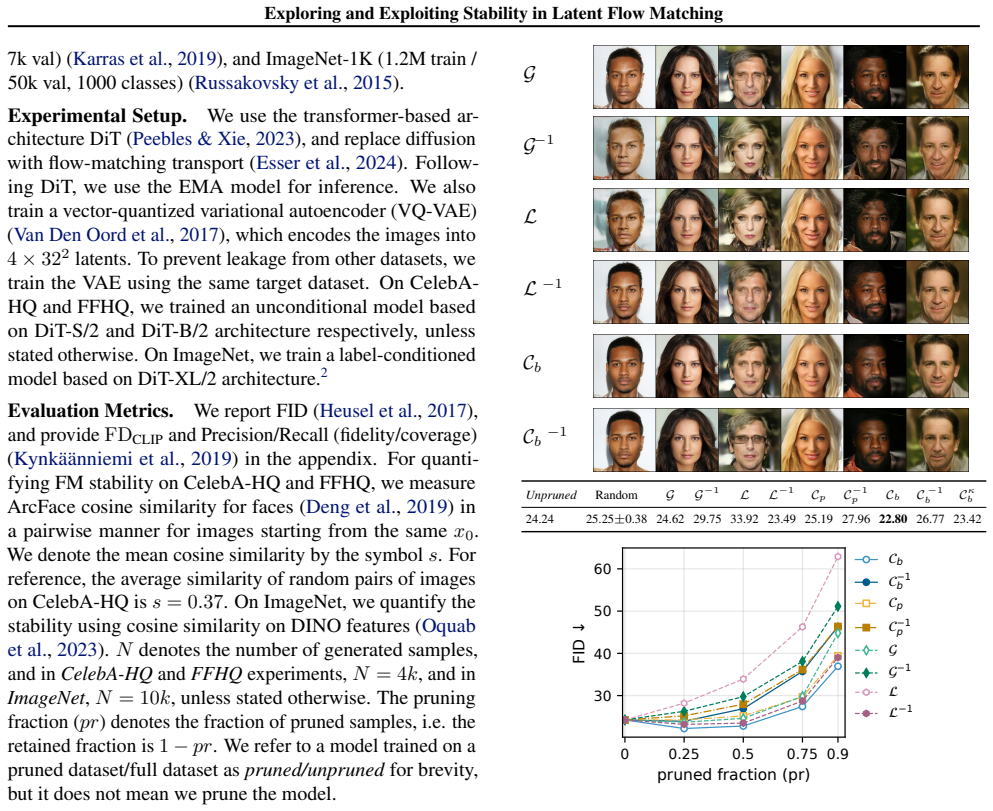
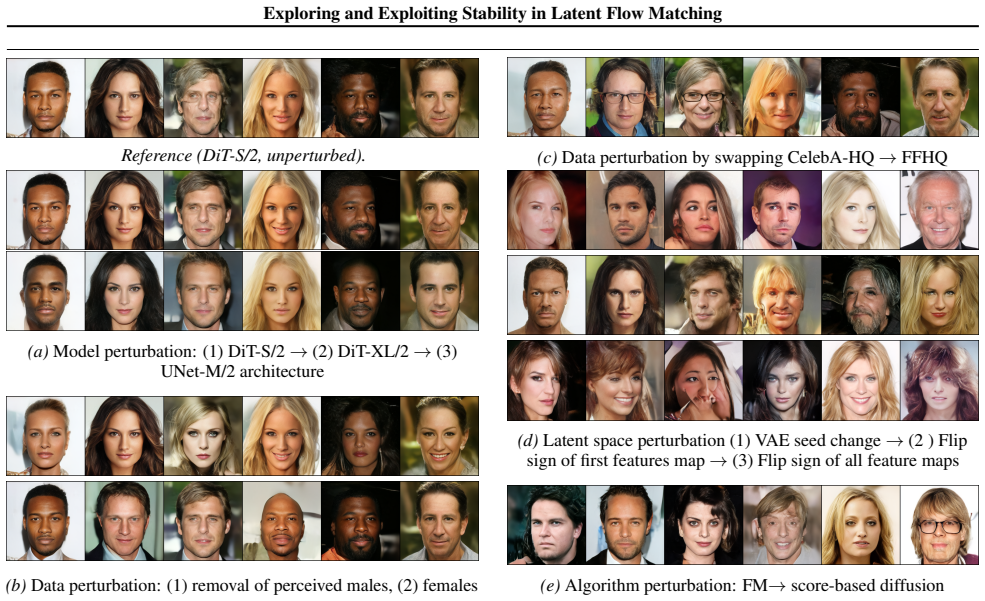
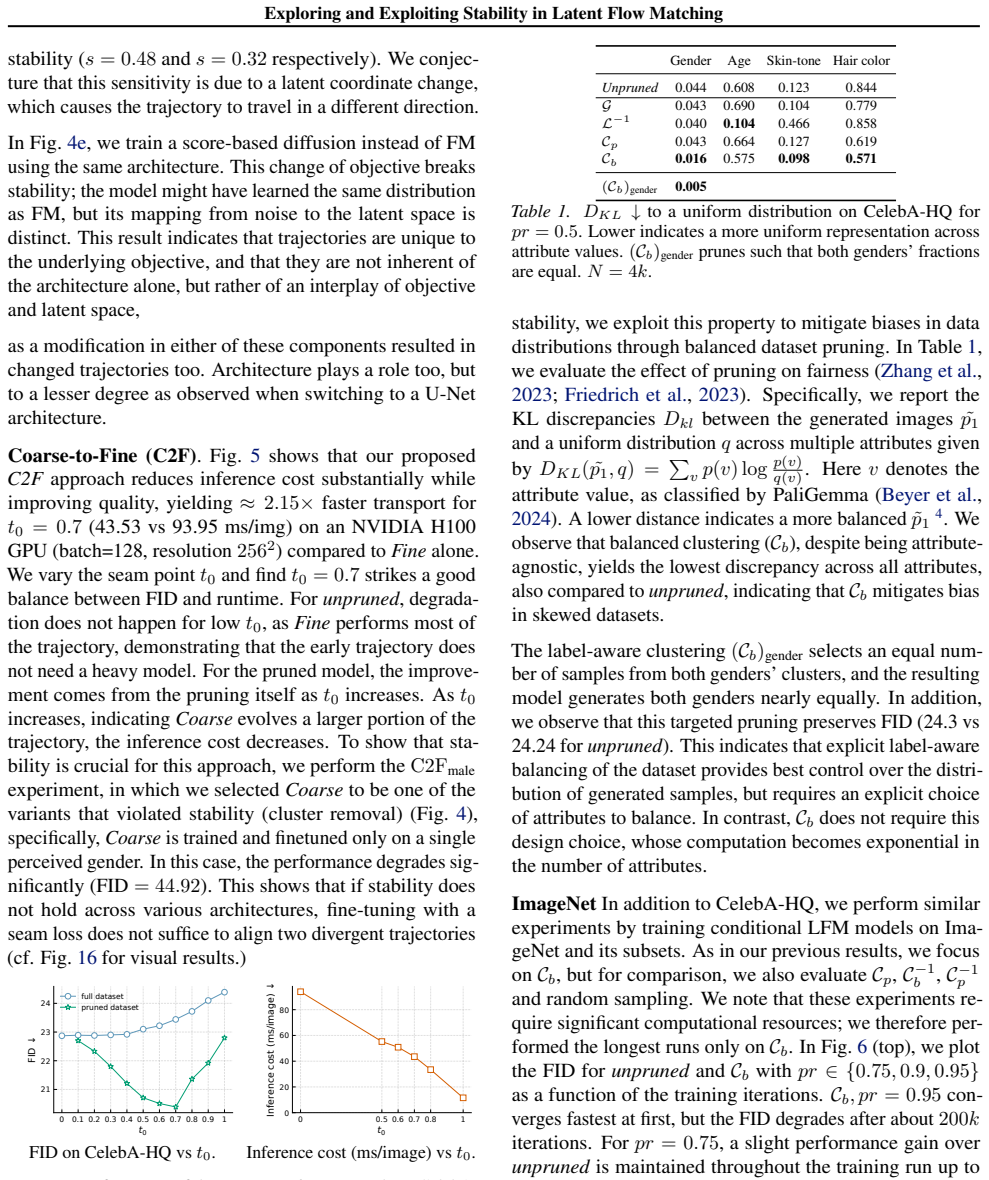
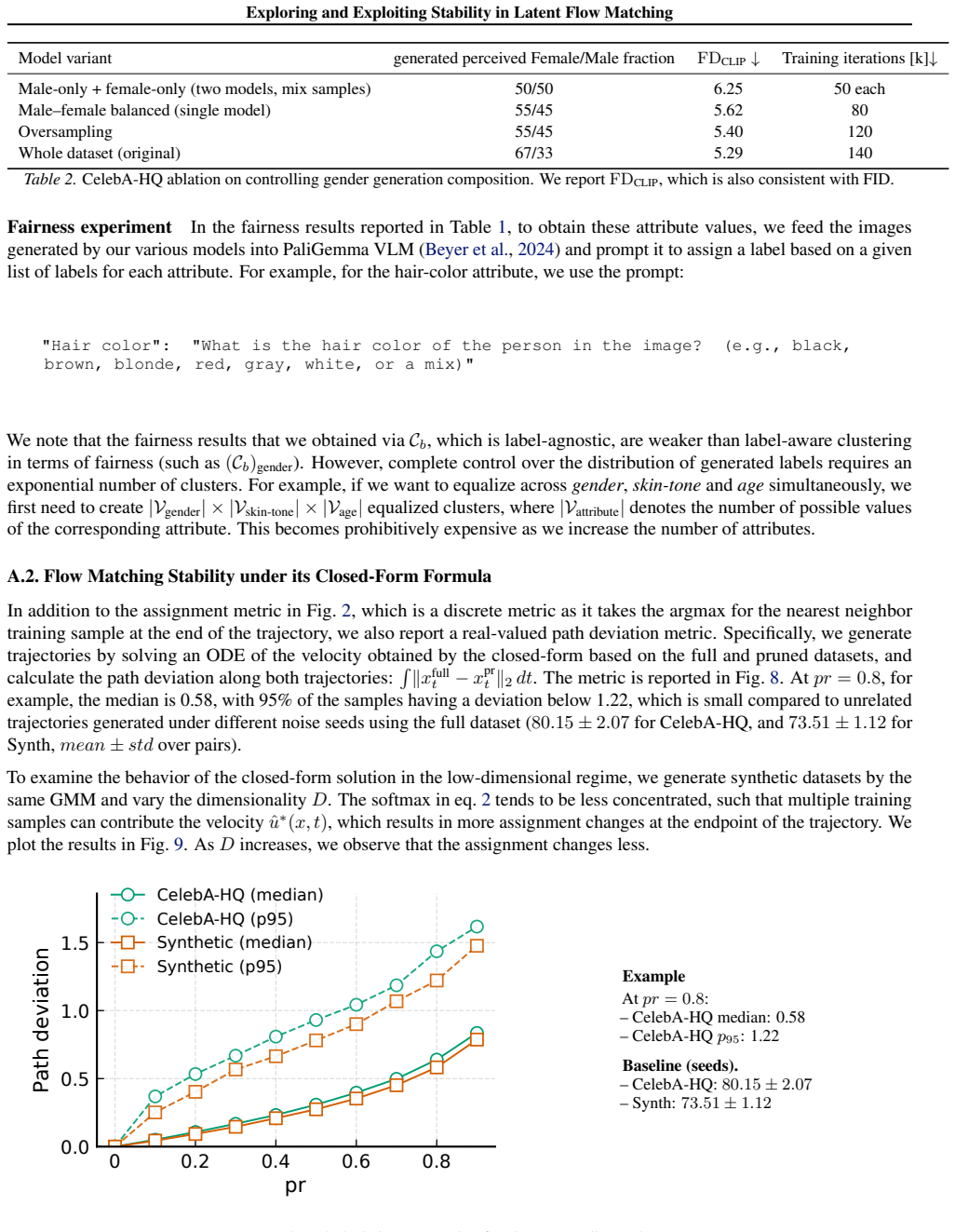
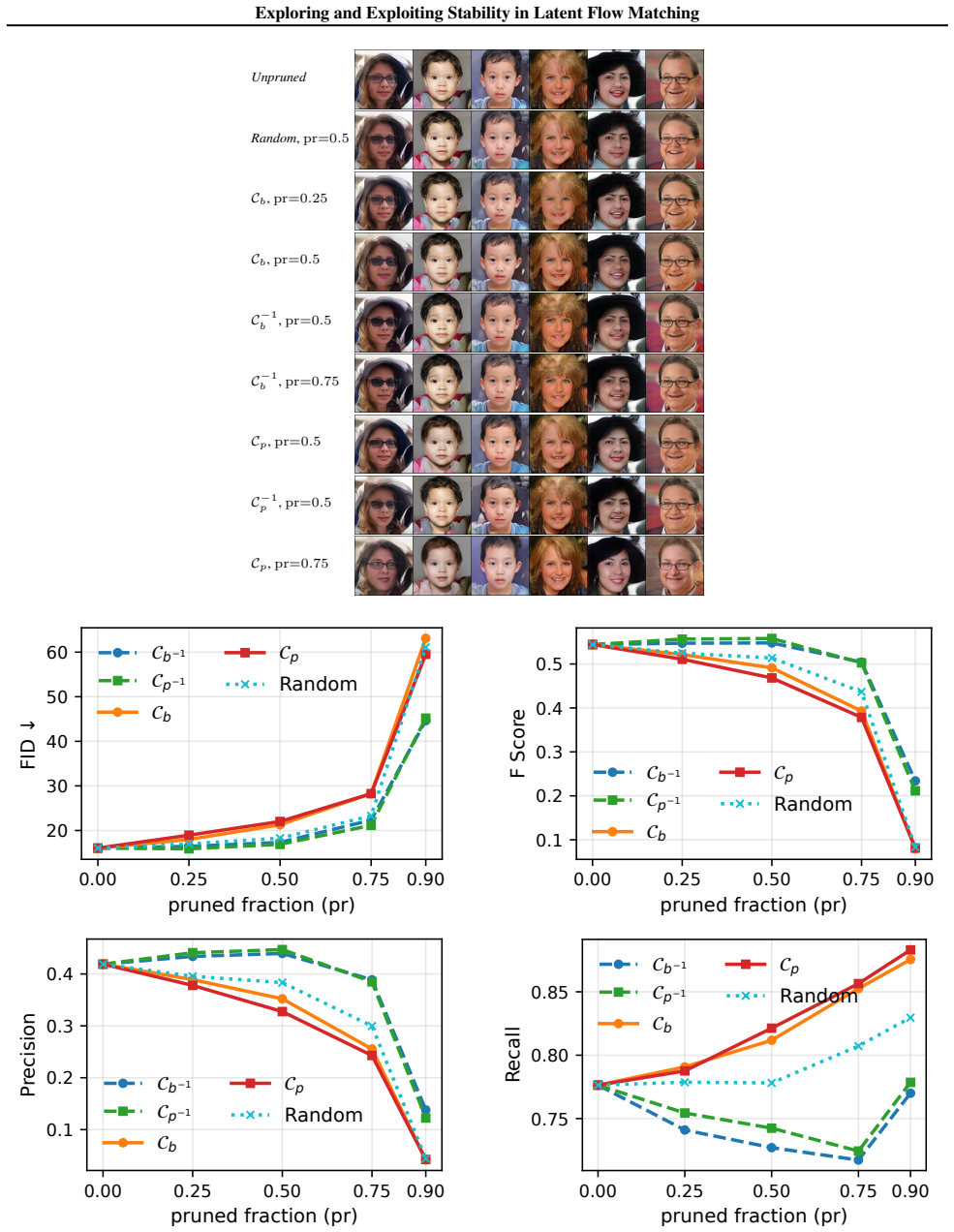
In this work, we show that Latent Flow-Matching (LFM) models are robust to different types of perturbations, including data reduction and model capacity shrinkage. We characterize this stability by their tendency to generate similar outputs under identical noise seeds. We provide a perspective relating this phenomenon to flow matching theory, which indicates that this stability is inherent to the FM objective. We further exploit this stability to derive practical algorithms for more efficient training and inference. Concretely, first, we show that by training LFM models on significantly reduced datasets, the performance does not degrade perceptually or quantitatively. This yields multiple advantages, such as reducing training time by converging faster under limited compute budget, and alleviating annotation effort when training conditional models. Second, LFM stability under architectural shrinkage gives rise to a two-model coarse-to-fine approach, one using a light-weight architecture for the first phase of the FM trajectory, and one with higher capacity for the second, thereby reducing the inference cost substantially. To determine which samples are informative, we introduce three sample-scoring criteria and evaluate them under standard metrics for generative models. Our results are thoroughly evaluated on multiple datasets, demonstrating the practical advantage of this stability, including data saving and a more than two-fold inference speedup while generating comparable outputs.
Editorial analysis
A structured set of objections, weighed in public.
Referee Report
Summary. The paper claims that Latent Flow-Matching (LFM) models exhibit inherent stability under perturbations such as data reduction and model capacity shrinkage, characterized by consistent outputs for fixed noise seeds. This stability is linked via a perspective to the flow-matching objective itself. The authors exploit it to train on significantly reduced datasets (selected via three introduced sample-scoring criteria) without perceptual or quantitative degradation, yielding faster convergence and reduced annotation needs, and to propose a two-model coarse-to-fine inference scheme that achieves more than 2x speedup while preserving output quality. Results are evaluated on multiple datasets using standard generative metrics.
Significance. If the stability is general and not conditional on sample curation, the results could enable substantial practical gains in training efficiency and inference cost for latent generative models. The theoretical perspective, if made rigorous, would strengthen the case for flow matching as a particularly stable paradigm compared to diffusion alternatives.
major comments (2)
- [Abstract] Abstract and the data-reduction experiments section: the claim that performance 'does not degrade perceptually or quantitatively' on 'significantly reduced datasets' is demonstrated only after applying the three sample-scoring criteria 'to determine which samples are informative.' This curation step is not incorporated into the perspective relating stability to the FM objective, so the asserted generality and inherent character of the stability remain unproven for arbitrary (non-curated) reductions.
- [Theoretical perspective section] The section presenting the theoretical perspective: the link between observed stability and the flow-matching objective is described as a 'perspective' rather than a derivation from the FM loss or vector-field properties. Without explicit steps showing how the objective enforces output invariance under data subsampling (independent of scoring), the claim that stability is 'inherent to the FM objective' lacks the required support for the central argument.
minor comments (1)
- [Abstract] The abstract states quantitative non-degradation but does not report the exact dataset sizes, reduction ratios, or error bars; these details should be added to the main text or a table for reproducibility.
Simulated Author's Rebuttal
We thank the referee for the constructive feedback, which helps us clarify the scope of our claims. We address the major comments point by point below.
read point-by-point responses
-
Referee: [Abstract] Abstract and the data-reduction experiments section: the claim that performance 'does not degrade perceptually or quantitatively' on 'significantly reduced datasets' is demonstrated only after applying the three sample-scoring criteria 'to determine which samples are informative.' This curation step is not incorporated into the perspective relating stability to the FM objective, so the asserted generality and inherent character of the stability remain unproven for arbitrary (non-curated) reductions.
Authors: We agree that the abstract phrasing could mislead readers into assuming the result holds for arbitrary reductions. The manuscript demonstrates no degradation only for datasets reduced via the three proposed sample-scoring criteria; arbitrary subsampling is not claimed or tested to preserve performance. The perspective is intended to provide intuition for why the FM objective yields stability that makes such selective reduction effective. We will revise the abstract to explicitly note that reduced datasets are obtained through the scoring criteria, and we will update the theoretical section to state that the perspective explains the observed stability without asserting invariance for non-curated cases. revision: yes
-
Referee: [Theoretical perspective section] The section presenting the theoretical perspective: the link between observed stability and the flow-matching objective is described as a 'perspective' rather than a derivation from the FM loss or vector-field properties. Without explicit steps showing how the objective enforces output invariance under data subsampling (independent of scoring), the claim that stability is 'inherent to the FM objective' lacks the required support for the central argument.
Authors: We acknowledge that the section is framed as a perspective and does not contain a complete derivation proving output invariance under arbitrary subsampling. The discussion connects the FM objective's regression to the conditional vector field with reduced sensitivity to data perturbations, but stops short of formal steps independent of the scoring. We will expand the section with additional explicit reasoning linking the loss formulation to the stability phenomenon while preserving the 'perspective' label to accurately reflect its interpretive nature rather than a theorem. This revision will better support the central argument without overstating the theoretical contribution. revision: partial
Circularity Check
No significant circularity; claims rest on empirical validation and an explicit perspective
full rationale
The paper reports experimental outcomes: LFM models trained on datasets reduced via three explicitly introduced sample-scoring criteria maintain perceptual and quantitative performance, and a coarse-to-fine two-model scheme reduces inference cost. The link to flow-matching theory is presented only as a 'perspective' rather than a formal derivation or theorem that reduces the observed stability to the training objective by construction. No equations are shown that equate a fitted quantity to a 'prediction,' no self-citation chain is invoked as load-bearing uniqueness, and the sample selection is openly methodological rather than hidden inside the stability claim. The argument therefore remains self-contained through direct measurement on multiple datasets.
Axiom & Free-Parameter Ledger
axioms (1)
- domain assumption Stability of LFM models under data and capacity perturbations is inherent to the FM objective
Lean theorems connected to this paper
-
IndisputableMonolith/Cost/FunctionalEquation.leanwashburn_uniqueness_aczel unclear?
unclearRelation between the paper passage and the cited Recognition theorem.
Closed form stability under pruning... ˆu∗(x, t) = Σ λi(x, t) (xi − x)/(1−t) with λi softmax over −∥x−t xi∥²/2(1−t)²
-
IndisputableMonolith/Foundation/ArithmeticFromLogic.leanembed_injective unclear?
unclearRelation between the paper passage and the cited Recognition theorem.
FM trajectories are largely shaped by individual training samples based on the closed-form solution to FM
What do these tags mean?
- matches
- The paper's claim is directly supported by a theorem in the formal canon.
- supports
- The theorem supports part of the paper's argument, but the paper may add assumptions or extra steps.
- extends
- The paper goes beyond the formal theorem; the theorem is a base layer rather than the whole result.
- uses
- The paper appears to rely on the theorem as machinery.
- contradicts
- The paper's claim conflicts with a theorem or certificate in the canon.
- unclear
- Pith found a possible connection, but the passage is too broad, indirect, or ambiguous to say the theorem truly supports the claim.
Reference graph
Works this paper leans on
- [1]
-
[2]
Error bounds for flow matching methods.arXiv preprint arXiv:2305.16860,
Benton, J., Deligiannidis, G., and Doucet, A. Error bounds for flow matching methods.arXiv preprint arXiv:2305.16860,
-
[3]
Bertrand, Q., Gagneux, A., Massias, M., and Emonet, R. On the closed-form of flow matching: Generalization does not arise from target stochasticity.arXiv preprint arXiv:2506.03719,
-
[4]
PaliGemma: A versatile 3B VLM for transfer
Beyer, L., Steiner, A., Pinto, A. S., Kolesnikov, A., Wang, X., Salz, D., Neumann, M., Alabdulmohsin, I., Tschan- nen, M., Bugliarello, E., et al. Paligemma: A versatile 3b vlm for transfer.arXiv preprint arXiv:2407.07726,
work page internal anchor Pith review Pith/arXiv arXiv
-
[5]
The Amazing Stability of Flow Matching
Briq, R., Kamp, M., Fried, O., Cohen, S., and Kesselheim, S. The amazing stability of flow matching.arXiv preprint arXiv:2604.16079,
work page internal anchor Pith review Pith/arXiv arXiv
-
[6]
Chen, Y ., Welling, M., and Smola, A
Presented at the EurIPS 2025 Workshop on Principles of Generative Models (PriGM). Chen, Y ., Welling, M., and Smola, A. Super-samples from kernel herding.arXiv preprint arXiv:1203.3472,
-
[7]
Selec- tion via proxy: Efficient data selection for deep learning
Coleman, C., Yeh, C., Mussmann, S., Mirzasoleiman, B., Bailis, P., Liang, P., Leskovec, J., and Zaharia, M. Selec- tion via proxy: Efficient data selection for deep learning. arXiv preprint arXiv:1906.11829,
-
[8]
Fair diffusion: Instructing text-to-image generation models on fairness,
Friedrich, F., Brack, M., Struppek, L., Hintersdorf, D., Schramowski, P., Luccioni, S., and Kersting, K. Fair diffusion: Instructing text-to-image generation models on fairness.arXiv preprint at arXiv:2302.10893,
-
[9]
How do flow matching models memorize and generalize in sample data subspaces?, 2024
Gao, W. and Li, M. How do flow matching models mem- orize and generalize in sample data subspaces?arXiv preprint arXiv:2410.23594,
-
[10]
Progressive Growing of GANs for Improved Quality, Stability, and Variation
Karras, T., Aila, T., Laine, S., and Lehtinen, J. Progres- sive growing of gans for improved quality, stability, and variation.arXiv preprint arXiv:1710.10196,
work page internal anchor Pith review arXiv
-
[11]
Flow Matching for Generative Modeling
Lipman, Y ., Chen, R. T., Ben-Hamu, H., Nickel, M., and Le, M. Flow matching for generative modeling.arXiv preprint arXiv:2210.02747,
work page internal anchor Pith review Pith/arXiv arXiv
-
[12]
Flow Straight and Fast: Learning to Generate and Transfer Data with Rectified Flow
Liu, X., Gong, C., and Liu, Q. Flow straight and fast: Learning to generate and transfer data with rectified flow. arXiv preprint arXiv:2209.03003,
work page internal anchor Pith review Pith/arXiv arXiv
-
[13]
Score-Based Generative Modeling through Stochastic Differential Equations
Song, Y ., Sohl-Dickstein, J., Kingma, D. P., Kumar, A., Er- mon, S., and Poole, B. Score-based generative modeling through stochastic differential equations.arXiv preprint arXiv:2011.13456,
work page internal anchor Pith review Pith/arXiv arXiv 2011
-
[14]
Further experiments and results A.1
12 Exploring and Exploiting Stability in Latent Flow Matching A. Further experiments and results A.1. Clustering Balanced clustering (Cb).In this method, when pruning based on a given pruning fraction pr, we divide the number of remaining samples equally by the number of clusters k: (1−pr)·|S| k (S denotes the dataset). If some clusters are too small to s...
work page 2012
-
[15]
When only the DiT-S/2 small architecture is used (row 1), we observe that the images have artifacts reflected in occasional blotches. When DiT-XL/2, a larger capacity model, is used (row 2), these artifacts disappear and the images appear sharper. In thecoarse-to-fineapproach, we observe that the fine model corrects the artifacts of the weaker coarse mode...
work page 2023
-
[16]
The bounds are so close to each other and do not correlate accurately with the FID, i.e. a lower bound does not indicate a better FID, hence cannot be used to deduce performance or stability. The most noticeable increase in error is incurred when we remove half the label-agnostic clusters (analogous to the gender removal experiment), which we have shown t...
work page 2023
discussion (0)
Sign in with ORCID, Apple, or X to comment. Anyone can read and Pith papers without signing in.