On the Rejection Criterion for Proxy-based Test-time Alignment
Pith reviewed 2026-05-10 08:09 UTC · model grok-4.3
The pith
Two proxy-based test-time alignment methods for language models reduce to sampling from similar graphical models that differ only in rejection criteria, and a conservative confidence bet improves results.
A machine-rendered reading of the paper's core claim, the machinery that carries it, and where it could break.
Core claim
Both the implicit reward approach, which skews the large model's distribution, and the nudging approach, which defers the next token to the small aligned model when the large base model is unconfident, can be reduced to sampling from similar graphical models, where they differ only in the definition of a rejection criterion or distribution. The confidence criterion is ill-motivated due to linguistic phenomena like ambiguous phrasing. A novel rejection criterion based on a conservative confidence bet is proposed, which experimentally outperforms previous work on several datasets.
What carries the argument
The rejection criterion or distribution in the graphical model for test-time sampling, which determines when the proxy influences generation versus the base model.
If this is right
- Alignment can be achieved and improved by adjusting only the rejection rule in the sampling process rather than redesigning the full method.
- The conservative confidence bet provides a practical replacement for standard confidence thresholds in proxy-guided generation.
- Better results are obtained on multiple datasets without the need for per-dataset tuning of the criterion.
- Test-time methods become more unified, allowing focus on rejection design to enhance proxy-based alignment.
Where Pith is reading between the lines
- This graphical model reduction implies that research on test-time alignment could benefit from exploring variations in other model components beyond rejection.
- The approach may extend naturally to non-language generative tasks where proxy guidance and uncertainty handling are relevant.
- It connects to broader challenges in estimating uncertainty in models that must handle inherent ambiguities in data.
- Combining the conservative bet with other sampling adjustments could be tested as a way to further boost alignment quality.
Load-bearing premise
The confidence criterion is ill-motivated due to linguistic phenomena like ambiguous phrasing, and the conservative confidence bet improves performance without introducing new failure modes or requiring dataset-specific tuning.
What would settle it
An experiment on one of the tested datasets where the conservative confidence bet shows equal or lower performance than the standard confidence criterion, or where it increases errors specifically on sentences with ambiguous phrasing.
Figures

read the original abstract
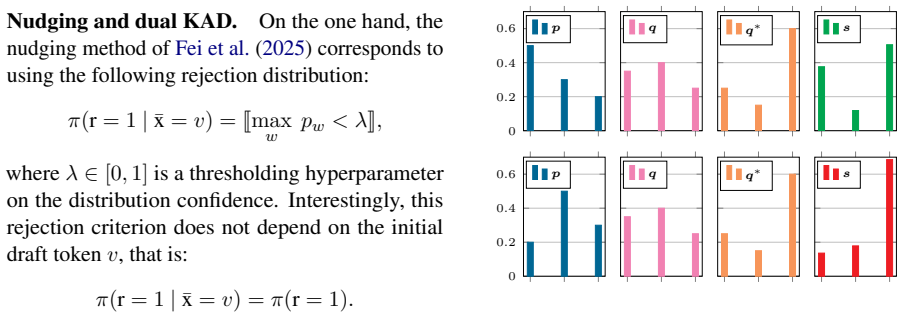
Recent works proposed test-time alignment methods that rely on a small aligned model as a proxy that guides the generation of a larger base (unaligned) model. The implicit reward approach skews the large model distribution, whereas the nudging approach defers the generation of the next token to the small aligned model when the large base one is unconfident about its outcome. In this work, we first show that both approaches can be reduced to sampling from similar graphical models, where they differ only in the definition of a rejection criterion (or distribution). Moreover, we argue that the confidence criterion is ill-motivated due to linguistic phenomena like ambiguous phrasing. We propose a novel rejection criterion based on a conservative confidence bet. Experimentally, our novel approach outperforms previous work on several datasets.
Editorial analysis
A structured set of objections, weighed in public.
Referee Report
Summary. The paper claims that two proxy-based test-time alignment methods (implicit reward, which skews the base model's distribution, and nudging, which defers to the proxy on low-confidence tokens) can both be reduced to sampling from similar graphical models that differ only in their rejection criterion. It argues that the standard confidence-based rejection is ill-motivated because of linguistic phenomena such as ambiguous phrasing, proposes a new 'conservative confidence bet' rejection criterion, and reports that the new approach outperforms prior methods on several datasets.
Significance. If the graphical-model unification is correct and the conservative confidence bet proves robust without dataset-specific tuning or new failure modes, the work would offer a simple, training-free improvement to test-time alignment of large language models. The experimental gains, if substantiated with clear baselines and metrics, could influence practical deployment of aligned LLMs; however, the absence of derivation details and error analysis in the current manuscript limits the assessed impact.
major comments (3)
- [Abstract and §2 (Method)] The central unification claim (both methods reduce to sampling from similar graphical models differing only in the rejection criterion) is asserted in the abstract and introduction but lacks any derivation, model diagram, or explicit probability factorization. Without this, it is impossible to verify whether the claimed equivalence holds or whether the new criterion can be directly substituted while preserving the graphical-model semantics.
- [§3 (Proposed Rejection Criterion)] The motivation for rejecting plain confidence (linguistic ambiguity) is reasonable, but the conservative confidence bet is introduced without a formal definition, pseudocode, or proof that it avoids analogous biases (e.g., over-conservatism on low-entropy but valid continuations). It is unclear whether the bet is implemented via a fixed margin, a learned threshold, or another mechanism, raising the possibility that reported gains depend on per-dataset tuning.
- [§4 (Experiments)] The experimental section reports outperformance but provides no concrete baselines, evaluation metrics, dataset sizes, statistical significance tests, or ablation on the new criterion's failure modes. This leaves the claim of robust superiority unsupported and prevents assessment of whether the unification transfers validity to the new method.
minor comments (2)
- [Throughout] Notation for the graphical models (nodes, factors, rejection distributions) should be introduced consistently and early; currently the abstract uses informal language that is not carried through to equations.
- [§1] The paper should include a short related-work subsection contrasting the new criterion with other confidence-based or uncertainty-aware decoding methods outside the proxy-alignment literature.
Simulated Author's Rebuttal
We thank the referee for the constructive and detailed feedback. We address each major comment below and will revise the manuscript to provide the requested derivations, formal definitions, and experimental details.
read point-by-point responses
-
Referee: [Abstract and §2 (Method)] The central unification claim (both methods reduce to sampling from similar graphical models differing only in the rejection criterion) is asserted in the abstract and introduction but lacks any derivation, model diagram, or explicit probability factorization. Without this, it is impossible to verify whether the claimed equivalence holds or whether the new criterion can be directly substituted while preserving the graphical-model semantics.
Authors: We agree that the unification was asserted without sufficient supporting derivation in the current manuscript. In the revision, we will include a complete step-by-step derivation of the graphical models for both implicit reward and nudging, showing their probability factorizations explicitly. We will also add a diagram of the shared graphical structure and demonstrate how the new conservative confidence bet substitutes directly into the rejection step while preserving the semantics. revision: yes
-
Referee: [§3 (Proposed Rejection Criterion)] The motivation for rejecting plain confidence (linguistic ambiguity) is reasonable, but the conservative confidence bet is introduced without a formal definition, pseudocode, or proof that it avoids analogous biases (e.g., over-conservatism on low-entropy but valid continuations). It is unclear whether the bet is implemented via a fixed margin, a learned threshold, or another mechanism, raising the possibility that reported gains depend on per-dataset tuning.
Authors: We acknowledge that the conservative confidence bet requires a formal definition and implementation details. We will add its precise mathematical definition, pseudocode for the token sampling procedure, and an analysis showing it mitigates linguistic ambiguity biases without over-conservatism on valid low-entropy continuations. The criterion uses a fixed margin on the proxy model's confidence scores and involves no per-dataset tuning or learned thresholds; we will clarify this and discuss potential failure modes. revision: yes
-
Referee: [§4 (Experiments)] The experimental section reports outperformance but provides no concrete baselines, evaluation metrics, dataset sizes, statistical significance tests, or ablation on the new criterion's failure modes. This leaves the claim of robust superiority unsupported and prevents assessment of whether the unification transfers validity to the new method.
Authors: We agree that the experimental reporting lacks necessary specifics. In the revised manuscript, we will detail the baselines (standard sampling, implicit reward, nudging), evaluation metrics (alignment scores, perplexity, preference win rates), dataset sizes and sources, statistical significance tests, and ablations on the conservative confidence bet's failure modes. This will substantiate the performance claims and allow assessment of the unification's validity. revision: yes
Circularity Check
No significant circularity; unification and proposal are analytically and experimentally grounded
full rationale
The paper's core chain unifies implicit reward and nudging methods by reducing them to sampling from similar graphical models that differ only in the rejection criterion (an analytical observation, not a definitional loop). It motivates rejecting plain confidence via linguistic ambiguity and introduces a conservative confidence bet as a novel criterion, then validates via experimental outperformance on datasets. No self-definitional reductions, fitted parameters renamed as predictions, or load-bearing self-citations appear; the result does not reduce to its inputs by construction and remains self-contained against external benchmarks.
Axiom & Free-Parameter Ledger
axioms (1)
- domain assumption The generation processes of implicit reward and nudging methods can be represented as sampling from similar graphical models
invented entities (1)
-
conservative confidence bet
no independent evidence
Reference graph
Works this paper leans on
-
[1]
Training Verifiers to Solve Math Word Problems
Training verifiers to solve math word prob- lems.Preprint, arXiv:2110.14168. Haikang Deng and Colin Raffel. 2023. Reward- augmented decoding: Efficient controlled text gener- ation with a unidirectional reward model. InProceed- ings of the 2023 Conference on Empirical Methods in Natural Language Processing, pages 11781–11791, Singapore. Association for Co...
work page internal anchor Pith review Pith/arXiv arXiv 2023
-
[2]
KAD: A framework for proxy-based test-time alignment with knapsack approximation deferral. In Proceedings of the 19th Conference of the European Chapter of the Association for Computational Lin- guistics (Volume 1: Long Papers), pages 3854–3872, Rabat, Morocco. Association for Computational Lin- guistics. Maxim Khanov, Jirayu Burapacheep, and Yixuan Li
-
[3]
InThe Twelfth International Conference on Learning Representations
ARGS: Alignment as reward-guided search. InThe Twelfth International Conference on Learning Representations. Nathan Lambert, Jacob Morrison, Valentina Pyatkin, Shengyi Huang, Hamish Ivison, Faeze Brahman, Lester James Validad Miranda, Alisa Liu, Nouha Dziri, Xinxi Lyu, Yuling Gu, Saumya Malik, Victoria Graf, Jena D. Hwang, Jiangjiang Yang, Ronan Le Bras, ...
work page 2025
-
[4]
Reward-shifted speculative sampling is an ef- ficient test-time weak-to-strong aligner. InProceed- ings of the 2025 Conference on Empirical Methods in Natural Language Processing, pages 11468–11478, Suzhou, China. Association for Computational Lin- guistics. Yifei Li, Zeqi Lin, Shizhuo Zhang, Qiang Fu, Bei Chen, Jian-Guang Lou, and Weizhu Chen. 2023. Maki...
work page 2025
-
[5]
Let’s verify step by step.Preprint, arXiv:2305.20050. Stephanie Lin, Jacob Hilton, and Owain Evans. 2022. TruthfulQA: Measuring how models mimic human falsehoods. InProceedings of the 60th Annual Meet- ing of the Association for Computational Linguistics (Volume 1: Long Papers), pages 3214–3252, Dublin, Ireland. Association for Computational Linguistics. ...
work page internal anchor Pith review arXiv 2022
-
[6]
Association for Computational Linguistics
Are NLP models really able to solve simple math word problems? InProceedings of the 2021 Conference of the North American Chapter of the Association for Computational Linguistics: Human Language Technologies, pages 2080–2094, Online. Association for Computational Linguistics. Ahmad Rashid, Ruotian Wu, Julia Grosse, Agustinus Kristiadi, and Pascal Poupart....
work page 2021
-
[7]
On the low-rank parametrization of reward models for controlled language generation.Transac- tions on Machine Learning Research. An Yang, Anfeng Li, Baosong Yang, Beichen Zhang, Binyuan Hui, Bo Zheng, Bowen Yu, Chang Gao, Chengen Huang, Chenxu Lv, Chujie Zheng, Day- iheng Liu, Fan Zhou, Fei Huang, Feng Hu, Hao Ge, Haoran Wei, Huan Lin, Jialong Tang, and 4...
work page internal anchor Pith review Pith/arXiv arXiv 2025
discussion (0)
Sign in with ORCID, Apple, or X to comment. Anyone can read and Pith papers without signing in.