Recognition: unknown
Constraining the Pulsar Beaming Fraction with TeV-Selected Galactic Pulsar Wind Nebulae and unidentified TeV Sources
Pith reviewed 2026-05-10 07:26 UTC · model grok-4.3
The pith
TeV observations of pulsar wind nebulae constrain the pulsar beaming fraction to 0.1-0.3.
A machine-rendered reading of the paper's core claim, the machinery that carries it, and where it could break.
Core claim
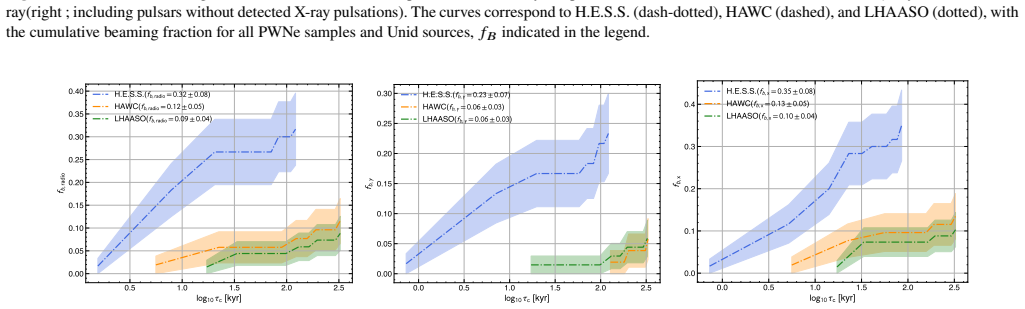
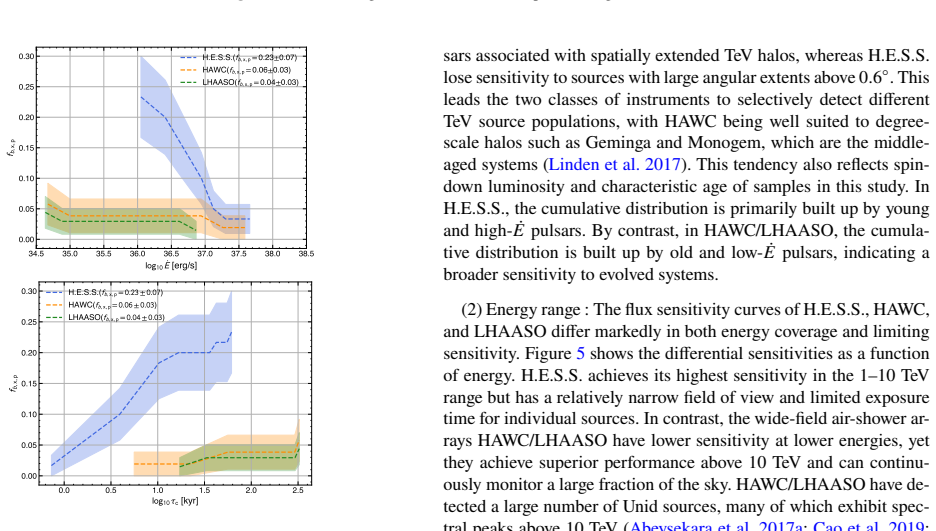
By treating TeV emission from pulsar wind nebulae as approximately isotropic and identifying unidentified TeV sources as nebulae from pulsars whose beams do not point at Earth, the ratio of detected to total sources yields beaming fractions of approximately 0.1-0.3 that are comparable across observational bands within each survey. These fractions differ by more than a factor of two between H.E.S.S. and HAWC/LHAASO, consistent with survey-dependent selection effects such as angular resolution and energy coverage, and possibly with HAWC/LHAASO samples containing older pulsars with larger nebulae. The values are reproduced by a unified framework that incorporates a time-dependent beam opening 1
What carries the argument
The ratio of TeV pulsar wind nebulae with detected pulsar beams to unidentified TeV sources assumed to be off-beam nebulae, used to infer the beaming fraction under isotropic TeV emission.
If this is right
- Beaming fractions stay comparable across radio, gamma-ray, and X-ray bands within any single survey.
- The factor-of-two difference between H.E.S.S. and HAWC/LHAASO arises from survey-specific selection effects including angular resolution and energy range.
- HAWC and LHAASO samples preferentially include older pulsars with more extended nebulae than those in the H.E.S.S. sample.
- The observed fractions are reproduced by a model with time-dependent beam opening angle.
- This time-dependent model remains compatible with the statistical properties of the observed pulsar population.
Where Pith is reading between the lines
- This method supplies an independent route to estimating the total Galactic pulsar population once selection biases are accounted for.
- Uniform future surveys with matched resolution and energy coverage could reduce the discrepancy now seen between instruments.
- The time-dependent opening angle model implies observable changes in beaming fraction as pulsars age that could be checked against individual source properties.
Load-bearing premise
The TeV emission from pulsar wind nebulae is approximately isotropic and unidentified TeV sources are powered by pulsars whose beams do not intersect our line of sight.
What would settle it
Finding pulsed emission from a substantial fraction of currently unidentified TeV sources, or direct evidence that TeV emission from pulsar wind nebulae is strongly directional rather than isotropic, would change the inferred beaming fractions.
Figures




read the original abstract
The pulsar beaming fraction is a fundamental quantity for connecting the observed pulsar population to the intrinsic Galactic population and for constraining pulsar emission geometry. In this study, we estimate the beaming fraction in each observational band (radio, $\gamma$-ray, and X-ray) and for each TeV survey (H.E.S.S., HAWC, and LHAASO) using TeV-selected pulsar wind nebulae (PWNe) and unidentified (Unid) TeV sources, assuming that the TeV emission from PWNe is approximately isotropic and that Unid sources are PWNe powered by pulsars whose beams do not intersect our line of sight. Within each survey, the inferred beaming fractions $\sim 0.1-0.3$ are comparable across bands. In contrast, the values differ by more than a factor of two between H.E.S.S. and HAWC/LHAASO. This discrepancy likely reflects survey-dependent selection effects, including differences in angular resolution and energy range, and is also consistent with the possibility that HAWC/LHAASO selected samples preferentially include older pulsars associated with more extended PWNe than those in the H.E.S.S. sample. We further show that the inferred beaming fractions can be reproduced within a unified framework using a time-dependent opening angle, and that this framework remains compatible with the statistical properties of the observed pulsar population.
Editorial analysis
A structured set of objections, weighed in public.
Referee Report
Summary. The manuscript estimates pulsar beaming fractions (~0.1-0.3) in radio, γ-ray, and X-ray bands separately for the H.E.S.S., HAWC, and LHAASO TeV surveys. It does so by taking the ratio of TeV-selected PWNe that have detected pulsars (in radio/γ/X) to the number of unidentified TeV sources, under the assumptions that TeV PWN emission is isotropic and that every Unid source is a PWN whose pulsar beam misses Earth. Within each survey the fractions are comparable across bands, but they differ by more than a factor of two between H.E.S.S. and the HAWC/LHAASO samples; the authors attribute this to survey selection effects (angular resolution, energy range, preference for older pulsars) and show that a single time-dependent opening-angle model can reproduce all the inferred values while remaining compatible with the statistical properties of the observed pulsar population.
Significance. If the two core assumptions hold, the work supplies a new, observationally grounded route to beaming fractions that is independent of traditional radio or γ-ray pulse-profile modeling. The inter-survey difference and the unified evolutionary model would then constitute a useful constraint on emission geometry and its time evolution, directly linking TeV source counts to the intrinsic Galactic pulsar population.
major comments (3)
- [Abstract and §3] Abstract and §3 (beaming-fraction derivation): the central numerical results rest on the untested claim that every Unid TeV source is a PWN powered by a pulsar whose beam misses Earth. No estimate is given of possible contamination (SNRs, halos, or PWNe with aligned but radio-faint pulsars), nor is a sensitivity analysis performed; a 20 % contamination fraction would shift the reported f_b values outside the 0.1-0.3 range and erase the claimed factor-of-two discrepancy between surveys.
- [§5] §5 (time-dependent opening-angle model): the model is shown to reproduce the survey-specific beaming fractions derived in §3, yet the age dependence is calibrated to the same TeV data it is meant to explain. Without an independent prior on the opening-angle evolution (e.g., from radio pulsar statistics alone) or a quantitative goodness-of-fit comparison to a constant-angle null model, the claimed compatibility with the observed pulsar population risks circularity.
- [§4] §4 (survey comparison): the statement that the H.E.S.S. vs. HAWC/LHAASO difference “likely reflects survey-dependent selection effects” is not supported by a quantitative propagation of the surveys’ differing angular resolutions, energy thresholds, or source-extension cuts into the expected Unid/PWN ratio; the discrepancy could equally be an artifact of the unquantified assumptions in §3.
minor comments (2)
- [§3] The error bars or confidence intervals on the reported beaming fractions are not shown; adding them (or describing the Poisson or binomial statistics used) would clarify whether the inter-survey difference is statistically significant.
- [§3] Notation for the beaming fraction f_b is introduced without an explicit equation; a single defining equation would remove ambiguity when the same symbol is used for radio, γ-ray, and X-ray bands.
Simulated Author's Rebuttal
We thank the referee for the thorough and constructive report. We address each major comment point by point below, outlining the revisions we will implement to strengthen the manuscript while maintaining the integrity of our analysis.
read point-by-point responses
-
Referee: [Abstract and §3] Abstract and §3 (beaming-fraction derivation): the central numerical results rest on the untested claim that every Unid TeV source is a PWN powered by a pulsar whose beam misses Earth. No estimate is given of possible contamination (SNRs, halos, or PWNe with aligned but radio-faint pulsars), nor is a sensitivity analysis performed; a 20 % contamination fraction would shift the reported f_b values outside the 0.1-0.3 range and erase the claimed factor-of-two discrepancy between surveys.
Authors: We agree that a quantitative treatment of contamination is necessary to robustly support the central assumptions. In the revised manuscript we will add a dedicated subsection to §3 that enumerates plausible contaminants (SNRs, TeV halos, and radio-faint but aligned pulsars) and performs a sensitivity analysis by injecting contamination fractions of 0–30 %. The analysis will show the resulting range of beaming fractions and demonstrate that the reported 0.1–0.3 interval and the inter-survey trend remain qualitatively intact for contamination levels below ~15 %, while higher levels would indeed require downward revision of the quoted values. We retain the working assumption that the majority of Unid sources are PWNe on the basis of their spectral indices and morphologies, but we will make this caveat and the sensitivity results explicit. revision: yes
-
Referee: [§5] §5 (time-dependent opening-angle model): the model is shown to reproduce the survey-specific beaming fractions derived in §3, yet the age dependence is calibrated to the same TeV data it is meant to explain. Without an independent prior on the opening-angle evolution (e.g., from radio pulsar statistics alone) or a quantitative goodness-of-fit comparison to a constant-angle null model, the claimed compatibility with the observed pulsar population risks circularity.
Authors: We acknowledge the risk of circularity. The evolutionary trend in opening angle is motivated by independent radio-pulsar statistics (e.g., the observed increase in pulse width with characteristic age reported in the literature). In the revision we will (i) state these radio-derived priors explicitly, (ii) add a quantitative model-comparison section that reports reduced-χ² and BIC values for the time-dependent model versus a constant-angle null hypothesis, and (iii) show that the time-dependent model remains compatible with the broader radio and γ-ray pulsar population statistics even when the TeV-derived beaming fractions are withheld from the fit. These additions will remove the appearance of circularity. revision: yes
-
Referee: [§4] §4 (survey comparison): the statement that the H.E.S.S. vs. HAWC/LHAASO difference “likely reflects survey-dependent selection effects” is not supported by a quantitative propagation of the surveys’ differing angular resolutions, energy thresholds, or source-extension cuts into the expected Unid/PWN ratio; the discrepancy could equally be an artifact of the unquantified assumptions in §3.
Authors: We concur that a purely qualitative attribution is insufficient. In the revised §4 we will present a quantitative propagation that folds the surveys’ angular-resolution, energy-threshold, and extension-cut differences into Monte-Carlo realizations of a Galactic PWN population. The resulting predicted Unid/PWN ratios for each survey will be compared directly with the observed ratios, thereby demonstrating that the factor-of-two discrepancy is consistent with the known instrumental differences. This exercise will also quantify the residual uncertainty attributable to the assumptions in §3. revision: yes
Circularity Check
No significant circularity; inference and model are independent of each other.
full rationale
The paper directly computes beaming fractions f_b from the ratio of TeV-selected PWNe (with detected pulsars) to Unid sources within each survey, under the two explicit assumptions of isotropic TeV emission and Unid sources being misaligned PWNe. This ratio is an empirical estimator, not a self-referential definition or fitted parameter renamed as a prediction. The subsequent time-dependent opening-angle framework is introduced separately to show that the survey-to-survey differences in the already-computed f_b values can be reproduced; no equation in the provided text reduces the model parameters to the same counts by construction, nor does any self-citation supply a uniqueness theorem that forces the result. The derivation chain therefore remains self-contained against external benchmarks once the stated assumptions are granted.
Axiom & Free-Parameter Ledger
axioms (2)
- domain assumption TeV emission from PWNe is approximately isotropic
- domain assumption Unidentified TeV sources are PWNe powered by pulsars whose beams do not intersect our line of sight
Reference graph
Works this paper leans on
-
[1]
Abdo A. A., et al., 2009, @doi [ ] 10.1088/0004-637X/700/2/1059 , https://ui.adsabs.harvard.edu/abs/2009ApJ...700.1059A 700, 1059
-
[2]
, archivePrefix = "arXiv", eprint =
Abdo A. A., et al., 2013, @doi [ ] 10.1088/0067-0049/208/2/17 , https://ui.adsabs.harvard.edu/abs/2013ApJS..208...17A 208, 17
-
[4]
Abeysekara A. U., et al., 2017b, @doi [ ] 10.3847/1538-4357/aa7555 , https://ui.adsabs.harvard.edu/abs/2017ApJ...843...39A 843, 39
-
[5]
Aharonian F., et al., 2005, @doi [ ] 10.1051/0004-6361:20041552 , https://ui.adsabs.harvard.edu/abs/2005A&A...431..197A 431, 197
-
[6]
Aharonian F., et al., 2021, @doi [Chinese Physics C] 10.1088/1674-1137/abd01b , https://ui.adsabs.harvard.edu/abs/2021ChPhC..45b5002A 45, 025002
-
[7]
Albert A., et al., 2020, @doi [ ] 10.3847/1538-4357/abc2d8 , https://ui.adsabs.harvard.edu/abs/2020ApJ...905...76A 905, 76
-
[8]
Albert A., et al., 2024, @doi [ ] 10.3847/1538-4357/ad5f2d , https://ui.adsabs.harvard.edu/abs/2024ApJ...972..144A 972, 144
-
[9]
Alfaro R., et al., 2024a, @doi [ ] 10.3847/1538-4357/ad00b6 , https://ui.adsabs.harvard.edu/abs/2024ApJ...961..104A 961, 104
-
[10]
Alfaro R., et al., 2024b, @doi [ ] 10.3847/1538-4357/ad782a , https://ui.adsabs.harvard.edu/abs/2024ApJ...975..198A 975, 198
-
[11]
Arons J., 1983, @doi [ ] 10.1086/160771 , https://ui.adsabs.harvard.edu/abs/1983ApJ...266..215A 266, 215
-
[12]
Bai X.-N., Spitkovsky A., 2010, @doi [ ] 10.1088/0004-637X/715/2/1282 , https://ui.adsabs.harvard.edu/abs/2010ApJ...715.1282B 715, 1282
-
[13]
Bamba A., Anada T., Dotani T., Mori K., Yamazaki R., Ebisawa K., Vink J., 2010, @doi [ ] 10.1088/2041-8205/719/2/L116 , https://ui.adsabs.harvard.edu/abs/2010ApJ...719L.116B 719, L116
-
[14]
Becker W., Aschenbach B., 2002, in Becker W., Lesch H., Tr \"u mper J., eds, Neutron Stars, Pulsars, and Supernova Remnants. p. 64 ( @eprint arXiv astro-ph/0208466 ), @doi 10.48550/arXiv.astro-ph/0208466
work page internal anchor Pith review doi:10.48550/arxiv.astro-ph/0208466 2002
-
[15]
Begelman M. C., Li Z.-Y., 1992, @doi [ ] 10.1086/171778 , https://ui.adsabs.harvard.edu/abs/1992ApJ...397..187B 397, 187
-
[16]
Brunelli G., et al., 2026, @doi [ ] 10.3847/1538-4357/ae38e0 , https://ui.adsabs.harvard.edu/abs/2026ApJ...998..230B 998, 230
-
[17]
Bucciantini N., Arons J., Amato E., 2011, @doi [ ] 10.1111/j.1365-2966.2010.17449.x , https://ui.adsabs.harvard.edu/abs/2011MNRAS.410..381B 410, 381
-
[18]
Camilo F., Lorimer D. R., Bhat N. D. R., Gotthelf E. V., Halpern J. P., Wang Q. D., Lu F. J., Mirabal N., 2002, @doi [ ] 10.1086/342351 , https://ui.adsabs.harvard.edu/abs/2002ApJ...574L..71C 574, L71
-
[19]
Camilo F., Ransom S. M., Gaensler B. M., Slane P. O., Lorimer D. R., Reynolds J., Manchester R. N., Murray S. S., 2006, @doi [ ] 10.1086/498386 , https://ui.adsabs.harvard.edu/abs/2006ApJ...637..456C 637, 456
-
[20]
Camilo F., et al., 2009, @doi [ ] 10.1088/0004-637X/705/1/1 , https://ui.adsabs.harvard.edu/abs/2009ApJ...705....1C 705, 1
-
[21]
Cao Z., et al., 2019, @doi [arXiv e-prints] 10.48550/arXiv.1905.02773 , https://ui.adsabs.harvard.edu/abs/2019arXiv190502773C p. arXiv:1905.02773
-
[22]
Cao Z., et al., 2024, @doi [ ] 10.3847/1538-4365/acfd29 , https://ui.adsabs.harvard.edu/abs/2024ApJS..271...25C 271, 25
-
[23]
Cheng K. S., Ho C., Ruderman M., 1986, @doi [ ] 10.1086/163829 , https://ui.adsabs.harvard.edu/abs/1986ApJ...300..500C 300, 500
-
[24]
Cherenkov Telescope Array Consortium et al., 2019, Science with the Cherenkov Telescope Array , @doi 10.1142/10986
-
[25]
Cie \'s lar M., Bulik T., Os owski S., 2018, @doi [arXiv e-prints] 10.48550/arXiv.1803.02397 , https://ui.adsabs.harvard.edu/abs/2018arXiv180302397C p. arXiv:1803.02397
-
[26]
Coerver A., et al., 2019, @doi [ ] 10.3847/1538-4357/ab21d0 , https://ui.adsabs.harvard.edu/abs/2019ApJ...878..126C 878, 126
-
[27]
Dermer C. D., Giebels B., 2016, @doi [Comptes Rendus Physique] 10.1016/j.crhy.2016.04.004 , https://ui.adsabs.harvard.edu/abs/2016CRPhy..17..594D 17, 594
-
[28]
Dewey R. J., Taylor J. H., Weisberg J. M., Stokes G. H., 1985, @doi [ ] 10.1086/184502 , https://ui.adsabs.harvard.edu/abs/1985ApJ...294L..25D 294, L25
-
[29]
Eagle J., Castro D., Temim T., Ballet J., Slane P., Gelfand J., Kerr M., Ajello M., 2022, @doi [ ] 10.3847/1538-4357/ac9eb4 , https://ui.adsabs.harvard.edu/abs/2022ApJ...940..143E 940, 143
-
[30]
Enoto T., Kisaka S., Shibata S., 2019, @doi [Reports on Progress in Physics] 10.1088/1361-6633/ab3def , https://ui.adsabs.harvard.edu/abs/2019RPPh...82j6901E 82, 106901
-
[31]
Esposito P., Tiengo A., de Luca A., Mattana F., 2007, @doi [ ] 10.1051/0004-6361:20077480 , https://ui.adsabs.harvard.edu/abs/2007A&A...467L..45E 467, L45
-
[32]
M., 2006, @doi [ ] 10.1086/501516 , https://ui.adsabs.harvard.edu/abs/2006ApJ...643..332F 643, 332
Faucher-Gigu \`e re C.-A., Kaspi V. M., 2006, @doi [ ] 10.1086/501516 , https://ui.adsabs.harvard.edu/abs/2006ApJ...643..332F 643, 332
-
[33]
Ferrand G., Safi-Harb S., 2012, @doi [Advances in Space Research] 10.1016/j.asr.2012.02.004 , https://ui.adsabs.harvard.edu/abs/2012AdSpR..49.1313F 49, 1313
-
[34]
Fesen R. A., Martin C. L., Shull J. M., 1992, @doi [ ] 10.1086/171951 , https://ui.adsabs.harvard.edu/abs/1992ApJ...399..599F 399, 599
-
[35]
Fishbach M., Ji A. P., Fong W.-f., Wu T. Y., Rastinejad J. C., Vijaykumar A., Chen H.-Y., 2026, @doi [arXiv e-prints] 10.48550/arXiv.2604.05059 , https://ui.adsabs.harvard.edu/abs/2026arXiv260405059F p. arXiv:2604.05059
work page internal anchor Pith review Pith/arXiv arXiv doi:10.48550/arxiv.2604.05059 2026
-
[36]
Gaensler B. M., Slane P. O., 2006, @doi [ ] 10.1146/annurev.astro.44.051905.092528 , https://ui.adsabs.harvard.edu/abs/2006ARA&A..44...17G 44, 17
-
[37]
Gaensler B. M., Schulz N. S., Kaspi V. M., Pivovaroff M. J., Becker W. E., 2003, @doi [ ] 10.1086/368356 , https://ui.adsabs.harvard.edu/abs/2003ApJ...588..441G 588, 441
-
[38]
Gelfand J. D., Slane P. O., Zhang W., 2009, @doi [ ] 10.1088/0004-637X/703/2/2051 , https://ui.adsabs.harvard.edu/abs/2009ApJ...703.2051G 703, 2051
-
[39]
Gonthier P. L., Harding A. K., Ferrara E. C., Frederick S. E., Mohr V. E., Koh Y.-M., 2018, @doi [ ] 10.3847/1538-4357/aad08d , https://ui.adsabs.harvard.edu/abs/2018ApJ...863..199G 863, 199
-
[40]
Gonzalez M. E., Kaspi V. M., Camilo F., Gaensler B. M., Pivovaroff M. J., 2005, @doi [ ] 10.1086/432032 , https://ui.adsabs.harvard.edu/abs/2005ApJ...630..489G 630, 489
-
[41]
Gotthelf E. V., Halpern J. P., 2008, @doi [ ] 10.1086/588779 , https://ui.adsabs.harvard.edu/abs/2008ApJ...681..515G 681, 515
-
[42]
Gotthelf E. V., Halpern J. P., 2009, @doi [ ] 10.1088/0004-637X/700/2/L158 , https://ui.adsabs.harvard.edu/abs/2009ApJ...700L.158G 700, L158
-
[43]
Gotthelf E. V., Halpern J. P., Dodson R., 2002, @doi [ ] 10.1086/340109 , https://ui.adsabs.harvard.edu/abs/2002ApJ...567L.125G 567, L125
-
[44]
Gotthelf E. V., Halpern J. P., Terrier R., Mattana F., 2011, @doi [ ] 10.1088/2041-8205/729/2/L16 , https://ui.adsabs.harvard.edu/abs/2011ApJ...729L..16G 729, L16
-
[45]
Gotthelf E. V., et al., 2014, @doi [ ] 10.1088/0004-637X/788/2/155 , https://ui.adsabs.harvard.edu/abs/2014ApJ...788..155G 788, 155
-
[46]
Grunthal K., Kramer M., Desvignes G., 2021, @doi [ ] 10.1093/mnras/stab2198 , https://ui.adsabs.harvard.edu/abs/2021MNRAS.507.5658G 507, 5658
-
[47]
H. E. S. S. Collaboration et al., 2018a, @doi [ ] 10.1051/0004-6361/201732098 , https://ui.adsabs.harvard.edu/abs/2018A&A...612A...1H 612, A1
-
[48]
H. E. S. S. Collaboration et al., 2018b, @doi [ ] 10.1051/0004-6361/201629377 , https://ui.adsabs.harvard.edu/abs/2018A&A...612A...2H 612, A2
-
[49]
H. E. S. S. Collaboration et al., 2018c, @doi [ ] 10.1051/0004-6361/201629790 , https://ui.adsabs.harvard.edu/abs/2018A&A...612A...6H 612, A6
-
[50]
Halpern J. P., Holt S. S., 1992, @doi [ ] 10.1038/357222a0 , https://ui.adsabs.harvard.edu/abs/1992Natur.357..222H 357, 222
-
[51]
Hessels J. W. T., et al., 2008, @doi [ ] 10.1086/590908 , https://ui.adsabs.harvard.edu/abs/2008ApJ...682L..41H 682, L41
-
[52]
A., Funk S., Carrigan S., Gallant Y
Hinton J. A., Funk S., Carrigan S., Gallant Y. A., de Jager O. C., Kosack K., Lemi \`e re A., P \"u hlhofer G., 2007, @doi [ ] 10.1051/0004-6361:20078775 , https://ui.adsabs.harvard.edu/abs/2007A&A...476L..25H 476, L25
-
[53]
Hofmann W., Zanin R., 2023, @doi [arXiv e-prints] 10.48550/arXiv.2305.12888 , https://ui.adsabs.harvard.edu/abs/2023arXiv230512888H p. arXiv:2305.12888
-
[54]
Igoshev A. P., 2020, @doi [ ] 10.1093/mnras/staa958 , https://ui.adsabs.harvard.edu/abs/2020MNRAS.494.3663I 494, 3663
-
[55]
Jankowski F., van Straten W., Keane E. F., Bailes M., Barr E. D., Johnston S., Kerr M., 2018, @doi [ ] 10.1093/mnras/stx2476 , https://ui.adsabs.harvard.edu/abs/2018MNRAS.473.4436J 473, 4436
-
[56]
Johnston S., Karastergiou A., 2019, @doi [ ] 10.1093/mnras/stz400 , https://ui.adsabs.harvard.edu/abs/2019MNRAS.485..640J 485, 640
-
[57]
Johnston S., Smith D. A., Karastergiou A., Kramer M., 2020, @doi [ ] 10.1093/mnras/staa2110 , https://ui.adsabs.harvard.edu/abs/2020MNRAS.497.1957J 497, 1957
-
[58]
G., 2007, @doi [ ] 10.1086/521814 , https://ui.adsabs.harvard.edu/abs/2007ApJ...670..655K 670, 655
Kargaltsev O., Pavlov G. G., 2007, @doi [ ] 10.1086/521814 , https://ui.adsabs.harvard.edu/abs/2007ApJ...670..655K 670, 655
-
[59]
Kargaltsev O., Cerutti B., Lyubarsky Y., Striani E., 2015, @doi [ ] 10.1007/s11214-015-0171-x , https://ui.adsabs.harvard.edu/abs/2015SSRv..191..391K 191, 391
-
[60]
Journal of Plasma Physics , archivePrefix = "arXiv", eprint =
Kargaltsev O., Pavlov G. G., Klingler N., Rangelov B., 2017, @doi [Journal of Plasma Physics] 10.1017/S0022377817000630 , https://ui.adsabs.harvard.edu/abs/2017JPlPh..83e6301K 83, 635830501
-
[61]
Kaspi V. M., Roberts M. E., Vasisht G., Gotthelf E. V., Pivovaroff M., Kawai N., 2001, @doi [ ] 10.1086/322515 , https://ui.adsabs.harvard.edu/abs/2001ApJ...560..371K 560, 371
-
[62]
Kim M., An H., 2020, @doi [ ] 10.3847/1538-4357/ab76c1 , https://ui.adsabs.harvard.edu/abs/2020ApJ...892....5K 892, 5
-
[63]
R., 2003, @doi [ ] 10.1086/345740 , https://ui.adsabs.harvard.edu/abs/2003ApJ...584..985K 584, 985
Kim C., Kalogera V., Lorimer D. R., 2003, @doi [ ] 10.1086/345740 , https://ui.adsabs.harvard.edu/abs/2003ApJ...584..985K 584, 985
-
[64]
Kirk J. G., Skj raasen O., Gallant Y. A., 2002, @doi [ ] 10.1051/0004-6361:20020599 , https://ui.adsabs.harvard.edu/abs/2002A&A...388L..29K 388, L29
-
[65]
Kisaka S., Kojima Y., 2011, @doi [ ] 10.1088/0004-637X/739/1/14 , https://ui.adsabs.harvard.edu/abs/2011ApJ...739...14K 739, 14
-
[66]
Klingler N., Kargaltsev O., Pavlov G. G., Ng C.-Y., Gong Z., Hare J., 2022, @doi [ ] 10.3847/1538-4357/ac6ac6 , https://ui.adsabs.harvard.edu/abs/2022ApJ...932...89K 932, 89
-
[67]
Kolonko M., Gil J., Maciesiak K., 2004, @doi [ ] 10.1051/0004-6361:20034399 , https://ui.adsabs.harvard.edu/abs/2004A&A...428..943K 428, 943
-
[68]
2004, MNRAS, 351, 1379, doi: 10.1111/j.1365-2966.2004.07876.x
Komissarov S. S., Lyubarsky Y. E., 2004, @doi [ ] 10.1111/j.1365-2966.2004.07597.x , https://ui.adsabs.harvard.edu/abs/2004MNRAS.349..779K 349, 779
-
[69]
Kuiper L., Hermsen W., 2015, @doi [ ] 10.1093/mnras/stv426 , https://ui.adsabs.harvard.edu/abs/2015MNRAS.449.3827K 449, 3827
-
[70]
Kuiper L., Hermsen W., Dekker A., 2018, @doi [ ] 10.1093/mnras/stx3128 , https://ui.adsabs.harvard.edu/abs/2018MNRAS.475.1238K 475, 1238
-
[71]
Li B.-P., Gao Z.-F., 2023, @doi [Astronomische Nachrichten] 10.1002/asna.20220111 , https://ui.adsabs.harvard.edu/abs/2023AN....34420111L 344, e20220111
-
[72]
Li K. L., Kong A. K. H., Tam P. H. T., Hou X., Takata J., Hui C. Y., 2017, @doi [ ] 10.3847/1538-4357/aa784e , https://ui.adsabs.harvard.edu/abs/2017ApJ...843...85L 843, 85
-
[73]
Li J., Torres D. F., Coti Zelati F., Papitto A., Kerr M., Rea N., 2018, @doi [ ] 10.3847/2041-8213/aae92b , https://ui.adsabs.harvard.edu/abs/2018ApJ...868L..29L 868, L29
-
[74]
Linden T., Auchettl K., Bramante J., Cholis I., Fang K., Hooper D., Karwal T., Li S. W., 2017, @doi [ ] 10.1103/PhysRevD.96.103016 , https://ui.adsabs.harvard.edu/abs/2017PhRvD..96j3016L 96, 103016
-
[75]
Livingstone M. A., Kaspi V. M., 2011, @doi [ ] 10.1088/0004-637X/742/1/31 , https://ui.adsabs.harvard.edu/abs/2011ApJ...742...31L 742, 31
-
[76]
Lyne A. G., Manchester R. N., 1988, @doi [ ] 10.1093/mnras/234.3.477 , https://ui.adsabs.harvard.edu/abs/1988MNRAS.234..477L 234, 477
-
[77]
Manchester R. N., Hobbs G. B., Teoh A., Hobbs M., 2005, @doi [ ] 10.1086/428488 , https://ui.adsabs.harvard.edu/abs/2005AJ....129.1993M 129, 1993
-
[78]
Mattana F., et al., 2009, @doi [ ] 10.1088/0004-637X/694/1/12 , https://ui.adsabs.harvard.edu/abs/2009ApJ...694...12M 694, 12
-
[79]
P., Razzano M., Esposito P., De Luca A., Marelli M., Oates S
Mignani R. P., Razzano M., Esposito P., De Luca A., Marelli M., Oates S. R., Saz-Parkinson P., 2012, @doi [ ] 10.1051/0004-6361/201218869 , https://ui.adsabs.harvard.edu/abs/2012A&A...543A.130M 543, A130
-
[80]
Mitra D., Melikidze G. I., Basu R., 2023, @doi [ ] 10.3847/1538-4357/acdc28 , https://ui.adsabs.harvard.edu/abs/2023ApJ...952..151M 952, 151
-
[81]
Muslimov A. G., Harding A. K., 2003, @doi [ ] 10.1086/368162 , https://ui.adsabs.harvard.edu/abs/2003ApJ...588..430M 588, 430
discussion (0)
Sign in with ORCID, Apple, or X to comment. Anyone can read and Pith papers without signing in.