Recognition: 2 theorem links
· Lean TheoremImplications of low neutron star merger rates for gamma-ray bursts, r-process production and Galactic double neutron stars
Pith reviewed 2026-05-10 19:02 UTC · model grok-4.3
The pith
Updated binary neutron star merger rate from gravitational waves is lower than rates from short gamma-ray bursts, r-process production, and Galactic double neutron stars.
A machine-rendered reading of the paper's core claim, the machinery that carries it, and where it could break.
Core claim
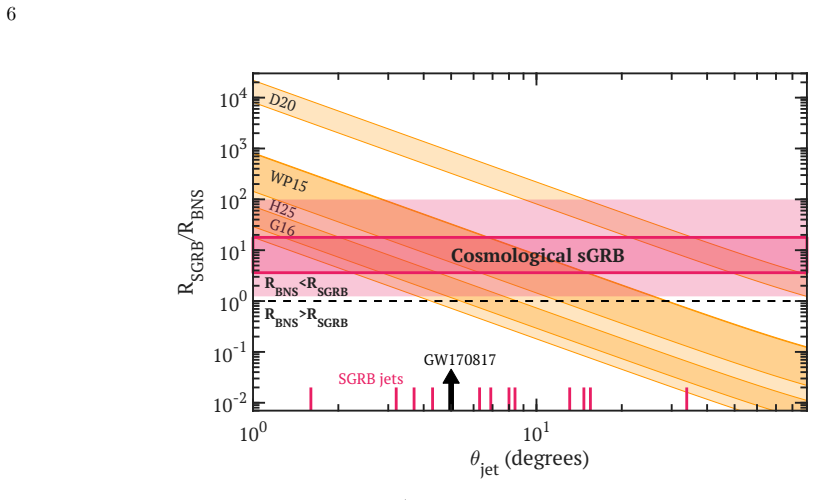
Analyzing data from the latest LIGO-Virgo-KAGRA catalog, the total binary neutron star merger rate is 28--300 Gpc^{-3} yr^{-1}, consisting of 53^{+176}_{-49} Gpc^{-3} yr^{-1} in GW170817-like systems. Compared to a reference rate of 100 Gpc^{-3} yr^{-1}, the cosmological short gamma-ray burst rate is a factor of 3.6--18 higher, the r-process rate is 0.9--4.1 times higher, and the rate inferred from Galactic double neutron stars is 2.3--5.1 times higher. Uncertainties in the inferred rates are shown to either reduce or increase these tensions, thereby constraining the physical processes that link mergers to electromagnetic signals and element production.
What carries the argument
Direct numerical comparison of the gravitational-wave binary neutron star merger rate against independent rate estimates from short gamma-ray burst observations, Milky Way r-process mass, and the Galactic double neutron star population.
If this is right
- If the tensions remain, the fraction of binary neutron star mergers that produce observable short gamma-ray bursts after beaming corrections must be higher than assumed.
- The r-process yield per merger or the contribution from neutron star-black hole systems may need to be revised upward to match observed abundances.
- Uncertainties in the completeness or merger-time distribution of the Galactic double neutron star population could lower the rate inferred from that channel.
- These comparisons constrain the conditions required for jet formation and heavy-element ejection during mergers.
- Neutron star-black hole mergers may help close the gap if they contribute significantly to the observed electromagnetic and chemical signals.
Where Pith is reading between the lines
- If binary neutron star mergers alone cannot supply the observed r-process material, other astrophysical sites such as certain supernovae may contribute more than standard models currently allow.
- The lower merger rate forecasts fewer joint gravitational-wave and gamma-ray burst detections in the next observing runs, providing a direct test.
- Refining models of jet launching efficiency in mergers could simultaneously address the short gamma-ray burst discrepancy and improve multimessenger predictions.
- Extending the rate comparison to include black hole-neutron star systems may reconcile the different observational channels without invoking new physics.
Load-bearing premise
The rate comparisons assume that binary neutron star mergers dominate short gamma-ray bursts and r-process production while the Galactic double neutron star sample is complete and its merger times are accurately known.
What would settle it
A future gravitational wave catalog that measures a binary neutron star merger rate above 300 Gpc^{-3} yr^{-1} at high , or a direct measurement showing the r-process yield per merger is substantially larger than current models, would remove the reported tensions.
Figures




read the original abstract
The first multimessenger discovery of a binary neutron star (BNS) merger, GW170817, proved that such mergers can source short gamma-ray bursts (SGRBs) and produce \rprocess elements. The initial merger rate from this single event in the first two observing runs of the LIGO-Virgo observatory network, $110$--$3840\,\mathrm{Gpc}^{-3}\,\mathrm{yr}^{-1}$, was found to be broadly consistent with the SGRB rate, the Milky Way (MW) r-process mass, and the Galactic population of double neutron star (DNS) systems that will merge in a Hubble time. However, only one additional BNS merger has been detected since, and the BNS merger rate has been consistently revised downwards with the past few gravitational wave (GW) catalog updates. Analyzing GW data from the latest catalog GWTC-4, we find a total BNS merger rate of $28$--$300\,\mathrm{Gpc}^{-3}\,\mathrm{yr}^{-1}$ (consistent with the most recently published values from LIGO-Virgo-KAGRA) consisting of $53^{+176}_{-49}\,\mathrm{Gpc}^{-3}\mathrm{yr}^{-1}$ in GW170817-like $\sim(1.3,1.3)\,M_\odot$ BNSs (90\% credibility). In light of this updated GW rate, we revisit the consistency of the BNS merger rate with SGRBs, r-process and Galactic DNSs. In all cases, there is an emerging tension with the BNS (and EM-bright neutron star--black hole, NSBH) merger rate. Comparing to a BNS merger rate of $100\,\mathrm{Gpc}^{-3}\mathrm{yr}^{-1}$, the cosmological SGRB rate is a factor of 3.6--18 higher, the r-process rate is a factor of 0.9--4.1 higher, and the rate inferred from Galactic DNSs is a factor of 2.3--5.1 higher than the BNS rate. We discuss how various uncertainties in the inferred rates either alleviate or exacerbate this tension, which point to the various physical processes that can be constrained by such rate comparisons.
Editorial analysis
A structured set of objections, weighed in public.
Referee Report
Summary. The paper derives an updated BNS merger rate of 28--300 Gpc^{-3} yr^{-1} (with a GW170817-like subpopulation at 53^{+176}_{-49} Gpc^{-3} yr^{-1}) from the GWTC-4 catalog and compares it to rates inferred from cosmological SGRBs, Galactic r-process abundances, and radio pulsar DNS systems. It reports factors of 3.6--18 (SGRBs), 0.9--4.1 (r-process), and 2.3--5.1 (DNS) higher than a reference BNS rate of 100 Gpc^{-3} yr^{-1}, framing these as emerging tensions that can constrain beaming fractions, r-process yields per merger, and DNS completeness/merger-time distributions. Uncertainties in the comparisons are discussed qualitatively.
Significance. If the tensions persist after full propagation of conversion uncertainties, the result would be significant for multimessenger astrophysics by linking GW rates to EM and chemical observables, potentially ruling out BNS mergers as the sole or dominant source for some channels and motivating targeted follow-up on NSBH contributions. The work builds on prior consistency checks post-GW170817 but updates them with the latest catalog.
major comments (2)
- [rate comparison and discussion sections] The central tension claims (abstract and rate-comparison section) are presented by fixing conversion factors (beaming fraction for SGRBs, r-process yield per event, DNS completeness and merger-time distribution) while quoting the broad BNS credible interval 28--300. This makes the quoted factors (e.g., SGRB 3.6--18) sensitive to the choice of central value 100; folding realistic widths on the conversion factors (as the skeptic note suggests) could erase statistical significance of the discrepancy. A quantitative marginalization or sensitivity table is needed to substantiate 'emerging tension' as load-bearing.
- [GW rate inference section] The GW rate derivation (GWTC-4 analysis) reports a total rate and a subpopulation split, but the manuscript does not detail how selection effects, mass priors, or the distinction between total BNS and EM-bright NSBH are propagated into the final credible intervals used for the tension factors. Without this, it is unclear whether the lower edge of 28 already incorporates or excludes the conversion uncertainties.
minor comments (2)
- [abstract and § on NSBH] Notation for the rate units is consistent, but the abstract and main text should explicitly state whether the quoted factors already include or exclude the NSBH contribution when comparing to SGRB and r-process channels.
- [discussion] The paper mentions 'we discuss how various uncertainties... alleviate or exacerbate this tension' but provides no table or figure summarizing the range of each uncertainty source; adding one would improve clarity without altering the central claim.
Simulated Author's Rebuttal
We thank the referee for their thoughtful and constructive comments, which help clarify the presentation of our results on BNS merger rate tensions. We will revise the manuscript to strengthen the analysis by adding a quantitative sensitivity study and expanded methodological details on the GW rate derivation, while preserving the core findings.
read point-by-point responses
-
Referee: [rate comparison and discussion sections] The central tension claims (abstract and rate-comparison section) are presented by fixing conversion factors (beaming fraction for SGRBs, r-process yield per event, DNS completeness and merger-time distribution) while quoting the broad BNS credible interval 28--300. This makes the quoted factors (e.g., SGRB 3.6--18) sensitive to the choice of central value 100; folding realistic widths on the conversion factors (as the skeptic note suggests) could erase statistical significance of the discrepancy. A quantitative marginalization or sensitivity table is needed to substantiate 'emerging tension' as load-bearing.
Authors: We agree that the presentation of the tension factors would be strengthened by explicit quantification of sensitivity to the conversion factors rather than fixing them at reference values. Although the broad BNS credible interval (28--300 Gpc^{-3} yr^{-1}) already shows that tensions remain even when adopting the upper edge of the BNS rate for SGRBs and DNSs (and are marginal for r-process), a sensitivity table will better demonstrate robustness across plausible ranges. In the revised manuscript we will add such a table (or equivalent marginalization discussion) in the rate-comparison section, varying beaming fraction, r-process yield per merger, and DNS completeness/merger-time parameters within observationally motivated bounds. This will address the dependence on the reference value of 100 Gpc^{-3} yr^{-1} and clarify when the discrepancies remain statistically meaningful. revision: yes
-
Referee: [GW rate inference section] The GW rate derivation (GWTC-4 analysis) reports a total rate and a subpopulation split, but the manuscript does not detail how selection effects, mass priors, or the distinction between total BNS and EM-bright NSBH are propagated into the final credible intervals used for the tension factors. Without this, it is unclear whether the lower edge of 28 already incorporates or excludes the conversion uncertainties.
Authors: The reported total BNS rate (28--300 Gpc^{-3} yr^{-1}) and GW170817-like subpopulation rate are obtained from our analysis of the GWTC-4 catalog and are stated to be consistent with the latest LVK published values. We acknowledge that the current text does not sufficiently detail the propagation of selection effects, mass priors, and the separation between the total BNS population and the EM-bright (including possible NSBH) subset. In the revision we will expand the GW rate inference section to explicitly describe these aspects of the analysis pipeline and to state that the quoted credible intervals reflect only the GW data constraints; they do not fold in the separate conversion uncertainties from SGRB, r-process, or DNS observables, which are treated in the subsequent comparison sections. This will remove ambiguity about the origin of the lower edge at 28 Gpc^{-3} yr^{-1}. revision: yes
Circularity Check
No significant circularity in cross-observable rate comparisons
full rationale
The paper computes the BNS merger rate directly from analysis of the external GWTC-4 gravitational-wave catalog (28--300 Gpc^{-3} yr^{-1}), then compares this value to SGRB rates (electromagnetic surveys), r-process yields (chemical abundances), and Galactic DNS populations (radio pulsar timing). These inputs originate from independent datasets and channels; no equation, fit, or self-citation reduces one rate to another by construction or renames a fitted parameter as a prediction. Uncertainties in beaming, yields, and completeness are discussed openly but do not close any loop within the paper's own derivations.
Axiom & Free-Parameter Ledger
free parameters (1)
- BNS merger rate =
28-300 Gpc^{-3} yr^{-1}
axioms (3)
- domain assumption BNS mergers dominate the production of observable SGRBs after accounting for beaming and efficiency factors
- domain assumption BNS mergers are the main source of r-process elements with a characteristic yield per event
- domain assumption The observed Galactic DNS population is representative of the merging systems with known selection effects and merger timescales
Lean theorems connected to this paper
-
IndisputableMonolith/Cost/FunctionalEquation.leanwashburn_uniqueness_aczel unclearAnalyzing GW data from the latest catalog GWTC-4, we find a total BNS merger rate of 28--300 Gpc^{-3} yr^{-1} ... the cosmological SGRB rate is a factor of 3.6--18 higher, the r-process rate is a factor of 0.9--4.1 higher...
-
IndisputableMonolith/Foundation/AbsoluteFloorClosure.leanreality_from_one_distinction unclearWe discuss how various uncertainties in the inferred rates either alleviate or exacerbate this tension
Forward citations
Cited by 3 Pith papers
-
Double Neutron Star Delay Times Across Cosmic Metallicities: The Role of Helium Star Progenitors
Simulations show double neutron star mergers peak 80-250 million years after star formation across metallicities, with 15% quick mergers and over 20% delayed over a billion years.
-
Constraining the Pulsar Beaming Fraction with TeV-Selected Galactic Pulsar Wind Nebulae and unidentified TeV Sources
TeV-selected PWNe and unidentified sources yield beaming fractions of 0.1-0.3 across radio, gamma-ray, and X-ray bands, with survey-to-survey differences explained by selection biases or older pulsars and reproducible...
-
Wide Jets or Low Rates: Reconciling Short GRB and Gravitational-Wave Neutron Star Merger Rates
Latest GW neutron star merger rates are consistent with short GRBs being produced by BNS mergers if jets are wide or rates low, with NSBH mergers subdominant.
Reference graph
Works this paper leans on
-
[1]
Abac, A. G., et al. 2024, Astrophys. J. Lett., 970, L34, doi: 10.3847/2041-8213/ad5beb
-
[2]
Abac, A. G., et al. 2025a, https://arxiv.org/abs/2508.18082
work page internal anchor Pith review Pith/arXiv arXiv
-
[3]
GWTC-4.0: Population Properties of Merging Compact Binaries
Abac, A. G., et al. 2025b, https://arxiv.org/abs/2508.18083
work page internal anchor Pith review Pith/arXiv arXiv
-
[4]
GWTC-4.0: Methods for Identifying and Characterizing Gravitational-wave Transients,
Abac, A. G., et al. 2025c, https://arxiv.org/abs/2508.18081
-
[5]
Abadie, J., Abbott, B. P., Abbott, R., et al. 2010, Classical and Quantum Gravity, 27, 173001, doi: 10.1088/0264-9381/27/17/173001
-
[6]
2017, PhRvL, 119, 161101, doi: 10.1103/PhysRevLett.119.161101
Abbott, B. P., et al. 2017a, Phys. Rev. Lett., 119, 161101, doi: 10.1103/PhysRevLett.119.161101
-
[7]
Abbott, B. P., et al. 2017b, Astrophys. J. Lett., 848, L12, doi: 10.3847/2041-8213/aa91c9
-
[8]
ApJ848(2), 13 (2017) https://doi.org/10.3847/2041-8213/aa920c arXiv:1710.05834 [astro-ph.HE]
Abbott, B. P., et al. 2017c, Astrophys. J. Lett., 848, L13, doi: 10.3847/2041-8213/aa920c
-
[9]
Abbott, B. P., et al. 2019, Phys. Rev. X, 9, 031040, doi: 10.1103/PhysRevX.9.031040
-
[10]
Abbott, B. P., Abbott, R., Abbott, T. D., et al. 2020, ApJL, 892, L3, doi: 10.3847/2041-8213/ab75f5
-
[11]
Abbott, R., et al. 2023, Phys. Rev. X, 13, 011048, doi: 10.1103/PhysRevX.13.011048
-
[12]
2015, Classical and Quantum Gravity, 32, 024001, doi: 10.1088/0264-9381/32/2/024001
Acernese, F., Agathos, M., Agatsuma, K., et al. 2015, Classical and Quantum Gravity, 32, 024001, doi: 10.1088/0264-9381/32/2/024001
-
[13]
Ahumada, T., Singer, L. P., Anand, S., et al. 2021, Nature Astronomy, 5, 917, doi: 10.1038/s41550-021-01428-7
-
[14]
Progress of Theoretical and Experimental Physics , keywords =
Akutsu, T., Ando, M., Arai, K., et al. 2021, Progress of Theoretical and Experimental Physics, 2021, 05A101, doi: 10.1093/ptep/ptaa125
-
[15]
Anders, E., & Grevesse, N. 1989, GeoCoA, 53, 197, doi: 10.1016/0016-7037(89)90286-X
-
[16]
C., Sagu´ es Carracedo, A., et al
Andreoni, I., Kool, E. C., Sagu´ es Carracedo, A., et al. 2020, ApJ, 904, 155, doi: 10.3847/1538-4357/abbf4c
-
[17]
Andreoni, I., Coughlin, M. W., Kool, E. C., et al. 2021, ApJ, 918, 63, doi: 10.3847/1538-4357/ac0bc7
-
[18]
Safarzadeh, M. 2020, Astrophys. J. Lett., 892, L9, doi: 10.3847/2041-8213/ab5b9a
-
[19]
Arlandini, C., K¨ appeler, F., Wisshak, K., et al. 1999, ApJ, 525, 886, doi: 10.1086/307938
-
[20]
2007, PhR, 450, 97, doi: 10.1016/j.physrep.2007.06.002
Arnould, M., Goriely, S., & Takahashi, K. 2007, PhR, 450, 97, doi: 10.1016/j.physrep.2007.06.002
-
[21]
Asplund, M., Grevesse, N., Sauval, A. J., & Scott, P. 2009, ARA&A, 47, 481, doi: 10.1146/annurev.astro.46.060407.145222
-
[23]
2014b, ARA&A, 52, 43, doi: 10.1146/annurev-astro-081913-035926
Berger, E. 2014, ARA&A, 52, 43, doi: 10.1146/annurev-astro-081913-035926
-
[24]
2023, Research Notes of the AAS, 7, 136, doi: 10.3847/2515-5172/ace258
Biscoveanu, S., Burns, E., Landry, P., & Vitale, S. 2023, Research Notes of the AAS, 7, 136, doi: 10.3847/2515-5172/ace258
-
[25]
Biscoveanu, S., Landry, P., & Vitale, S. 2022, Mon. Not. Roy. Astron. Soc., 518, 5298, doi: 10.1093/mnras/stac3052
-
[26]
2020, ApJ, 893, 38, doi: 10.3847/1538-4357/ab7eaf
Biscoveanu, S., Thrane, E., & Vitale, S. 2020, ApJ, 893, 38, doi: 10.3847/1538-4357/ab7eaf
-
[27]
2014, ApJ, 787, 10, doi: 10.1088/0004-637X/787/1/10
Bisterzo, S., Travaglio, C., Gallino, R., Wiescher, M., & K¨ appeler, F. 2014, ApJ, 787, 10, doi: 10.1088/0004-637X/787/1/10
-
[28]
2013, ApJ, 764, 179, doi: 10.1088/0004-637X/764/2/179
Bromberg, O., Nakar, E., Piran, T., & Sari, R. 2013, ApJ, 764, 179, doi: 10.1088/0004-637X/764/2/179
-
[29]
2025, https://arxiv.org/abs/2506.18151
Chen, H.-Y., & Gottlieb, O. 2025, https://arxiv.org/abs/2506.18151
-
[30]
Chen, H.-Y., & Holz, D. E. 2013, Phys. Rev. Lett., 111, 181101, doi: 10.1103/PhysRevLett.111.181101
-
[31]
Chen, H.-Y., Landry, P., Read, J. S., & Siegel, D. M. 2025, ApJ, 985, 154, doi: 10.3847/1538-4357/add0af
-
[32]
Coulter, D. A., Kilpatrick, C. D., Jones, D. O., et al. 2025, ApJ, 988, 169, doi: 10.3847/1538-4357/ade0b3
-
[33]
Coward, D. M., Howell, E. J., Piran, T., et al. 2012, MNRAS, 425, 2668, doi: 10.1111/j.1365-2966.2012.21604.x Della Valle, M., Guetta, D., Cappellaro, E., et al. 2018, MNRAS, 481, 4355, doi: 10.1093/mnras/sty2541
-
[34]
2020, Monthly Notices of the Royal Astronomical Society, 492, 5011, doi: 10.1093/mnras/staa124
Dichiara, S., Troja, E., O’Connor, B., et al. 2020, MNRAS, 492, 5011, doi: 10.1093/mnras/staa124
-
[35]
Essick, R., Coughlin, M. W., Zevin, M., et al. 2025, PhRvD, 112, 102001, doi: 10.1103/44x3-hv3y
-
[36]
Farah, A., Essick, R., Doctor, Z., Fishbach, M., & Holz, D. E. 2020, ApJ, 895, 108, doi: 10.3847/1538-4357/ab8d26
-
[37]
Fong, W., Berger, E., Margutti, R., & Zauderer, B. A. 2015, ApJ, 815, 102, doi: 10.1088/0004-637X/815/2/102 16
-
[38]
Fong, W.-f., Nugent, A. E., Dong, Y., et al. 2022, ApJ, 940, 56, doi: 10.3847/1538-4357/ac91d0
-
[39]
Foucart, F., Hinderer, T., & Nissanke, S. 2018, Phys. Rev. D, 98, 081501, doi: 10.1103/PhysRevD.98.081501
-
[40]
Frebel, A., & Ji, A. P. 2023, Observations of R-Process Stars in the Milky Way and Dwarf Galaxies, ed. I. Tanihata, H. Toki, & T. Kajino, 1–64, doi: 10.1007/978-981-15-8818-1 92-1
-
[41]
Galaudage, S., Adamcewicz, C., Zhu, X.-J., Stevenson, S., & Thrane, E. 2021, Astrophys. J. Lett., 909, L19, doi: 10.3847/2041-8213/abe7f6
-
[42]
2024, A&A, 687, A168, doi: 10.1051/0004-6361/202349078
Gallart, C., Surot, F., Cassisi, S., et al. 2024, A&A, 687, A168, doi: 10.1051/0004-6361/202349078
-
[43]
Ghirlanda, G., Salafia, O. S., Pescalli, A., et al. 2016, A&A, 594, A84, doi: 10.1051/0004-6361/201628993
-
[44]
Gillanders, J. H., & Smartt, S. J. 2025, MNRAS, 538, 1663, doi: 10.1093/mnras/staf287
-
[45]
2017, ApJL, 848, L14, doi: 10.3847/2041-8213/aa8f41
Goldstein, A., Veres, P., Burns, E., et al. 2017, ApJL, 848, L14, doi: 10.3847/2041-8213/aa8f41
-
[46]
Gompertz, B. P., Levan, A. J., & Tanvir, N. R. 2020, ApJ, 895, 58, doi: 10.3847/1538-4357/ab8d24
-
[47]
2021, MNRAS, 507, 5658, doi: 10.1093/mnras/stab2198
Grunthal, K., Kramer, M., & Desvignes, G. 2021, MNRAS, 507, 5658, doi: 10.1093/mnras/stab2198
-
[48]
2009, A&A, 498, 329, doi: 10.1051/0004-6361:200810493
Guetta, D., & Stella, L. 2009, A&A, 498, 329, doi: 10.1051/0004-6361:200810493
-
[49]
Holmbeck, E. M., & Andrews, J. J. 2024, Astrophys. J., 963, 110, doi: 10.3847/1538-4357/ad1e52
-
[50]
2018, International Journal of Modern Physics D, 27, 1842005, doi: 10.1142/S0218271818420051
Hotokezaka, K., Beniamini, P., & Piran, T. 2018, International Journal of Modern Physics D, 27, 1842005, doi: 10.1142/S0218271818420051
-
[51]
Howell, E. J., Burns, E., & Goldstein, A. 2025, MNRAS, 544, 3158, doi: 10.1093/mnras/staf1915
-
[52]
Jespersen, C. K., Severin, J. B., Steinhardt, C. L., et al. 2020, ApJL, 896, L20, doi: 10.3847/2041-8213/ab964d
-
[53]
Ji, A. P., Drout, M. R., & Hansen, T. T. 2019, ApJ, 882, 40, doi: 10.3847/1538-4357/ab3291
-
[54]
2017, Nature, 551, 80, doi: 10.1038/nature24453
Ramirez-Ruiz, E. 2017, Nature, 551, 80, doi: 10.1038/nature24453
-
[55]
Keinan, I., & Arcavi, I. 2025, Astrophys. J., 985, 142, doi: 10.3847/1538-4357/adcba5
-
[56]
Kim, C.-L., Kalogera, V., Lorimer, D. R., & White, T. 2004, Astrophys. J., 616, 1109, doi: 10.1086/424954
-
[57]
2023, The Astrophysical Journal Letters, 943, L12, doi: 10.3847/2041-8213/acad82
Kobayashi, C., Mandel, I., Belczynski, K., et al. 2023, The Astrophysical Journal Letters, 943, L12, doi: 10.3847/2041-8213/acad82
-
[58]
K., Hanna, C., Kalogera, V., et al
Kopparapu, R. K., Hanna, C., Kalogera, V., et al. 2008, ApJ, 675, 1459, doi: 10.1086/527348
-
[59]
Levan, A. J., Gompertz, B. P., Salafia, O. S., et al. 2024, Nature, 626, 737, doi: 10.1038/s41586-023-06759-1 LIGO Scientific Collaboration, Virgo Collaboration, & KAGRA Collaboration. 2025, GWTC-4.0 cumulative search sensitivity estimates, Zenodo LIGO Scientific Collaboration, Aasi, J., Abbott, B. P., et al. 2015, Classical and Quantum Gravity, 32, 07400...
-
[60]
Lodders, K., Bergemann, M., & Palme, H. 2025, SSRv, 221, 23, doi: 10.1007/s11214-025-01146-w Ludovico De Santis, A., Ronchini, S., Santoliquido, F., &
-
[61]
2026, arXiv e-prints, arXiv:2602.13391
Branchesi, M. 2026, arXiv e-prints, arXiv:2602.13391. https://arxiv.org/abs/2602.13391
-
[62]
, archivePrefix = "arXiv", eprint =
Madau, P., & Dickinson, M. 2014, ARA&A, 52, 415, doi: 10.1146/annurev-astro-081811-125615
work page internal anchor Pith review doi:10.1146/annurev-astro-081811-125615 2014
-
[63]
Mandel, I., & Broekgaarden, F. S. 2022, Living Reviews in Relativity, 25, 1, doi: 10.1007/s41114-021-00034-3
-
[64]
2018, Galaxies, 6, 130, doi: 10.3390/galaxies6040130
Mandhai, S., Tanvir, N., Lamb, G., Levan, A., & Tsang, D. 2018, Galaxies, 6, 130, doi: 10.3390/galaxies6040130
-
[65]
2025, ApJ, 982, 179, doi: 10.3847/1538-4357/ada3bd
Maoz, D., & Nakar, E. 2025, ApJ, 982, 179, doi: 10.3847/1538-4357/ada3bd
-
[66]
2021, ARA&A, 59, 155, doi: 10.1146/annurev-astro-112420-030742
Margutti, R., & Chornock, R. 2021, ARA&A, 59, 155, doi: 10.1146/annurev-astro-112420-030742
-
[67]
McMillan, P. J. 2017, MNRAS, 465, 76, doi: 10.1093/mnras/stw2759
-
[68]
Metzger, B. D. 2020, Living Rev. Rel., 23, 1, doi: 10.1007/s41114-019-0024-0
-
[69]
2016, Progress in Particle and Nuclear Physics, 86, 86, doi: 10.1016/j.ppnp.2015.09.001
Aprahamian, A. 2016, Progress in Particle and Nuclear Physics, 86, 86, doi: 10.1016/j.ppnp.2015.09.001
-
[70]
Colle, F., & Lee, W. H. 2014, ApJL, 788, L8, doi: 10.1088/2041-8205/788/1/L8
-
[71]
2014, ApJL, 784, L28, doi: 10.1088/2041-8205/784/2/L28
Nagakura, H., Hotokezaka, K., Sekiguchi, Y., Shibata, M., & Ioka, K. 2014, ApJL, 784, L28, doi: 10.1088/2041-8205/784/2/L28
-
[72]
Nakar, E., Gal-Yam, A., & Fox, D. B. 2006, ApJ, 650, 281, doi: 10.1086/505855
-
[73]
2025, arXiv e-prints, arXiv:2509.09741, doi:10.48550/ arXiv.2509.097413
Niu, W., et al. 2025, https://arxiv.org/abs/2509.09741
-
[74]
2025, ApJ, 982, 144, doi: 10.3847/1538-4357/adbb6a O’Shaughnessy, R., Kalogera, V., & Belczynski, K
Voort, F. 2025, ApJ, 982, 144, doi: 10.3847/1538-4357/adbb6a O’Shaughnessy, R., Kalogera, V., & Belczynski, K. 2010, ApJ, 716, 615, doi: 10.1088/0004-637X/716/1/615 ¨Ozel, F., Psaltis, D., Narayan, R., & Santos Villarreal, A. 2012, ApJ, 757, 55, doi: 10.1088/0004-637X/757/1/55
-
[75]
Pavan, A., Ciolfi, R., Dreas, E., & Kalinani, J. V. 2025, MNRAS, 540, 1345, doi: 10.1093/mnras/staf795 17
-
[76]
Peeples, M. S., Werk, J. K., Tumlinson, J., et al. 2014, The Astrophysical Journal, 786, 54, doi: 10.1088/0004-637x/786/1/54 P´ eroux, C., & Howk, J. C. 2020, ARA&A, 58, 363, doi: 10.1146/annurev-astro-021820-120014
-
[77]
Phinney, E. S. 1991, ApJL, 380, L17, doi: 10.1086/186163
-
[78]
2025, PhRvD, 112, 083002, doi: 10.1103/6ld6-95xh
Pillas, M., Antier, S., Ackley, K., et al. 2025, PhRvD, 112, 083002, doi: 10.1103/6ld6-95xh
-
[79]
Pol, N., McLaughlin, M., & Lorimer, D. R. 2019, ApJ, 870, 71, doi: 10.3847/1538-4357/aaf006
-
[80]
2026, arXiv e-prints, arXiv:2601.03861, doi: 10.48550/arXiv.2601.03861
Pracchia, M., & Sharan Salafia, O. 2026, arXiv e-prints, arXiv:2601.03861, doi: 10.48550/arXiv.2601.03861
-
[81]
and Bernuzzi, Sebastiano and Roberts, Luke F
Radice, D., Perego, A., Hotokezaka, K., et al. 2018, ApJ, 869, 130, doi: 10.3847/1538-4357/aaf054
discussion (0)
Sign in with ORCID, Apple, or X to comment. Anyone can read and Pith papers without signing in.