Recognition: unknown
Some results on small ordered and cyclic Ramsey numbers
Pith reviewed 2026-05-10 07:55 UTC · model grok-4.3
The pith
Computational patterns in small ordered and cyclic Ramsey numbers yield exact values for entire classes of graphs such as monotone paths and cycles.
A machine-rendered reading of the paper's core claim, the machinery that carries it, and where it could break.
Core claim
By computing small instances and identifying recurring structural patterns, all ordered or cyclic Ramsey numbers are determined for several pairs of graph classes, such as monotone paths against monotone cycles. Additional bounds are derived for cases where one argument is a connected graph and the other is a monotone path or cycle. Permutational Ramsey numbers are introduced to place the ordered, cyclic, and classical variants inside a single group-theoretic framework.
What carries the argument
SAT encodings of the conditions for avoiding monochromatic ordered or cyclically ordered subgraphs, followed by manual detection of patterns across the resulting tables to obtain closed forms for infinite families.
If this is right
- Exact closed-form expressions are now available for the ordered Ramsey numbers between any two monotone paths.
- The same closed forms hold for the corresponding cyclic Ramsey numbers in those classes.
- Upper and lower bounds apply to all ordered and cyclic Ramsey numbers mixing an arbitrary connected graph with a monotone path or cycle.
- The permutational formulation places classical, ordered, and cyclic Ramsey numbers inside one common setting.
Where Pith is reading between the lines
- The same pattern-spotting method from small computations could be tried on other families of extremal numbers to generate conjectured formulas.
- The group-theoretic unification opens the possibility of algebraic proofs that replace the computational evidence for the observed formulas.
- Because ordered versions require stricter conditions than classical Ramsey numbers, the exact values here supply new lower bounds on classical numbers for the same graphs.
Load-bearing premise
The structural patterns visible in the computed small instances continue to hold for all larger graphs within the same classes.
What would settle it
An explicit counterexample computation for a pair of larger monotone paths whose ordered Ramsey number differs from the formula suggested by the pattern in smaller cases.
Figures

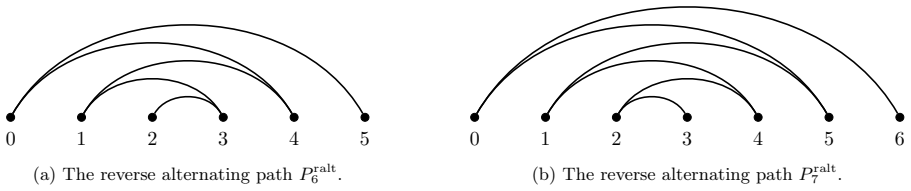

read the original abstract
Let $k \in \mathbb{N}$ and let $H_1, H_2, \ldots, H_k$ be simple graphs such that for each $j \in \{ 1, 2, \ldots, k \}$, the vertex set of $H_j$ is $\{ 0, 1, 2, \ldots, n_j - 1 \}$ for some $n_j \in \mathbb{N}$. The ordered Ramsey number $R_\mathrm{ord}(H_1, H_2, \ldots, H_k)$ is the smallest $n \in \mathbb{N}$ for which every $k$-edge-coloring of the complete graph on the vertex set $\{ 0, 1, 2, \ldots, n - 1 \}$ contains $H_j$ as a monochromatic subgraph of color $j$ for some $j \in \{ 1, 2, \ldots, k \}$, with the vertices appearing in the same order as in $H_j$. Inspired by the work of Poljak, we apply the Kissat SAT solver to determine new small two-color ordered Ramsey numbers of various classes of graphs: monotone paths, monotone cycles, alternating paths, stars, complete graphs and nested matchings. In addition, we introduce the cyclic Ramsey numbers $R_\mathrm{cyc}(H_1, H_2, \ldots, H_k)$ as a natural relaxation of the ordered Ramsey numbers, and once again use Kissat to determine various such numbers for the two-color case. By observing structural patterns in the computational results, we determine all ordered or cyclic Ramsey numbers for several pairs of classes of graphs. Furthermore, we obtain some bounds on ordered and cyclic Ramsey numbers where one argument is a connected graph, while the other is a monotone path or a monotone cycle. We also explore how reinforcement learning can be used through the recently developed Reinforcement Learning for Graph Theory (RLGT) framework to obtain lower bounds on ordered and cyclic Ramsey numbers. Finally, we introduce the permutational Ramsey numbers to show how the different Ramsey-type formulations involving standard, ordered and cyclic Ramsey numbers can be unified within a group-theoretic framework.
Editorial analysis
A structured set of objections, weighed in public.
Referee Report
Summary. The paper defines the ordered Ramsey number R_ord(H1,...,Hk) as the smallest n such that every k-edge-coloring of the ordered complete graph on {0,...,n-1} contains a monochromatic ordered copy of each Hj in color j. It applies the Kissat SAT solver to compute new small two-color ordered Ramsey numbers for classes including monotone paths, monotone cycles, alternating paths, stars, complete graphs, and nested matchings. The paper introduces cyclic Ramsey numbers R_cyc as a relaxation of the ordered variant and computes small values for the same classes. By identifying structural patterns in the computed tables, it claims closed-form determinations for all ordered or cyclic Ramsey numbers in several pairs of graph classes, provides bounds when one argument is a connected graph and the other a monotone path or cycle, explores reinforcement learning via the RLGT framework for lower bounds, and introduces permutational Ramsey numbers to unify standard, ordered, and cyclic variants in a group-theoretic setting.
Significance. If the SAT computations are correct, the work supplies new exact small values and closed-form expressions for ordered and cyclic Ramsey numbers across multiple graph families, extending classical Ramsey theory with order and cyclic constraints. The pattern-based closed forms and the group-theoretic unification via permutational numbers provide structural insight, while the RL lower-bound experiments illustrate an alternative computational technique. These contributions could support further exact determinations and theoretical analysis in structured Ramsey problems.
major comments (2)
- [Computational sections (around the Kissat experiments)] The sections describing the computational approach and SAT encodings provide no explicit CNF variable mapping or clause list for the order-preserving embedding condition (for R_ord) or the rotational invariance condition (for R_cyc). Without this, or any independent verification such as reproduction of known small classical Ramsey numbers or hand-checked instances for n≤10, the reported tables cannot be confirmed to correctly model the definitions.
- [Sections deriving closed forms from computational results] The closed-form claims for entire classes (e.g., all R_ord or R_cyc between monotone paths and cycles, or similar pairs) rest on patterns observed in the SAT-derived tables. Because the tables themselves lack cross-checks or encoding validation, these extrapolations are load-bearing but rest on unverified data; a single encoding error would invalidate the pattern-based determinations.
minor comments (2)
- The abstract mentions the use of Kissat and RLGT but gives no indication of the scale of the computations or the range of graph sizes considered; adding a brief summary of the largest instances solved would improve clarity.
- Notation for the new permutational Ramsey numbers is introduced late; an early diagram or table comparing the three variants (standard, ordered, cyclic) would help readers track the unification argument.
Simulated Author's Rebuttal
We thank the referee for their careful reading of the manuscript and for identifying areas where additional transparency would strengthen the presentation of our computational results. We address the two major comments point by point below.
read point-by-point responses
-
Referee: [Computational sections (around the Kissat experiments)] The sections describing the computational approach and SAT encodings provide no explicit CNF variable mapping or clause list for the order-preserving embedding condition (for R_ord) or the rotational invariance condition (for R_cyc). Without this, or any independent verification such as reproduction of known small classical Ramsey numbers or hand-checked instances for n≤10, the reported tables cannot be confirmed to correctly model the definitions.
Authors: We agree that the current manuscript lacks sufficient detail on the SAT encoding. In the revised version we will add an explicit description of the variable mapping (one Boolean variable per potential edge in each color together with auxiliary variables for vertex mappings) and the principal clauses that enforce order preservation for R_ord and rotational invariance for R_cyc. We will also include a short verification subsection that reproduces several well-known small classical Ramsey numbers (e.g., R(3,3)=6, R(3,4)=9) using the same encoding framework, and we will supply hand-checkable instances for selected n≤10 cases that match the definitions directly. revision: yes
-
Referee: [Sections deriving closed forms from computational results] The closed-form claims for entire classes (e.g., all R_ord or R_cyc between monotone paths and cycles, or similar pairs) rest on patterns observed in the SAT-derived tables. Because the tables themselves lack cross-checks or encoding validation, these extrapolations are load-bearing but rest on unverified data; a single encoding error would invalidate the pattern-based determinations.
Authors: The closed-form statements are indeed pattern-based extrapolations from the computed tables. Once the encoding details and verification results are added (as described in the response to the first comment), the reliability of the underlying data will be established. In the revision we will also state clearly which closed forms are accompanied by combinatorial proofs and which remain conjectural but are supported by exhaustive computation up to a verified bound together with matching theoretical upper and lower bounds derived in the paper. This makes the evidential basis explicit rather than load-bearing on unverified tables. revision: partial
Circularity Check
No circularity detected in the derivation chain
full rationale
The paper computes small ordered and cyclic Ramsey numbers via direct Kissat SAT encodings of the embedding conditions, then observes patterns in those independent computational tables to conjecture closed forms for graph classes. No step reduces a claimed result to its own inputs by construction: the solver outputs are external, the pattern step is observational generalization rather than a fitted prediction or self-definition, and no load-bearing self-citations or imported uniqueness theorems appear. New concepts (cyclic, permutational Ramsey numbers) are introduced by explicit definition without circular reference back to the computed values or patterns.
Axiom & Free-Parameter Ledger
axioms (1)
- standard math Standard definitions of ordered subgraphs and monochromatic copies in edge colorings of complete graphs
invented entities (2)
-
Cyclic Ramsey number R_cyc(H1,...,Hk)
no independent evidence
-
Permutational Ramsey numbers
no independent evidence
Reference graph
Works this paper leans on
-
[1]
F. Angileri, G. Lombardi, A. Fois, R. Faraone, C. Metta, M. Salvi, L. A. Bianchi, M. Fantozzi, S. G. Galfrè, D. Pavesi, M. Parton and F. Morandin, A systematization of the Wagner framework: Graph theory conjectures and reinforcement learning, in: D. Pedreschi, A. Monreale, R. Guidotti, R. Pellungrini and F. Naretto (eds.),Discovery Science, vol. 15243 ofL...
-
[2]
F. Angileri, G. Lombardi, A. Fois, R. Faraone, C. Metta, M. Salvi, L. A. Bianchi, M. Fantozzi, S. G. Galfrè, D. Pavesi, M. Parton and F. Morandin, Analyzing RL components for Wagner’s framework via Brouwer’s conjecture,Mach. Learn.114(2025), Art. No. 242,https://doi.org/10.1007/s10994-025-06890-2
-
[3]
Balko, A survey on ordered Ramsey numbers, 2025,arXiv:2502.02155 [math.CO]
M. Balko, A survey on ordered Ramsey numbers, 2025,arXiv:2502.02155 [math.CO]
-
[4]
M. Balko, J. Cibulka, K. Král and J. Kynčl, Ramsey numbers of ordered graphs,Electron. Notes Discrete Math.49(2015), 419–424,https://doi.org/10.1016/j.endm.2015.06.059
-
[5]
M. Balko, J. Cibulka, K. Král and J. Kynčl, Ramsey numbers of ordered graphs,Electron. J. Comb.27 (2020), #P1.16,https://doi.org/10.37236/7816
-
[6]
M. Balko, V. Jelínek and P. Valtr, On ordered Ramsey numbers of bounded-degree graphs,J. Comb. Theory Ser. B134(2019), 179–202,https://doi.org/10.1016/j.jctb.2018.06.002
-
[7]
M. Balko and M. Poljak, On off-diagonal ordered Ramsey numbers of nested matchings,Discrete Math. 346(2023), 113223,https://doi.org/10.1016/j.disc.2022.113223
-
[8]
M. Balko and M. Poljak, On ordered Ramsey numbers of matchings versus triangles,Electron. J. Comb. 31(2024), #P2.23,https://doi.org/10.37236/12107. 21
-
[9]
Bašić, I
N. Bašić, I. Damnjanović, D. Stevanović and I. Stošić, Some results on small ordered and cyclic Ramsey numbers: Supplementary material (GitHub repository),https://github.com/Ivan-Damnjanovic/ord- ram-num
-
[10]
Biere, T
A. Biere, T. Faller, K. Fazekas, M. Fleury, N. Froleyks and F. Pollitt, CaDiCaL, Gimsatul, IsaSAT and Kissat entering the SAT competition 2024, in: M. J. H. Heule, M. Iser, M. Järvisalo and M. Suda (eds.), Proceedings of SAT Competition 2024: Solver, Benchmark and Proof Checker Descriptions, vol. B-2024-1 of Department of Computer Science Report Series B,...
2024
-
[11]
Biere, T
A. Biere, T. Faller, K. Fazekas, M. Fleury, N. Froleyks and F. Pollitt, CaDiCaL, Gimsatul, IsaSAT and Kissat entering the SAT competition 2024 (GitHub repository),https://github.com/arminbiere/ kissat
2024
-
[12]
A Tutorial on the Cross-Entropy Method.Annals of Operations Research 2005; 134(1): 19–67
P.-T. de Boer, D. P. Kroese, S. Mannor and R. Y. Rubinstein, A tutorial on the cross-entropy method, Ann. Oper. Res.134(2005), 19–67,https://doi.org/10.1007/s10479-005-5724-z
-
[13]
D. Bradač, P. Morawski, B. Sudakov and Y. Wigderson, Ordered Ramsey numbers of graphs withmedges, Proc. Amer. Math. Soc.154(2026), 927–942,https://doi.org/10.1090/proc/17442
- [14]
-
[15]
A. E. Brouwer and W. H. Haemers,Spectra of Graphs, Universitext, Springer, New York, NY, 2012, https://doi.org/10.1007/978-1-4614-1939-6
-
[16]
S. A. Burr and J. A. Roberts, On Ramsey numbers for stars,Util. Math.4(1973), 217–220
1973
-
[17]
Chvátal, Tree-complete graph Ramsey numbers,J
V. Chvátal, Tree-complete graph Ramsey numbers,J. Graph Theory1(1977), 93,https://doi.org/10. 1002/jgt.3190010118
1977
-
[18]
S. A. Choudum and B. Ponnusamy, Ordered Ramsey numbers,Discrete Math.247(2002), 79–92,https: //doi.org/10.1016/S0012-365X(01)00161-3
-
[19]
D. Conlon, J. Fox, C. Lee and B. Sudakov, Ordered Ramsey numbers,J. Comb. Theory Ser. B122(2017), 353–383,https://doi.org/10.1016/j.jctb.2016.06.007
-
[20]
D. Conlon, J. Fox and B. Sudakov, Recent developments in graph Ramsey theory, in: A. Czumaj, A. Geor- gakopoulos, D. Kráľ, V. Lozin and O. Pikhurko (eds.),Surveys in Combinatorics 2015, vol. 424 ofLondon Mathematical Society Lecture Note Series, Cambridge University Press, Cambridge, UK, 2015, pp. 49–118, https://doi.org/10.1017/CBO9781316106853
-
[21]
C. Cox and D. Stolee, Ordered Ramsey numbers of loose paths and matchings,Discrete Math.339(2016), 499–505,https://doi.org/10.1016/j.disc.2015.09.026
-
[22]
RLGT: A reinforcement learning framework for extremal graph theory
I. Damnjanović, U. Milivojević, I. Ðorđević and D. Stevanović, RLGT: A reinforcement learning framework for extremal graph theory, 2026,arXiv:2602.17276 [cs.LG]
work page internal anchor Pith review Pith/arXiv arXiv 2026
-
[23]
Damnjanović, U
I. Damnjanović, U. Milivojević, I. Ðorđević and D. Stevanović, RLGT: A reinforcement learning framework for extremal graph theory (GitHub documentation),https://ivan-damnjanovic.github.io/rlgt/
-
[24]
Damnjanović, U
I. Damnjanović, U. Milivojević, I. Ðorđević and D. Stevanović, RLGT: A reinforcement learning framework for extremal graph theory (GitHub repository),https://github.com/Ivan-Damnjanovic/rlgt
-
[25]
Erdős and Gy
P. Erdős and Gy. Szekeres, A combinatorial problem in geometry,Compos. Math.2(1935), 463–470, http://eudml.org/doc/88611
1935
-
[26]
P. Frankl, J. Pach, C. Reiher and V. Rödl, Borsuk and Ramsey type questions in Euclidean space, in: S. Butler, J. Cooper and G. Hurlbert (eds.),Connections in Discrete Mathematics: A Celebration of the Work of Ron Graham, Cambridge University Press, Cambridge, UK, 2018, pp. 259–277,https://doi. org/10.1017/9781316650295
-
[27]
Gerencsér and A
L. Gerencsér and A. Gyárfás, On Ramsey-type problems,Ann. Univ. Sci. Budap. Rolando Eötvös Sect. Math.10(1967), 167–170
1967
-
[28]
M.Ghebleh, S.Al-Yakoob, A.KansoandD.Stevanović, Graphshavingtwomaineigenvaluesandarbitrarily many distinct vertex degrees,Appl. Math. Comput.495(2025), 129311,https://doi.org/10.1016/j. amc.2025.129311. 22
work page doi:10.1016/j 2025
-
[29]
M. Ghebleh, S. Al-Yakoob, A. Kanso and D. Stevanović, Reinforcement learning for graph theory, II. Small Ramsey numbers,Art Discrete Appl. Math.8(2025), #P1.07,https://doi.org/10.26493/2590- 9770.1788.8af
-
[30]
M. Ghebleh, S. Al-Yakoob, A. Kanso and D. Stevanović, Reinforcement learning for graph theory, I: Reimplementation of Wagner’s approach,Discrete Appl. Math.380(2026), 468–479,https://doi.org/ 10.1016/j.dam.2025.10.047
- [31]
-
[32]
L. Gishboliner, Z. Jin and B. Sudakov, Ramsey problems for monotone paths in graphs and hypergraphs, Combinatorica44(2024), 509–529,https://doi.org/10.1007/s00493-024-00082-7
-
[33]
R. L. Graham, B. L. Rothschild and J. H. Spencer,Ramsey Theory, 2nd edition, John Wiley & Sons, Inc., New York, NY, 1990
1990
-
[34]
K. Grinerová,Multi-colored ordered Ramsey numbers, Bachelor’s thesis, Faculty of Mathematics and Physics, Charles University, Prague, Czech Republic, 2024,http://hdl.handle.net/20.500.11956/ 193039
2024
-
[35]
Gy. Károlyi, J. Pach and G. Tóth, Ramsey-type results for geometric graphs, I,Discrete Comput. Geom. 18(1997), 247–255,https://doi.org/10.1007/PL00009317
-
[36]
Gy. Károlyi, J. Pach, G. Tóth and P. Valtr, Ramsey-type results for geometric graphs, II,Discrete Comput. Geom.20(1998), 375–388,https://doi.org/10.1007/PL00009391
-
[37]
G. Kucheriya, A. Lo, J. Petr, A. Sgueglia and J. Yan, Ordered Ramsey and Turán numbers of alternating paths and their variants, 2026,arXiv:2603.12358 [math.CO]
-
[38]
Lapan,Deep Reinforcement Learning Hands-On, 2nd edition, Packt Publishing, Birmingham, UK, 2020
M. Lapan,Deep Reinforcement Learning Hands-On, 2nd edition, Packt Publishing, Birmingham, UK, 2020
2020
-
[39]
Y. Li and Q. Lin,Elementary Methods of Graph Ramsey Theory, vol. 211 ofApplied Mathematical Sciences, Springer, Cham, Switzerland, 2022,https://doi.org/10.1007/978-3-031-12762-5
-
[40]
B. D. McKay, Description of graph6, sparse6 and digraph6 encodings, 2022,https://users.cecs.anu. edu.au/~bdm/data/formats.txt
2022
-
[41]
B. D. McKay and A. Piperno, Practical graph isomorphism, II,J. Symb. Comput.60(2014), 94–112, https://doi.org/10.1016/j.jsc.2013.09.003
-
[42]
K. G. Milans, D. Stolee and D. B. West, Ordered Ramsey theory and track representations of graphs,J. Comb.6(2015), 445–456,https://doi.org/10.4310/JOC.2015.v6.n4.a3
-
[43]
Morris, Some recent results in Ramsey theory, arXiv preprintarXiv:2601.05221,2026
R. Morris, Some recent results in Ramsey theory, 2026,arXiv:2601.05221 [math.CO]
-
[44]
D. Mubayi and A. Suk, Ramsey numbers of cliques versus monotone paths,Eur. J. Comb.118(2024), 103922,https://doi.org/10.1016/j.ejc.2024.103922
-
[45]
D. Neidinger and D. B. West, Ramsey numbers of interval 2-chromatic ordered graphs,Graphs Comb.35 (2019), 1065–1076,https://doi.org/10.1007/s00373-019-02057-8
-
[46]
J. Nešetřil and V. Rödl (eds.),Mathematics of Ramsey Theory, vol. 5 ofAlgorithms and Combinatorics, Springer, Berlin, Heidelberg, Germany, 1990,https://doi.org/10.1007/978-3-642-72905-8
-
[47]
Nguyen Van Thé, A survey on structural Ramsey theory and topological dynamics with the Kechris– Pestov–Todorcevic correspondence in mind,Zb
L. Nguyen Van Thé, A survey on structural Ramsey theory and topological dynamics with the Kechris– Pestov–Todorcevic correspondence in mind,Zb. Rad. (Beogr.)17(25)(2015), 189–207
2015
-
[48]
Overman, J
W. Overman, J. F. Alm, K. Coffey and C. Langhoff, Some ordered Ramsey numbers of graphs on four ver- tices,Australas. J. Comb.88(2024), 266–281,https://ajc.maths.uq.edu.au/pdf/88/ajc_v88_p266. pdf
2024
-
[49]
T. D. Parsons, The Ramsey numbersr(Pm, Kn),Discrete Math.6(1973), 159–162,https://doi.org/10. 1016/0012-365X(73)90045-9
1973
-
[50]
M. Poljak,Computing and estimating ordered Ramsey numbers, Bachelor’s thesis, Faculty of Mathematics and Physics, Charles University, Prague, Czech Republic, 2020,http://hdl.handle.net/20.500.11956/ 119412. 23
2020
-
[51]
M. Poljak,Off-diagonal ordered Ramsey numbers, Master’s thesis, Faculty of Mathematics and Physics, Charles University, Prague, Czech Republic, 2023,http://hdl.handle.net/20.500.11956/182079
2023
-
[52]
W. B. Powell,Reinforcement Learning and Stochastic Optimization: A Unified Framework for Sequen- tial Decisions, 1st edition, John Wiley & Sons, Inc., Hoboken, NJ, 2022,https://doi.org/10.1002/ 9781119815068
2022
-
[53]
S. P. Radziszowski, Small Ramsey numbers,Electron. J. Comb.(2024), DS1.17,https://doi.org/10. 37236/21
2024
-
[54]
F. P. Ramsey, On a problem of formal logic,Proc. Lond. Math. Soc. (2)30(1930), 264–286,https: //doi.org/10.1112/plms/s2-30.1.264
-
[55]
Rohatgi, Off-diagonal ordered Ramsey numbers of matchings,Electron
D. Rohatgi, Off-diagonal ordered Ramsey numbers of matchings,Electron. J. Comb.26(2019), #P2.21, https://doi.org/10.37236/8085
-
[56]
R. Y. Rubinstein, Optimization of computer simulation models with rare events,Eur. J. Oper. Res.99 (1997), 89–112,https://doi.org/10.1016/S0377-2217(96)00385-2
-
[57]
R. S. Sutton and A. G. Barto,Reinforcement Learning: An Introduction, 2nd edition, Adaptive Computa- tion and Machine Learning, MIT Press, Cambridge, MA, 2018
2018
-
[58]
Cs. Szepesvári,Algorithms for Reinforcement Learning, 1st edition, Synthesis Lectures on Artificial Intel- ligence and Machine Learning, Springer, Cham, Switzerland, 2010,https://doi.org/10.1007/978-3- 031-01551-9
- [59]
discussion (0)
Sign in with ORCID, Apple, or X to comment. Anyone can read and Pith papers without signing in.