Recognition: unknown
A digitally controlled silicon quantum processing unit
Pith reviewed 2026-05-10 08:43 UTC · model grok-4.3
The pith
An integrated cryogenic control system advances silicon exchange-only qubits by an order of magnitude.
A machine-rendered reading of the paper's core claim, the machinery that carries it, and where it could break.
Core claim
We introduce a quantum processing unit composed of a custom-designed cryogenic CMOS controller, a novel high-density superconducting ribbon cable, and a low-noise exchange-only qubit device. The quantum chip features a three-rail array of 54 exchange-coupled quantum dots, configurable to host up to 18 exchange-only qubits. We integrate and use these components to demonstrate qubit performance for both single-qubit and entangling operations that advances the exchange-only state of the art by an order of magnitude. We further validate this system by implementing a distance-5 repetition code and a quantum error detecting code then make detailed comparisons with simulations.
What carries the argument
The integrated quantum processing unit that combines the cryogenic CMOS controller for digital control, the superconducting ribbon cable for high-density low-noise connections, and the 54-dot exchange-only qubit array.
If this is right
- Qubit performance for single-qubit and entangling operations improves by an order of magnitude over prior exchange-only devices.
- A distance-5 repetition code is implemented and compared in detail with simulations.
- A quantum error detecting code is also run on the system.
- The overall approach facilitates utility-scale quantum computers with manageable operational and capital requirements.
Where Pith is reading between the lines
- The semiconductor manufacturing compatibility could allow fabrication of even larger qubit arrays without new infrastructure.
- Digital control at cryogenic temperatures may reduce the complexity of wiring for systems with thousands of qubits.
- The close match between experiment and simulation suggests the dominant noise sources are well characterized and can be further mitigated.
- Such an architecture might be adapted for other qubit types that benefit from dense wiring and integrated control.
Load-bearing premise
The integration of the cryogenic CMOS controller and superconducting ribbon cable does not introduce new noise or decoherence sources that erase the claimed order-of-magnitude performance gain.
What would settle it
If measurements of the qubit gate fidelities or coherence times in the new integrated system do not show the reported order-of-magnitude improvement over previous exchange-only devices, the central performance claim would be falsified.
Figures

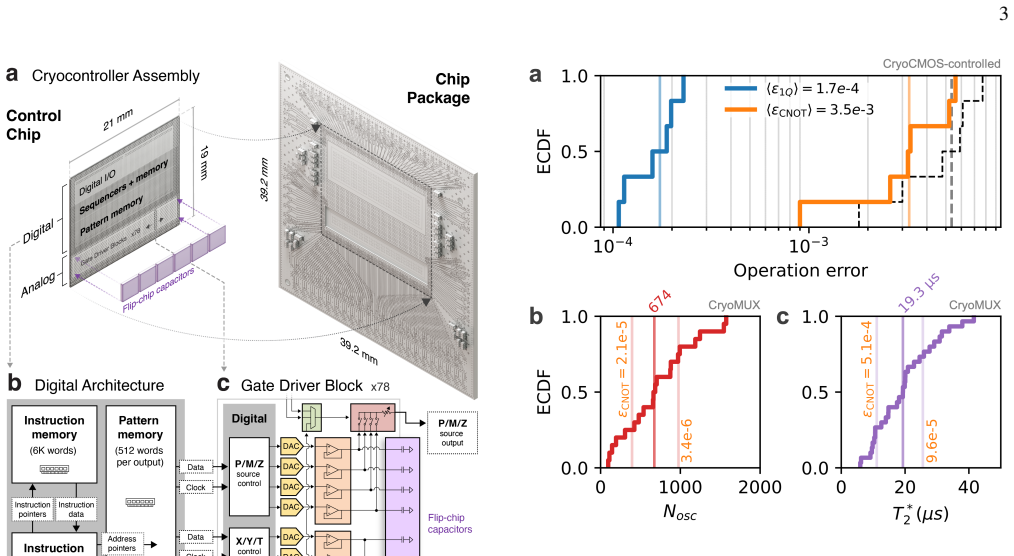

read the original abstract
Commercially-relevant quantum computers will require large numbers of high-performing qubits that can be manufactured, integrated, and controlled at scale. Silicon exchange-only (EO) qubits are a strong candidate modality due to their control-signal simplicity and compatibility with advanced semiconductor manufacturing, but questions remain around the achievability of sufficiently low noise and a scalable control and wiring solution. Here we introduce a quantum processing unit composed of a custom-designed cryogenic CMOS controller, a novel high-density superconducting ribbon cable, and a low-noise EO qubit device. The quantum chip features a three-rail array of 54 exchange-coupled quantum dots, configurable to host up to 18 EO qubits. We integrate and use these components to demonstrate qubit performance for both single-qubit and entangling operations that advances the EO state of the art by an order of magnitude. We further validate this system by implementing a distance-5 repetition code and a quantum error detecting code then make detailed comparisons with simulations. Our approach facilitates a utility-scale quantum computer with manageable operational and capital requirements.
Editorial analysis
A structured set of objections, weighed in public.
Referee Report
Summary. The manuscript describes the development and integration of a silicon quantum processing unit consisting of a custom cryogenic CMOS controller, a high-density superconducting ribbon cable, and a 54-dot exchange-only (EO) qubit array configurable for up to 18 qubits. It reports single-qubit and entangling gate performance that advances the EO state of the art by an order of magnitude, demonstrates a distance-5 repetition code and a quantum error detecting code, and includes detailed comparisons of experimental results with simulations.
Significance. If the performance claims hold after addressing noise attribution, this represents a meaningful advance toward scalable control of silicon qubits. The integration of cryogenic electronics with EO qubits and the successful execution of error correction protocols on the combined system provide concrete evidence that wiring and control bottlenecks can be mitigated in a semiconductor-compatible platform, strengthening the case for utility-scale EO-based processors.
major comments (2)
- Results section (performance metrics): The headline claim of an order-of-magnitude advance in single- and two-qubit metrics over prior EO devices is load-bearing for the paper's central narrative, yet the manuscript provides no explicit noise budget or isolation experiment that attributes decoherence and control errors to the qubit chip versus the cryogenic CMOS controller and ribbon cable. Without this breakdown, the integration could introduce charge noise or crosstalk that returns fidelities to the prior EO range, undermining the advance.
- Error correction demonstrations: In the section presenting the distance-5 repetition code and quantum error detecting code, the simulation comparisons are used to validate the system, but the text does not specify how additional noise sources from the digital control lines or ribbon cable are incorporated into the error models. This omission makes it impossible to assess whether the reported agreement between experiment and simulation truly confirms the hardware integration's viability.
minor comments (2)
- Abstract: The statement that the system 'advances the EO state of the art by an order of magnitude' would benefit from a parenthetical reference to the specific metrics (e.g., T2*, gate fidelity) and prior works being surpassed.
- Figure captions and methods: Several figures comparing experimental data to simulations lack error bars or details on data selection criteria, reducing clarity for readers attempting to reproduce the analysis.
Simulated Author's Rebuttal
We thank the referee for their careful reading and constructive feedback. We address each major comment below with clarifications on the existing data and indicate revisions that will be incorporated to improve transparency.
read point-by-point responses
-
Referee: Results section (performance metrics): The headline claim of an order-of-magnitude advance in single- and two-qubit metrics over prior EO devices is load-bearing for the paper's central narrative, yet the manuscript provides no explicit noise budget or isolation experiment that attributes decoherence and control errors to the qubit chip versus the cryogenic CMOS controller and ribbon cable. Without this breakdown, the integration could introduce charge noise or crosstalk that returns fidelities to the prior EO range, undermining the advance.
Authors: The reported gate fidelities and coherence times were obtained on the fully integrated system comprising the qubit array, cryogenic CMOS controller, and ribbon cable. This integrated performance constitutes the relevant benchmark for scalability, as it shows that the complete control chain enables an order-of-magnitude improvement relative to prior EO literature. Simulations calibrated to the full hardware stack, including modeled contributions from control electronics and interconnects, reproduce the experimental error rates. We acknowledge that an explicit experimental isolation of individual noise sources would further strengthen attribution. We will add a dedicated paragraph in the results section discussing the dominant noise mechanisms inferred from the integrated measurements and simulation comparisons, while noting that separate isolation runs were not performed. revision: partial
-
Referee: Error correction demonstrations: In the section presenting the distance-5 repetition code and quantum error detecting code, the simulation comparisons are used to validate the system, but the text does not specify how additional noise sources from the digital control lines or ribbon cable are incorporated into the error models. This omission makes it impossible to assess whether the reported agreement between experiment and simulation truly confirms the hardware integration's viability.
Authors: The error models used for the repetition code and error-detecting code simulations are parameterized directly from the measured error rates of the integrated device. These rates already embed the combined effects of qubit decoherence, control-line noise, and any crosstalk introduced by the ribbon cable. The close quantitative agreement between experiment and simulation therefore indicates that the additional noise channels from the digital control path are captured within the fitted parameters. We will revise the main text and supplementary information to explicitly state the origin of the model parameters and how control-related noise is included. revision: yes
- Dedicated isolation experiments that separately characterize noise from the qubit chip, controller, and cable alone are not available in the current dataset and would require additional hardware configurations.
Circularity Check
No circularity: experimental hardware demonstration with measured results
full rationale
This is an experimental paper reporting integration of a cryogenic CMOS controller, superconducting ribbon cable, and a 54-dot EO qubit array, followed by direct measurements of single-qubit and two-qubit gate performance plus implementation of a distance-5 repetition code. All central claims rest on laboratory data and comparisons to external simulations rather than any mathematical derivation chain. No equations, fitted parameters renamed as predictions, self-definitional steps, or load-bearing self-citations appear in the reported results. The work is therefore self-contained against external benchmarks and receives the default non-circularity finding.
Axiom & Free-Parameter Ledger
Forward citations
Cited by 3 Pith papers
-
Understanding oxide-thickness-dependent variability in dense Si-MOS quantum dot arrays
A 17 nm SiO2 gate oxide thickness minimizes threshold voltage variability below 63 mV standard deviation in dense silicon quantum dot arrays.
-
Understanding oxide-thickness-dependent variability in dense Si-MOS quantum dot arrays
17 nm SiO2 oxide thickness minimizes threshold voltage variability below 63 mV standard deviation in dense 7x7 silicon quantum dot arrays fabricated via 300 mm CMOS and EUV lithography.
-
Sub-kelvin thermal conductivity of substrates and on-chip routing in quantum integrated systems
High-resistivity silicon shows the highest thermal conductivity at 300 mK among tested substrates, and Nb routing lines increase in-plane conductance but leave the substrate as the dominant heat path.
Reference graph
Works this paper leans on
-
[1]
The topol- ogy also may or may not contain anencoding, which describes how spins are grouped to form DFS qubits
The user passes aresource topology, which provides the device graph, whose nodes are the spins and whose edges are the possible exchange couplings. The topol- ogy also may or may not contain anencoding, which describes how spins are grouped to form DFS qubits. We use the encoding for GAQQMap (Sec. S4 D) to track spin labels belong to DFS, but in general c...
-
[2]
The user passes aflatseqobject, which is a data struc- ture that contains the sequence of pulse operations and state preparation and measurement (SPAM), operations to apply to the spins. a. This is typically encoded as a matrix, where each row is a timestep, each column a particular ex- change axis, and each entry either zero or the de- sired pulse angle....
-
[3]
Note that in pyquest,𝑇 ∗ 2 is a property of eachdot, rather than eachexchange axis
The user specifies noise parameters for the system, such as𝑁 osc for each axis or𝑇 ∗ 2 for each dot, the (static) magnetic field experienced by each spin, and static pulse miscalibration. Note that in pyquest,𝑇 ∗ 2 is a property of eachdot, rather than eachexchange axis. For a DFS qubit with three spins {𝑧, 𝑡, 𝑛}, with pairwise𝑇 ∗ 2 values 𝑇 ∗ 2 (𝑧, 𝑡), 𝑇...
-
[4]
conditioners
Pyquest then generates anoise trajectory(i.e., a particu- lar sampling of fluctuating magnetic fields or fluctuating S23 exchange couplings) and simulates application of the se- quence with the sampled noise trajectory. This process can be repeated for a desired number of shots, with pyquest automatically re-sampling noise for each shot. Fluctuating magne...
-
[5]
A global static magnetic field of 160𝜇𝑇was measured via dynamical decoupling spectroscopy [22]
−2 =(𝑇 ∗ 2,env ) −2 +𝜔 2/2. A global static magnetic field of 160𝜇𝑇was measured via dynamical decoupling spectroscopy [22]. Time-domain exchange oscillation experiments estimate the microscopic charge noise parameter𝑁 osc. We include an ersatz quasi-static miscalibration error of 1.5% to account for contextual pulse miscalibration, as described in Sec. S7...
-
[6]
a” and the flag qubit as “f
on all idle qubits interleaved with operational pulses. In the [[4,2,2]] code, the logical codewords for the𝑍basis are: |00⟩ 𝐿 = 1√ 2 (|0000⟩ + |1111⟩ ) , |01⟩ 𝐿 = 1√ 2 (|0011⟩ + |1100⟩ ) , |10⟩ 𝐿 = 1√ 2 (|0101⟩ + |1010⟩ ) , |11⟩ 𝐿 = 1√ 2 (|0110⟩ + |1001⟩ ) . The data qubits are initially prepared in a computational state, such as|0000⟩. In this case, the...
-
[7]
D.et al.Reduced sensitivity to charge noise in semi- conductor spin qubits via symmetric operation.Phys
Reed, M. D.et al.Reduced sensitivity to charge noise in semi- conductor spin qubits via symmetric operation.Phys. Rev. Lett. 116, 110402 (2016)
2016
-
[8]
DiCarlo, L.et al.Differential charge sensing and charge delo- calization in a tunable double quantum dot.Phys. Rev. Lett.92, 226801 (2004)
2004
-
[9]
Z.et al.Fast and high-fidelity state preparation and measurement in triple-quantum-dot spin qubits.PRX Quantum 3, 010352 (2022)
Blumoff, J. Z.et al.Fast and high-fidelity state preparation and measurement in triple-quantum-dot spin qubits.PRX Quantum 3, 010352 (2022)
2022
-
[10]
Fong, B. H. & Wandzura, S. M. Universal quantum computa- tion and leakage reduction in the 3-qubit decoherence free sub- system.Quantum Information & Computation11, 1003–1018 (2011)
2011
-
[11]
& Nemoto, K
Hukushima, K. & Nemoto, K. Exchange Monte Carlo Method S39 Supplementary Fig. S53.DEMs constructed from experimental (black) and simulated (blue) data for the [[4,2,2]] code with 3-rounds of syndrome detection.This is a DEM of size𝑁=2×4=8.a,Comparison of total error probabilities for each weight-class of error events.b,Comparison of error probabilities ev...
1996
-
[12]
& Glaser, S
Khaneja, N., Reiss, T., Kehlet, C., Schulte-Herbr¨ uggen, T. & Glaser, S. Optimal control of coupled spin dynamics: Design of NMR pulse sequences by gradient ascent algorithms.Journal of Magnetic Resonance172, 296–305 (2005)
2005
-
[13]
J.et al.Universal logic with encoded spin qubits in silicon.Nature615, 817–822 (2023)
Weinstein, A. J.et al.Universal logic with encoded spin qubits in silicon.Nature615, 817–822 (2023)
2023
-
[14]
Reichardt, B. W.et al.Fault-tolerant quantum computation with a neutral atom processor (2025). arXiv:2411.11822 [quant-ph]
-
[15]
Paquelet Wuetz, B.et al.Multiplexed quantum transport using commercial off-the-shelf CMOS at sub-kelvin temperatures.npj Quantum Information6, 43 (2020)
2020
-
[16]
Pauka, S.et al.Characterizing quantum devices at scale with custom cryo-cmos.Phys. Rev. Appl.13, 054072 (2020)
2020
-
[17]
Eastoe, J.et al.Method for Efficient Large-Scale Cryogenic Characterization of CMOS Technologies.IEEE Transactions on Instrumentation and Measurement74, 1–10 (2025)
2025
-
[18]
J.et al.Rapid cryogenic characterization of 1,024 integrated silicon quantum dot devices.Nature Electronics8, 75–83 (2025)
Thomas, E. J.et al.Rapid cryogenic characterization of 1,024 integrated silicon quantum dot devices.Nature Electronics8, 75–83 (2025)
2025
-
[19]
Tosato, A.et al.A crossbar chip for benchmarking semiconduc- tor spin qubits.Nature Electronics9, 324–333 (2026)
2026
-
[20]
A.et al.On-chip cryogenic multiplexing of Si/SiGe quantum devices (2024)
Wolfe, M. A.et al.On-chip cryogenic multiplexing of Si/SiGe quantum devices (2024). arXiv:2410.13721 [cond-mat]
-
[21]
K.et al.Multiplexed charge-locking device for large arrays of quantum devices.Applied Physics Letters107, 143501 (2015)
Puddy, R. K.et al.Multiplexed charge-locking device for large arrays of quantum devices.Applied Physics Letters107, 143501 (2015)
2015
-
[22]
Lodari, M.et al.Low disorder and high valley splitting in silicon.npj Quantum Information10, 26 (2024)
2024
-
[23]
C.et al.Valley splitting correlations across a silicon quantum well containing germanium.Nature Communications 16, 11381 (2025)
Marcks, J. C.et al.Valley splitting correlations across a silicon quantum well containing germanium.Nature Communications 16, 11381 (2025)
2025
-
[24]
H.et al.Detuning Axis Pulsed Spectroscopy of Valley- Orbital States in Si/SiGe Quantum Dots.Physical Review Ap- plied15, 044033 (2021)
Chen, E. H.et al.Detuning Axis Pulsed Spectroscopy of Valley- Orbital States in Si/SiGe Quantum Dots.Physical Review Ap- plied15, 044033 (2021)
2021
-
[25]
P.et al.Effect of quantum hall edge strips on valley splitting in silicon quantum wells.Phys
Wuetz, B. P.et al.Effect of quantum hall edge strips on valley splitting in silicon quantum wells.Phys. Rev. Lett.125, 186801 (2020)
2020
-
[26]
Stehouwer, L. E. A.et al.Engineering Ge Profiles in Si/SiGe Heterostructures for Increased Valley Splitting.Nano Letters 25, 12892–12898 (2025)
2025
-
[27]
W.et al.Quantifying error and leakage in an en- coded Si/SiGe triple-dot qubit.Nature Nanotechnology(2019)
Andrews, R. W.et al.Quantifying error and leakage in an en- coded Si/SiGe triple-dot qubit.Nature Nanotechnology(2019)
2019
-
[28]
Kerckhoff, J.et al.Magnetic gradient fluctuations from quadrupolar 73Ge in Si/SiGe exchange-only qubits.PRX Quan- tum2, 010347 (2021)
2021
-
[29]
Voss, R. F. Efficient incremental simulation of “1/f” noises. Fractals30, 2250020 (2022)
2022
-
[30]
& Tobochnik, J
Lin, H., Gubernatis, J., Gould, H. & Tobochnik, J. Exact Diago- nalization Methods for Quantum Systems.Computer in Physics 7, 400–407 (1993)
1993
-
[31]
quimb: A python package for quantum information and many-body calculations.Journal of Open Source Software3, 819 (2018)
Gray, J. quimb: A python package for quantum information and many-body calculations.Journal of Open Source Software3, 819 (2018)
2018
-
[32]
& Kourtis, S
Gray, J. & Kourtis, S. Hyper-optimized tensor network contrac- tion.Quantum5, 410 (2021)
2021
-
[33]
Gray, J. autoray. Retrieved from github.com: https://github.com/jcmgray/autoray
-
[34]
& Crissman
Okuta, R., Unno, Y., Nishino, D., Hido, S. & Crissman. CuPy : A NumPy-Compatible Library for NVIDIA GPU Calcu- lations(NIPS, 2017). In Proceedings of Workshop on Machine Learning Systems (LearningSys) in the 31st Annual Conference on Neural Information Processing Systems (NIPS)
2017
-
[35]
Blume-Kohout, R. & Young, K. Estimating detector error mod- els from syndrome data (2025). arXiv:2504.14643 [quant-ph]
-
[36]
Technol.5, 044002 (2020)
Nielsen, E.et al.Probing quantum processor performance with pyGSTi.Quantum Sci. Technol.5, 044002 (2020). For DEM analysis, we use pygsti.extras.sparsedems
2020
-
[37]
& Gidney, C
Higgott, O. & Gidney, C. Sparse Blossom: correcting a mil- lion errors per core second with minimum-weight matching. Quantum9, 1600 (2025)
2025
-
[38]
Chen, Z.et al.Exponential suppression of bit or phase errors with cyclic error correction.Nature595, 383–387 (2021)
2021
-
[39]
Sun, B.et al.Full-permutation dynamical decoupling in triple- quantum-dot spin qubits.PRX Quantum5, 020356 (2024)
2024
discussion (0)
Sign in with ORCID, Apple, or X to comment. Anyone can read and Pith papers without signing in.