Recognition: unknown
The thermodynamic efficiency of coupled chaotic dissipative structures
Pith reviewed 2026-05-10 07:55 UTC · model grok-4.3
The pith
Master-slave and symmetric diffusive couplings reduce coupled dissipative structures to equivalent engines whose efficiency follows from the components.
A machine-rendered reading of the paper's core claim, the machinery that carries it, and where it could break.
Core claim
We introduce two canonical couplings -- master-slave coupling (series) and symmetric diffusive coupling (parallel) -- and prove two fundamental association laws allowing us to reduce the composite systems to an equivalent engine with a specified efficiency. We then apply these abstract results to coupled Lorenz waterwheels, deriving efficiency formulas consistent with the underlying power balance.
What carries the argument
The two fundamental association laws for master-slave (series) and symmetric diffusive (parallel) couplings that reduce any composite dissipative structure to a single equivalent engine whose thermodynamic efficiency is determined by the power-balance of its parts.
If this is right
- Series coupling raises the thermodynamic efficiency of the composite system relative to the separate engines.
- Parallel coupling produces an efficiency that is the weighted average of the component efficiencies while increasing total energy flow through the system.
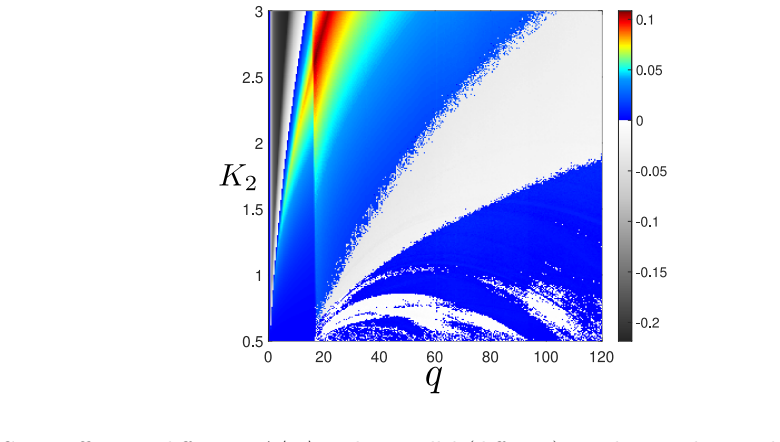
- Synchronization between the coupled structures is typically neutral or beneficial for efficiency except inside narrow parameter intervals.
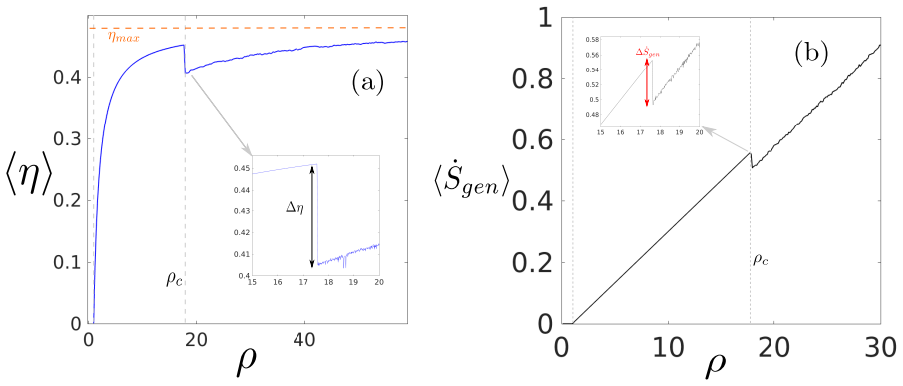
- The coupling type changes the curvature of entropy-generation curves as the driving parameter is varied.
Where Pith is reading between the lines
- The association laws supply a template for computing efficiency in larger networks of dissipative structures once the topology is specified as series or parallel subgraphs.
- The same reduction could be tested on other chaotic models, such as coupled Rössler oscillators or fluid-convection cells, to check whether efficiency formulas remain predictive.
- Engineered systems that can be switched between series and parallel coupling might use the laws to select configurations that optimize efficiency or entropy production.
- The framework offers a route to define thermodynamic performance for abstract flow networks without requiring full solution of the high-dimensional dynamics.
Load-bearing premise
The power-balance definition of efficiency remains valid and additive under the chosen couplings without additional hidden dissipation or non-thermodynamic effects introduced by the coupling terms themselves.
What would settle it
Numerical integration of two coupled Lorenz waterwheels under master-slave coupling that yields a measured efficiency differing from the value predicted by the series association law for the same parameter values would falsify the reduction.
Figures



read the original abstract
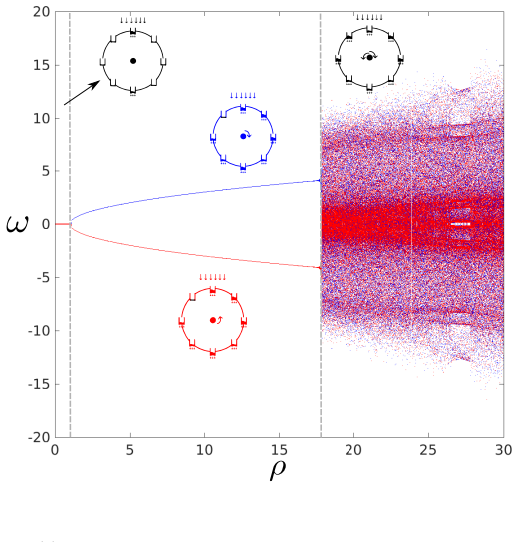
Dissipative structures are open dynamical systems that sustain coherent macroscopic organization by continuously exchanging energy and matter with their environment and generating entropy. A recent thermodynamic analysis of the paradigmatic Malkus--Lorenz waterwheel interpreted the Lorenz system as an engine, deriving an exact formula for its thermodynamic efficiency, and showing that efficiency tends to increase as the system is driven far from equilibrium while displaying sharp drops near the Hopf subcritical bifurcation to chaos. Here, we extend that single-engine framework to coupled dissipative structures. We introduce two canonical couplings -- master-slave coupling (series) and symmetric diffusive coupling (parallel) -- and prove two fundamental association laws allowing us to reduce the composite systems to an equivalent engine with a specified efficiency. We then apply these abstract results to coupled Lorenz waterwheels, deriving efficiency formulas consistent with the underlying power balance. We perform numerical simulations confirming that (a) series coupling induces an increase in thermodynamic efficiency, (b) parallel coupling averages the efficiency of engines and increases total energy flow, (c) synchronization is typically neutral or beneficial for efficiency except in narrow parameter regions, and (d) coupling modifies the curvature of entropy-generation trends. Our theorems suggest a mathematically rigorous and transparent route to define and compute thermodynamic efficiency for generalized flow networks, with potential application to complex systems energetics.
Editorial analysis
A structured set of objections, weighed in public.
Referee Report
Summary. The paper extends a prior thermodynamic analysis of the Malkus-Lorenz waterwheel (treated as an engine with exact efficiency formula) to coupled dissipative structures. It defines two canonical couplings—master-slave (series) and symmetric diffusive (parallel)—and proves two association laws that reduce any composite system to an equivalent single engine whose efficiency is fixed by the global power balance. These laws are applied to coupled Lorenz waterwheels to obtain explicit efficiency expressions claimed to be consistent with the underlying power balance. Numerical simulations are presented to confirm four trends: series coupling raises efficiency, parallel coupling averages efficiencies while increasing total flow, synchronization is usually neutral or beneficial, and coupling alters the curvature of entropy-production curves. The work positions the association laws as a general route to efficiency calculations for flow networks.
Significance. If the association laws are rigorously established, the manuscript supplies a mathematically transparent method for assigning thermodynamic efficiency to networks of coupled chaotic dissipative structures without introducing new free parameters. Credit is due for deriving the reduction from the model equations rather than data fitting, for the explicit power-balance consistency claim, and for the reproducible simulation trends that test the predicted monotonicities and averaging properties. The framework could apply to other open chaotic systems in fluid mechanics or complex networks, provided the power-neutrality of the chosen couplings is verified.
major comments (2)
- [§3] §3 (Association Laws): The central reduction to an equivalent engine requires that the coupling vector fields contribute exactly zero net power (or entropy production) to the global energy balance. The manuscript states that the derived efficiencies are “consistent with the underlying power balance,” but the load-bearing step—explicit cancellation or reallocation of the coupling terms inside the time derivative of total mechanical/thermal energy—is not shown with sufficient detail for the Lorenz waterwheel realization. Please insert the global energy equation (including the coupling term) and the integration step that demonstrates exact neutrality before applying the association law.
- [§4] §4 (Application to Coupled Waterwheels): The efficiency formulas for both series and parallel configurations rest on the association laws. If the master-slave torque transfer or diffusive coupling introduces even small unaccounted viscous losses, the composite efficiency would be offset by an invisible dissipation channel. The text claims consistency with power balance; an explicit verification that the coupling contribution integrates to zero (or is absorbed into the driving/dissipation terms already present) must be provided, together with the resulting composite efficiency expression.
minor comments (2)
- [Figures 2-3] Figure 2 and 3 captions: the efficiency curves lack error bars or ensemble statistics; please state the number of realizations and the integration time used to compute time averages.
- [§2] Notation: the symbol for the composite efficiency is introduced without a clear definition distinguishing it from the single-engine efficiency; a short table of symbols would improve readability.
Simulated Author's Rebuttal
We thank the referee for the careful and constructive review. The two major comments correctly identify that the manuscript would benefit from more explicit derivations of the global energy balance and coupling neutrality. We will revise the paper to include these details as requested.
read point-by-point responses
-
Referee: [§3] §3 (Association Laws): The central reduction to an equivalent engine requires that the coupling vector fields contribute exactly zero net power (or entropy production) to the global energy balance. The manuscript states that the derived efficiencies are “consistent with the underlying power balance,” but the load-bearing step—explicit cancellation or reallocation of the coupling terms inside the time derivative of total mechanical/thermal energy—is not shown with sufficient detail for the Lorenz waterwheel realization. Please insert the global energy equation (including the coupling term) and the integration step that demonstrates exact neutrality before applying the association law.
Authors: We agree that the explicit step showing cancellation of coupling terms in the global energy balance was not presented with sufficient detail. In the revised manuscript we will insert, at the end of §3, the full time derivative of the total mechanical plus thermal energy for the coupled Lorenz waterwheels (including the master-slave torque and diffusive coupling terms). We will then integrate over one period (or take the long-time average) and demonstrate that the coupling contributions sum exactly to zero, thereby confirming neutrality and justifying direct application of the association laws. revision: yes
-
Referee: [§4] §4 (Application to Coupled Waterwheels): The efficiency formulas for both series and parallel configurations rest on the association laws. If the master-slave torque transfer or diffusive coupling introduces even small unaccounted viscous losses, the composite efficiency would be offset by an invisible dissipation channel. The text claims consistency with power balance; an explicit verification that the coupling contribution integrates to zero (or is absorbed into the driving/dissipation terms already present) must be provided, together with the resulting composite efficiency expression.
Authors: We accept the referee’s concern that potential hidden dissipation channels must be ruled out explicitly. In the revised §4 we will add the required verification: after writing the global power-balance equation for each configuration, we show by direct substitution that the coupling terms either cancel identically or are absorbed into the existing driving and viscous-dissipation terms already present in the single-wheel model. The resulting composite efficiency expressions (obtained via the association laws) will be stated immediately after this verification. revision: yes
Circularity Check
Association laws derived directly from power-balance equations; no reduction to inputs or self-citation chains
full rationale
The paper introduces master-slave and symmetric diffusive couplings, then states that it proves two association laws from the underlying model equations to reduce composite systems to an equivalent engine whose efficiency follows from the global power balance. Efficiency is defined via external thermodynamic accounting (power input minus dissipation), not fitted to data or redefined in terms of the target result. No self-citation is invoked as the sole justification for the association laws themselves; the single-engine case is referenced only as background. The numerical simulations and Lorenz-waterwheel applications are presented as consistency checks rather than the source of the formulas. Because every load-bearing step is an explicit derivation from the vector-field equations rather than a renaming, fit, or unverified self-citation, the derivation chain remains non-circular.
Axiom & Free-Parameter Ledger
axioms (1)
- domain assumption The power-balance definition of thermodynamic efficiency remains valid for the composite system under the stated couplings.
Reference graph
Works this paper leans on
-
[1]
Symmetry breaking instabili ties in dissipative systems
Prigogine, I., Lefever, R. Symmetry breaking instabili ties in dissipative systems. J. Chem. Phys. 1968, 48, 1695
1968
-
[2]
Time, structure and fluctuations
Prigogine, I. Time, structure and fluctuations. Science 1978, 201, 777–785
1978
-
[3]
Local Activity Principle , Imperial College Press: London, UK, 2013
Mainzer, K., Chua, L.O. Local Activity Principle , Imperial College Press: London, UK, 2013. 27
2013
-
[4]
Valani, R.N., López, A. G. Quantum-like behavior of an ac tive particle in a double-well po- tential. Chaos Solit. Fractals 2024, 186, 115253
2024
-
[5]
Nonlinear Dynamics and Chaos
Strogatz, S.H. Nonlinear Dynamics and Chaos . Westview Press: Boulder, CO, USA, 2015
2015
-
[6]
The thermodynamic efficiency of the Lorenz system
López, Á.G., Benito, F., Sabuco, J., Delgado-Bonal, A. The thermodynamic efficiency of the Lorenz system. Chaos Solit. Fractals 2023, 172, 113521
2023
-
[7]
The non-linear theory of the maintenan ce of oscillations
Le Corbeiller, P. The non-linear theory of the maintenan ce of oscillations. J. Inst. Electr. Eng. 1936, 79, 361-378
1936
-
[8]
Self-oscillation
Jenkins, A. Self-oscillation. Phys. Rep. 2013, 525, 167-222
2013
-
[9]
Contribution to the energetics of evolution
Lotka, A.J. Contribution to the energetics of evolution . Proc. Natl. Acad. Sci. USA 1922, 8, 147–151
1922
-
[10]
Environmental Accounting: Emergy and Environmental Decis ion Making
Odum, H.T. Environmental Accounting: Emergy and Environmental Decis ion Making . Wiley: New York, NY, USA, 1995
1995
-
[11]
Life as a manifestation of th e second law of thermodynamics
Schneider, E.D., Kay, J.J. Life as a manifestation of th e second law of thermodynamics. Mathl. Comput. Model. 1994, 19, 25–48
1994
-
[12]
Scharler, U.M
Fath, B.D. Scharler, U.M. Ulanowicz, R.E. Hannon, B. Ecol ogical network analysis: network construction. Ecol. Model. 2007, 208, 49–55
2007
-
[13]
The trophic-dynamic aspect of ecology
Lindeman, R.L. The trophic-dynamic aspect of ecology. Ecology 1942, 23, 399–418
1942
-
[14]
A., Sanghi, S
Mishra, A. A., Sanghi, S. A study of the asymmetric Malku s waterwheel: The biased Lorenz equations. Chaos 2006, 16, 013114
2006
-
[15]
Kim, H., Seo J., Jeong, B. Min, C. An experiment of the Malk us-Lorenz waterwheel and its measurement by image processing. Int. J. Bifurc. Chaos. 2017, 27, 1750006
2017
-
[16]
Thermodynamic efficiency of atmosphe ric motion governed by the Lorenz system
Li, Z., Izumida, Y. Thermodynamic efficiency of atmosphe ric motion governed by the Lorenz system. Phys. Rev. E 2023, 108, 044201
2023
-
[17]
Lorenz, E. N. Deterministic Nonperiodic Flow. J. Atmos. Sci. 1963, 20, 130–141
1963
-
[18]
Johnson, D. H. Origins of the equivalent circuit concep t: The voltage-source equivalent. Pro- ceedings of the IEEE 2003, 91, 636–640
2003
-
[19]
Eroglu, D. Lamb, J. S. W. Pereira, T. Synchronization of chaos and its applications. Contemp. Phys. 2017, 58, 207–243
2017
-
[20]
A Short History of Mathematical Population Dynamics
Bacaër, N. A Short History of Mathematical Population Dynamics . Springer: London, UK, 2011. 28
2011
-
[21]
Nowak, M. A. Evolutionary Dynamics: Exploring the Equations of Life . Harvard University Press: Cambridge, MA, USA, 2006
2006
-
[22]
Boccaletti, S
Bayani, A., Nazarimehr, F., Jafari, S., Kovalenko, K., C ontreras-Aso, G., Alfaro-Bittner, K., ... Boccaletti, S. The transition to synchronization of netw orked systems. Nat. Commun. 2024, 15, 4955
2024
-
[23]
Observation of a fast rotating wave in rings of coupled chaotic oscillato rs
Matias, M.A., Pérez-Muñuzuri, V., Lorenzo, M.N., Mari ño, I.P., Pérez-Villar, V. Observation of a fast rotating wave in rings of coupled chaotic oscillato rs. Phys. Rev. Lett. 1997, 78, 219
1997
-
[24]
Low-dimensional paradigms for high-dimensional hete- rochaos
Saiki, Y., Sanjuán M.A.F, Yorke, J.A. Low-dimensional paradigms for high-dimensional hete- rochaos. Chaos 2018, 28, 10
2018
-
[25]
Synchronization in Complex Networks
Arenas, A., Díaz-Guilera, A., Kurths, J., Moreno, Y., Z hou, C. Synchronization in Complex Networks. Phys. Rep. 2008, 469, 93–153
2008
-
[26]
Thermodynamic circuit s: Association of devices in stationary nonequilibrium
Raux, P., Goupil, C., Verley, G. Thermodynamic circuit s: Association of devices in stationary nonequilibrium. Phys. Rev. E 2024, 110, 014134
2024
-
[27]
Polettini, M
Dal Cengio, S. Polettini, M. Esposito, M. Geometry of no nequilibrium reaction networks. Phys. Rev. X 2023, 13, 021040
2023
-
[28]
From Micro to Macro via production netwo rks
Carvalho, V.M. From Micro to Macro via production netwo rks. J. Econ. Perspect. , 2014, 28, 23–48. 29
2014
discussion (0)
Sign in with ORCID, Apple, or X to comment. Anyone can read and Pith papers without signing in.