Recognition: unknown
Physics-informed, Generative Adversarial Design of Funicular Shells
Pith reviewed 2026-05-10 06:51 UTC · model grok-4.3
The pith
A physics-informed GAN generates previously unseen three-dimensional funicular shell geometries that favor pure compression.
A machine-rendered reading of the paper's core claim, the machinery that carries it, and where it could break.
Core claim
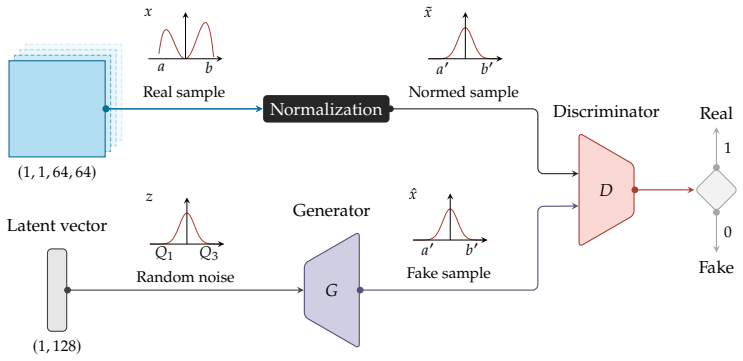
The central claim is that a modified deep convolutional generative adversarial network, equipped with an auxiliary discriminator driven by the membrane factor, learns to produce realistic and structurally efficient funicular shell geometries in three dimensions. The membrane factor serves as the physics-informed constraint that discourages designs dominated by bending moments, allowing the generator to explore forms that carry loads primarily through in-plane compression.
What carries the argument
The auxiliary discriminator guided by the membrane factor, a scalar that quantifies how completely a shell's stresses act as membrane forces rather than bending moments.
If this is right
- The model consistently outputs shells with elevated membrane-factor values, indicating load paths that stay close to pure compression.
- Generated forms are smooth and topologically varied while remaining previously unseen in the training set.
- Training remains stable even with the added physics penalty, avoiding common GAN failure modes.
- The framework removes the need for explicit geometric rules to extend the funicular concept into three dimensions.
Where Pith is reading between the lines
- The same constraint-driven GAN approach could be applied to other unreinforced or minimally reinforced structural elements such as vaults or domes.
- Physical prototypes printed from the generated designs and tested to failure would provide direct evidence of whether high membrane factor predicts real compressive behavior.
- The method opens a route to fully automated exploration of shell topologies that satisfy equilibrium under gravity without user-specified boundary conditions.
Load-bearing premise
The membrane factor measured on the generated digital geometry serves as a reliable proxy for true funicular behavior once the shell is built and loaded.
What would settle it
Run finite-element analysis on several generated shells under self-weight and measure whether the bending-moment contribution remains below a few percent of total strain energy across the entire surface.
Figures


read the original abstract
Shell structures are pivotal in the fields of architecture and engineering, due to their aesthetic appeal and structural efficiency. Recently, 3D concrete printing has reignited the interest in these structures. But, as printed concrete cannot be reinforced with steel, structures built in this way must be designed to withstand primarily pure compression: they must be funicular shells. Nevertheless, a fundamental challenge remains unsolved since Robert Hooke's discovered the catenary arch in 1675: it is not known whether the concept of a funicular polygon can be generalised to three-dimensional structures. Generative Adversarial Networks (GANs), have shown remarkable success in generating realistic data samples matching the distribution of the training data and have been shown to produce highly convincing synthetic images. This work proposes a physics-informed generative adversarial framework for the design of funicular shell structures. The approach employs a modified Deep Convolutional Generative Adversarial architecture physically guided by an auxiliary discriminator to generate realistic and structurally efficient shell geometries. Specifically, the model is constrained by the membrane factor to penalize geometries dominated by bending. An additional discriminator is also employed allowing the model to deal with more complex structures. Results show that the developed model is stable and capable of generating physically optimal, previously unseen, funicular shells with smooth forms and high membrane factor distributions.
Editorial analysis
A structured set of objections, weighed in public.
Referee Report
Summary. The manuscript proposes a physics-informed generative adversarial network (GAN) for designing funicular shell structures for 3D concrete printing. It modifies a deep convolutional GAN architecture with an auxiliary discriminator that penalizes low membrane-factor geometries to enforce pure compression, plus an additional discriminator for complex forms. The central claim is that the resulting model stably generates smooth, previously unseen, physically optimal funicular shells exhibiting high membrane-factor distributions.
Significance. If the central claim holds under rigorous validation, the work would offer a novel data-driven route to generalizing the funicular concept from 2D catenaries to arbitrary 3D shells, potentially enabling more efficient unreinforced printed structures. The integration of an independent structural-mechanics constraint (membrane factor) into the GAN training loop is a constructive step, but the absence of quantitative benchmarks, baselines, or finite-element corroboration currently limits the assessed significance.
major comments (2)
- [Abstract] Abstract: the assertion that the model generates 'physically optimal, previously unseen, funicular shells with ... high membrane factor distributions' is unsupported by any reported quantitative metrics, baseline comparisons, error analysis, or validation examples against full shell theory.
- [Results] Results (implied by abstract claims): the membrane factor is used as a scalar proxy to penalize bending, yet no verification is described that high values guarantee local equilibrium, zero transverse shear, or negligible bending moments on non-developable 3D surfaces generated by the GAN; the mapping can break for rapidly varying curvatures or non-thin shells.
minor comments (1)
- [Abstract] Abstract: the role and architecture of the 'additional discriminator' for complex structures is mentioned but not specified, leaving the training procedure unclear.
Simulated Author's Rebuttal
We thank the referee for the constructive and detailed feedback. The comments highlight important aspects of validation and theoretical grounding that we address point-by-point below. We have revised the manuscript to incorporate additional quantitative support, baseline comparisons, and explicit discussion of assumptions and limitations while preserving the core contribution of the physics-informed GAN framework.
read point-by-point responses
-
Referee: [Abstract] Abstract: the assertion that the model generates 'physically optimal, previously unseen, funicular shells with ... high membrane factor distributions' is unsupported by any reported quantitative metrics, baseline comparisons, error analysis, or validation examples against full shell theory.
Authors: We agree that the abstract claims benefit from more explicit quantitative backing. In the revised version we have added mean and standard-deviation membrane-factor statistics across large batches of generated samples, direct side-by-side histograms comparing the physics-informed model to a standard DCGAN baseline (showing consistently higher MF values), and additional visual examples with overlaid membrane-factor color maps. We have also clarified that “physically optimal” is used in the specific sense of the membrane-theory proxy employed during training. Full finite-element verification against complete shell theory for every sample was not performed in the original study; we therefore qualify the claim accordingly and note this as a direction for future work. revision: partial
-
Referee: [Results] Results (implied by abstract claims): the membrane factor is used as a scalar proxy to penalize bending, yet no verification is described that high values guarantee local equilibrium, zero transverse shear, or negligible bending moments on non-developable 3D surfaces generated by the GAN; the mapping can break for rapidly varying curvatures or non-thin shells.
Authors: The membrane factor is introduced as a scalar derived from the ratio of membrane to total strain energy under the assumptions of classical thin-shell (Kirchhoff–Love) theory. For the smooth, thin geometries targeted by 3D concrete printing, elevated values indicate that in-plane forces dominate and bending moments remain small. We acknowledge that the proxy is not universally exact: transverse shear, local equilibrium violations, or significant bending can appear on non-developable surfaces with rapid curvature changes or when the thin-shell hypothesis is violated. The revised manuscript now contains an expanded discussion of these limitations, explicit statement of the modeling assumptions, and references to the relevant shell-theory literature. We have also added a forward-looking statement that comprehensive finite-element corroboration lies beyond the present generative-modeling scope. revision: yes
Circularity Check
No significant circularity; physics-informed constraint drawn from independent mechanics
full rationale
The paper's central derivation employs a standard DCGAN architecture augmented by an auxiliary discriminator that applies the membrane factor as an external penalty term drawn from classical shell theory. This factor is not fitted to or defined by the GAN outputs, nor does any equation reduce the optimality claim to a self-referential fit, renaming, or self-citation chain. The generation of new shell geometries remains an open mapping from noise to shapes, with the physical guidance supplied by an independent structural proxy rather than by construction from the model's own predictions. No load-bearing step collapses to tautology.
Axiom & Free-Parameter Ledger
free parameters (1)
- membrane factor penalty weight
axioms (2)
- domain assumption Membrane theory provides a valid scalar proxy for funicular (bending-free) behavior in thin 3D shells
- domain assumption Constrained GANs converge to distributions of physically valid shell geometries
Reference graph
Works this paper leans on
-
[1]
Hooke, A description of helioscopes, and some other instruments, printed by T.R
R. Hooke, A description of helioscopes, and some other instruments, printed by T.R. for John Martyn, 1676.doi:10.3931/e-rara-2171
-
[2]
Hill, The rational mechanics of flexible or elastic bodies 1638–1788: C
R. Hill, The rational mechanics of flexible or elastic bodies 1638–1788: C. truesdell: Introduction to leonhardi euleri opera omnia, vol. x et xi. seriei seeundae. orell füssli turiei, switzerland, 1960. 435 pp, Journal of the Mechanics and Physics of Solids 10 (2) (1962) 184.doi:10.1016/0022-5096(62) 90022-4
-
[3]
P. Block, M. DeJong, J. Ochsendorf, As hangs the flexible line: Equilibrium of masonry arches, Nexus Network Journal 8 (2006) 13–24.doi:10.1007/s00004-006-0015-9
-
[4]
Block, M
P. Block, M. DeJong, J. Ochsendorf, As hangs the flexible line: Equilibrium of masonry arches, Nexus Network Journal 8 (2) (2006) 13–24
2006
-
[5]
Adriaenssens, P
S. Adriaenssens, P. Block, D. Veenendaal, C. Williams, Shell structures for architecture: form finding and optimization, Routledge, 2014
2014
-
[6]
F. Bos, R. Wolfs, Z. Ahmed, T. Salet, Additive manufacturing of concrete in construction: potentials and challenges of 3d concrete printing, Virtual and physical prototyping 11 (3) (2016) 209–225.doi: 10.1080/17452759.2016.1209867
-
[7]
T. Mader, M. Schreter-Fleischhacker, O. Shkundalova, M. Neuner, G. Hofstetter, Constitutive modeling of orthotropic nonlinear mechanical behavior of hardened 3d printed concrete, Acta Mechanica 234 (2023) 5893–5918.doi:10.1007/s00707-023-03706-z
-
[8]
Bhooshan, V
S. Bhooshan, V. Bhooshan, A. Dell’Endice, J. Chu, P. Singer, J. Megens, T. Van Mele, P. Block, The striatus bridge: Computational design and robotic fabrication of an unreinforced, 3d-concrete-printed, masonry arch bridge, Architecture, structures and construction 2 (4) (2022) 521–543
2022
-
[9]
Chilton, H
J. Chilton, H. Isler, The engineer’s contribution to contemporary architecture - Heinz Isler, Thomas Telford, 2000
2000
-
[10]
P.Block, J.Ochsendorf, Thrustnetworkanalysis: anewmethodologyforthree-dimensionalequilibrium, Journal of the International Association for shell and spatial structures 48 (3) (2007) 167–173
2007
-
[11]
C. Olivieri, L. Sibille, S. Cocking, R. N. Charandabi, F. Fabbrocino, S. Adriaenssens, Design of purely compressive shells under vertical and horizontal loads through machine learning-driven form-finding, Mechanics Research Communications 148 (2025) 104491.doi:10.1016/j.mechrescom.2025.104491
-
[12]
R. Pastrana, E. Medina, I. M. de Oliveira, S. Adriaenssens, R. P. Adams, Real-time design of ar- chitectural structures with differentiable mechanics and neural networks (2025).arXiv:2409.02606, doi:10.48550/arXiv.2409.02606
-
[13]
I.J.Goodfellow, J.Pouget-Abadie, M.Mirza, B.Xu, D.Warde-Farley, S.Ozair, A.Courville, Y.Bengio, Generative adversarial networks (2014).arXiv:1406.2661,doi:10.48550/arXiv.1406.2661
work page internal anchor Pith review doi:10.48550/arxiv.1406.2661 2014
- [14]
-
[15]
W. Li, C. Wang, H. Guan, J. Wang, J. Yang, C. Zhang, D. Tao, Generative adversarial physics-informed neural networks for solving forward and inverse problem with small labeled samples, Computers & Mathematics with Applications 183 (2025) 98–120.doi:10.1016/j.camwa.2025.01.025
-
[16]
E. Smith, D. Meger, Improved adversarial systems for 3d object generation and reconstruction (2017). arXiv:1707.09557,doi:10.48550/arXiv.1707.09557. 26
-
[17]
Chen, Guanjie, Z
C. Chen, Guanjie, Z. H. Wei, Z. Li, Physics-informed generative adversarial networks for sequence generation with limited data, in: Interpretable Inductive Biases and Physically Structured Learning, 2020. URLhttps://inductive-biases.github.io/papers/7.pdf
2020
-
[18]
A. Daw, M. Maruf, A. Karpatne, Pid-gan: A gan framework based on a physics-informed discriminator for uncertainty quantification with physics, in: Proceedings of the 27th ACM SIGKDD Conference on Knowledge Discovery & Data Mining, KDD ’21, Association for Computing Machinery, 2021, p. 237–247.doi:10.1145/3447548.3467449
- [19]
-
[20]
M. Raissi, P. Perdikaris, G. Karniadakis, Physics-informed neural networks: A deep learning framework for solving forward and inverse problems involving nonlinear partial differential equations, Journal of Computational Physics 378 (2019) 686–707.doi:10.1016/j.jcp.2018.10.045
-
[21]
J.-H.Bastek, D.M.Kochmann, Physics-informedneuralnetworksforshellstructures, EuropeanJournal of Mechanics - A/Solids 97 (2023) 104849.doi:10.1016/j.euromechsol.2022.104849
-
[22]
T. D. Nguyen, T. Le, H. Vu, D. Phung, Dual discriminator generative adversarial nets (2017).arXiv: 1709.03831,doi:10.48550/arXiv.1709.03831
-
[23]
Theory and analysis of elastic plates and shells, CRC press, 1999
1999
-
[24]
A.C.Ugural, StressesinBeams, PlatesandShells, 3rdEdition, CRCPress, 2009.doi:10.1201/b17516
-
[25]
E. Ventsel, T. Krauthammer, Thin plates and shells: Theory, analysis, and applications, Applied Mechanics Reviews 55 (4) (2002) B72–B73.doi:10.1115/1.1483356
-
[26]
J. N. Reddy, Theory and Analysis of Elastic Plates and Shells, 2nd Edition, CRC Press, 2006.doi: 10.1201/9780849384165
-
[27]
Improved Techniques for Training GANs
T. Salimans, I. Goodfellow, W. Zaremba, V. Cheung, A. Radford, X. Chen, Improved techniques for training gans (2016).arXiv:1606.03498,doi:10.48550/arXiv.1606.03498
-
[28]
Unsupervised Representation Learning with Deep Convolutional Generative Adversarial Networks
A. Radford, L. Metz, S. Chintala, Unsupervised representation learning with deep convolutional gen- erative adversarial networks (2016).arXiv:1511.06434,doi:10.48550/arXiv.1511.06434
work page internal anchor Pith review doi:10.48550/arxiv.1511.06434 2016
-
[29]
Spectral Normalization for Generative Adversarial Networks
T. Miyato, T. Kataoka, M. Koyama, Y. Yoshida, Spectral normalization for generative adversarial networks (2018).arXiv:1802.05957,doi:/10.48550/arXiv.1802.05957
-
[30]
M. Arjovsky, S. Chintala, L. Bottou, Wasserstein gan (2017).arXiv:1701.07875,doi:10.48550/ arXiv.1701.07875
work page Pith review arXiv 2017
-
[31]
Z. Lin, V. Sekar, G. Fanti, Why spectral normalization stabilizes gans: Analysis and improvements (2021).arXiv:2009.02773,doi:10.48550/arXiv.2009.02773
-
[32]
URLhttp://www.blender.org
Blender Online Community, Blender - a 3D modelling and rendering package, Blender Foundation, Blender Institute, Amsterdam (2026). URLhttp://www.blender.org
2026
-
[33]
Smith, ABAQUS/Standard User’s Manual, Version 6.11, United States (2009)
M. Smith, ABAQUS/Standard User’s Manual, Version 6.11, United States (2009)
2009
-
[34]
S. Osher, R. Fedkiw, K. Piechor, Level set methods and dynamic implicit surfaces, Appl. Mech. Rev. 57 (3) (2004) B15–B15.doi:10.1115/1.1760520. 27
-
[35]
U-Net: Convolutional Networks for Biomedical Image Segmentation
O. Ronneberger, P. Fischer, T. Brox, U-net: Convolutional networks for biomedical image segmentation (2015).arXiv:1505.04597,doi:10.48550/arXiv.1505.04597
work page internal anchor Pith review Pith/arXiv arXiv doi:10.48550/arxiv.1505.04597 2015
-
[36]
L. Sun, H. Gao, S. Pan, J.-X. Wang, Surrogate modeling for fluid flows based on physics-constrained deep learning without simulation data, Computer Methods in Applied Mechanics and Engineering 361 (2020) 112732.doi:10.1016/j.cma.2019.112732
-
[37]
L. Guo, S. Ye, J. Han, H. Zheng, H. Gao, D. Z. Chen, J.-X. Wang, C. Wang, Ssr-vfd: Spatial super- resolution for vector field data analysis and visualization, in: 2020 IEEE Pacific Visualization Sympo- sium (PacificVis), 2020, pp. 71–80.doi:10.1109/PacificVis48177.2020.8737
-
[38]
Z. Gao, L. Zhao, J. Zheng, T. Yi, C. Zhang, Q. Wang, Principal component guided dcgan for mitigating mode collapse in electromagnetic pulse signal synthesis, Scientific Reports 15 (2025) 36858.doi: 10.1038/s41598-025-20962-2
-
[39]
Batch Normalization: Accelerating Deep Network Training by Reducing Internal Covariate Shift
S. Ioffe, C. Szegedy, Batch normalization: Accelerating deep network training by reducing internal covariate shift (2015).arXiv:1502.03167,doi:10.48550/arXiv.1502.03167
work page internal anchor Pith review doi:10.48550/arxiv.1502.03167 2015
-
[40]
M. Despotovic, V. Nedic, D. Despotovic, S. Cvetanovic, Evaluation of empirical models for predicting monthly mean horizontal diffuse solar radiation, Renewable and Sustainable Energy Reviews 56 (2016) 246–260.doi:10.1016/j.rser.2015.11.058
-
[41]
M. Heusel, H. Ramsauer, T. Unterthiner, B. Nessler, S. Hochreiter, Gans trained by a two time-scale update rule converge to a local nash equilibrium (2018).arXiv:1706.08500,doi:10.48550/arXiv. 1706.08500
work page internal anchor Pith review doi:10.48550/arxiv 2018
-
[42]
Rethinking the Inception Architecture for Computer Vision
C. Szegedy, V. Vanhoucke, S. Ioffe, J. Shlens, Z. Wojna, Rethinking the inception architecture for computer vision (2015).arXiv:1512.00567,doi:10.48550/arXiv.1512.00567
-
[43]
J. Deng, W. Dong, R. Socher, L.-J. Li, K. Li, L. Fei-Fei, Imagenet: A large-scale hierarchical image database, in: 2009 IEEE Conference on Computer Vision and Pattern Recognition, 2009, pp. 248–255. doi:10.1109/CVPR.2009.5206848
-
[44]
van der Maaten, G
L. van der Maaten, G. Hinton, Visualizing data using t-sne, Journal of Machine Learning Research 9 (86) (2008) 2579–2605. URLhttp://jmlr.org/papers/v9/vandermaaten08a.html
2008
-
[45]
UMAP: Uniform Manifold Approximation and Projection for Dimension Reduction
L. McInnes, J. Healy, J. Melville, Umap: Uniform manifold approximation and projection for dimension reduction (2020).arXiv:1802.03426,doi:10.48550/arXiv.1802.03426
work page internal anchor Pith review doi:10.48550/arxiv.1802.03426 2020
-
[46]
Scholkopf, C
B. Scholkopf, C. Burges, A. Smola, Kernel principal component analysis, in: Advances in Kernel Methods – Support Vector Learning, MIT Press, 1999, pp. 327–352. 28
1999
discussion (0)
Sign in with ORCID, Apple, or X to comment. Anyone can read and Pith papers without signing in.