Recognition: unknown
Shadow, Quasinormal Modes, Sparsity, and Energy Emission Rate of Euler-Heisenberg Black Hole Surrounded by Perfect Fluid Dark Matter
Pith reviewed 2026-05-10 07:32 UTC · model grok-4.3
The pith
The perfect fluid dark matter parameter and black-hole charge strongly affect the photon sphere, shadow size, quasinormal frequencies, and energy emission rate of an Euler-Heisenberg black hole, while the nonlinear correction remains suble
A machine-rendered reading of the paper's core claim, the machinery that carries it, and where it could break.
Core claim
The central claim is that the perfect fluid dark matter environment imprints dominantly on the photon sphere, shadow size, eikonal quasinormal frequencies, Hawking temperature, and energy emission rate of the Euler-Heisenberg black hole, with the black-hole charge also playing a significant role, while the Euler-Heisenberg nonlinear correction is typically subleading within the explored parameter range but may become relevant in strong-charge regimes.
What carries the argument
The static spherically symmetric metric that combines the Euler-Heisenberg nonlinear electrodynamics Lagrangian with a perfect fluid dark matter density term, together with the eikonal correspondence that relates quasinormal modes and grey-body factors to the unstable photon sphere.
Load-bearing premise
The metric ansatz is an exact solution to the Einstein equations with the chosen matter sources and the eikonal approximation accurately describes the quasinormal modes and grey-body factors throughout the parameter space examined.
What would settle it
An observed shadow radius or ringdown frequency that scales with the Euler-Heisenberg parameter rather than with the perfect fluid dark matter density, or a measured energy emission rate that deviates from the predicted PFDM-dominated profile.
Figures


read the original abstract
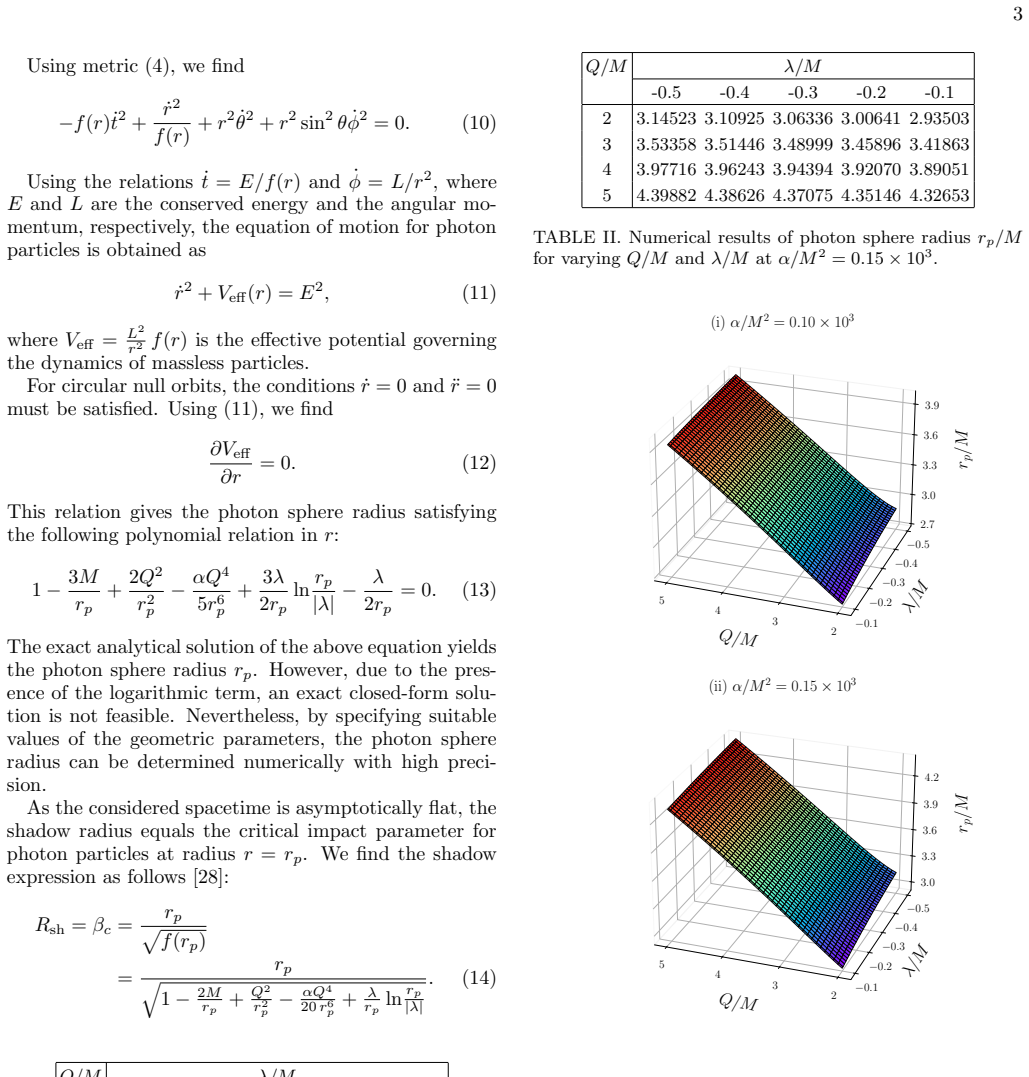
In this work, we investigate the optical, dynamical, and radiative properties of an Euler--Heisenberg black hole immersed in a perfect fluid dark matter (PFDM) background. We analyze the photon sphere and shadow, the scalar quasinormal-mode spectrum in the eikonal regime, the grey-body factor through the eikonal QNM correspondence, the sparsity of Hawking radiation, and the corresponding energy emission rate. Our results show that both the black-hole charge and the PFDM parameter significantly affect the photon sphere, shadow size, quasinormal frequencies, Hawking temperature, and emission profile, whereas the Euler--Heisenberg correction is typically subleading in the parameter range explored, although it may become more visible in strong-charge regimes for selected observables. Overall, the dark-matter environment provides the dominant imprint on the phenomenology of the system, indicating that shadow and ringdown-related quantities may serve as useful probes of PFDM effects within the approximations considered.
Editorial analysis
A structured set of objections, weighed in public.
Referee Report
Summary. The paper computes the photon sphere radius, shadow size, eikonal-limit scalar quasinormal frequencies, grey-body factors via the eikonal correspondence, Hawking temperature, radiation sparsity, and energy emission rates for the Euler-Heisenberg black hole metric immersed in a perfect-fluid dark-matter halo. It concludes that the PFDM parameter produces the dominant shifts in all these observables while the Euler-Heisenberg correction remains sub-leading except possibly at large charge values.
Significance. If the metric and approximations are accepted, the work supplies a systematic comparison of nonlinear-electrodynamics versus dark-matter effects across several observables, offering concrete predictions that could be tested with shadow imaging and ringdown data. The explicit statement that PFDM dominates is a falsifiable claim within the adopted framework.
major comments (1)
- [Sections on metric and QNMs] The central claim that PFDM dominates rests on the validity of the composite metric and the eikonal correspondence for QNMs and grey-body factors. The manuscript should provide a brief justification or reference for the metric construction (likely in the introduction or §2) and a quantitative check of the eikonal approximation's accuracy over the explored parameter ranges, for example by comparing a few low-lying modes to the full wave equation solution.
minor comments (2)
- [Abstract] The abstract refers to 'the parameter range explored' without quoting the numerical intervals for the Euler-Heisenberg parameter, PFDM parameter, and charge; these intervals should be stated explicitly.
- [Figures] Figures showing shadow radius or emission spectra versus parameters would be clearer if they included a reference curve for the Schwarzschild case and indicated the direction of increasing PFDM parameter.
Simulated Author's Rebuttal
We thank the referee for the careful reading of the manuscript and the constructive suggestion. We address the major comment below and have revised the manuscript accordingly where feasible.
read point-by-point responses
-
Referee: The central claim that PFDM dominates rests on the validity of the composite metric and the eikonal correspondence for QNMs and grey-body factors. The manuscript should provide a brief justification or reference for the metric construction (likely in the introduction or §2) and a quantitative check of the eikonal approximation's accuracy over the explored parameter ranges, for example by comparing a few low-lying modes to the full wave equation solution.
Authors: We thank the referee for highlighting these points. We have added a concise justification for the composite metric in the introduction and Section 2, together with references to the standard construction of Euler-Heisenberg black holes immersed in perfect-fluid dark-matter halos. Regarding the eikonal correspondence, we have expanded the discussion in the QNM and grey-body sections to recall the regime of validity of the high-frequency approximation and to cite supporting literature on its accuracy for similar spacetimes. A direct numerical comparison of a few low-lying modes against the full wave equation, however, lies outside the analytical and semi-analytical scope of the present study; such a computation would require a separate numerical campaign that we consider beyond the current work. revision: partial
- Performing a quantitative numerical check of the eikonal approximation by solving the full wave equation for low-lying modes across the explored parameter ranges.
Circularity Check
No significant circularity; derivation is self-contained
full rationale
The paper first assembles a composite metric by superposing the Euler-Heisenberg nonlinear-electrodynamics correction onto a perfect-fluid dark-matter halo solution, then computes photon-sphere radius, shadow size, eikonal quasinormal frequencies, grey-body factors, Hawking temperature, sparsity, and energy emission rate directly from the metric functions using standard geodesic and wave-equation techniques. All reported trends (PFDM dominance, sub-leading EH corrections) follow from numerical evaluation over the parameter space; no parameter is fitted to the output observables, no uniqueness theorem is invoked via self-citation, and no ansatz is smuggled in. The central claims therefore reduce to the accepted metric plus textbook GR calculations rather than to any internal redefinition or self-referential loop.
Axiom & Free-Parameter Ledger
free parameters (3)
- Euler-Heisenberg parameter
- PFDM parameter
- Black hole charge
axioms (2)
- domain assumption The spacetime metric is the standard Euler-Heisenberg solution immersed in perfect fluid dark matter as given in the literature.
- domain assumption Eikonal (high-frequency) approximation accurately describes the quasinormal modes and grey-body factors.
Forward citations
Cited by 1 Pith paper
-
Quasinormal modes of massless scalar and electromagnetic perturbations for Euler Heisenberg black holes surrounded by perfect fluid dark matter
Quasinormal frequencies and greybody factors for massless scalar and electromagnetic perturbations in Euler-Heisenberg black holes with perfect fluid dark matter are calculated via AIM and sixth-order WKB, showing tha...
Reference graph
Works this paper leans on
-
[1]
J. D. Bekenstein, Phys. Rev. D7, 2333 (1973)
1973
-
[2]
S. W. Hawking, Commun. Math Phys.43, 199 (1975)
1975
-
[3]
S. W. Hawking and D. N. Page, Commun. Math Phys. 87, 577 (1983)
1983
-
[4]
Regge and J
T. Regge and J. A. Wheeler, Phys. Rev.108, 1063 (1957)
1957
-
[5]
F. J. Zerilli, Phys. Rev. Lett.24, 737 (1970)
1970
-
[6]
C. V. Vishveshwara, Nature227, 936 (1970)
1970
-
[7]
K. D. Kokkotas and B. G. Schmidt, Living Rev. Relativ. 2, 2 (1999)
1999
-
[8]
Berti, V
E. Berti, V. Cardoso, and A. O. Starinets, Class. Quan- tum Grav.26, 163001 (2009)
2009
-
[9]
Heisenberg and H
W. Heisenberg and H. Euler, Zeits. f¨ ur Phys. (Berlin)98, 714 (1936). 13
1936
-
[10]
J. F. Plebanski,Lectures on Nonlinear Electrodynamics (Nordita, Copenhagen, 1970)
1970
-
[11]
Salazar, A
H. Salazar, A. Garc´ ıa, and J. F. Pleba´ nski, J. Math. Phys. 28, 2171 (1987)
1987
-
[13]
Breton and L
N. Breton and L. A. L´ opez, Phys. Rev. D104, 024064 (2021)
2021
-
[14]
Rahaman, K
F. Rahaman, K. K. Nandi, A. Bhadra, M. Kalam, and K. Chakraborty, Phys. Lett. B694, 10 (2010)
2010
-
[15]
Li and K.-C
M.-H. Li and K.-C. Yang, Phys. Rev. D86, 123015 (2012)
2012
-
[16]
Haroon, M
S. Haroon, M. Jamil, K. Jusufi, K. Lin, and R. B. Mann, Phys. Rev. D99, 044015 (2019)
2019
- [17]
-
[18]
M. R. Shahzad, G. Abbas, T. Zhu, R. H. Ali, A. Ashraf, and B. S. Al-Kahtani, Eur. Phys. J C85, 164 (2025)
2025
-
[19]
S. J. Ma, R. B. Wang, J. B. Deng, and X.-R. Hu, Eur. Phys. J C84, 595 (2024)
2024
- [20]
- [21]
-
[22]
A. Al-Badawi, F. Ahmed, and I. Sakalli, (2026), arXiv:2603.02276 [gr-qc]
- [23]
-
[24]
J. L. Synge, MNRAS131, 463 (1966)
1966
-
[25]
C. T. Cunningham and J. M. Bardeen, Astrophys. J183, 237 (1973)
1973
-
[26]
Luminet, Astron
J.-P. Luminet, Astron. & Astrophys.75, 228 (1979)
1979
-
[27]
Hioki and K.-i
K. Hioki and K.-i. Maeda, Phys. Rev. D80, 024042 (2009)
2009
-
[28]
Perlick and O
V. Perlick and O. Y. Tsupko, Phys. Rep.947, 1 (2022)
2022
-
[29]
Akiyamaet al., Astrophys
K. Akiyamaet al., Astrophys. J Lett.875, L1 (2019)
2019
-
[30]
Akiyamaet al., Astrophys
K. Akiyamaet al., Astrophys. J Lett.875, L6 (2019)
2019
-
[31]
Akiyamaet al., Astrophys
K. Akiyamaet al., Astrophys. J Lett.930, L12 (2022)
2022
-
[32]
Akiyamaet al., Astrophys
K. Akiyamaet al., Astrophys. J Lett.930, L17 (2022)
2022
-
[33]
B. F. Schutz and C. M. Will, Astrophys. J Lett.291, L33 (1985)
1985
-
[34]
Iyer and C
S. Iyer and C. M. Will, Phys. Rev. D35, 3621 (1987)
1987
-
[35]
Cardoso, A
V. Cardoso, A. S. Miranda, E. Berti, H. Witek, and V. T. Zanchin, Phys. Rev. D79, 064016 (2009)
2009
-
[36]
D. N. Page, Phys. Rev. D13, 198 (1976)
1976
-
[37]
D. N. Page, Phys. Rev. D14, 3260 (1976)
1976
-
[38]
F. Gray, S. Schuster, A. Van-Brunt, and M. Visser, Class. Quantum Grav.33, 115003 (2016)
2016
-
[39]
Chowdhury and N
A. Chowdhury and N. Banerjee, Phys. Lett. B805, 135417 (2020)
2020
-
[40]
Wei and Y.-X
S.-W. Wei and Y.-X. Liu, Phys. Rev. D84, 041501(R) (2011)
2011
-
[41]
Wei and Y.-X
S.-W. Wei and Y.-X. Liu, JCAP2013(11), 063
-
[42]
D´ ecanini, G
Y. D´ ecanini, G. Esposito-Far` ese, and A. Folacci, Phys. Rev. D83, 044032 (2011)
2011
-
[43]
R. A. Konoplya and A. Zhidenko, Journal of Cosmology and Astroparticle Physics2024(09), 068
-
[44]
R. A. Konoplya and A. Zhidenko, Phys. Lett. B861, 139288 (2025)
2025
-
[45]
Lambiase, D
G. Lambiase, D. J. Gogoi, R. C. Pantig, and A. ¨Ovg¨ un, Phys. Dark Univ.49, 101886 (2025)
2025
-
[46]
Q. Tan, D. Liu, J. Liang, and Z.-W. Long, Eur. Phys. J. C85, 687 (2025)
2025
-
[47]
Charged Black Holes in KR-gravity Surrounded by Perfect Fluid Dark Matter
F. Ahmed, M. Fathi, and E. O. Silva, (2026), arXiv:2604.11357 [gr-qc]
work page internal anchor Pith review Pith/arXiv arXiv 2026
-
[48]
Heisenberg and H
W. Heisenberg and H. Euler, Zeitsch. f¨ ur Phys.98, 714 (1936)
1936
-
[49]
Yajima and T
H. Yajima and T. Tamaki, Phys. Rev. D63, 064007 (2001)
2001
-
[50]
Salazar, A
H. Salazar, A. Garcia D., and J. Plebanski, J. Math. Phys.28, 2171 (1987)
1987
-
[51]
Magos and N
D. Magos and N. Breton, Phys. Rev. D102, 084011 (2020)
2020
-
[52]
M. H. Li and K. C. Yang, Phys. Rev. D86, 123015 (2012)
2012
-
[53]
Z. Xu, X. Hou, J. Wang, and Y. Liao, Adv. High Energy Phys.2017, 1 (2017)
2017
-
[54]
R. A. Konoplya and A. Zhidenko, Rev. Mod. Phys.83, 793 (2011)
2011
-
[55]
R. A. Konoplya, A. Zhidenko, and A. F. Zinhailo, Class. Quantum Grav.36, 155002 (2019)
2019
-
[56]
Mashhoon, Phys
B. Mashhoon, Phys. Rev. D31, 290 (1985)
1985
-
[57]
S. W. Hawking, Nature248, 30 (1974)
1974
-
[58]
Mashhoon, Phys
B. Mashhoon, Phys. Rev. D7, 2807 (1973)
1973
-
[59]
C. W. Misner, K. S. Thorne, and J. A. Wheeler,Gravi- tation(W. H. Freeman, San Francisco, 1973)
1973
discussion (0)
Sign in with ORCID, Apple, or X to comment. Anyone can read and Pith papers without signing in.