Recognition: 1 theorem link
· Lean TheoremQuasinormal modes of massless scalar and electromagnetic perturbations for Euler Heisenberg black holes surrounded by perfect fluid dark matter
Pith reviewed 2026-05-15 01:39 UTC · model grok-4.3
The pith
Charge, nonlinear parameter, and dark matter density modify quasinormal frequencies and greybody factors in Euler-Heisenberg black holes.
A machine-rendered reading of the paper's core claim, the machinery that carries it, and where it could break.
Core claim
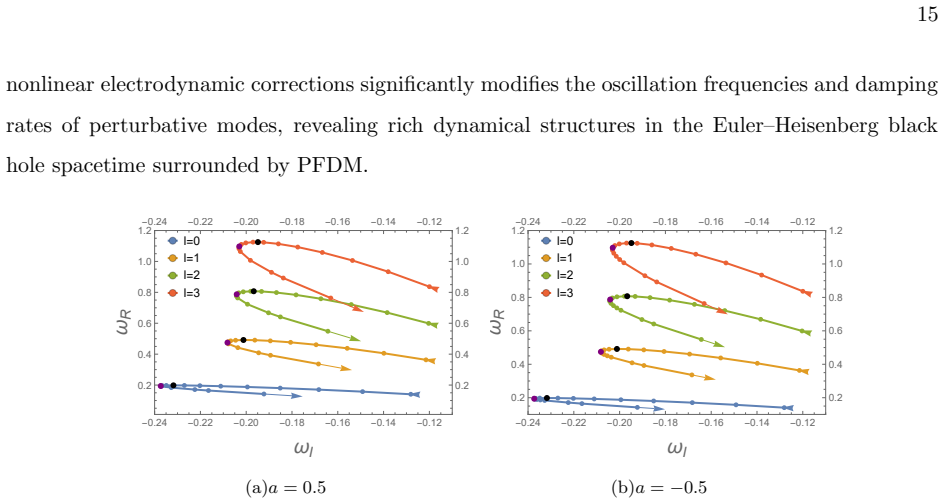
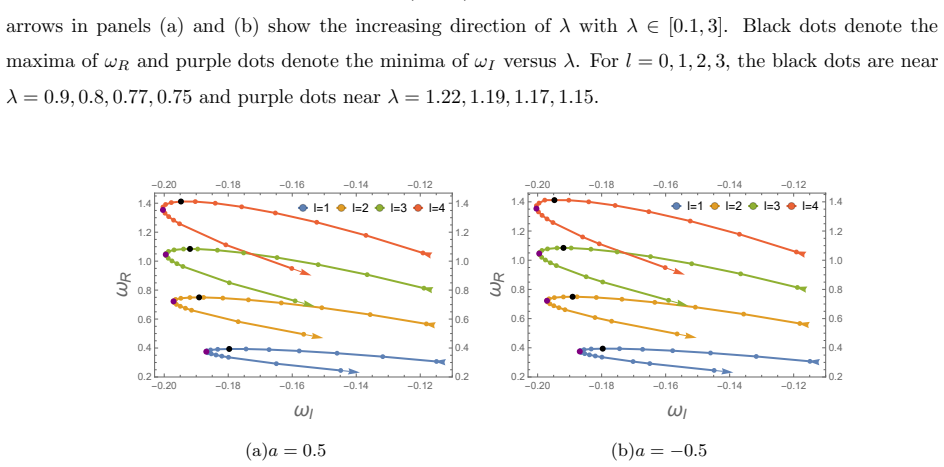
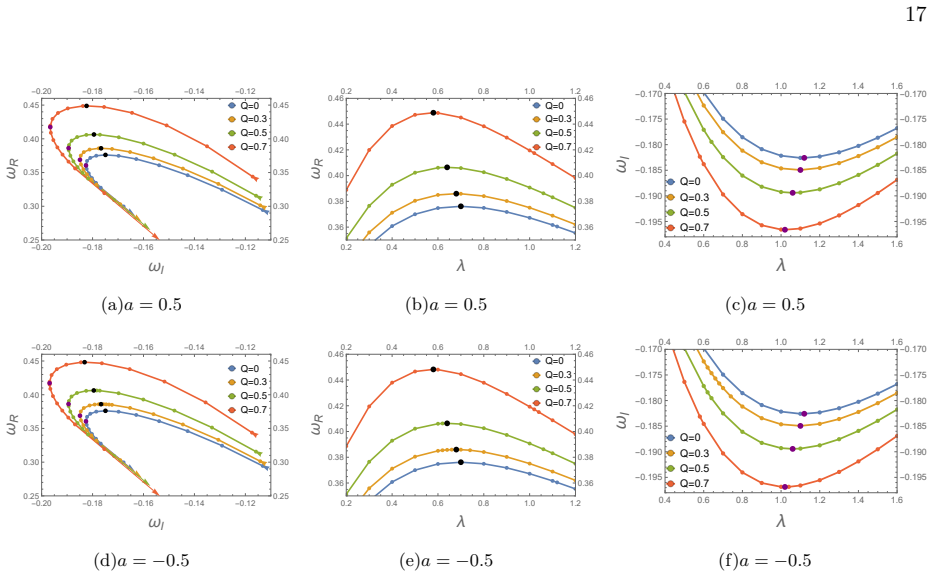
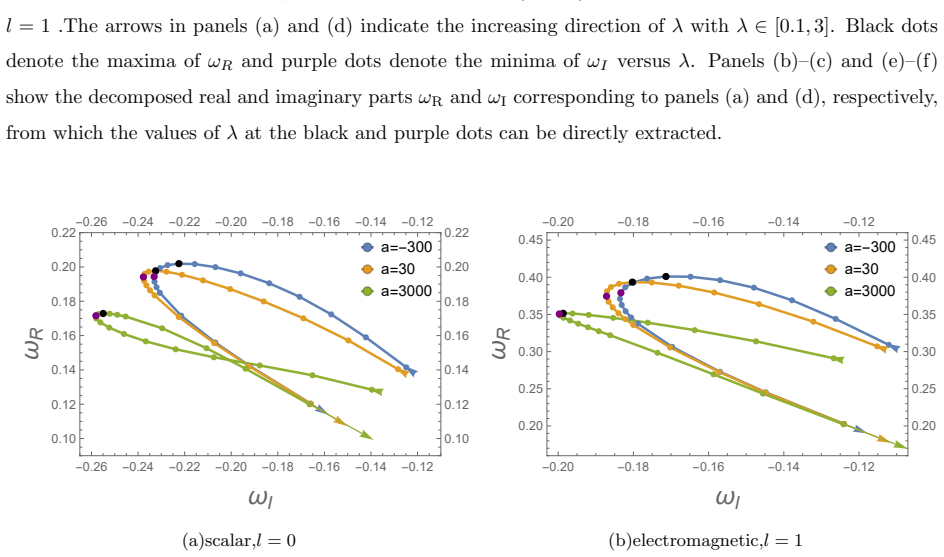
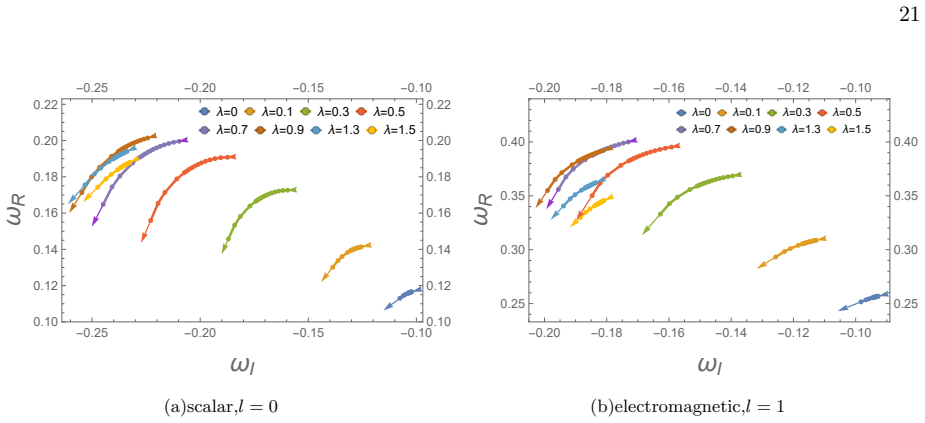
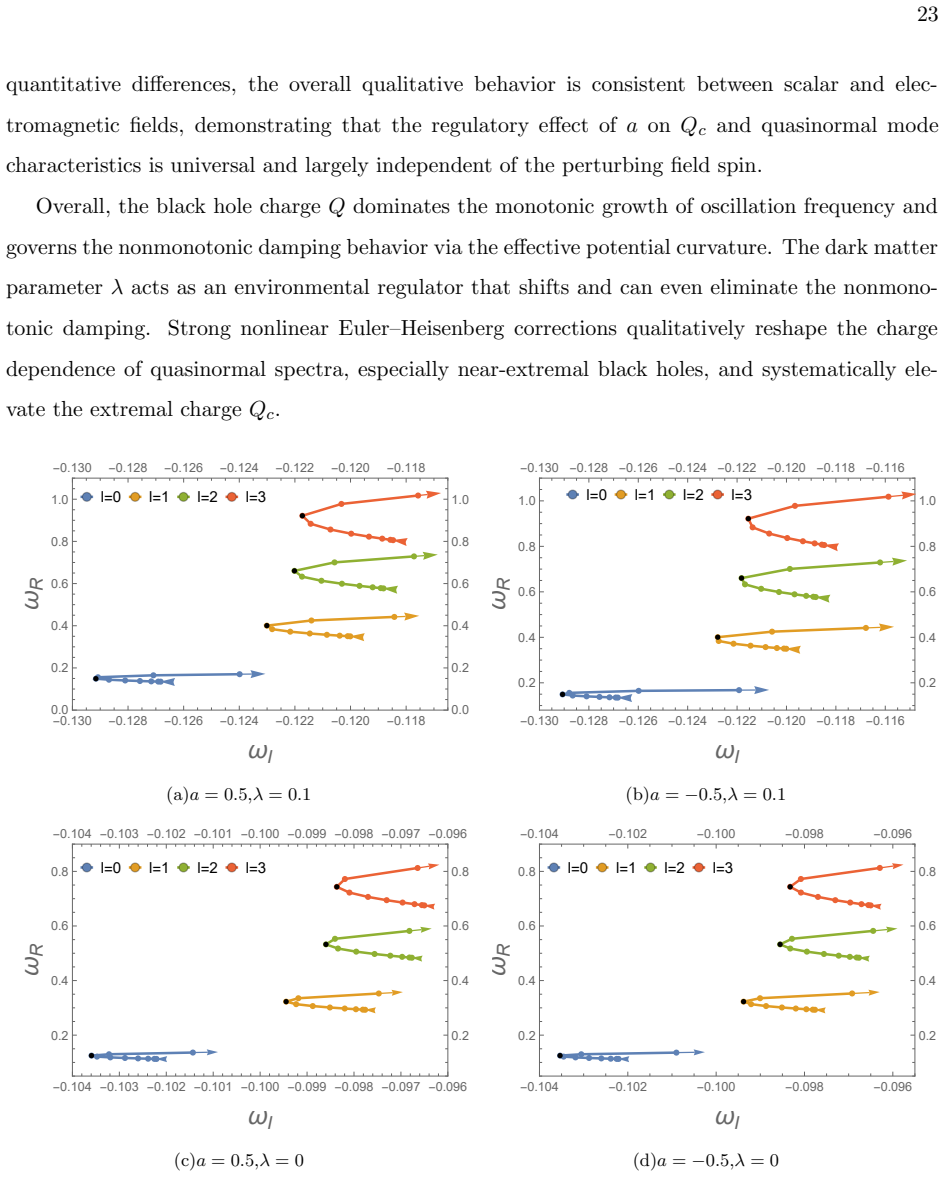
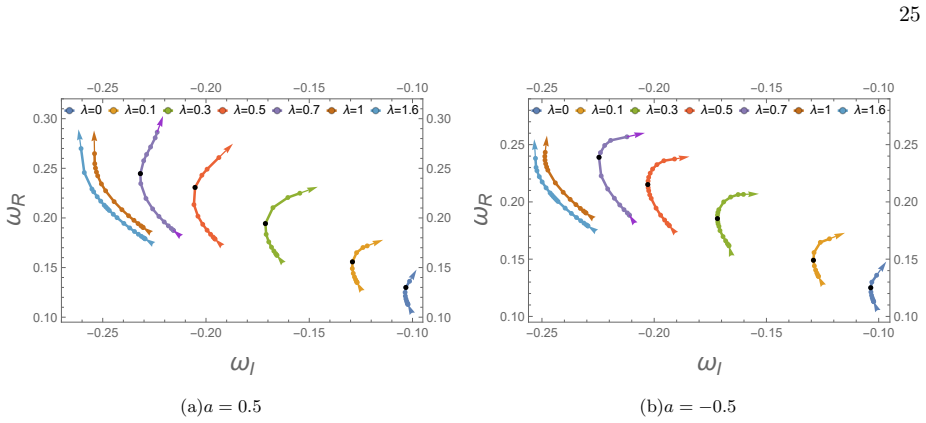
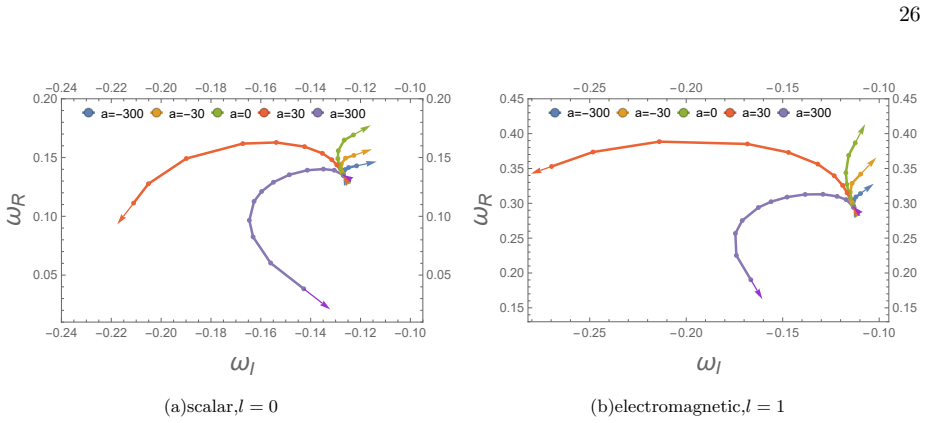
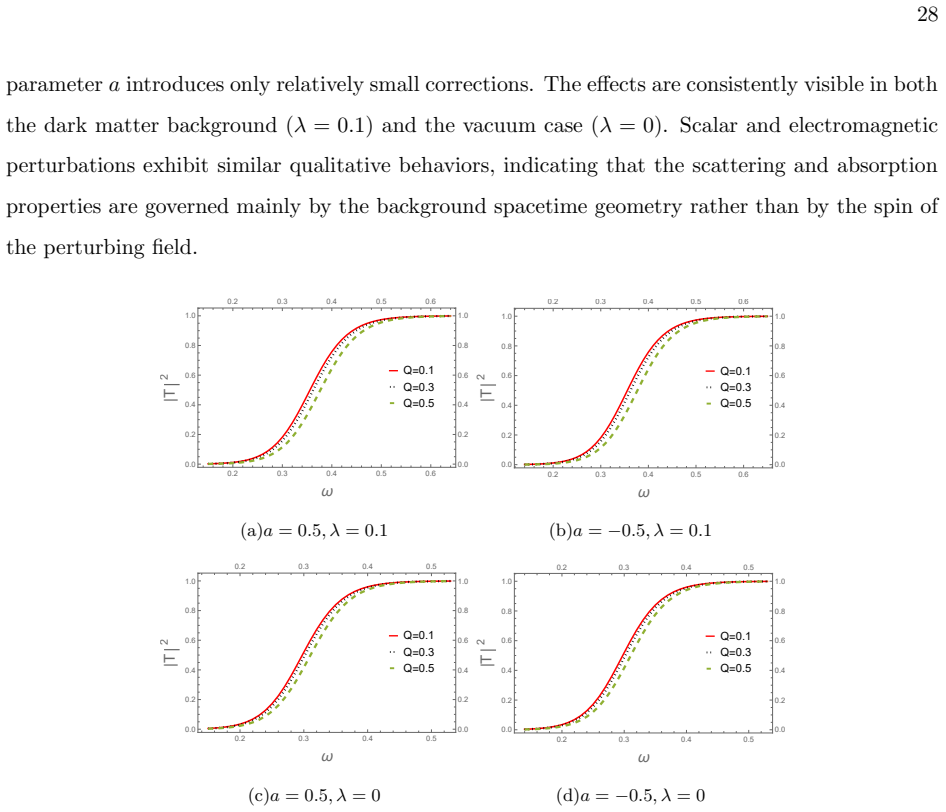
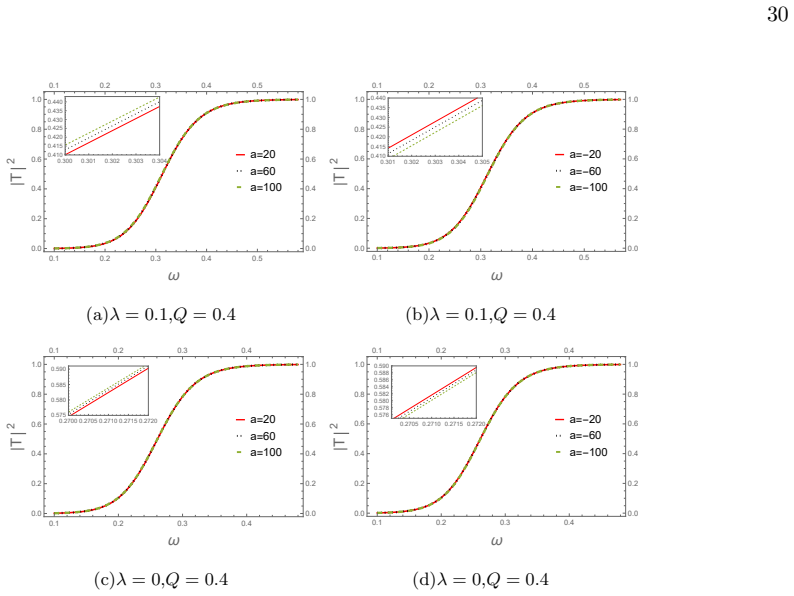
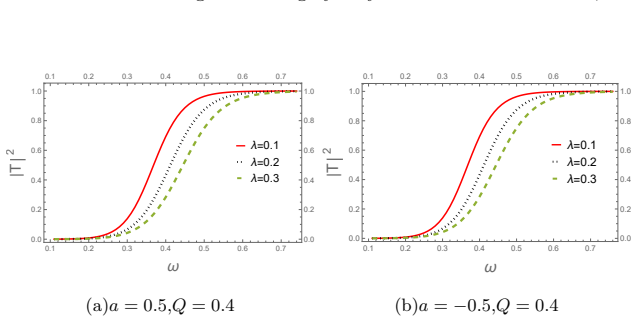
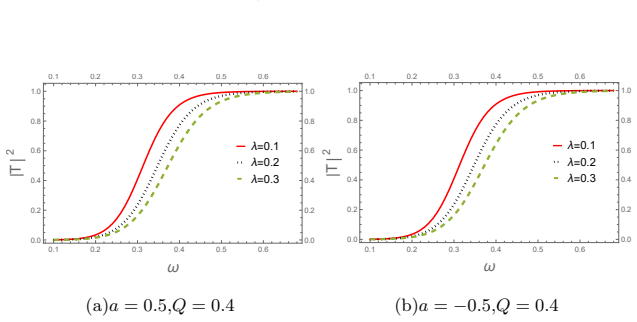
The parameters Q, a, λ, and l significantly modify the structure of the effective potential barriers, and thus affect the oscillation frequencies, damping rates, and wave transmission and reflection properties of the perturbed fields.
What carries the argument
The effective potential barrier in the Schrödinger-like wave equation for scalar and electromagnetic perturbations on the Euler-Heisenberg metric with perfect fluid dark matter.
Load-bearing premise
The given metric is an exact solution of the Einstein equations with the chosen sources, and the asymptotic iteration and sixth-order WKB methods capture the quasinormal modes accurately without large systematic errors over the parameter ranges studied.
What would settle it
A high-resolution numerical integration of the perturbation wave equation that produces frequencies differing by more than the reported method-to-method deviation for any chosen set of Q, a, λ, and l values.
Figures









read the original abstract
We investigate the quasinormal modes of massless scalar and electromagnetic perturbations in charged Euler--Heisenberg black holes surrounded by perfect fluid dark matter. The quasinormal frequencies are calculated using the asymptotic iteration method and the sixth-order WKB approximation, and the relative deviation between the two methods is quantitatively analyzed to verify the reliability of results. The greybody factors for both perturbations are also evaluated within the sixth-order WKB framework. We systematically examine the effects of the black hole charge $Q$, nonlinear electrodynamic parameter $a$, dark matter parameter $\lambda$, and angular quantum number $l$ on the quasinormal frequencies and greybody factors. We find that these parameters significantly modify the structure of the effective potential barriers, and thus affect the oscillation frequencies, damping rates, and wave transmission and reflection properties of the perturbed fields.
Editorial analysis
A structured set of objections, weighed in public.
Referee Report
Summary. The manuscript investigates quasinormal modes of massless scalar and electromagnetic perturbations around charged Euler-Heisenberg black holes surrounded by perfect fluid dark matter. It computes the frequencies via the asymptotic iteration method and sixth-order WKB approximation, quantifies their relative deviations, evaluates greybody factors within the WKB framework, and examines the dependence on parameters Q, a, λ, and l, concluding that these parameters modify the effective potential barriers and thereby alter oscillation frequencies, damping rates, and transmission/reflection properties.
Significance. If the numerical results hold, the work adds a systematic parameter study of QNMs and greybody factors in a nonlinear electrodynamics plus dark-matter background. The explicit cross-check between AIM and WKB with relative-deviation analysis is a clear methodological strength that increases in the reported frequencies. The findings are incremental but useful for black-hole spectroscopy and greybody calculations in modified spacetimes.
major comments (2)
- [Greybody factor computation] Greybody-factor section: the sixth-order WKB transmission formula is applied directly to the effective potential modified by the λ term, yet the paper provides no independent check (e.g., numerical integration of the wave equation or higher-order WKB) on the accuracy of the greybody values once λ alters the large-r tail. This is load-bearing for the claim that λ significantly affects wave transmission and reflection.
- [Effective potential and wave equation] Effective-potential derivation: the explicit form of V(r) for both scalar and electromagnetic perturbations (including the Euler-Heisenberg and perfect-fluid-dark-matter contributions) is not cross-verified against the background metric solution; any inconsistency here would propagate into all reported frequencies and greybody factors.
minor comments (2)
- [Numerical results] The relative-deviation plots between AIM and WKB would benefit from an additional panel or table showing absolute errors as a function of λ to make the convergence assessment more quantitative.
- [Methods] A brief statement on the range of validity of the sixth-order WKB formula for the chosen parameter intervals (especially large λ) would clarify the domain of applicability.
Simulated Author's Rebuttal
We are grateful to the referee for the positive assessment and the insightful comments that have helped improve the manuscript. Below we provide point-by-point responses to the major comments.
read point-by-point responses
-
Referee: [Greybody factor computation] Greybody-factor section: the sixth-order WKB transmission formula is applied directly to the effective potential modified by the λ term, yet the paper provides no independent check (e.g., numerical integration of the wave equation or higher-order WKB) on the accuracy of the greybody values once λ alters the large-r tail. This is load-bearing for the claim that λ significantly affects wave transmission and reflection.
Authors: We thank the referee for this valuable comment. The sixth-order WKB approximation is widely used for computing greybody factors in asymptotically flat spacetimes, and we have already demonstrated its reliability through cross-validation with the AIM method for the quasinormal frequencies. Regarding the large-r tail modified by λ, we note that the perfect fluid dark matter term affects the metric at large distances, but the WKB method remains applicable as the potential still decays sufficiently. In the revised manuscript, we have added a paragraph discussing the convergence of the WKB series for the greybody factors by comparing sixth-order results with fourth-order ones, showing small deviations. A full numerical integration of the wave equation for greybody factors is computationally intensive and was not performed in this study, but we agree it would be a useful extension. revision: partial
-
Referee: [Effective potential and wave equation] Effective-potential derivation: the explicit form of V(r) for both scalar and electromagnetic perturbations (including the Euler-Heisenberg and perfect-fluid-dark-matter contributions) is not cross-verified against the background metric solution; any inconsistency here would propagate into all reported frequencies and greybody factors.
Authors: We appreciate this suggestion for ensuring rigor. The effective potentials are derived from the Klein-Gordon equation for scalar fields and the Maxwell equations for electromagnetic perturbations using the standard tortoise coordinate transformation and separation of variables on the given metric. To address the concern, we have now explicitly included the derivation steps in the revised manuscript, showing how the metric components (f(r) from the Euler-Heisenberg plus dark matter solution) enter into V(r) for each case. We have cross-checked that in the limit λ=0 and a=0, our V(r) reduces to the known Reissner-Nordström form, confirming consistency. revision: yes
Circularity Check
Direct numerical solution of wave equation on assumed exact metric; minor self-citation not load-bearing
full rationale
The paper computes quasinormal frequencies via asymptotic iteration method and sixth-order WKB on the provided background metric, then evaluates greybody factors within the same WKB framework. No quantity is defined in terms of a fitted parameter from the output data, and no derivation step reduces by construction to its own inputs. The metric is adopted as an exact solution from prior literature (not self-citation load-bearing for the present results), and relative deviations between AIM and WKB are reported only for frequencies. This is standard independent computation, yielding only a minor score for routine citation of the background.
Axiom & Free-Parameter Ledger
free parameters (3)
- Q
- a
- λ
axioms (1)
- domain assumption The line element for the charged Euler-Heisenberg black hole surrounded by perfect fluid dark matter is a valid exact solution of the field equations
Lean theorems connected to this paper
-
IndisputableMonolith/Foundation/RealityFromDistinction.lean, AlexanderDuality.lean, Cost/FunctionalEquation.leanreality_from_one_distinction, alexander_duality_circle_linking, washburn_uniqueness_aczel unclear?
unclearRelation between the paper passage and the cited Recognition theorem.
The spacetime geometry ... f(r) = 1-2M/r + Q^{2}/r^{2} - a Q^{4}/(20 r^{6}) + (λ/r) ln|r/λ| ... effective potential V_s(r) = r f(r) f'(r) + f(r) l(l+1)/r^{2} ... sixth-order WKB ... greybody factors
What do these tags mean?
- matches
- The paper's claim is directly supported by a theorem in the formal canon.
- supports
- The theorem supports part of the paper's argument, but the paper may add assumptions or extra steps.
- extends
- The paper goes beyond the formal theorem; the theorem is a base layer rather than the whole result.
- uses
- The paper appears to rely on the theorem as machinery.
- contradicts
- The paper's claim conflicts with a theorem or certificate in the canon.
- unclear
- Pith found a possible connection, but the passage is too broad, indirect, or ambiguous to say the theorem truly supports the claim.
Reference graph
Works this paper leans on
-
[1]
B. P. Abbottet al.[LIGO Scientific and Virgo Collaborations], Phys. Rev. Lett.116(2016) no.6, 061102 [arXiv:1602.03837 [gr-qc]]
work page internal anchor Pith review Pith/arXiv arXiv 2016
-
[2]
B. P. Abbottet al.[LIGO Scientific and Virgo Collaborations], Phys. Rev. Lett.119(2017) no.16, 161101 [arXiv:1710.05832 [gr-qc]]
work page internal anchor Pith review Pith/arXiv arXiv 2017
-
[3]
K. D. Kokkotas and B. G. Schmidt, Living Rev. Rel.2(1999), 2 [arXiv:gr-qc/9909058 [gr-qc]]
work page internal anchor Pith review Pith/arXiv arXiv 1999
-
[4]
Quasinormal modes of black holes and black branes
E. Berti, V. Cardoso and A. O. Starinets, Class. Quant. Grav.26(2009), 163001 [arXiv:0905.2975 [gr-qc]]
work page internal anchor Pith review Pith/arXiv arXiv 2009
-
[5]
R. A. Konoplya and A. Zhidenko, Rev. Mod. Phys.83(2011), 793-836 [arXiv:1102.4014 [gr-qc]]
work page internal anchor Pith review Pith/arXiv arXiv 2011
-
[6]
Testing the nature of dark compact objects: a status report
V. Cardoso and P. Pani, Living Rev. Rel.22(2019) no.1, 4 [arXiv:1904.05363 [gr-qc]]
work page internal anchor Pith review Pith/arXiv arXiv 2019
-
[7]
Extreme Gravity Tests with Gravitational Waves from Compact Binary Coalescences: (I) Inspiral-Merger
E. Berti, K. Yagi and N. Yunes, Gen. Rel. Grav.50(2018) no.4, 46 [arXiv:1801.03208 [gr-qc]]
work page internal anchor Pith review Pith/arXiv arXiv 2018
-
[8]
V. C. Rubin, N. Thonnard and W. K. Ford, Astrophys. J.238(1980), 471-487
work page 1980
-
[9]
A direct empirical proof of the existence of dark matter
D. Clowe, M. Bradaˇ c, A. H. Gonzalez, M. Markevitch, S. W. Randall, C. Jones and D. Zaritsky, Astrophys. J. Lett.648(2006), L109-L113 [arXiv:astro-ph/0608407 [astro-ph]]
work page internal anchor Pith review Pith/arXiv arXiv 2006
-
[10]
Planck 2018 results. VI. Cosmological parameters
N. Aghanimet al.[Planck Collaboration], Astron. Astrophys.641(2020), A6 [arXiv:1807.06209 [astro- ph.CO]]
work page internal anchor Pith review Pith/arXiv arXiv 2020
- [13]
-
[14]
Consequences of Dirac Theory of the Positron
W. Heisenberg and H. Euler, Z. Phys.98(1936) no.11-12, 714-732 [arXiv:physics/0605038 [physics]]
work page internal anchor Pith review Pith/arXiv arXiv 1936
-
[16]
M. E. Rodrigues and M. V. de Sousa, Phys. Dark Univ.41(2023), 101255
work page 2023
-
[19]
First M87 Event Horizon Telescope Results. I. The Shadow of the Supermassive Black Hole
K. Akiyamaet al.[Event Horizon Telescope Collaboration], Astrophys. J. Lett.875(2019), L1 [arXiv:1906.11238 [astro-ph.GA]]
work page internal anchor Pith review Pith/arXiv arXiv 2019
-
[20]
Akiyamaet al.[Event Horizon Telescope Collaboration], Astrophys
K. Akiyamaet al.[Event Horizon Telescope Collaboration], Astrophys. J. Lett.930(2022), L12 [arXiv:2205.11579 [astro-ph.GA]]
-
[21]
H. T. Cho, A. S. Cornell, J. Doukas and W. Naylor, Class. Quant. Grav.27(2010), 155004 36 [arXiv:0912.2740 [gr-qc]]
work page internal anchor Pith review Pith/arXiv arXiv 2010
-
[22]
R. A. Konoplya, Phys. Rev. D68(2003), 024018 [arXiv:gr-qc/0303052 [gr-qc]]
work page internal anchor Pith review Pith/arXiv arXiv 2003
-
[23]
M. Li, K. Yang and Y. Zhong, JCAP09(2013), 043 [arXiv:1307.4658 [gr-qc]]
work page internal anchor Pith review Pith/arXiv arXiv 2013
-
[24]
Z. Xu, X. Hou, X. Gong and J. Wang, JCAP09(2018), 038 [arXiv:1803.00767 [gr-qc]]
work page internal anchor Pith review Pith/arXiv arXiv 2018
-
[25]
Y. Ma, H. Wu and Y. Yang, Phys. Dark Univ.45(2024), 101234
work page 2024
- [26]
- [27]
- [28]
-
[29]
S. I. Kruglov, Annals Phys.378(2017), 59–70 [arXiv:1703.02174 [physics.gen-ph]]
work page internal anchor Pith review Pith/arXiv arXiv 2017
-
[30]
K. Schwarzschild, Sitzungsber. Preuss. Akad. Wiss. Berlin (1916), 189–196
work page 1916
- [31]
- [32]
-
[33]
T. Regge and J. A. Wheeler, Stability of a Schwarzschild singularity, Phys. Rev.108(1957), 1063–1069
work page 1957
-
[34]
C. V. Vishveshwara, Scattering of gravitational radiation by a Schwarzschild black-hole, Nature227 (1970), 936–938
work page 1970
- [35]
-
[36]
D. N. Page, Phys. Rev. D13(1976), 198-206
work page 1976
-
[37]
Greybody Factors for d-Dimensional Black Holes
T. Harmark, J. Natario and R. Schiappa, Adv. Theor. Math. Phys.14(2010), 727-794 [arXiv:0708.0017 [hep-th]]
work page internal anchor Pith review Pith/arXiv arXiv 2010
-
[38]
On the partition function of the six-vertex model with domain wall boundary conditions
H. Ciftci, R. L. Hall and N. Saad, J. Phys. A36(2003), 11807-11816 [arXiv:math-ph/0309064 [math- ph]]
work page internal anchor Pith review Pith/arXiv arXiv 2003
-
[39]
H. S. Belchioret al., arXiv:2605.04994 [gr-qc]
work page internal anchor Pith review Pith/arXiv arXiv
-
[40]
E. O. Silva and F. Ahmed, “Shadow, quasinormal modes, sparsity, and energy emission rate of Eu- ler–Heisenberg black hole surrounded by perfect fluid dark matter,” [arXiv:2604.16628 [gr-qc]]
work page internal anchor Pith review Pith/arXiv arXiv
discussion (0)
Sign in with ORCID, Apple, or X to comment. Anyone can read and Pith papers without signing in.