Recognition: unknown
Probing Flavor-Violating Higgs Decays in the Type-III Two-Higgs-Doublet Model at the LHC and HL-LHC
Pith reviewed 2026-05-10 07:35 UTC · model grok-4.3
The pith
Neutral and heavy charged flavor-violating Higgs decays in the Type-III two-Higgs-doublet model can exceed 5σ significance at the LHC with 300 fb^{-1} of data.
A machine-rendered reading of the paper's core claim, the machinery that carries it, and where it could break.
Core claim
Using a common cut-based analysis with realistic detector simulation, the study shows a phenomenological hierarchy among the signatures: the neutral mode H → t c-bar and the heavy charged mode H± → t b-bar emerge as the most robust, with parameter regions exceeding the 5σ benchmark at 300 fb^{-1}. The light charged channel H± → c b-bar is more sensitive to the event-selection strategy because of large QCD backgrounds, though one competitive benchmark survives. The results identify the neutral and heavy charged channels as the most promising targets for discovery-oriented searches and for constraining the Type-III 2HDM parameter space at the LHC and HL-LHC. All quoted significances are purely
What carries the argument
A comparative cut-based analysis of three specific flavor-violating decay channels: neutral Higgs to top-charm, charged Higgs to charm-bottom, and charged Higgs to top-bottom, performed with detector simulation.
Load-bearing premise
The reported significances rely on statistical errors alone without accounting for systematic uncertainties or detailed background modeling.
What would settle it
A complete experimental analysis of the neutral Higgs to top-charm channel using 300 fb^{-1} of 14 TeV data that finds no excess above background expectations would falsify the existence of parameter regions with 5σ significance.
Figures





read the original abstract
We present a comparative collider study of three flavor-violating Higgs signatures in the Type-III Two-Higgs-Doublet Model (\ddHmIII) at \(\sqrt{s}=14\)~TeV: \(pp \to H \to t\bar{c} \ (\bar{t}c)\), \(pp \to H^\pm \to c\bar{b} \ (\bar{c}b)\), and \(pp \to H^\pm \to t\bar{b} \ (\bar{t}b)\). Using a common cut-based analysis and realistic detector simulation, we identify a clear phenomenological hierarchy. The neutral mode and the heavy charged mode emerge as the most robust signatures, containing parameter regions that already exceed the \(5\sigma\) benchmark at an integrated luminosity of \(300~\text{fb}^{-1}\). In contrast, the light charged channel \(H^{\pm}\to c\bar{b}\) is considerably more sensitive to the event-selection strategy because of large QCD backgrounds, although one competitive benchmark survives. Our results single out the neutral and heavy charged flavor-violating channels as the most promising targets for discovery-oriented searches and for constraining the \ddHmIII\ parameter space at the LHC and HL-LHC. All quoted significances are purely statistical and do not include systematic uncertainties.
Editorial analysis
A structured set of objections, weighed in public.
Referee Report
Summary. The paper conducts a comparative collider study of three flavor-violating Higgs decay signatures in the Type-III Two-Higgs-Doublet Model at 14 TeV: the neutral mode pp → H → t c̄ (t̄ c), the light charged mode pp → H± → c b̄ (c̄ b), and the heavy charged mode pp → H± → t b̄ (t̄ b). Employing a common cut-based analysis together with realistic detector simulation, the work identifies a phenomenological hierarchy in which the neutral and heavy charged channels contain parameter regions (masses, tan β, flavor-violating couplings) that yield statistical significances exceeding 5σ already at 300 fb^{-1}, while the light charged channel is more sensitive to the choice of event selection because of large QCD backgrounds. The study concludes that the neutral and heavy charged modes are the most promising targets for discovery searches and for constraining the model at the LHC and HL-LHC; all quoted significances are stated to be purely statistical and exclude systematic uncertainties.
Significance. If the reported statistical significances survive the inclusion of realistic systematic uncertainties on backgrounds and detector effects, the paper would usefully highlight the neutral H → t c̄ and heavy H± → t b̄ channels as the most robust probes of flavor violation in the Type-III 2HDM, thereby guiding experimental searches and providing concrete targets for parameter-space constraints at current and future LHC luminosities. The explicit comparative analysis across the three modes and the identification of a clear hierarchy constitute a constructive contribution to the phenomenology of extended Higgs sectors.
major comments (1)
- [Abstract] Abstract: The central claim that parameter regions in the neutral H → t c̄ and heavy H± → t b̄ channels already exceed the 5σ benchmark at an integrated luminosity of 300 fb^{-1} rests exclusively on purely statistical significances. The final states involve jets, b-tags, and missing energy or leptons, where the dominant backgrounds are QCD multijet and t t̄ production; typical experimental systematics (jet-energy scale, b-tagging efficiency, luminosity, and background normalization) are 10–30 %. The manuscript itself notes that the light charged channel is sensitive to the event-selection strategy precisely because of large QCD backgrounds, indicating that analogous modeling uncertainties could affect the neutral and heavy charged channels and potentially bring the significances below 5σ, thereby weakening the assertion that these modes are the 'most robust'.
minor comments (1)
- [Abstract] Abstract: The explicit disclaimer that 'all quoted significances are purely statistical and do not include systematic uncertainties' should be repeated in the conclusions and in any summary tables or figures that present the 5σ results, to prevent readers from overlooking the limitation.
Simulated Author's Rebuttal
We thank the referee for the constructive and detailed review of our manuscript. We address the major comment on systematic uncertainties point by point below and outline the revisions we will implement.
read point-by-point responses
-
Referee: [Abstract] Abstract: The central claim that parameter regions in the neutral H → t c̄ and heavy H± → t b̄ channels already exceed the 5σ benchmark at an integrated luminosity of 300 fb^{-1} rests exclusively on purely statistical significances. The final states involve jets, b-tags, and missing energy or leptons, where the dominant backgrounds are QCD multijet and t t̄ production; typical experimental systematics (jet-energy scale, b-tagging efficiency, luminosity, and background normalization) are 10–30 %. The manuscript itself notes that the light charged channel is sensitive to the event-selection strategy precisely because of large QCD backgrounds, indicating that analogous modeling uncertainties could affect the neutral and heavy charged channels and potentially bring the significances below 5σ, thereby weakening the assertion that these modes are the 'most robust'.
Authors: We agree that systematic uncertainties must be considered for any realistic assessment of discovery reach and thank the referee for emphasizing this. Our analysis is a cut-based phenomenological study using Delphes fast simulation; we already state explicitly in the abstract and throughout the text that all significances are purely statistical and exclude systematics. The comparative hierarchy we report arises because the neutral H → tc and heavy H± → tb channels have substantially lower QCD multijet backgrounds and higher signal-to-background ratios than the light charged mode under the same selection criteria. While 10–30 % systematics could reduce absolute significances, the relative robustness of the neutral and heavy channels is expected to persist. We will revise the abstract to make the statistical-only disclaimer more prominent at the outset and add a short paragraph in the conclusions discussing the likely impact of typical experimental systematics, noting that the light charged channel remains the most vulnerable. These changes constitute a partial revision: we clarify limitations without altering the core phenomenological conclusions or the identification of the most promising channels. revision: partial
Circularity Check
No circularity: collider study uses independent Monte Carlo simulation and cut-based analysis
full rationale
The paper's central results are obtained by generating signal and background events with standard Monte Carlo tools, applying a common cut-based selection, and performing a realistic detector simulation to compute expected significances in three flavor-violating channels. These significances are derived from Poisson statistics on the post-cut yields at fixed luminosities; no parameter is fitted to the target observables and then re-used as a prediction, no self-citation supplies a load-bearing uniqueness theorem, and no ansatz or renaming reduces the claimed hierarchy to an input by construction. The analysis chain is externally falsifiable via independent event generators and detector models, satisfying the criteria for a self-contained, non-circular derivation.
Axiom & Free-Parameter Ledger
free parameters (1)
- Type-III 2HDM parameters (masses, tan beta, flavor-violating couplings)
axioms (1)
- domain assumption Type-III 2HDM allows tree-level flavor-changing neutral currents via non-diagonal Yukawa matrices
Reference graph
Works this paper leans on
-
[1]
abenchmark-dependentM(jj)windowcenteredon mH. For this neutral channel, the quantity denoted by M(jj)should be understood operationally as the re- constructed dijet invariant-mass observable used in the MadAnalysis5implementation as the final discrimina- tor. In other words,M(jj)labels the jet-pair invariant- mass variable entering the last signal-region ...
-
[2]
Number of jets:N(j)≥4(orN(j)≥5for the heaviest benchmark),
-
[3]
Number of bottom quarks:N(b)≥1,
-
[4]
Hard-jet requirement, typicallypT (j)>50GeV or stronger for heavier mass benchmarks,
-
[5]
Benchmark-dependentE T threshold,
-
[6]
A window (M(jj)) centered on the benchmark mass. As in the other channels,M(jj)is understood oper- ationally as the reconstructed dijet invariant-mass ob- servable used in theMadAnalysis5implementation as the final discriminator defining the signal region. In the present heavy charged-Higgs analysis, this variable should not be interpreted as a fully opti...
-
[7]
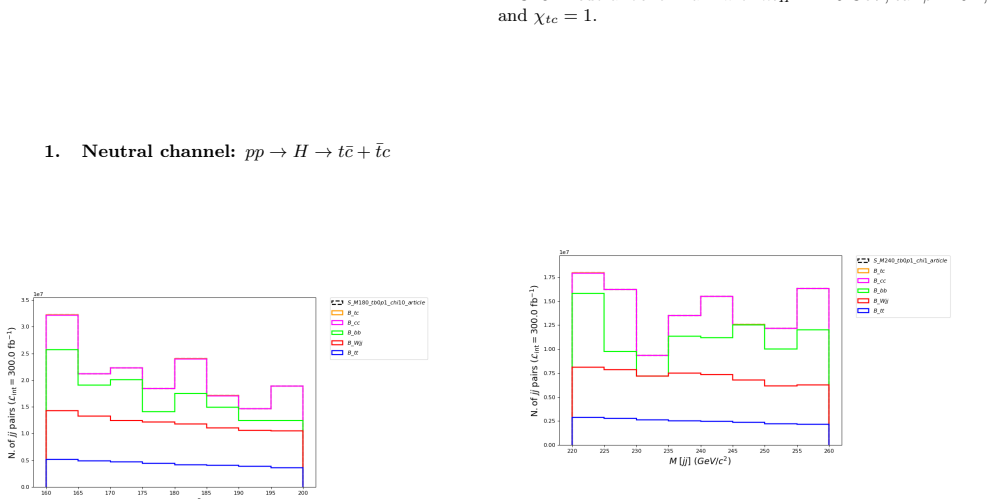
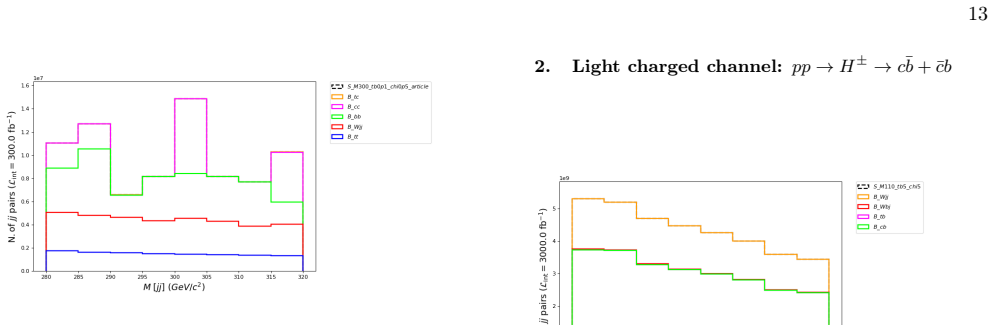
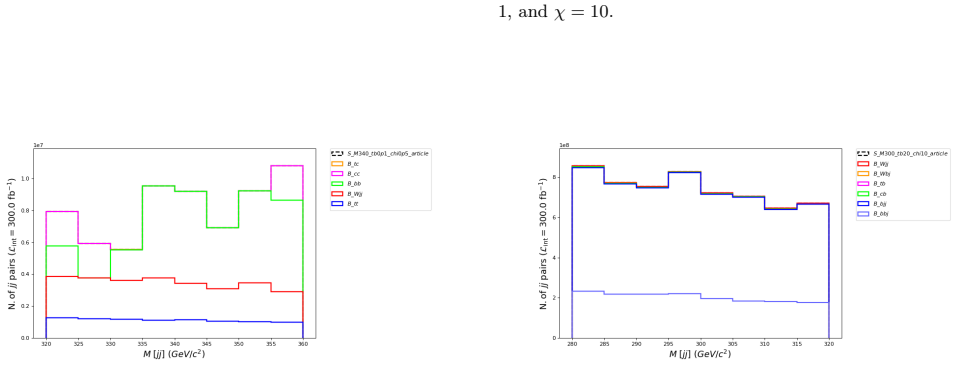
Neutral channel:pp→H→t¯c+ ¯tc FIG. 1. Neutral benchmark withmH = 180GeV,tanβ= 0.1, andχ tc = 10. FIG. 2. Neutral benchmark withmH = 200GeV,tanβ= 1, andχ tc = 5. FIG. 3. Neutral benchmark withmH = 220GeV,tanβ= 0.1, andχ tc = 1. FIG. 4. Neutral benchmark withmH = 240GeV,tanβ= 0.1, andχ tc = 1. FIG. 5. Neutral benchmark withmH = 280GeV,tanβ= 0.1, andχ tc = 0...
-
[8]
Light charged channel:pp→H ± →c ¯b+ ¯cb FIG. 9. Improved light charged-Higgs benchmark with mH± = 110GeV,tanβ= 5, andχ cb = 5, showing the fi- nal dijet mass distribution in the selected90< M(jj)<130 GeV region
-
[9]
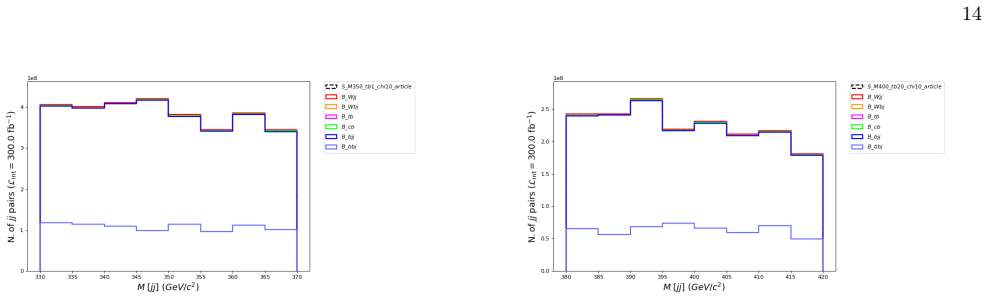
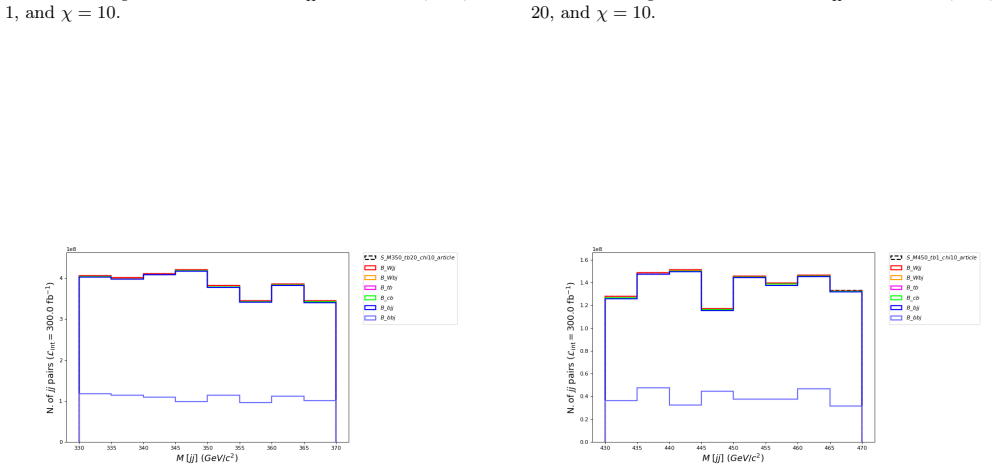
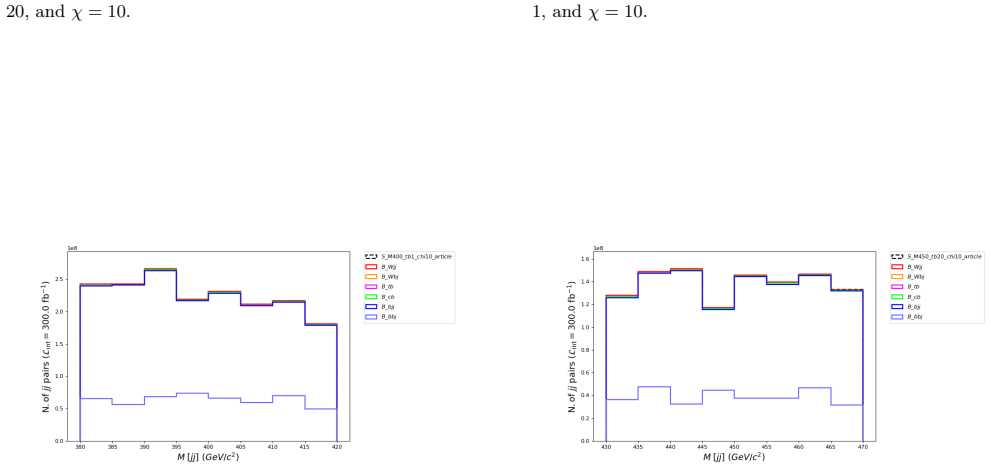
Heavy charged channel:pp→H ± →t ¯b+ ¯tb FIG. 10. Charged benchmark withmH± = 300GeV,tanβ= 1, andχ= 10. FIG. 11. Charged benchmark withmH± = 300GeV,tanβ= 20, andχ= 10. 14 FIG. 12. Charged benchmark withmH± = 350GeV,tanβ= 1, andχ= 10. FIG. 13. Charged benchmark withmH± = 350GeV,tanβ= 20, andχ= 10. FIG. 14. Charged benchmark withmH± = 400GeV,tanβ= 1, andχ= 1...
-
[10]
ATLAS Collaboration, Physics Letters B716, 1 (2012), arXiv:1207.7214 [hep-ex]
work page internal anchor Pith review arXiv 2012
- [11]
-
[12]
S. L. Glashow, Nuclear Physics22, 579 (1961)
1961
-
[13]
Weinberg, Physical Review Letters19, 1264 (1967)
S. Weinberg, Physical Review Letters19, 1264 (1967)
1967
-
[14]
Salam, inElementary Particle Theory: Relativis- tic Groups and Analyticity, Nobel Symposium No
A. Salam, inElementary Particle Theory: Relativis- tic Groups and Analyticity, Nobel Symposium No. 8, edited by N. Svartholm (Almqvist and Wiksell, Stock- holm, 1968) pp. 367–377
1968
-
[15]
G. C. Branco, P. M. Ferreira, L. Lavoura, M. N. Rebelo, M. Sher, and J. P. Silva, Physics Reports516, 1 (2012), arXiv:1106.0034 [hep-ph]
work page Pith review arXiv 2012
-
[16]
Phenomenology of two Higgs doublet models with flavor changing neutral currents,
D. Atwood, L. Reina, and A. Soni, Physical Review D 55, 3156 (1997), arXiv:hep-ph/9609279 [hep-ph]
-
[17]
J. F. Gunion, H. E. Haber, G. L. Kane, and S. Dawson, The Higgs Hunter’s Guide, Frontiers in Physics, Vol. 80 (CRC Press, Boca Raton, 2000)
2000
- [18]
- [19]
-
[20]
Cheng and M
T.-P. Cheng and M. Sher, Physical Review D35, 3484 (1987)
1987
-
[21]
J. Hernández-Sánchez, L. López-Lozano, R. Noriega- Papaqui, and A. Rosado, Physical Review D85, 071301 (2012), arXiv:1106.5035 [hep-ph]
-
[22]
Félix-Beltrán, F
O. Félix-Beltrán, F. González-Canales, J. Hernández- Sánchez, S. Moretti, R. Noriega-Papaqui, and A. Rosado, Physics Letters B742, 347 (2015)
2015
- [23]
- [24]
-
[25]
J. Alwall, R. Frederix, S. Frixione, V. Hirschi, F. Maltoni, O. Mattelaer, H.-S. Shao, T. Stelzer, P. Torrielli, and M. Zaro, Journal of High Energy Physics07, 079 (2014), arXiv:1405.0301 [hep-ph]
work page internal anchor Pith review arXiv 2014
-
[26]
T.Sjöstrand, S.Ask, J.R.Christiansen, R.Corke, N.De- sai, P. Ilten, S. Mrenna, S. Prestel, C. O. Rasmussen, and P. Z. Skands, Computer Physics Communications191, 159 (2015), arXiv:1410.3012 [hep-ph]
work page internal anchor Pith review arXiv 2015
-
[27]
DELPHES 3, A modular framework for fast simulation of a generic collider experiment
J. de Favereau, C. Delaere, P. Demin, A. Giammanco, V. Lemaître, A. Mertens, and M. Selvaggi, Journal of High Energy Physics02, 057 (2014), arXiv:1307.6346 [hep-ex]
work page internal anchor Pith review arXiv 2014
- [28]
-
[29]
E. Conte, B. Dumont, B. Fuks, and C. Wymant, European Physical Journal C74, 3103 (2014), arXiv:1405.3982 [hep-ph]
- [30]
-
[31]
Gómez-Bock, W
M. Gómez-Bock, W. Gonzalez-Olivares, M. Hentschinski, and S. Rosado Navarro, International Journal of Modern Physics A39, 2450110 (2024)
2024
-
[32]
J. Hernandez-Sanchez, C. G. Honorato, S. Moretti, and S. Rosado-Navarro, Physical Review D102, 055008 (2020), arXiv:2003.06263 [hep-ph]
-
[33]
M. A. Arroyo-Ureña, E. A. Herrera-Chacón, S. Rosado Navarro, and H. Salazar, Physical Review D 111, 015023 (2025)
2025
discussion (0)
Sign in with ORCID, Apple, or X to comment. Anyone can read and Pith papers without signing in.