Recognition: unknown
No-Worse Context-Aware Decoding: Preventing Neutral Regression in Context-Conditioned Generation
Pith reviewed 2026-05-10 08:03 UTC · model grok-4.3
The pith
NWCAD prevents neutral regression on baseline-correct items by backing off to no-context decoding for non-informative contexts while retaining gains from helpful ones.
A machine-rendered reading of the paper's core claim, the machinery that carries it, and where it could break.
Core claim
By combining a two-stream architecture with a two-stage gate, NWCAD detects non-informative contexts and falls back to no-context decoding in those cases, thereby eliminating accuracy drops on baseline-correct items while still delivering context-driven accuracy improvements when the context is helpful.
What carries the argument
A two-stage gate inside a two-stream decoding setup that checks whether the provided context is informative and backs off to no-context generation when it is not.
If this is right
- Context-augmented generation can satisfy a strict do-no-harm constraint without retraining the underlying model.
- Evaluation of context use must separately report regression on already-correct items and gains on genuinely helpful items.
- Decode-time adapters become a practical route for adding reliability guarantees to existing LLMs.
- The same gate logic could be applied to other conditional generation tasks where external input risks overwriting internal knowledge.
Where Pith is reading between the lines
- The approach suggests a general pattern for any retrieval-augmented system: always maintain a no-context baseline and only deviate when evidence quality can be verified on the fly.
- Extending the gate to multi-turn conversations could prevent cumulative regression across a dialogue history.
- Testing the method on summarization or code-generation tasks would reveal whether the same do-no-harm property holds outside question answering.
Load-bearing premise
The two-stage gate can reliably distinguish non-informative contexts from helpful ones without introducing new errors or false switches.
What would settle it
Running NWCAD on a set of baseline-correct questions paired with answer-consistent but non-informative contexts and observing any accuracy drop relative to pure no-context decoding would falsify the central claim.
Figures


read the original abstract
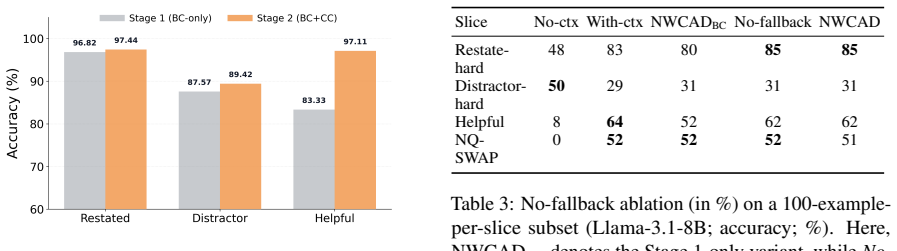
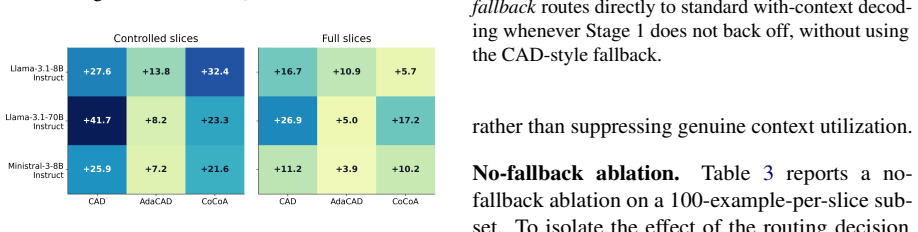
Large language models (LLMs) can answer questions and summarize documents when conditioned on external contexts (e.g., retrieved evidence), yet context use remains unreliable: models may overwrite an already-correct output (neutral regression) even when the context is non-informative. We formalize neutral regression as a do-no-harm requirement and quantify it by measuring accuracy drops on baseline-correct items under answer-consistent contexts. We propose No-Worse Context-Aware Decoding (NWCAD), a decode-time adapter built on a two-stream setup with a two-stage gate: it backs off to no-context decoding when the context is non-informative, and otherwise uses context-conditioned decoding with a CAD-style fallback under uncertainty. We evaluate NWCAD on benchmarks that separate do-no-harm reliability from context utilization (accuracy gains on genuinely helpful contexts). NWCAD prevents neutral regression on baseline-correct items while preserving strong context-driven accuracy on helpful contexts.
Editorial analysis
A structured set of objections, weighed in public.
Referee Report
Summary. The paper formalizes neutral regression as a do-no-harm requirement in context-conditioned LLM generation and proposes No-Worse Context-Aware Decoding (NWCAD), a decode-time adapter using a two-stream setup with a two-stage gate. The gate backs off to no-context decoding for non-informative contexts and applies CAD-style fallback under uncertainty otherwise. It evaluates the method on benchmarks designed to separately measure prevention of accuracy drops on baseline-correct items under answer-consistent contexts and preservation of gains on genuinely helpful contexts.
Significance. If the empirical results hold, NWCAD would provide a practical, training-free solution to a common failure mode in retrieval-augmented and context-dependent generation, improving reliability without sacrificing utility. The separation of do-no-harm and context-utilization benchmarks is a useful methodological contribution that could influence evaluation practices in the field.
major comments (2)
- [Method] The two-stage gate is the load-bearing component for the do-no-harm claim, yet its exact decision criterion (e.g., how non-informative contexts are detected, any thresholds, or uncertainty measure) is not specified with sufficient precision to allow reproduction or to confirm it introduces no new errors on baseline-correct items.
- [Abstract / Experiments] The abstract states that NWCAD 'prevents neutral regression' and 'preserves strong context-driven accuracy,' but the provided text supplies no quantitative results, error analysis, or statistical significance tests on the separated benchmarks; without these, the central empirical claim remains unsupported.
minor comments (2)
- [Method] Notation for the two streams and the gate stages should be introduced with explicit equations or pseudocode to improve clarity.
- [Discussion] The paper should include a limitations section discussing cases where the gate might fail (e.g., ambiguous contexts) and any computational overhead of the two-stream setup.
Simulated Author's Rebuttal
We thank the referee for the constructive comments and for acknowledging the potential utility of separating do-no-harm and context-utilization evaluations. We address each major comment below, providing clarifications and committing to targeted revisions that strengthen reproducibility and empirical support without altering the core claims.
read point-by-point responses
-
Referee: [Method] The two-stage gate is the load-bearing component for the do-no-harm claim, yet its exact decision criterion (e.g., how non-informative contexts are detected, any thresholds, or uncertainty measure) is not specified with sufficient precision to allow reproduction or to confirm it introduces no new errors on baseline-correct items.
Authors: We agree that the two-stage gate requires more explicit specification to support reproduction and to verify it introduces no new errors. Section 3.2 describes the gate at a conceptual level using divergence between the two streams and an entropy-based uncertainty check, but we will revise the manuscript to include the precise decision rules, all numerical thresholds, and pseudocode for the full procedure. We will also add an ablation confirming performance on baseline-correct items under non-informative contexts. These details will be incorporated in the revised version. revision: yes
-
Referee: [Abstract / Experiments] The abstract states that NWCAD 'prevents neutral regression' and 'preserves strong context-driven accuracy,' but the provided text supplies no quantitative results, error analysis, or statistical significance tests on the separated benchmarks; without these, the central empirical claim remains unsupported.
Authors: The abstract is a high-level summary and does not contain numerical results, which is conventional. However, the full manuscript already reports quantitative results, error analyses, and statistical significance tests on the separated benchmarks in Section 4 (Tables 2–4 and Figure 3). To better anchor the abstract claims, we will revise the abstract to include concise quantitative highlights (e.g., average reduction in neutral regression and retention of context-driven gains) with explicit pointers to the detailed evaluations and significance tests in the body. This is a partial revision focused on the abstract. revision: partial
Circularity Check
No significant circularity identified
full rationale
The paper introduces NWCAD as a novel decode-time adapter built on a two-stream setup with an explicitly described two-stage gate that backs off to no-context decoding for non-informative contexts. Neutral regression is formalized independently as a do-no-harm metric (accuracy drops on baseline-correct items under answer-consistent contexts), and the evaluation separates this from context utilization gains. No equations, parameter fits, or self-citations appear in the provided text that would reduce the central claims to their own inputs by construction. The derivation chain remains self-contained with independent design choices and benchmark protocols.
Axiom & Free-Parameter Ledger
Reference graph
Works this paper leans on
-
[1]
AI@Meta . 2024. https://github.com/meta-llama/llama3/blob/main/MODEL_CARD.md Llama 3 model card
2024
- [2]
- [3]
- [4]
- [5]
- [6]
-
[7]
Kenton Lee, Ming-Wei Chang, and Kristina Toutanova. 2019. https://doi.org/10.18653/v1/P19-1612 Latent retrieval for weakly supervised open domain question answering . In Proceedings of the 57th Annual Meeting of the Association for Computational Linguistics, pages 6086--6096, Florence, Italy. Association for Computational Linguistics
-
[8]
Retrieval-Augmented Generation for Knowledge-Intensive NLP Tasks
Patrick Lewis, Ethan Perez, Aleksandra Piktus, Fabio Petroni, Vladimir Karpukhin, Naman Goyal, Heinrich K \"u ttler, Mike Lewis, Wen-tau Yih, Tim Rockt \"a schel, Sebastian Riedel, and Douwe Kiela. 2020. https://arxiv.org/abs/2005.11401 Retrieval-augmented generation for knowledge-intensive NLP tasks . In Advances in Neural Information Processing Systems
work page internal anchor Pith review arXiv 2020
- [9]
-
[10]
Pan Lu, Yichong Zhang, Xinyu Liu, and William Yang Wang. 2023. Dynamic prompt learning via policy gradient for semi-structured mathematical reasoning. In Proceedings of the 2023 International Conference on Learning Representations
2023
-
[11]
Chaitanya Malaviya, Subin Lee, Sihao Chen, Elizabeth Sieber, Mark Yatskar, and Dan Roth. 2024. https://doi.org/10.18653/v1/2024.naacl-long.167 Expertqa: Expert-curated questions and attributed answers . In Proceedings of the 2024 Conference of the North American Chapter of the Association for Computational Linguistics: Human Language Technologies (Volume ...
-
[12]
Alex Mallen, Akari Asai, Victor Zhong, Rajarshi Das, Daniel Khashabi, and Hannaneh Hajishirzi. 2023. https://doi.org/10.18653/v1/2023.acl-long.546 When not to trust language models: Investigating effectiveness of parametric and non-parametric memories . In Proceedings of the 61st Annual Meeting of the Association for Computational Linguistics (Volume 1: L...
- [13]
-
[14]
Sewon Min, Kalpesh Krishna, Xinxi Lyu, Mike Lewis, Wen-tau Yih, Pang Koh, Mohit Iyyer, Luke Zettlemoyer, and Hannaneh Hajishirzi. 2023. https://aclanthology.org/2023.emnlp-main.741 FA ct S core: Fine-grained atomic evaluation of factual precision in long form text generation . In Proceedings of the 2023 Conference on Empirical Methods in Natural Language ...
2023
-
[15]
Mistral AI . 2025. Introducing mistral 3. https://mistral.ai/news/mistral-3
2025
- [16]
- [17]
- [18]
- [19]
-
[20]
Liyan Tang, Igor Shalyminov, Amy Wong, Jon Burnsky, Jake Vincent, Yu'an Yang, Siffi Singh, Song Feng, Hwanjun Song, Hang Su, Lijia Sun, Yi Zhang, Saab Mansour, and Kathleen McKeown. 2024 b . https://doi.org/10.18653/v1/2024.naacl-long.251 Tofueval: Evaluating hallucinations of LLM s on topic-focused dialogue summarization . In Proceedings of the 2024 Conf...
-
[21]
Yufei Tao, Adam Hiatt, Rahul Seetharaman, and Ameeta Agrawal. 2025. https://doi.org/10.1109/ICDMW69685.2025.00204 “lost-in-the-later”: Framework for quantifying contextual grounding in large language models . In 2025 IEEE International Conference on Data Mining Workshops (ICDMW), pages 1703--1712
- [22]
- [23]
- [24]
-
[25]
Zhilin Yang, Peng Qi, Saizheng Zhang, Yoshua Bengio, William Cohen, Ruslan Salakhutdinov, and Christopher D. Manning. 2018. https://doi.org/10.18653/v1/D18-1259 Hotpotqa: A dataset for diverse, explainable multi-hop question answering . In Proceedings of the 2018 Conference on Empirical Methods in Natural Language Processing, pages 2369--2380
-
[26]
Huajian Zhang, Yumo Xu, and Laura Perez-Beltrachini. 2024. https://doi.org/10.18653/v1/2024.eacl-long.102 Fine-grained natural language inference based faithfulness evaluation for diverse summarisation tasks . In Proceedings of the 18th Conference of the European Chapter of the Association for Computational Linguistics (Volume 1: Long Papers), pages 1701-...
-
[27]
online" 'onlinestring :=
ENTRY address archivePrefix author booktitle chapter edition editor eid eprint eprinttype howpublished institution journal key month note number organization pages publisher school series title type volume year doi pubmed url lastchecked label extra.label sort.label short.list INTEGERS output.state before.all mid.sentence after.sentence after.block STRING...
-
[28]
write newline
" write newline "" before.all 'output.state := FUNCTION n.dashify 't := "" t empty not t #1 #1 substring "-" = t #1 #2 substring "--" = not "--" * t #2 global.max substring 't := t #1 #1 substring "-" = "-" * t #2 global.max substring 't := while if t #1 #1 substring * t #2 global.max substring 't := if while FUNCTION word.in bbl.in capitalize " " * FUNCT...
discussion (0)
Sign in with ORCID, Apple, or X to comment. Anyone can read and Pith papers without signing in.