Recognition: unknown
AstroSURE: Learning to Remove Noise from Astronomical Images Without Ground Truth Data
Pith reviewed 2026-05-10 07:25 UTC · model grok-4.3
The pith
Unsupervised denoising can improve faint source detection in astronomical images without clean ground truth data.
A machine-rendered reading of the paper's core claim, the machinery that carries it, and where it could break.
Core claim
Unsupervised deep denoising methods trained without ground-truth clean images can raise the correct detection rate of faint astronomical sources relative to the original noisy frames, with stronger results on HST data after domain-consistent initialization and more limited gains when applied to CFHT observations.
What carries the argument
Unsupervised training losses (Noise2Noise, Stein's Unbiased Risk Estimator, and blind-spot masking) that allow denoising networks to learn from noisy astronomical images alone.
If this is right
- Object detection pipelines gain sensitivity to faint sources by adding an unsupervised denoising stage before cataloging.
- Performance improvements require close matching of noise statistics between training and application data.
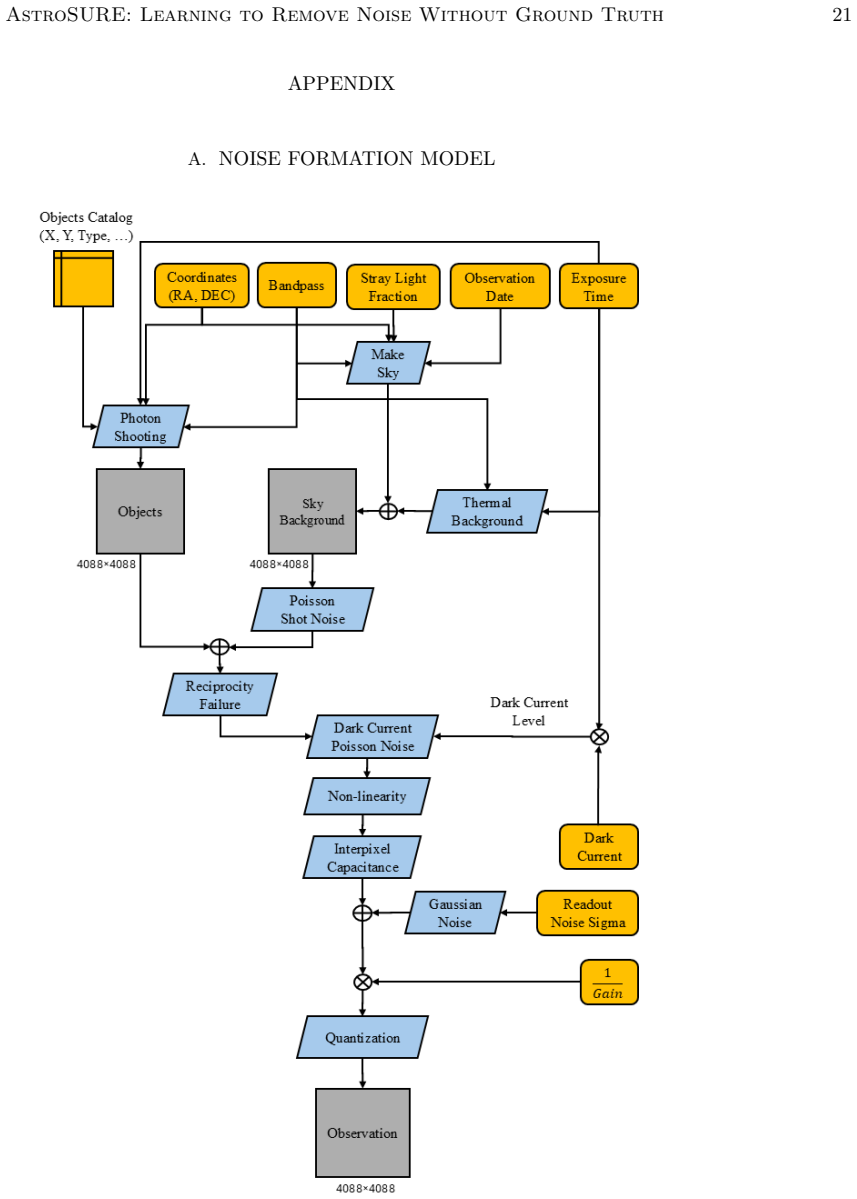
- Synthetic noise models can substitute for real paired clean data when evaluating these methods.
Where Pith is reading between the lines
- Instrument-specific retraining or fine-tuning may be needed for reliable results across different telescopes.
- The same unsupervised pipeline could be tested on other large surveys to check whether detection gains generalize beyond HST and CFHT.
- Downstream tasks such as photometry or morphological classification might also benefit if the denoised images preserve flux and shape information.
Load-bearing premise
The denoising step does not introduce artifacts that increase false detections or hide real faint sources in downstream object detection.
What would settle it
A controlled comparison of source catalogs extracted from the same set of real telescope images both before and after denoising, using an independent verification of true faint sources to measure net change in true-positive and false-positive rates.
Figures






read the original abstract
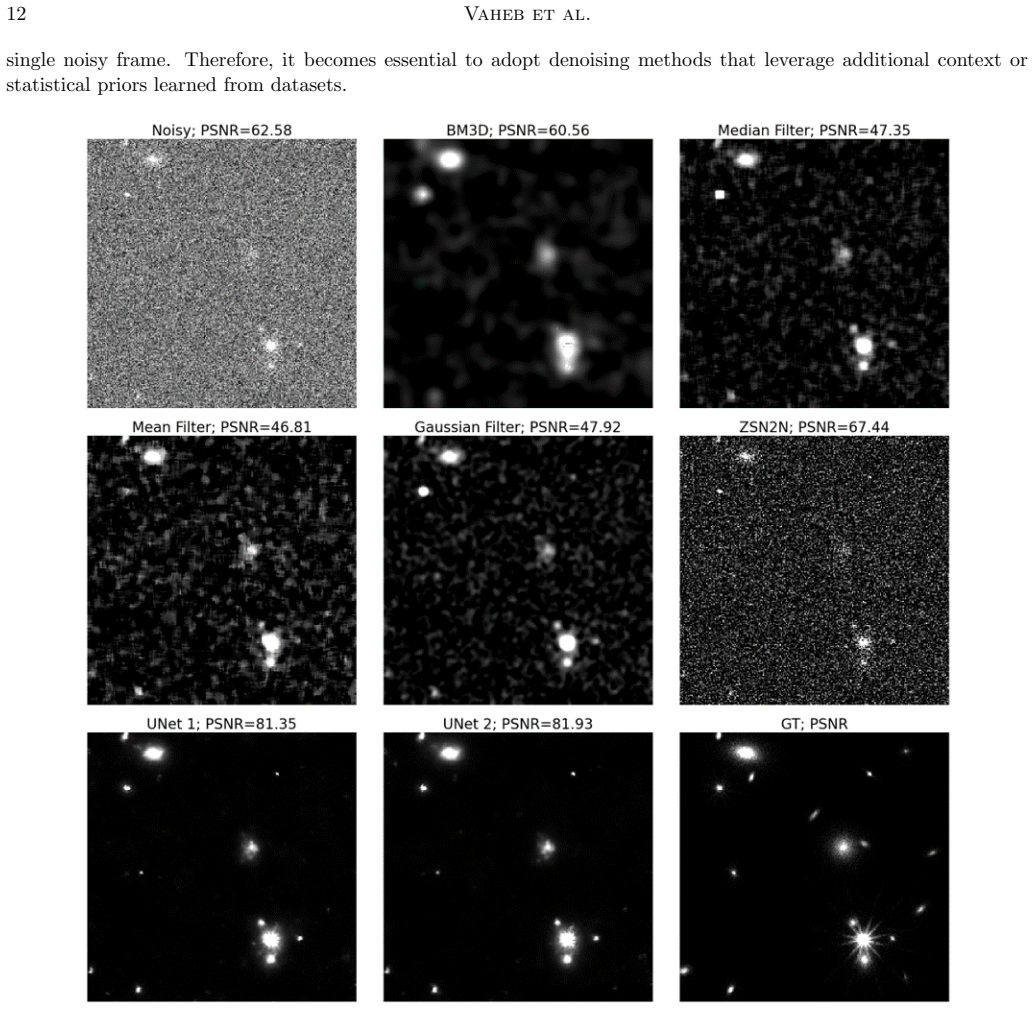
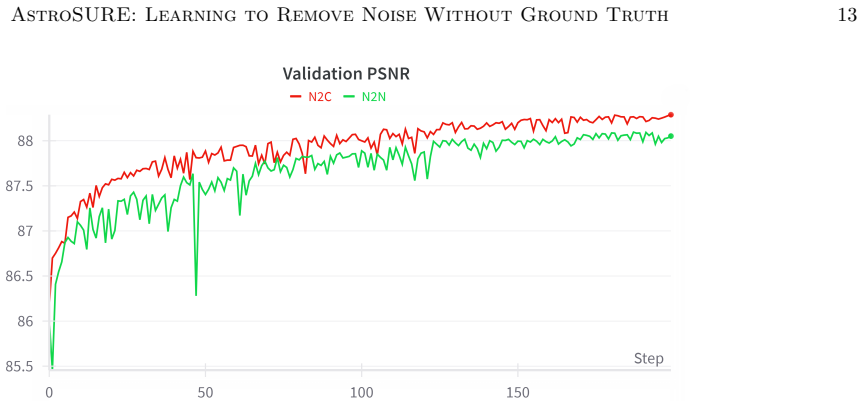
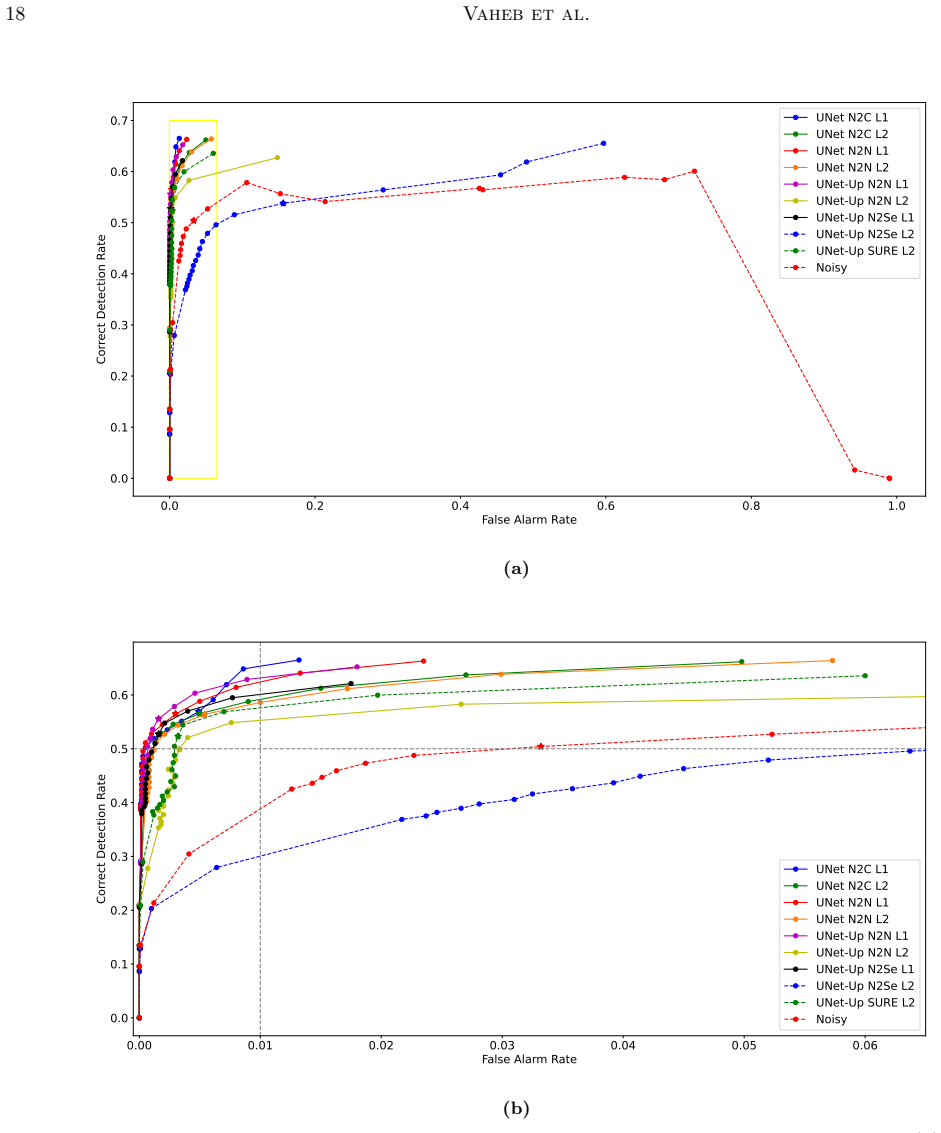
In astronomical imaging, the low photon count of exposures necessitates extensive post-processing steps, including contamination removal and denoising. This paper evaluates deep-learning denoising methods that can be trained without clean ground-truth images and assesses their utility for detection11 oriented analysis of astronomical data. We adapt and compare Noise2Noise, Stein's Unbiased Risk Estimator, and blind-spot-based methods using synthetic data and real observations from the Hubble Space Telescope (HST) and the Canada-France-Hawaii Telescope (CFHT). Performance is evaluated using object-detection metrics, including correct detection rate and false alarm rate, together with image-based metrics and pixel-distribution diagnostics. The results show that these methods can improve faint-source detectability relative to the original noisy images, with encouraging gains on HST data after domain-consistent initialization, while transfer to CFHT data is more limited, highlighting the importance of instrument/domain similarity for unsupervised adaptation.
Editorial analysis
A structured set of objections, weighed in public.
Referee Report
Summary. The manuscript evaluates unsupervised deep-learning denoising methods (Noise2Noise, Stein's Unbiased Risk Estimator, and blind-spot-based approaches) for astronomical images without requiring clean ground-truth data. It adapts and compares these techniques on synthetic data as well as real observations from HST and CFHT, assessing performance through object-detection metrics (correct detection rate, false alarm rate), image-based metrics, and pixel-distribution diagnostics. The central claim is that the methods improve faint-source detectability relative to the original noisy images, with encouraging gains on HST data after domain-consistent initialization but more limited transfer to CFHT data.
Significance. If the detection improvements prove robust under proper validation, the work could aid processing of large surveys where ground-truth references are unavailable. Strengths include the focus on downstream detection tasks rather than purely image-quality metrics and the explicit comparison of multiple unsupervised methods on real telescope data.
major comments (2)
- [Abstract] Abstract and evaluation on real data: The claim that the methods 'improve faint-source detectability' with 'encouraging gains on HST data' is presented without any numerical values, error bars, or statistical significance tests for the correct detection rate and false alarm rate. This leaves the central empirical claim without verifiable quantitative support.
- [Results on real observations] Evaluation on real HST/CFHT data: Correct detection and false-alarm rates are computed by matching detections to external catalogs or deeper exposures, yet the manuscript provides no description of controls (e.g., source-injection tests on the original noisy frames or checks for introduced correlated artifacts) to confirm that denoising does not silently suppress real faint sources while only reducing noise-triggered false alarms.
minor comments (1)
- [Abstract] Abstract: 'detection11 oriented' appears to be a typographical error and should read 'detection-oriented'.
Simulated Author's Rebuttal
We thank the referee for their constructive comments, which help clarify the presentation of our quantitative results and the robustness of our real-data evaluation. We respond to each major comment below and indicate the revisions planned for the manuscript.
read point-by-point responses
-
Referee: [Abstract] Abstract and evaluation on real data: The claim that the methods 'improve faint-source detectability' with 'encouraging gains on HST data' is presented without any numerical values, error bars, or statistical significance tests for the correct detection rate and false alarm rate. This leaves the central empirical claim without verifiable quantitative support.
Authors: We agree that the abstract would be strengthened by explicit quantitative support. In the revised manuscript we will update the abstract to report the specific improvements in correct detection rate (e.g., the percentage gain observed on HST fields) and the corresponding change in false-alarm rate, together with a brief reference to the error bars and statistical tests already computed in Section 4. This change directly addresses the lack of verifiable numbers while remaining faithful to the results presented in the body of the paper. revision: yes
-
Referee: [Results on real observations] Evaluation on real HST/CFHT data: Correct detection and false-alarm rates are computed by matching detections to external catalogs or deeper exposures, yet the manuscript provides no description of controls (e.g., source-injection tests on the original noisy frames or checks for introduced correlated artifacts) to confirm that denoising does not silently suppress real faint sources while only reducing noise-triggered false alarms.
Authors: We acknowledge that an explicit description of controls would increase confidence in the real-data results. Our current evaluation already uses deeper exposures and external catalogs as an independent reference to verify that newly detected sources are real rather than artifacts; however, we did not include source-injection tests or a dedicated artifact analysis. In the revised manuscript we will add a short subsection under 'Results on real observations' that (i) explains how the catalog-matching procedure serves as a control against source suppression and (ii) reports any additional checks for correlated artifacts that can be performed on the existing data. If the referee considers source-injection experiments essential, we are prepared to conduct a limited set on the HST fields and include the outcomes. revision: partial
Circularity Check
No significant circularity in empirical evaluation
full rationale
The paper adapts standard unsupervised denoising methods (Noise2Noise, SURE, blind-spot) and reports empirical gains on synthetic data plus real HST/CFHT observations via object-detection metrics and external catalog matching. No load-bearing step reduces by construction to a self-definition, fitted parameter renamed as prediction, or self-citation chain; claims rest on independent benchmarks and standard metrics rather than internal tautologies.
Axiom & Free-Parameter Ledger
axioms (1)
- domain assumption Unsupervised denoising methods such as Noise2Noise can be trained effectively without clean ground-truth images
Reference graph
Works this paper leans on
-
[1]
Astropy Collaboration, Robitaille, T. P., Tollerud, E. J., et al. 2013, A&A, 558, A33, doi: 10.1051/0004-6361/201322068 Astropy Collaboration, Price-Whelan, A. M., Sip˝ ocz, B. M., et al. 2018, AJ, 156, 123, doi: 10.3847/1538-3881/aabc4f
-
[2]
J., Benoit, D
Bartlett, O. J., Benoit, D. M., Pimbblet, K. A., Simmons, B., & Hunt, L. 2023, Monthly Notices of the Royal Astronomical Society, 521, 6318
2023
-
[3]
D., de la Cruz Rodriguez, J., & Danilovic, S
Baso, C. D., de la Cruz Rodriguez, J., & Danilovic, S. 2019, Astronomy & Astrophysics, 629, A99
2019
-
[4]
2019, in International Conference on Machine Learning, PMLR, 524–533
Batson, J., & Royer, L. 2019, in International Conference on Machine Learning, PMLR, 524–533
2019
-
[5]
Bertin, E., & Arnouts, S. 1996, A&AS, 117, 393, doi: 10.1051/aas:1996164
-
[6]
2002, in Astronomical Data Analysis Software and Systems XI, Vol
Bertin, E., Mellier, Y., Radovich, M., et al. 2002, in Astronomical Data Analysis Software and Systems XI, Vol. 281, 228
2002
-
[7]
2018, Astronomy & Astrophysics, 616, A1
Brown, A., Vallenari, A., Prusti, T., et al. 2018, Astronomy & Astrophysics, 616, A1
2018
-
[8]
2018, in Proceedings of the IEEE Conference on Computer Vision and Pattern Recognition, 3291–3300
Chen, C., Chen, Q., Xu, J., & Koltun, V. 2018, in Proceedings of the IEEE Conference on Computer Vision and Pattern Recognition, 3291–3300
2018
-
[9]
Chen, D., Tachella, J., & Davies, M. E. 2021, in Proceedings of the IEEE/CVF International Conference on Computer Vision, 4379–4388
2021
-
[10]
Chen, D., Tachella, J., & Davies, M. E. 2022, in Proceedings of the IEEE/CVF Conference on Computer Vision and Pattern Recognition, 5647–5656 AstroSURE:Learning to Remove Noise Without Ground Truth25
2022
-
[11]
2013, The Astrophysical Journal Letters, 775, L8
Chen, Y.-T., Kavelaars, J., Gwyn, S., et al. 2013, The Astrophysical Journal Letters, 775, L8
2013
-
[12]
2024, Astronomy & Astrophysics, 683, A105, doi: 10.1051/0004-6361/202347948
Drozdova, M., Kinakh, V., Bait, O., et al. 2024, Astronomy & Astrophysics, 683, A105, doi: 10.1051/0004-6361/202347948
-
[13]
Eldar, Y. C. 2008, IEEE Transactions on Signal Processing, 57, 471
2008
-
[14]
A., Ghoniemy, T
Elhakiem, A. A., Ghoniemy, T. E., & Salama, G. I. 2021, in 2021 Tenth International Conference on Intelligent Computing and Information Systems (ICICIS), IEEE, 51–56
2021
-
[15]
2010, in Software and Cyberinfrastructure for Astronomy, Vol
Gaudet, S., Hill, N., Armstrong, P., et al. 2010, in Software and Cyberinfrastructure for Astronomy, Vol. 7740, SPIE, 577–586
2010
-
[16]
2026, Science, doi: 10.1126/science.ady9404 H¨ außler, B., Vika, M., Bamford, S
Guo, Y., Zhang, H., Li, M., et al. 2026, Science, doi: 10.1126/science.ady9404 H¨ außler, B., Vika, M., Bamford, S. P., et al. 2022, A&A, 664, A92, doi: 10.1051/0004-6361/202142935
-
[17]
Khan, R., Gauch, D. J., & Nakarmi, D. U. 2024, arXiv preprint arXiv:2407.15799
-
[18]
Adam: A Method for Stochastic Optimization
Kingma, D. P., & Ba, J. 2014, arXiv preprint arXiv:1412.6980
work page internal anchor Pith review Pith/arXiv arXiv 2014
-
[19]
M., Aussel, H., Calzetti, D., et al
Koekemoer, A. M., Aussel, H., Calzetti, D., et al. 2007, The Astrophysical Journal Supplement Series, 172, 196
2007
-
[20]
Krizhevsky, A., Sutskever, I., & Hinton, G. E. 2012, Advances in Neural Information Processing Systems, 25
2012
-
[21]
2019, in Proceedings of the IEEE/CVF Conference on Computer Vision and Pattern Recognition, 2129–2137
Krull, A., Buchholz, T.-O., & Jug, F. 2019, in Proceedings of the IEEE/CVF Conference on Computer Vision and Pattern Recognition, 2129–2137
2019
-
[22]
1998, Proceedings of the IEEE, 86, 2278
LeCun, Y., Bottou, L., Bengio, Y., & Haffner, P. 1998, Proceedings of the IEEE, 86, 2278
1998
-
[23]
Noise2Noise: Learning Image Restoration without Clean Data
Lehtinen, J., Munkberg, J., Hasselgren, J., et al. 1803, arXiv preprint arXiv:1803.04189
-
[24]
Liu, S., Ge, X., Gu, Z., et al. 2026, arXiv preprint arXiv:2601.23276
-
[25]
Liu, T., Quan, Y., Su, Y., et al. 2023 —. 2025, Nature Astronomy, 9, 608–615, doi: 10.1038/s41550-025-02484-z
-
[26]
2010, IEEE Transactions on Image Processing, 20, 696
Luisier, F., Blu, T., & Unser, M. 2010, IEEE Transactions on Image Processing, 20, 696
2010
-
[27]
2023, in Proceedings of the IEEE/CVF Conference on Computer Vision and Pattern Recognition, 14018–14027
Mansour, Y., & Heckel, R. 2023, in Proceedings of the IEEE/CVF Conference on Computer Vision and Pattern Recognition, 14018–14027
2023
-
[28]
2022, arXiv preprint arXiv:2210.05553
Marcos-Morales, A., Leibovich, M., Mohan, S., et al. 2022, arXiv preprint arXiv:2210.05553
-
[29]
M., Marinoni, S., Fabrizio, M., & Altavilla, G
Marrese, P. M., Marinoni, S., Fabrizio, M., & Altavilla, G. 2019, Astronomy & Astrophysics, 621, A144
2019
-
[30]
Mittal, A., Soundararajan, R., & Bovik, A. C. 2012, IEEE Signal Processing Letters, 20, 209
2012
-
[31]
Radio-Interferometric Image Reconstruction with Denoising Diffusion Restoration Models
Morales, M., Tolley, E., & Poitevineau, R. 2026, Radio-Interferometric Image Reconstruction with Denoising Diffusion Restoration Models. https://arxiv.org/abs/2601.15844
work page internal anchor Pith review Pith/arXiv arXiv 2026
-
[32]
2020, in Proceedings of the IEEE/CVF Conference on Computer Vision and Pattern Recognition, 12064–12072
Moran, N., Schmidt, D., Zhong, Y., & Coady, P. 2020, in Proceedings of the IEEE/CVF Conference on Computer Vision and Pattern Recognition, 12064–12072
2020
-
[33]
2025, The Astrophysical Journal, 990, 122, doi: 10.3847/1538-4357/adf223
Ni, S., Qiu, Y., Chen, Y., et al. 2025, The Astrophysical Journal, 990, 122, doi: 10.3847/1538-4357/adf223
-
[34]
2020, Astronomy & Astrophysics, 634, A48
Paillassa, M., Bertin, E., & Bouy, H. 2020, Astronomy & Astrophysics, 634, A48
2020
-
[35]
2013, The Astrophysical Journal, 767, 133
Paudel, S., Duc, P.-A., Cˆ ot´ e, P., et al. 2013, The Astrophysical Journal, 767, 133
2013
-
[36]
M., Sip˝ ocz, B., G¨ unther, H., et al
Price-Whelan, A. M., Sip˝ ocz, B., G¨ unther, H., et al. 2018, The Astronomical Journal, 156, 123
2018
-
[37]
M., Lim, P
Price-Whelan, A. M., Lim, P. L., Earl, N., et al. 2022, The Astrophysical Journal, 935, 167
2022
-
[38]
G., et al
Prusti, T., De Bruijne, J., Brown, A. G., et al. 2016, Astronomy & Astrophysics, 595, A1
2016
-
[39]
2022, in 2022 China Automation Congress (CAC), IEEE, 1901–1905
Qi, J., Chen, M., Wu, Z., et al. 2022, in 2022 China Automation Congress (CAC), IEEE, 1901–1905
2022
-
[40]
2020, in Proceedings of the IEEE/CVF Conference on Computer Vision and Pattern Recognition, 1890–1898
Quan, Y., Chen, M., Pang, T., & Ji, H. 2020, in Proceedings of the IEEE/CVF Conference on Computer Vision and Pattern Recognition, 1890–1898
2020
-
[41]
2014, The Astrophysical Journal, 797, 102
Raichoor, A., Mei, S., Erben, T., et al. 2014, The Astrophysical Journal, 797, 102
2014
-
[42]
2008, IEEE Transactions on Image Processing, 17, 1540
Ramani, S., Blu, T., & Unser, M. 2008, IEEE Transactions on Image Processing, 17, 1540
2008
-
[43]
Raphan, M., & Simoncelli, E. P. 2011, Neural Computation, 23, 374
2011
-
[44]
On the Convergence of Adam and Beyond
Reddi, S. J., Kale, S., & Kumar, S. 2019, arXiv preprint arXiv:1904.09237
work page Pith review arXiv 2019
-
[45]
P., Tollerud, E
Robitaille, T. P., Tollerud, E. J., Greenfield, P., et al. 2013, Astronomy & Astrophysics, 558, A33
2013
-
[46]
Ronneberger, O., Fischer, P., & Brox, T. 2015, in Medical image computing and computer-assisted intervention–MICCAI 2015: 18th international conference, Munich, Germany, October 5-9, 2015, proceedings, part III 18, Springer, 234–241
2015
-
[47]
2020, Astronomy & Astrophysics, 643, A43
Roscani, V., Tozza, S., Castellano, M., et al. 2020, Astronomy & Astrophysics, 643, A43
2020
-
[48]
T., Jarvis, M., Mandelbaum, R., et al
Rowe, B. T., Jarvis, M., Mandelbaum, R., et al. 2015, Astronomy and Computing, 10, 121
2015
-
[49]
M., & Ghafoor, A
Shamshad, F., Riaz, M. M., & Ghafoor, A. 2018, Advances in Astronomy, 2018, 2417939 26Vaheb et al
2018
-
[50]
Soltanayev, S., & Chun, S. Y. 2018, Advances in Neural Information Processing Systems, 31
2018
-
[51]
Stein, C. M. 1981, The Annals of Statistics, 1135
1981
-
[52]
2025, Astronomy and Computing, 53, 100999, doi: 10.1016/j.ascom.2025.100999
Sukurdeep, Y., Navarro, F., & Budav´ ari, T. 2025, Astronomy and Computing, 53, 100999, doi: 10.1016/j.ascom.2025.100999
-
[53]
2022, Advances in Neural Information Processing Systems, 35, 4983
Tachella, J., Chen, D., & Davies, M. 2022, Advances in Neural Information Processing Systems, 35, 4983
2022
-
[54]
Taylor, M. B. 2005, in Astronomical Data Analysis Software and Systems XIV, Vol. 347, 29
2005
-
[55]
Unit, C. A. S. 2024, Software Release, http: //casu.ast.cam.ac.uk/surveys-projects/software-release
2024
-
[56]
2021, Monthly Notices of the Royal Astronomical Society, 503, 3204
Vojtekova, A., Lieu, M., Valtchanov, I., et al. 2021, Monthly Notices of the Royal Astronomical Society, 503, 3204
2021
-
[57]
2020, in Proceedings of the IEEE/CVF Conference on Computer Vision and Pattern Recognition, 2758–2767
Wei, K., Fu, Y., Yang, J., & Huang, H. 2020, in Proceedings of the IEEE/CVF Conference on Computer Vision and Pattern Recognition, 2758–2767
2020
-
[58]
2020, Advances in Neural Information Processing Systems, 33, 20320
Xie, Y., Wang, Z., & Ji, S. 2020, Advances in Neural Information Processing Systems, 33, 20320
2020
-
[59]
Yan, Z., & Sanders, J. L. 2025, Monthly Notices of the Royal Astronomical Society, 540, 2289, doi: 10.1093/mnras/staf852
-
[60]
W., Arora, A., Khan, S., et al
Zamir, S. W., Arora, A., Khan, S., et al. 2022, in Proceedings of the IEEE/CVF Conference on Computer Vision and Pattern Recognition, 5728–5739
2022
-
[61]
2017, IEEE Transactions on Image Processing, 26, 3142
Zhang, K., Zuo, W., Chen, Y., Meng, D., & Zhang, L. 2017, IEEE Transactions on Image Processing, 26, 3142
2017
-
[62]
2022, Research Notes of the AAS, 6, 187
Zhang, Y., Nord, B., Pagul, A., & Lepori, M. 2022, Research Notes of the AAS, 6, 187
2022
-
[63]
2014, The Astrophysical Journal, 792, 59
Zhu, L., Long, R., Mao, S., et al. 2014, The Astrophysical Journal, 792, 59
2014
discussion (0)
Sign in with ORCID, Apple, or X to comment. Anyone can read and Pith papers without signing in.