Recognition: unknown
A Community-Based Approach for Stance Distribution and Argument Organization
Pith reviewed 2026-05-10 07:08 UTC · model grok-4.3
The pith
An unsupervised method builds graphs from argument relations to detect communities revealing stance distributions in debates.
A machine-rendered reading of the paper's core claim, the machinery that carries it, and where it could break.
Core claim
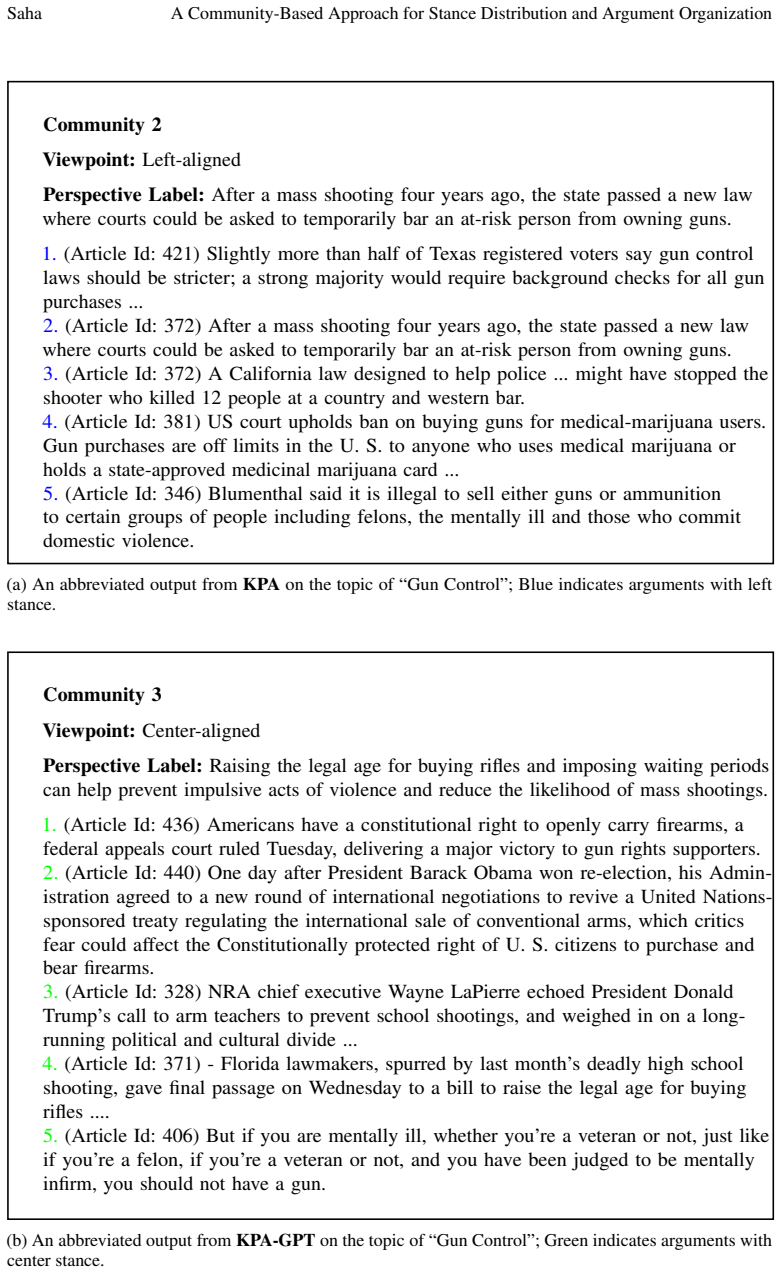
We present an unsupervised graph-based approach for community-based argument organization that helps users navigate and understand complex argumentative landscapes. Our system analyzes collections of topic-focused articles and constructs a rich interaction graph by capturing multiple relationship types between arguments: topic similarity, semantic coherence, shared keywords, and common entities. We then employ community detection to identify argument communities that reveal homogeneous and heterogeneous viewpoint distributions. The detected communities are simplified through strategic graph operations to present users with digestible, yet comprehensive summaries of key argumentative patterns
What carries the argument
The interaction graph connecting arguments via topic similarity, semantic coherence, shared keywords, and common entities, on which community detection is performed to reveal viewpoint distributions.
If this is right
- The approach identifies meaningful argument communities that show homogeneous and heterogeneous viewpoint distributions.
- It presents interpretable summaries of key argumentative patterns to users.
- It processes hundreds of articles while preserving nuanced relationships.
- Users gain better understanding of complex socio-political debates without needing labeled training data.
Where Pith is reading between the lines
- This could be tested by applying it to new domains such as online reviews or news comments.
- Future work might integrate user feedback to refine the communities dynamically.
- Comparing the detected stance distributions to poll data on the topics could validate real-world utility.
Load-bearing premise
That the communities found by detecting groups in the constructed interaction graph will correspond to meaningful homogeneous and heterogeneous viewpoint distributions.
What would settle it
Human evaluation of the communities where no consistent stance patterns or viewpoint groupings are found would show the method does not achieve its goal.
Figures




read the original abstract
The proliferation of online debate platforms and social media has led to an unprecedented volume of argumentative content on controversial topics from multiple perspectives. While this wealth of perspectives offers opportunities for developing critical thinking and breaking filter bubbles (Pariser 2011), the sheer volume and complexity of arguments make it challenging for readers to synthesize and comprehend diverse viewpoints effectively. We present an unsupervised graph-based approach for community-based argument organization that helps users navigate and understand complex argumentative landscapes. Our system analyzes collections of topic-focused articles and constructs a rich interaction graph by capturing multiple relationship types between arguments: topic similarity, semantic coherence, shared keywords, and common entities. We then employ community detection to identify argument communities that reveal homogeneous and heterogeneous viewpoint distributions. The detected communities are simplified through strategic graph operations to present users with digestible, yet comprehensive summaries of key argumentative patterns. Our approach requires no training data and can effectively process hundreds of articles while preserving nuanced relationships between arguments. Experimental results demonstrate our system's ability to identify meaningful argument communities and present them in an interpretable manner, facilitating users' understanding of complex socio-political debates.
Editorial analysis
A structured set of objections, weighed in public.
Referee Report
Summary. The manuscript presents an unsupervised graph-based approach for organizing arguments from collections of topic-focused articles. It builds a multi-relational interaction graph using topic similarity, semantic coherence, shared keywords, and common entities, applies community detection to identify argument communities that are claimed to reveal homogeneous and heterogeneous viewpoint distributions, and performs graph simplification operations to generate interpretable summaries. The method requires no training data, scales to hundreds of articles, and is supported by experimental results demonstrating its ability to identify meaningful communities that facilitate understanding of complex socio-political debates.
Significance. If properly validated, the approach could provide a practical, training-free tool for navigating large volumes of argumentative content by surfacing both agreeing and disagreeing clusters. The multi-signal graph construction and focus on post-detection simplification are constructive elements. No machine-checked proofs, reproducible code releases, or parameter-free derivations are described, but the unsupervised design avoids reliance on labeled stance data.
major comments (2)
- [Abstract] Abstract: The headline claim that 'experimental results demonstrate our system's ability to identify meaningful argument communities' and that the communities 'reveal homogeneous and heterogeneous viewpoint distributions' is unsupported. The manuscript describes an unsupervised graph built from four lexical/semantic signals followed by standard community detection, yet provides no datasets, ground-truth stance annotations, quantitative metrics (e.g., intra-community stance homogeneity scores), baselines, or statistical validation that the detected clusters align with actual viewpoint structure rather than topical or lexical artifacts.
- [Approach] Approach description (graph construction and community detection steps): The interaction graph is defined solely from unsupervised signals with no explicit stance modeling or post-detection alignment check. Consequently, the assertion that the resulting communities capture 'homogeneous and heterogeneous viewpoint distributions' rests on untested post-hoc interpretability; this is load-bearing for the central contribution and requires either a quantitative evaluation protocol or a clear statement of the assumptions under which interpretability suffices.
minor comments (1)
- [Abstract] Abstract: The parenthetical citation (Pariser 2011) appears without a corresponding reference entry; ensure the full bibliography is complete and consistently formatted.
Simulated Author's Rebuttal
We thank the referee for their constructive comments on our manuscript. We address the major concerns regarding the validation of our experimental claims and the assumptions in our approach below. We have made revisions to clarify these aspects.
read point-by-point responses
-
Referee: [Abstract] Abstract: The headline claim that 'experimental results demonstrate our system's ability to identify meaningful argument communities' and that the communities 'reveal homogeneous and heterogeneous viewpoint distributions' is unsupported. The manuscript describes an unsupervised graph built from four lexical/semantic signals followed by standard community detection, yet provides no datasets, ground-truth stance annotations, quantitative metrics (e.g., intra-community stance homogeneity scores), baselines, or statistical validation that the detected clusters align with actual viewpoint structure rather than topical or lexical artifacts.
Authors: We appreciate this observation. Our experiments consist of qualitative case studies on collections of articles from socio-political debates, where we manually analyze the detected communities to show they group arguments with similar viewpoints (homogeneous) and opposing ones (heterogeneous) in interpretable ways. As the method is fully unsupervised, we do not have ground-truth stance annotations and thus rely on interpretability rather than quantitative metrics. We agree that this could be strengthened and will revise the abstract to more accurately reflect the nature of our evaluation. Additionally, we will include a discussion of potential lexical artifacts and how our multi-signal approach mitigates them. revision: partial
-
Referee: [Approach] Approach description (graph construction and community detection steps): The interaction graph is defined solely from unsupervised signals with no explicit stance modeling or post-detection alignment check. Consequently, the assertion that the resulting communities capture 'homogeneous and heterogeneous viewpoint distributions' rests on untested post-hoc interpretability; this is load-bearing for the central contribution and requires either a quantitative evaluation protocol or a clear statement of the assumptions under which interpretability suffices.
Authors: The referee correctly notes the unsupervised nature of the graph construction. The central claim is based on the hypothesis that the combination of topic similarity, semantic coherence, shared keywords, and common entities will lead to communities that reflect stance distributions, which we support through the experimental case studies. To make this explicit, we will add a subsection in the Approach section stating the assumptions under which the interpretability holds, including that in argumentative texts, these signals correlate with viewpoint similarity. We will also outline limitations regarding possible topical confounds. revision: yes
Circularity Check
No circularity: unsupervised graph construction and community detection
full rationale
The paper presents a purely unsupervised pipeline: it constructs an interaction graph from four signals (topic similarity, semantic coherence, shared keywords, common entities) and applies community detection, then interprets the resulting clusters post hoc. No equations, fitted parameters, or derivations are shown that reduce any claimed output (e.g., 'homogeneous and heterogeneous viewpoint distributions') to the inputs by construction. No self-citations, uniqueness theorems, or ansatzes are invoked as load-bearing steps. The central claim rests on interpretability of the clusters rather than any self-referential reduction, making the derivation self-contained.
Axiom & Free-Parameter Ledger
Reference graph
Works this paper leans on
-
[1]
We can detect your bias: Predicting the political ideology of news articles. In Proceedings of the 2020 Conference on Empirical Methods in Natural Language Processing (EMNLP), EMNLP ’20, pages 4982–4991. Bar-Haim, Roy, Lilach Eden, Roni Friedman, Yoav Kantor, Dan Lahav, and Noam Slonim. 2020a. From arguments to key points: Towards automatic argument summa...
-
[2]
arXiv preprint arXiv:2106.06758
Every bite is an experience: Key point analysis of business reviews. arXiv preprint arXiv:2106.06758. Bar-Haim, Roy, Yoav Kantor, Lilach Eden, Roni Friedman, Dan Lahav, and Noam Slonim. 2020b. Quantitative argument summarization and beyond: Cross-domain key point analysis. arXiv preprint arXiv:2010.05369. Baroni, Pietro and Massimiliano Giacomin
-
[3]
In Advances in Artificial Intelligence (AIxIA 2023), Lecture Notes in Computer Science, Springer
Deriving dependency graphs from abstract argumentation frameworks. In Advances in Artificial Intelligence (AIxIA 2023), Lecture Notes in Computer Science, Springer. 29 Computational Linguistics V olume vv, Number nn Cattan, Arie, Lilach Eden, Yoav Kantor, and Roy Bar-Haim
2023
-
[4]
arXiv preprint arXiv:2306.03853
From key points to key point hierarchy: Structured and expressive opinion summarization. arXiv preprint arXiv:2306.03853. Chen, Sihao, Daniel Khashabi, Wenpeng Yin, Chris Callison-Burch, and Dan Roth
-
[5]
The Knowledge Engineering Review, 21(4):293–316
Towards an argument interchange format. The Knowledge Engineering Review, 21(4):293–316. Citraro, Salvatore and Giulio Rossetti. 2020a. Eva: Attribute-aware network segmentation. In Complex Networks and Their Applications VIII: Volume 1 Proceedings of the Eighth International Conference on Complex Networks and Their Applications COMPLEX NETWORKS 2019 8, p...
2019
-
[6]
In Proceedings of the 2023 Conference on Empirical Methods in Natural Language Processing: Industry Track, pages 483–491
Welcome to the real world: Efficient, incremental and scalable key point analysis. In Proceedings of the 2023 Conference on Empirical Methods in Natural Language Processing: Industry Track, pages 483–491. Ekström, Axel G, Diederick C Niehorster, and Erik J Olsson
2023
-
[7]
BERTopic: Neural topic modeling with a class-based TF-IDF procedure
Bertopic: Neural topic modeling with a class-based tf-idf procedure. arXiv preprint arXiv:2203.05794. Guimarães, Anna and Gerhard Weikum
work page internal anchor Pith review arXiv
-
[8]
In Proceedings of the 2014 conference on empirical methods in natural language processing (EMNLP), pages 751–762
Why are you taking this stance? identifying and classifying reasons in ideological debates. In Proceedings of the 2014 conference on empirical methods in natural language processing (EMNLP), pages 751–762. Hirao, Tsutomu, Yasuhisa Yoshida, Masaaki Nishino, Norihito Yasuda, and Masaaki Nagata
2014
-
[9]
In Proceedings of the 2013 conference on empirical methods in natural language processing, pages 1515–1520
Single-document summarization as a tree knapsack problem. In Proceedings of the 2013 conference on empirical methods in natural language processing, pages 1515–1520. Ibeke, Ebuka, Chenghua Lin, Adam Wyner, and Mohamad Hardyman Barawi
2013
-
[10]
In Proceedings of the 13th ACM Web Science Conference 2021, pages 215–224
Analysis and prediction of multilingual controversy on reddit. In Proceedings of the 13th ACM Web Science Conference 2021, pages 215–224. Kruskal, Joseph B
2021
-
[11]
arXiv preprint arXiv:1910.12840
Evaluating the factual consistency of abstractive text summarization. arXiv preprint arXiv:1910.12840. Lee, Sangah and Hyopil Shin
-
[12]
G-Eval: NLG Evaluation using GPT-4 with Better Human Alignment
arXiv preprint arXiv:2303.16634. Liu, Yinhan
work page internal anchor Pith review arXiv
-
[13]
RoBERTa: A Robustly Optimized BERT Pretraining Approach
Roberta: A robustly optimized bert pretraining approach. arXiv preprint arXiv:1907.11692,
work page internal anchor Pith review Pith/arXiv arXiv 1907
-
[14]
arXiv preprint arXiv:1709.00662
Using summarization to discover argument facets in online ideological dialog. arXiv preprint arXiv:1709.00662. Mohammad, Saif, Svetlana Kiritchenko, Parinaz Sobhani, Xiaodan Zhu, and Colin Cherry
-
[15]
In Proceedings of the 10th International Workshop on Semantic Evaluation (SemEval-2016), pages 31–41, Association for Computational Linguistics, San Diego, California
SemEval-2016 task 6: Detecting stance in tweets. In Proceedings of the 10th International Workshop on Semantic Evaluation (SemEval-2016), pages 31–41, Association for Computational Linguistics, San Diego, California. Pariser, Eli
2016
-
[16]
In Proceedings of the 2019 Conference on Empirical Methods in Natural Language Processing, Association for Computational Linguistics
Sentence-bert: Sentence embeddings using siamese bert-networks. In Proceedings of the 2019 Conference on Empirical Methods in Natural Language Processing, Association for Computational Linguistics. Reimers, Nils, Benjamin Schiller, Tilman Beck, Johannes Daxenberger, Christian Stab, and Iryna Gurevych
2019
-
[17]
arXiv preprint arXiv:1906.09821
Classification and clustering of arguments with contextualized word embeddings. arXiv preprint arXiv:1906.09821. Ross Arguedas, Amy, Craig Robertson, Richard Fletcher, and Rasmus Nielsen
-
[18]
arXiv preprint arXiv:1908.00648
Contrastive reasons detection and clustering from online polarized debate. arXiv preprint arXiv:1908.00648. Trabelsi, Amine and Osmar R Zaïane
-
[19]
In Proceedings of the 2017 conference on empirical methods in natural language processing, pages 1573–1582
Detecting perspectives in political debates. In Proceedings of the 2017 conference on empirical methods in natural language processing, pages 1573–1582. Wei, Penghui, Jiahao Zhao, and Wenji Mao
2017
-
[20]
arXiv preprint arXiv:2005.07886
Integrating semantic and structural information with graph convolutional network for controversy detection. arXiv preprint arXiv:2005.07886. 32
discussion (0)
Sign in with ORCID, Apple, or X to comment. Anyone can read and Pith papers without signing in.