Recognition: unknown
Noise-Adaptive Diffusion Sampling for Inverse Problems Without Task-Specific Tuning
Pith reviewed 2026-05-10 07:34 UTC · model grok-4.3
The pith
Moving inference to the initial noise space lets diffusion models solve inverse problems robustly without task-specific adjustments.
A machine-rendered reading of the paper's core claim, the machinery that carries it, and where it could break.
Core claim
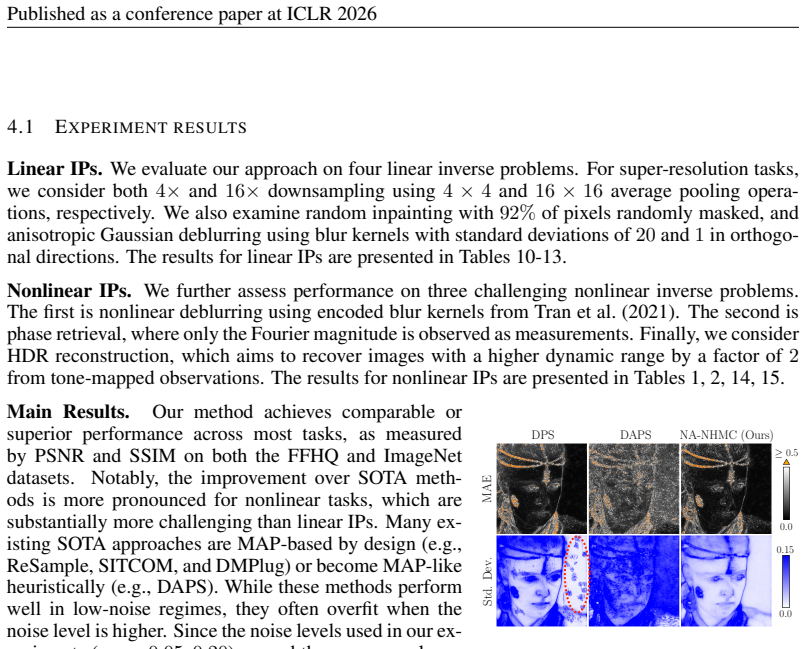
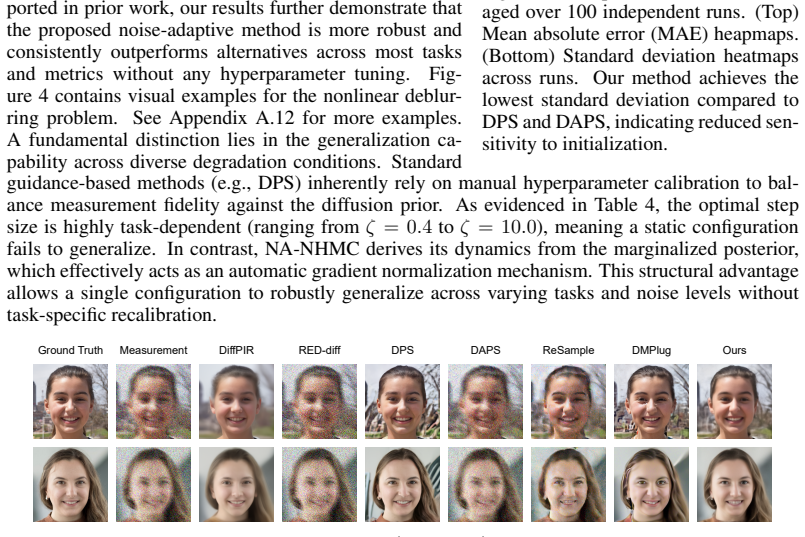
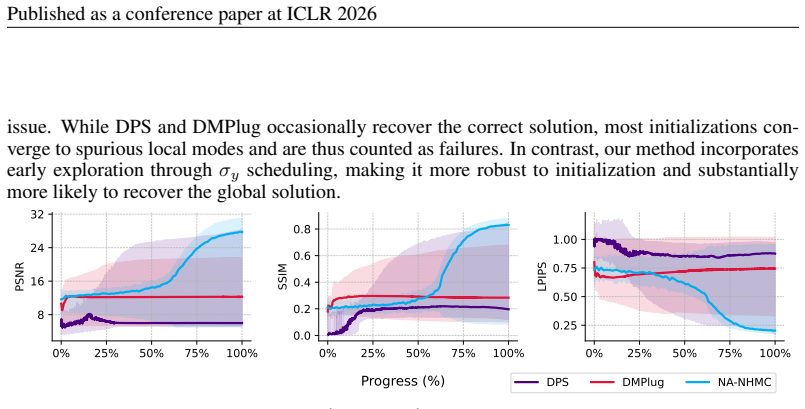
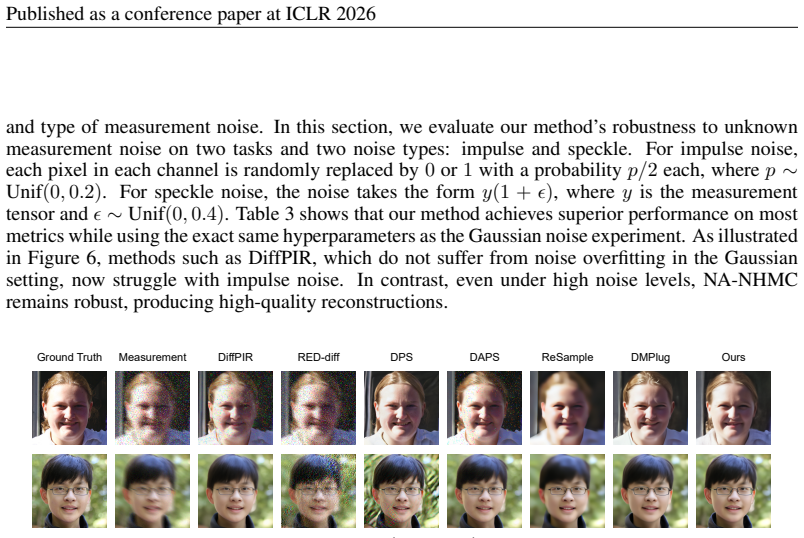
N-HMC samples in the noise space by treating the entire reverse diffusion as a deterministic mapping from initial noise to clean image, enabling Hamiltonian Monte Carlo to explore the posterior over solutions while staying on the data manifold. NA-NHMC extends this with noise adaptation to handle unknown noise without tuning. This yields superior reconstruction quality and robustness across hyperparameters and initializations on multiple inverse problems.
What carries the argument
Noise-space Hamiltonian Monte Carlo (N-HMC), which moves the sampling process into the space of initial noises by viewing reverse diffusion as a fixed mapping to images.
Load-bearing premise
The assumption that shifting all inference to the initial noise space keeps every proposal on the data manifold and allows full exploration of solutions without introducing new problems.
What would settle it
Observing that NA-NHMC produces reconstructions with higher error or less robustness than existing diffusion-based solvers on a standard inverse problem benchmark would falsify the central claim.
Figures




read the original abstract
Diffusion models (DMs) have recently shown remarkable performance on inverse problems (IPs). Optimization-based methods can fast solve IPs using DMs as powerful regularizers, but they are susceptible to local minima and noise overfitting. Although DMs can provide strong priors for Bayesian approaches, enforcing measurement consistency during the denoising process leads to manifold infeasibility issues. We propose Noise-space Hamiltonian Monte Carlo (N-HMC), a posterior sampling method that treats reverse diffusion as a deterministic mapping from initial noise to clean images. N-HMC enables comprehensive exploration of the solution space, avoiding local optima. By moving inference entirely into the initial-noise space, N-HMC keeps proposals on the learned data manifold. We provide a comprehensive theoretical analysis of our approach and extend the framework to a noise-adaptive variant (NA-NHMC) that effectively handles IPs with unknown noise type and level. Extensive experiments across four linear and three nonlinear inverse problems demonstrate that NA-NHMC achieves superior reconstruction quality with robust performance across different hyperparameters and initializations, significantly outperforming recent state-of-the-art methods. The code is available at https://github.com/NA-HMC/NA-HMC.
Editorial analysis
A structured set of objections, weighed in public.
Referee Report
Summary. The paper proposes Noise-space Hamiltonian Monte Carlo (N-HMC), which treats the deterministic reverse diffusion process as a fixed mapping from initial noise to images on the learned data manifold, and performs posterior sampling via HMC entirely in the initial-noise space to solve inverse problems. This is extended to a noise-adaptive variant (NA-NHMC) that handles unknown noise type and level without task-specific tuning. The authors provide a theoretical analysis of the approach and report extensive experiments on four linear and three nonlinear inverse problems, claiming superior reconstruction quality, robustness to hyperparameters and initializations, and outperformance of recent state-of-the-art methods.
Significance. If the theoretical analysis is sound and the experimental protocols are reproducible, the method offers a principled way to avoid local minima and manifold-infeasibility issues common in optimization-based and consistency-enforcing diffusion approaches for inverse problems. The noise-adaptive extension without per-task tuning could broaden applicability, and the open-source code supports verification.
minor comments (3)
- §3.2: clarify the precise form of the Hamiltonian and the discretization scheme used for N-HMC, including any Metropolis-Hastings correction steps, to ensure the sampler is exactly targeting the posterior.
- §4.3 and Table 2: the reported PSNR/SSIM gains for NA-NHMC versus baselines should include standard deviations over multiple random seeds and initializations to substantiate the robustness claim.
- [§5] §5: the theoretical analysis would benefit from an explicit statement of the assumptions under which the noise-space proposals remain on the manifold (e.g., regarding the diffusion model's training distribution and the forward operator).
Simulated Author's Rebuttal
We thank the referee for the positive summary of our work and the recommendation for minor revision. We appreciate the recognition of N-HMC's ability to perform posterior sampling in noise space to avoid local minima and manifold infeasibility, as well as the potential of the noise-adaptive NA-NHMC variant.
Circularity Check
No significant circularity in derivation chain
full rationale
The paper introduces N-HMC by reinterpreting the deterministic reverse diffusion process as a fixed mapping from initial noise to manifold images, then performing HMC sampling directly in that noise space to target the posterior. This construction is presented as an independent methodological shift that avoids local minima and manifold infeasibility without relying on fitted parameters renamed as predictions or self-referential definitions. The noise-adaptive extension NA-NHMC is described as a practical generalization with its own analysis. No load-bearing step reduces by construction to prior inputs or self-citations; the central claims rest on the proposed sampling strategy, theoretical analysis, and cross-problem experiments, which remain externally verifiable.
Axiom & Free-Parameter Ledger
axioms (2)
- domain assumption Diffusion models provide strong priors for Bayesian approaches to inverse problems
- domain assumption Enforcing measurement consistency during the denoising process leads to manifold infeasibility issues
invented entities (2)
-
Noise-space Hamiltonian Monte Carlo (N-HMC)
no independent evidence
-
Noise-adaptive variant (NA-NHMC)
no independent evidence
Reference graph
Works this paper leans on
-
[1]
URLhttps://arxiv.org/abs/1907.05600. Yang Song, Liyue Shen, Lei Xing, and Stefano Ermon. Solving inverse problems in medical imag- ing with score-based generative models, 2022b. URLhttps://arxiv.org/abs/2111. 08005. 12 Published as a conference paper at ICLR 2026 Phong Tran, Anh Tuan Tran, Quynh Phung, and Minh Hoai. Explore image deblurring via encoded b...
-
[2]
The measurement is given by y=A(x ∗
Measurement noiseη∈R m follows gaussian distribution with unknownσ 2 y: p(y|xT , σ2 y) = 1 (2πσ 2y)m/2 exp − ∥y− A(D(x T ))∥2 2σ2y .(12) 2.σ y follows a Jeffreys prior distribution: p(σ2 y)∝ 1 σ2y .(13) Marginalizingσ 2 y yields p(y|xT ) = Z ∞ 0 p(y|xT , σ2 y)p(σ 2 y)dσ 2 y (14) ∝ Z ∞ 0 1 (2πσ 2y)m/2 exp − ∥y− A(D(x T ))∥2 2σ2y 1 σ2y dσ2 y (15) ∝ Z ∞ 0 (σ...
-
[3]
In the following proofs,Ais assumed to be approximately linear aroundx ∗
+η, η∼ N(0, σ 2 yIm),(19) whereA:R n →R m is the measurement operator andηrepresents Gaussian measurement noise. In the following proofs,Ais assumed to be approximately linear aroundx ∗
-
[4]
Thus,A(x 0) =Ax 0. Generative model.Consider the DDIM sampler defined by ˆx0 =D(x T ),x T ∼ N(0,I n),(20) whereDdenotes the deterministic decoder via the diffusion model. Lemma 1.Product of two Gaussian probability density functions (PDFs). q1(x) =N(x;µ 1,Σ 1), q 2(x) =N(x;µ 2,Σ 2). Then, the product ofq 1(x)andq 2(x)is proportional to a Gaussian PDFN(x, ...
discussion (0)
Sign in with ORCID, Apple, or X to comment. Anyone can read and Pith papers without signing in.