Recognition: unknown
Planetary climate interactions of the Qinghai-Tibetan Plateau
Pith reviewed 2026-05-10 06:39 UTC · model grok-4.3
The pith
The Qinghai-Tibetan Plateau maintains a persistent directional link to Arctic and Antarctic climate through a tripolar atmospheric-oceanic mode.
A machine-rendered reading of the paper's core claim, the machinery that carries it, and where it could break.
Core claim
We uncover a persistent and directional interaction structure linking the QTP with multiple major climate tipping elements. In particular, we identify a robust tripolar interaction mode coupling the QTP with both the Arctic and Antarctica through coherent atmospheric-oceanic pathways. Our findings establish the QTP as a critical planetary climate integrator, revealing a significant blind spot in current climate models and risk frameworks regarding cascading tipping dynamics in a warming world.
What carries the argument
A climate network framework that resolves planetary teleconnection architecture, with physical consistency checked through Lagrangian trajectory diagnostics and targeted numerical experiments.
If this is right
- The QTP functions as a planetary climate integrator that organizes interactions among distant tipping elements.
- Current climate models contain a blind spot on cascading tipping risks that involve the QTP.
- Risk assessment frameworks must incorporate these directional atmospheric-oceanic pathways to avoid underestimating global change propagation.
Where Pith is reading between the lines
- Altering conditions on the QTP could influence polar climate stability more directly than standard models assume.
- Targeted monitoring of QTP variables might serve as an early indicator for broader planetary tipping cascades.
- Similar network analyses applied to other high-elevation regions could reveal additional climate integrators.
Load-bearing premise
The network analysis and trajectory diagnostics capture genuine physical causal links that stay stable rather than fleeting statistical correlations.
What would settle it
An independent model simulation or observational record that shows no consistent tripolar interaction pattern between the QTP, Arctic, and Antarctica under comparable conditions.
Figures


read the original abstract
The Qinghai-Tibetan Plateau (QTP), Earth's "Third Pole", profoundly shapes the Asian monsoon and regional climate and exerts far-reaching influence on the global climate system. Yet its role in organizing planetary-scale climate interactions remains poorly quantified. Here we develop a climate network framework to explicitly resolve the planetary teleconnection architecture associated with the QTP across historical observations and future climate projections, with physical consistency assessed using Lagrangian trajectory diagnostics and targeted numerical experiments. We uncover a persistent and directional interaction structure linking the QTP with multiple major climate tipping elements. In particular, we identify a robust tripolar interaction mode coupling the QTP with both the Arctic and Antarctica through coherent atmospheric-oceanic pathways. Our findings establish the QTP as a critical planetary climate integrator, revealing a significant blind spot in current climate models and risk frameworks regarding cascading tipping dynamics in a warming world.
Editorial analysis
A structured set of objections, weighed in public.
Referee Report
Summary. The manuscript develops a climate network framework to resolve planetary-scale teleconnections associated with the Qinghai-Tibetan Plateau (QTP) across historical observations and future projections. Physical consistency is assessed via Lagrangian trajectory diagnostics and targeted numerical experiments. The central claim is the identification of a persistent, directional tripolar interaction mode coupling the QTP with both the Arctic and Antarctica through coherent atmospheric-oceanic pathways, establishing the QTP as a critical planetary climate integrator and revealing a blind spot in current climate models regarding cascading tipping dynamics.
Significance. If the tripolar mode is demonstrated to be mechanistically causal and robust rather than a statistical artifact, the work would advance understanding of QTP's global role in climate teleconnections and tipping-element interactions. The multi-method approach (networks plus Lagrangian diagnostics plus numerical experiments) is a positive feature that could strengthen causal inference if convergence is shown quantitatively. The focus on directional structures and future projections adds value for risk assessment, but significance is limited by the absence of validation metrics and sensitivity tests needed to rule out circularity.
major comments (3)
- [Abstract] Abstract: The statement that 'physical consistency was assessed with Lagrangian diagnostics and numerical experiments' is load-bearing for the causality claim, yet no quantitative validation metrics, error estimates, or data exclusion criteria are supplied. Without these, it is not possible to evaluate whether the diagnostics confirm directional forcing from the QTP rather than shared variability.
- [Methods] Methods (network construction): Threshold or correlation choices in building the climate network can embed the target tripolar structure by design. The manuscript must demonstrate that the mode emerges independently of these parameter choices (e.g., via systematic sensitivity tests across thresholds) and is validated against external benchmarks; otherwise the 'robust' and 'directional' descriptors remain at risk of circularity.
- [Results and Discussion] Results/Discussion: The assertions that the QTP is a 'critical planetary climate integrator' and that models contain a 'significant blind spot' regarding cascading tipping require concrete evidence, such as direct comparisons showing that CMIP-class models fail to reproduce the identified tripolar mode under identical boundary conditions. Absent such tests, the policy-relevant conclusions do not follow from the network analysis alone.
minor comments (2)
- [Abstract] Abstract: Add a concise statement of the primary observational and projection datasets employed to allow immediate assessment of temporal coverage and resolution.
- [Figures] Figures: Ensure all panels depicting the tripolar mode include explicit color bars, significance contours, and captions that distinguish correlation strength from the Lagrangian-derived pathway directions.
Simulated Author's Rebuttal
We thank the referee for their constructive and detailed comments, which have prompted us to clarify key aspects of our analysis and strengthen the manuscript. We respond point-by-point to the major comments below.
read point-by-point responses
-
Referee: [Abstract] Abstract: The statement that 'physical consistency was assessed with Lagrangian diagnostics and numerical experiments' is load-bearing for the causality claim, yet no quantitative validation metrics, error estimates, or data exclusion criteria are supplied. Without these, it is not possible to evaluate whether the diagnostics confirm directional forcing from the QTP rather than shared variability.
Authors: We agree that the abstract and methods would benefit from explicit quantitative details to support the causality assessment. In the revised manuscript, we will expand the relevant sections to report specific metrics, including the fraction of Lagrangian trajectories aligning with the identified pathways (with standard errors from ensemble runs), RMSE values from the numerical experiments relative to observations, and clear data exclusion criteria based on trajectory duration and quality thresholds. These additions will help demonstrate that the directional signals are not merely shared variability by isolating QTP-specific perturbations. revision: yes
-
Referee: [Methods] Methods (network construction): Threshold or correlation choices in building the climate network can embed the target tripolar structure by design. The manuscript must demonstrate that the mode emerges independently of these parameter choices (e.g., via systematic sensitivity tests across thresholds) and is validated against external benchmarks; otherwise the 'robust' and 'directional' descriptors remain at risk of circularity.
Authors: We acknowledge the risk of parameter-dependent artifacts and the need for explicit robustness checks. The original analysis included preliminary threshold variations, but we will add a comprehensive sensitivity subsection in the Methods. This will systematically vary correlation thresholds (0.35–0.75) and network construction variants, quantifying the persistence of the tripolar mode via link overlap percentages and stability indices. We will also validate the mode against an independent observational product not used in the primary network to address potential circularity. revision: yes
-
Referee: [Results and Discussion] Results/Discussion: The assertions that the QTP is a 'critical planetary climate integrator' and that models contain a 'significant blind spot' regarding cascading tipping require concrete evidence, such as direct comparisons showing that CMIP-class models fail to reproduce the identified tripolar mode under identical boundary conditions. Absent such tests, the policy-relevant conclusions do not follow from the network analysis alone.
Authors: We partially agree that the strength of the integrator and blind-spot claims would be enhanced by direct model intercomparisons. Our conclusions draw from observational networks, future projections, and supporting diagnostics, which we believe support the QTP's integrative role; however, we recognize that explicit CMIP reproduction tests under matched conditions are absent. In revision, we will revise the language to 'indicates a potential gap in standard model representations of QTP teleconnections' with added caveats, while retaining the core findings from the multi-method evidence. We will also outline the need for targeted future experiments. revision: partial
- Performing comprehensive direct comparisons of the tripolar mode in CMIP-class models under identical boundary conditions, as this requires substantial new computational resources beyond the scope of the current study.
Circularity Check
No significant circularity; derivation relies on independent empirical construction and external validation
full rationale
The paper develops a climate network framework from historical observations and future projections, then identifies a tripolar interaction mode, with physical consistency checked via Lagrangian trajectory diagnostics and targeted numerical experiments. No equations or method descriptions in the provided text reduce the claimed tripolar structure or integrator role to a fitted parameter, self-defined quantity, or self-citation chain by construction. The central claims rest on data-driven network analysis plus independent diagnostics rather than tautological inputs, satisfying the criteria for a self-contained derivation.
Axiom & Free-Parameter Ledger
Reference graph
Works this paper leans on
-
[1]
Geophys.61, e2022RG000771 (2023)
Huang, J.et al.Global climate impacts of land-surface and atmospheric processes over the Tibetan Plateau.Rev. Geophys.61, e2022RG000771 (2023)
2023
-
[2]
Boos, W. R. & Kuang, Z. Dominant control of the South Asian monsoon by orographic insulation versus plateau heating.Nature463, 218–222 (2010)
2010
-
[3]
& Chen, J
Liu, G., Zhao, P. & Chen, J. Possible effect of the thermal condition of the Tibetan Plateau on the interannual variability of the Summer Asian–Pacific Oscillation.J. Clim.30, 9965–9977 (2017)
2017
-
[4]
& Wang, Z
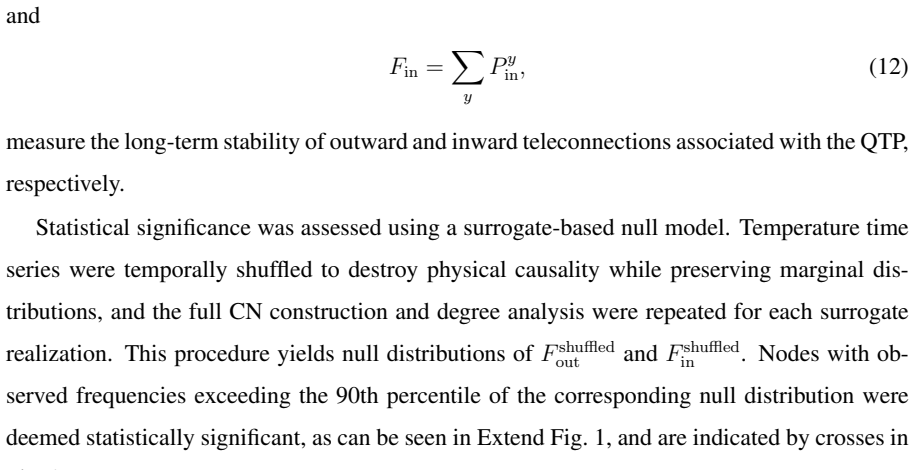
Lu, M. & Wang, Z. Role of Atlantic air–sea interaction in modulating the effect of Tibetan Plateau heating on the upstream climate over Afro-Eurasia–Atlantic regions.Clim. Dyn.53, 509–519 (2019)
2019
-
[5]
& Chen, J
Nan, S., Zhao, P. & Chen, J. Variability of summertime Tibetan tropospheric temperature and associated precipitation anomalies over the central-eastern Sahel.Clim. Dyn.52, 1819–1835 (2019)
2019
-
[6]
Commun.15, 2602 (2024)
Yang, H.et al.The role of mountains in shaping the global meridional overturning circulation.Nat. Commun.15, 2602 (2024)
2024
-
[7]
& Wen, Q
Yang, H., Shen, X., Yao, J. & Wen, Q. Portraying the impact of the Tibetan Plateau on global climate.J. Clim.33, 3565–3583 (2020)
2020
-
[8]
Bull.69, 367–374 (2024)
Tang, S.et al.Resonance between projected Tibetan Plateau surface darkening and Arctic climate change.Sci. Bull.69, 367–374 (2024)
2024
-
[9]
& Hock, R
Huss, M. & Hock, R. Global-scale hydrological response to future glacier mass loss.Nat. Clim. Change8, 135–140 (2018)
2018
-
[10]
K ¨a¨ab, A.et al.Massive collapse of two glaciers in western Tibet in 2016 after surge-like instability. Nat. Geosci.11, 114–120 (2018)
2016
-
[11]
Piao, S.et al.Impacts of climate and CO2 changes on the vegetation growth and carbon balance of Qinghai–Tibetan grasslands over the past five decades.Glob. Planet. Change98–99, 73–80 (2012)
2012
-
[12]
Zhu, Z.et al.Greening of the Earth and its drivers.Nat. Clim. Change6, 791–795 (2016)
2016
-
[13]
Liu, T.et al.Teleconnections among tipping elements in the Earth system.Nat. Clim. Change13, 67–74 (2023)
2023
-
[14]
Yao, T.et al.Recent Third Pole’s rapid warming accompanies cryospheric melt and water cycle intensification and interactions between monsoon and environment.Bull. Am. Meteorol. Soc.100, 423–444 (2019)
2019
- [15]
-
[16]
Wunderling, N.et al.Climate tipping point interactions and cascades: a review.Earth Syst. Dyn. 15, 41–74 (2024)
2024
-
[17]
I.et al.Exceeding 1.5°C global warming could trigger multiple climate tipping points.Science377, eabn7950 (2022)
Armstrong McKay, D. I.et al.Exceeding 1.5°C global warming could trigger multiple climate tipping points.Science377, eabn7950 (2022)
2022
-
[18]
Newman, M.Networks: An Introduction(Oxford University Press, 2010)
2010
-
[19]
Boers, N.et al.Complex networks reveal global pattern of extreme-rainfall teleconnections.Nature 566, 373–377 (2019)
2019
-
[20]
A., Hern ´andez-Garc´ıa, E., Masoller, C
Dijkstra, H. A., Hern ´andez-Garc´ıa, E., Masoller, C. & Barreiro, M.Networks in Climate(Cam- bridge University Press, 2019)
2019
-
[21]
Natl Acad
Ludescher, J.et al.Network-based forecasting of climate phenomena.Proc. Natl Acad. Sci. USA 118, e1922872118 (2021)
2021
-
[22]
Rep.896, 1–84 (2021)
Fan, J.et al.Statistical physics approaches to the complex Earth system.Phys. Rep.896, 1–84 (2021)
2021
-
[23]
Meng, J., Fan, J., Bhatt, U. S. & Kurths, J. Arctic weather variability and connectivity.Nat. Commun.14, 6574 (2023)
2023
-
[24]
& Zhang, Y
Wu, G. & Zhang, Y . Tibetan Plateau forcing and the timing of the monsoon onset over South Asia and the South China Sea.Mon. Wea. Rev.126, 913–927 (1998)
1998
-
[25]
M.et al.Climate tipping points — too risky to bet against.Nature575, 592–595 (2019)
Lenton, T. M.et al.Climate tipping points — too risky to bet against.Nature575, 592–595 (2019)
2019
-
[26]
H.et al.Early warning signals of the termination of the African Humid Period(s).Nat
Trauth, M. H.et al.Early warning signals of the termination of the African Humid Period(s).Nat. Commun.15, 3697 (2024)
2024
-
[27]
& Yang, H
Chen, Z., Wen, Q. & Yang, H. Impact of Tibetan Plateau on North African precipitation.Clim. Dyn.57, 2767–2777 (2021)
2021
-
[28]
& Schellnhuber, H
Fan, J., Meng, J., Ashkenazy, Y ., Havlin, S. & Schellnhuber, H. J. Network analysis reveals strongly localized impacts of El Ni˜no.Proc. Natl Acad. Sci. USA114, 7543–7548 (2017)
2017
-
[29]
& Saba, V
Caesar, L., Rahmstorf, S., Robinson, A., Feulner, G. & Saba, V . Observed fingerprint of a weak- ening Atlantic Ocean overturning circulation.Nature556, 191–196 (2018)
2018
-
[30]
A., Jochum, M., Lucarini, V
Lohmann, J., Dijkstra, H. A., Jochum, M., Lucarini, V . & Ditlevsen, P. D. Multistability and intermediate tipping of the Atlantic Ocean circulation.Sci. Adv.10, eadi4253 (2024)
2024
-
[31]
Xie, Y .et al.Oceanic repeaters boost the global climatic impact of the Tibetan Plateau.Sci. Bull. 68, 2225–2235 (2023)
2023
-
[32]
Yu, W.et al.Potential impact of Winter–Spring North Atlantic Tripole SSTAs on the following 20 Autumn–Winter El Ni ˜no–Southern Oscillation: Bridging Role of the Tibetan Plateau.Geophys. Res. Lett.50, e2022GL100663 (2023)
2023
-
[33]
Clim.32, 3109–3130 (2019)
Sun, R.et al.Interannual variability of the North Pacific mixed layer associated with the spring Tibetan Plateau thermal forcing.J. Clim.32, 3109–3130 (2019)
2019
-
[34]
Bull.70, 3908–3918 (2025)
Duan, A.et al.Climate teleconnections among the Earth’s three poles.Sci. Bull.70, 3908–3918 (2025)
2025
-
[35]
& Xue, Y
Zhang, Y ., Zou, T. & Xue, Y . An Arctic–Tibetan connection on subseasonal to seasonal time scale. Geophys. Res. Lett.46, 2790–2799 (2019)
2019
-
[36]
Li, F.et al.Arctic sea-ice loss intensifies aerosol transport to the Tibetan Plateau.Nat. Clim. Change10, 1037–1044 (2020)
2020
-
[37]
Duan, A.et al.Sea ice loss of the Barents-Kara Sea enhances the winter warming over the Tibetan Plateau.npj Clim. Atmos. Sci.5, 26 (2022)
2022
-
[38]
& Pan, Z
Zhang, C., Duan, A., Jia, X., Wang, Z. & Pan, Z. A dynamic link between spring Arctic sea ice and the Tibetan Plateau snow increment indicator.npj Clim. Atmos. Sci.6, 1–10 (2023)
2023
-
[39]
Tang, Y ., Duan, A. & Hu, J. Surface heating over the Tibetan Plateau associated with the Antarctic Oscillation.J. Geophys. Res. Atmos.127, e2022JD036851 (2022)
2022
-
[40]
Earth Environ.3, 298 (2022)
Liang, Y .et al.Asian monsoon intensity coupled to Antarctic climate during Dansgaard–Oeschger 8 and Heinrich 4 glacial intervals.Commun. Earth Environ.3, 298 (2022)
2022
-
[41]
Granger, C. W. J. Investigating causal relations by econometric models and cross-spectral methods. Econometrica37, 424–438 (1969)
1969
-
[42]
Liang, X. S. & Kleeman, R. Information transfer between dynamical system components.Phys. Rev. Lett.95, 244101 (2005)
2005
-
[43]
Liang, X. S. Unraveling the cause-effect relation between time series.Phys. Rev. E90, 052150 (2014)
2014
-
[44]
Li, Y ., Feng, J., Li, J. & Hu, A. Equatorial windows and barriers for stationary Rossby wave propagation.J. Clim.32, 6117–6135 (2019)
2019
-
[45]
& Alexander, M
Liu, Z. & Alexander, M. Atmospheric bridge, oceanic tunnel, and global climatic teleconnections. Rev. Geophys.45, RG2005 (2007)
2007
-
[46]
Geosci.7, 627–637 (2014)
Cohen, J.et al.Recent Arctic amplification and extreme mid-latitude weather.Nat. Geosci.7, 627–637 (2014)
2014
-
[47]
& Havlin, S
Zhou, D., Gozolchiani, A., Ashkenazy, Y . & Havlin, S. Teleconnection paths via climate network direct link detection.Phys. Rev. Lett.115, 268501 (2015). 21
2015
-
[48]
& Duan, A
Xiao, Z. & Duan, A. Impacts of Tibetan Plateau snow cover on the interannual variability of the East Asian summer monsoon.J. Clim.29, 8495–8514 (2016)
2016
-
[49]
E., Adams, J
Overland, J. E., Adams, J. M. & Bond, N. A. Decadal variability of the Aleutian Low and its relation to high-latitude circulation.J. Clim.12, 1542–1548 (1999)
1999
-
[50]
Rogers, J. C. & van Loon, H. Spatial variability of sea level pressure and 500 mb height anomalies over the Southern Hemisphere.Mon. Wea. Rev.110, 1375–1392 (1982)
1982
-
[51]
& Wang, S
Gong, D. & Wang, S. Definition of Antarctic oscillation index.Geophys. Res. Lett.26, 459–462 (1999)
1999
-
[52]
Nicholson, S. E. The ITCZ and the seasonal cycle over equatorial Africa.Bull. Am. Meteorol. Soc. 99, 337–348 (2018)
2018
-
[53]
& Chiang, J
Kong, W. & Chiang, J. C. H. Interaction of the westerlies with the Tibetan Plateau in determining the Mei-Yu termination.J. Clim.33, 339–363 (2020)
2020
-
[54]
F.et al.NOAA’s HYSPLIT atmospheric transport and dispersion modeling system.Bull
Stein, A. F.et al.NOAA’s HYSPLIT atmospheric transport and dispersion modeling system.Bull. Am. Meteorol. Soc.96, 2059–2077 (2015)
2059
-
[55]
Cai, W.et al.Changing El Ni ˜no–Southern Oscillation in a warming climate.Nat. Rev. Earth Environ.2, 628–644 (2021)
2021
-
[56]
Cai, W.et al.Increased variability of eastern Pacific El Ni ˜no under greenhouse warming.Nature 564, 201–206 (2018)
2018
-
[57]
Geng, T.et al.Increased occurrences of consecutive La Ni ˜na events under global warming.Nature 619, 774–781 (2023)
2023
-
[58]
Natl Acad
Wang, B.et al.Historical change of El Ni ˜no properties sheds light on future changes of extreme El Ni˜no.Proc. Natl Acad. Sci. USA116, 22512–22517 (2019)
2019
-
[59]
& Kang, S
Ding, Y ., Zhang, S., Zhao, L., Li, Z. & Kang, S. Global warming weakening the inherent stability of glaciers and permafrost.Sci. Bull.64, 245–253 (2019)
2019
-
[60]
Screen, J. A. & Simmonds, I. The central role of diminishing sea ice in recent Arctic temperature amplification.Nature464, 1334–1337 (2010)
2010
-
[61]
& Landais, A
Casado, M., H ´ebert, R., Faranda, D. & Landais, A. The quandary of detecting the signature of climate change in Antarctica.Nat. Clim. Change13, 1082–1088 (2023)
2023
-
[62]
A.et al.Record-low Antarctic sea ice in 2023 increased ocean heat loss and storms
Josey, S. A.et al.Record-low Antarctic sea ice in 2023 increased ocean heat loss and storms. Nature636, 635–639 (2024)
2023
-
[63]
R., Polvani, L
England, M. R., Polvani, L. M., Sun, L. & Deser, C. Tropical climate responses to projected Arctic and Antarctic sea-ice loss.Nat. Geosci.13, 275–281 (2020). 22
2020
-
[64]
& Nan, S
Zhao, P., Zhou, X., Chen, J., Liu, G. & Nan, S. Global climate effects of summer Tibetan Plateau. Sci. Bull.64, 1–3 (2019)
2019
-
[65]
P., Liu, Y .-Y ., Wang, L
Li, A., Cornelius, S. P., Liu, Y .-Y ., Wang, L. & Barab ´asi, A.-L. The fundamental advantages of temporal networks.Science358, 1042–1046 (2017)
2017
-
[66]
& Saram ¨aki, J
Holme, P. & Saram ¨aki, J. Temporal networks.Phys. Rep.519, 97–125 (2012)
2012
-
[67]
More is different in real-world multilayer networks.Nat
De Domenico, M. More is different in real-world multilayer networks.Nat. Phys.19, 1068–1069 (2023)
2023
-
[68]
Rep.544, 1–122 (2014)
Boccaletti, S.et al.The structure and dynamics of multilayer networks.Phys. Rep.544, 1–122 (2014)
2014
-
[69]
E.et al.Disentangling high-order mechanisms and high-order behaviours in complex systems.Nat
Rosas, F. E.et al.Disentangling high-order mechanisms and high-order behaviours in complex systems.Nat. Phys.18, 476–477 (2022)
2022
-
[70]
P.et al.Topology shapes dynamics of higher-order networks.Nat
Mill ´an, A. P.et al.Topology shapes dynamics of higher-order networks.Nat. Phys.21, 106–113 (2025)
2025
-
[71]
Geosci.18, 949–960 (2025)
Boers, N.et al.Destabilization of Earth system tipping elements.Nat. Geosci.18, 949–960 (2025)
2025
-
[72]
Wunderling, N.et al.Global warming overshoots increase risks of climate tipping cascades in a network model.Nat. Clim. Change13, 75–82 (2023)
2023
-
[73]
Globally networked risks and how to respond.Nature497, 51–59 (2013)
Helbing, D. Globally networked risks and how to respond.Nature497, 51–59 (2013). METHODS Data We employ three complementary datasets to quantify, validate, and project climate telecon- nections associated with the QTP. First, near-surface (2 m) air temperature was obtained from the ERA5 global reanalysis [71], produced by the European Centre for Medium-Ra...
2013
-
[74]
Here,drepresents the start day of the year, and each series has a length of 365 days
For a given yeary, we computed the time-lagged cross-correlation function between temperature anomaly time seriesS i(d)andS j(d), whereidenotes a QTP node andjdenotes a non-QTP node. Here,drepresents the start day of the year, and each series has a length of 365 days. Correlations were evaluated as, C y i,j(τ) = ⟨Si(d)Sj(d+τ)⟩ − ⟨S i(d)⟩⟨Sj(d+τ)⟩p ⟨(Si(d)...
-
[75]
Hersbach, H.et al.The ERA5 global reanalysis.Q. J. Roy. Meteor. Soc.146, 1999–2049 (2020)
1999
-
[76]
C., Barrett, A
Serreze, M. C., Barrett, A. P., Stroeve, J. C., Kindig, D. N., Holland, M. M. The emergence of surface-based Arctic amplification.Cryosphere3, 11–19 (2009)
2009
-
[77]
Clim.35, 1009–1020 (2022)
Fan, J.et al.Network-based approach and climate change benefits for forecasting the amount of Indian monsoon rainfall.J. Clim.35, 1009–1020 (2022)
2022
-
[78]
Meng, J.et al.Percolation framework to describe El Ni ˜no conditions.Chaos27, 035807 (2017)
2017
-
[79]
& Havlin, S
Yamasaki, K., Gozolchiani, A. & Havlin, S. Climate networks around the globe are significantly affected by El Ni˜no.Phys. Rev. Lett.100, 228501 (2008)
2008
-
[80]
Dijkstra, E. W. A note on two problems in connexion with graphs.Numer. Math.1, 269–271 (1959)
1959
discussion (0)
Sign in with ORCID, Apple, or X to comment. Anyone can read and Pith papers without signing in.