Hyperspectral Unmixing Hierarchies
Pith reviewed 2026-05-10 06:26 UTC · model grok-4.3
The pith
Imposing hierarchical abundance sum constraints on deep nonnegative matrix factorization solves spectral variability and endmember count ambiguity in hyperspectral unmixing.
A machine-rendered reading of the paper's core claim, the machinery that carries it, and where it could break.
Core claim
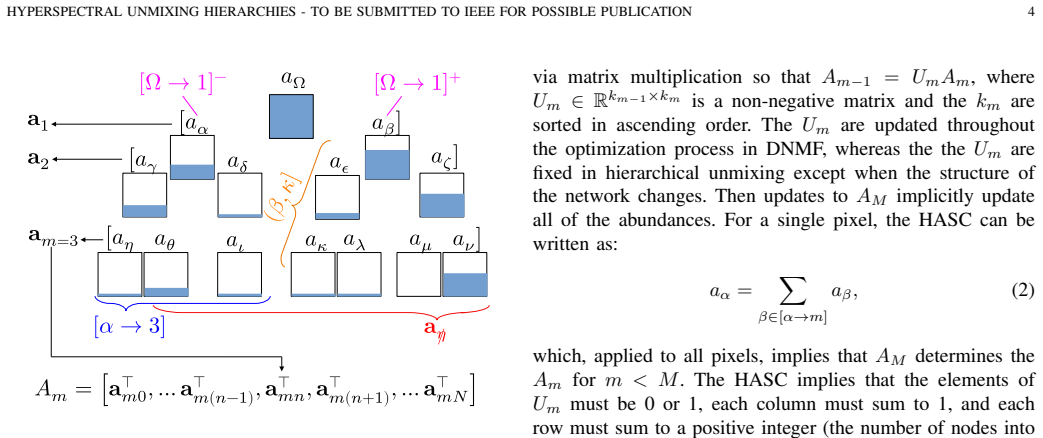
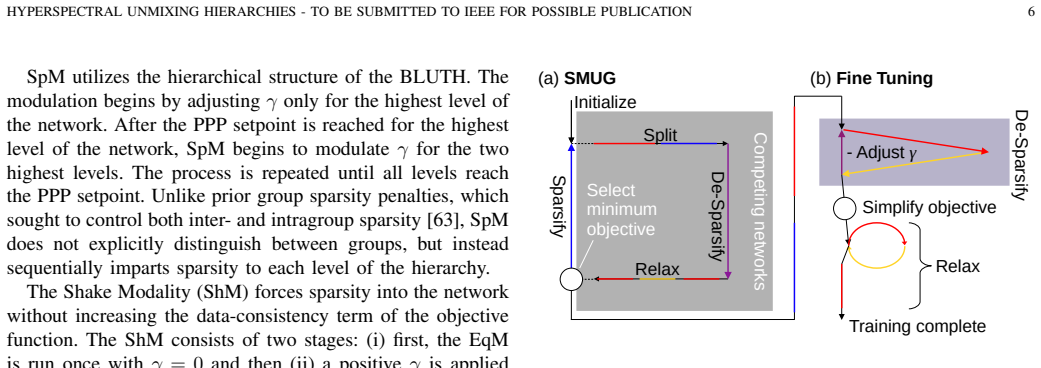
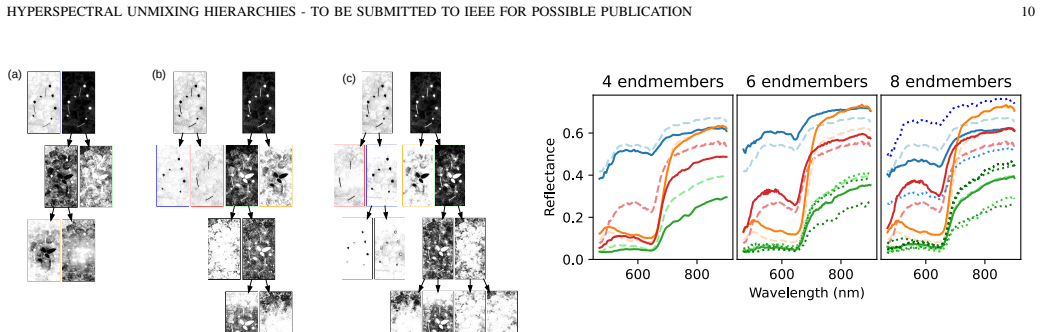
Hierarchical unmixing is defined by imposing a hierarchical abundance sum constraint on Deep Nonnegative Matrix Factorization. Binary Linear Unmixing Tactile Hierarchies (BLUTHs) solve the hierarchical unmixing problem with a simple network architecture. Sparsity modulation unmixing growth tailors the topology of a BLUTH to each scene. The structure imposed by BLUTHs allows endmembers with varying levels of spectral contrast to be revealed, mitigating the challenge of spectral variability.
What carries the argument
Binary Linear Unmixing Tactile Hierarchies (BLUTHs), a network that applies hierarchical abundance sum constraints to deep nonnegative matrix factorization and uses sparsity modulation to grow scene-specific topologies.
Load-bearing premise
That the hierarchical abundance sum constraint combined with sparsity modulation will mitigate spectral variability, resolve ambiguity in the number of endmembers, and improve endmember clarity without introducing new fitting artifacts or scene-specific biases.
What would settle it
A laboratory hyperspectral scene with known ground-truth endmembers and abundances where BLUTHs produce higher abundance estimation error than leading non-hierarchical unmixing algorithms would falsify the performance advantage.
Figures






read the original abstract
Unmixing reveals the spatial distribution and spectral details of different constituents, called endmembers, in a hyperspectral image. Because unmixing has limited ground truth requirements, can accommodate mixed pixels, and is closely tied to light propagation, it is a uniquely powerful tool for analyzing hyperspectral images. However, spectral variability inhibits unmixing performance, the proper way to determine the number of endmembers is ambiguous, and the clarity of the endmembers degrades as more are included. Hierarchical structure is a possible solution to all three problems. Here, hierarchical unmixing is defined by imposing a hierarchical abundance sum constraint on Deep Nonnegative Matrix Factorization. Binary Linear Unmixing Tactile Hierarchies (BLUTHs) solve the hierarchical unmixing problem with a simple network architecture. Sparsity modulation unmixing growth tailors the topology of a BLUTH to each scene. The structure imposed by BLUTHs allows endmembers with varying levels of spectral contrast to be revealed, mitigating the challenge of spectral variability. The performance of BLUTHs exceeds state-of-the-art unmixing algorithms on laboratory scenes, particularly with regard to abundance estimation, while their performance remains competitive on remote sensing scenes. In addition, ocean color unmixing by BLUTHs is demonstrated on hyperspectral scenes from the HYPSO and PACE satellites.
Editorial analysis
A structured set of objections, weighed in public.
Referee Report
Summary. The paper introduces Binary Linear Unmixing Tactile Hierarchies (BLUTHs) as a hierarchical unmixing method for hyperspectral images. Hierarchical unmixing is defined via a hierarchical abundance sum constraint imposed on Deep Nonnegative Matrix Factorization; BLUTHs realize this with a simple network architecture whose topology is adapted per scene via sparsity modulation. The approach is motivated as a way to mitigate spectral variability, resolve ambiguity in the number of endmembers, and preserve endmember clarity. The central empirical claim is that BLUTHs exceed state-of-the-art unmixing algorithms on laboratory scenes (especially for abundance estimation) while remaining competitive on remote-sensing scenes, with additional demonstrations of ocean-color unmixing on HYPSO and PACE satellite data.
Significance. If the reported performance gains are substantiated by rigorous, quantitative comparisons with appropriate baselines, error bars, and scene-specific validation, the work would constitute a useful architectural contribution to hyperspectral unmixing. The hierarchical abundance-sum constraint offers a principled way to handle variable spectral contrast and endmember cardinality without explicit model selection; the satellite demonstrations suggest immediate applicability to ocean-color remote sensing. The absence of free parameters or invented entities in the core construction is a positive feature.
minor comments (2)
- Abstract: the performance claims (superiority on laboratory scenes, competitiveness on remote sensing) are stated without any numerical results, baselines, or error statistics. Adding at least one key quantitative comparison (e.g., RMSE or SAM values against a standard method) would strengthen the abstract and allow readers to gauge the magnitude of the improvement.
- The term 'Tactile Hierarchies' is non-standard; a brief explanation of the intended meaning of 'tactile' (or a reference to its origin) would improve clarity for readers outside the immediate research group.
Simulated Author's Rebuttal
We thank the referee for the positive summary of our work on Binary Linear Unmixing Tactile Hierarchies (BLUTHs) and for recommending minor revision. We appreciate the recognition of the hierarchical abundance-sum constraint as a principled approach and the noted applicability to ocean-color remote sensing.
Circularity Check
No significant circularity detected
full rationale
The paper introduces BLUTHs as a novel architecture that imposes a hierarchical abundance sum constraint on Deep Nonnegative Matrix Factorization, augmented by sparsity modulation for topology tailoring. This construction is presented as a direct definition of hierarchical unmixing rather than a re-derivation or prediction of quantities from prior fitted values or self-citations. Performance claims rest on empirical comparisons to external SOTA algorithms on laboratory and remote-sensing scenes, with no load-bearing steps that reduce by construction to the method's own inputs. No self-definitional loops, uniqueness theorems imported from the authors' prior work, or ansatzes smuggled via citation appear in the derivation chain. The approach is self-contained as a new method with independent empirical validation.
Axiom & Free-Parameter Ledger
Reference graph
Works this paper leans on
-
[1]
Imaging Spectrometry for Earth Remote Sensing,
A. F. H. Goetzet al., “Imaging Spectrometry for Earth Remote Sensing,” Science,” 1985. HYPERSPECTRAL UNMIXING HIERARCHIES - TO BE SUBMITTED TO IEEE FOR POSSIBLE PUBLICATION 12 (a) (b) (c) (d) (e) (f) ToA Reflectance (dark pixel subtraction) Fig. 10. Unmixing hierarchies can separate water masses both in data collected by large hyperspectral missions such ...
work page 1985
-
[2]
Detection of different chemical binders in coatings using hyperspectral imaging,
B. Raeissiet al., “Detection of different chemical binders in coatings using hyperspectral imaging,”Journal of Coatings Technology and Research,” 2022
work page 2022
-
[3]
P. Maet al., “Coating Condition Detection and Assessment on the Steel Girder of a Bridge through Hyperspectral Imaging,”Coatings,” 2023
work page 2023
-
[4]
S. Primpkeet al., “Rapid Identification and Quantification of Microplas- tics in the Environment by Quantum Cascade Laser-Based Hyperspectral Infrared Chemical Imaging,”Environmental Science & Technology,” 2020
work page 2020
-
[5]
A. Faltynkovaet al., “Use of an uncrewed surface vehicle and near infrared hyperspectral imaging for sampling and analysis of aquatic microplastics,”Marine Pollution Bulletin,” 2024
work page 2024
-
[6]
I. Dumkeet al., “First hyperspectral imaging survey of the deep seafloor: High-resolution mapping of manganese nodules,”Remote Sensing of Environment,” 2018
work page 2018
-
[7]
A. Van Exemet al., “New source-to-sink approach in an arctic catchment based on hyperspectral core-logging (Lake Linn ´e, Svalbard),”Quater- nary Science Reviews,” 2019
work page 2019
-
[8]
Modelling Spectral Unmixing of Geological Mix- tures: An Experimental Study Using Rock Samples,
M. M. Sahooet al., “Modelling Spectral Unmixing of Geological Mix- tures: An Experimental Study Using Rock Samples,”Remote Sensing,” 2023
work page 2023
-
[9]
Can hyperspectral imaging be used to map corrosion products on outdoor bronze sculptures?
E. Catelliet al., “Can hyperspectral imaging be used to map corrosion products on outdoor bronze sculptures?”Journal of Spectral Imaging” 2018
work page 2018
-
[10]
A. T. Badar ´oet al., “Near infrared hyperspectral imaging and spectral unmixing methods for evaluation of fiber distribution in enriched pasta,” Food Chemistry,” 2021
work page 2021
-
[11]
UA V Hyperspectral Remote Sensing Image Classifica- tion: A Systematic Review,
Z. Zhanget al., “UA V Hyperspectral Remote Sensing Image Classifica- tion: A Systematic Review,”IEEE Journal of Selected Topics in Applied Earth Observations and Remote Sensing,” 2025
work page 2025
-
[12]
H. M. Dierssenet al., “Synergies Between NASA’s Hyperspectral Aquatic Missions PACE, GLIMR, and SBG: Opportunities for New Science and Applications,”Journal of Geophysical Research: Biogeo- sciences,” 2023
work page 2023
-
[13]
M. E. Grøtteet al., “Ocean Color Hyperspectral Remote Sensing With High Resolution and Low Latency–The HYPSO-1 CubeSat Mission,” IEEE Transactions on Geoscience and Remote Sensing,” 2021
work page 2021
-
[14]
Q. Zhanget al., “On-Orbit Radiometric Calibration of Hyperspectral Sensors on Board Micro-Nano Satellite Constellation Based on RadCal- Net Data,”Remote Sensing,” 2022
work page 2022
-
[15]
Hyperfield - Hyperspectral small satellites for improving life on Earth,
T. Tikkaet al., “Hyperfield - Hyperspectral small satellites for improving life on Earth,” in2023 IEEE Aerospace Conference, 2023
work page 2023
-
[16]
High-Resolution Methane Mapping With the EnMAP Satellite Imaging Spectroscopy Mission,
J. Rogeret al., “High-Resolution Methane Mapping With the EnMAP Satellite Imaging Spectroscopy Mission,”IEEE Transactions on Geo- science and Remote Sensing,” 2024
work page 2024
-
[17]
J. Louet al., “Variational Autoencoder Framework for Hyperspectral Retrievals (Hyper-V AE) of Phytoplankton Absorption and Chlorophyll a in Coastal Waters for NASA’s EMIT and PACE Missions,”IEEE Transactions on Geoscience and Remote Sensing,” 2025
work page 2025
-
[18]
Integrating Soil Spectral Library and PRISMA Data to Estimate Soil Organic Carbon in Crop Lands,
B. S. Reddy and H. R. Shwetha, “Integrating Soil Spectral Library and PRISMA Data to Estimate Soil Organic Carbon in Crop Lands,”IEEE Geoscience and Remote Sensing Letters,” 2024
work page 2024
-
[19]
Hyperspectral Unmixing Overview: Geo- metrical, Statistical, and Sparse Regression-Based Approaches,
J. M. Bioucas-Diaset al., “Hyperspectral Unmixing Overview: Geo- metrical, Statistical, and Sparse Regression-Based Approaches,”IEEE Journal of Selected Topics in Applied Earth Observations and Remote Sensing,” 2012
work page 2012
-
[20]
C. Cuiet al., “Realistic Mixing Miniature Scene Hyperspectral Un- mixing: From Benchmark Datasets to Autonomous Unmixing,”IEEE Transactions on Geoscience and Remote Sensing,” 2023
work page 2023
-
[21]
Coupled Nonnegative Matrix Factorization Unmixing for Hyperspectral and Multispectral Data Fusion,
N. Yokoyaet al., “Coupled Nonnegative Matrix Factorization Unmixing for Hyperspectral and Multispectral Data Fusion,”IEEE Transactions on Geoscience and Remote Sensing,” 2012
work page 2012
-
[22]
A Novel Semantic Content-Based Retrieval System for Hyperspectral Remote Sensing Imagery,
F. ¨Omr¨uuzunet al., “A Novel Semantic Content-Based Retrieval System for Hyperspectral Remote Sensing Imagery,”Remote Sensing,” 2024
work page 2024
-
[23]
Endmember variability in Spectral Mixture Analysis: A review,
B. Somerset al., “Endmember variability in Spectral Mixture Analysis: A review,”Remote Sensing of Environment,” 2011
work page 2011
-
[24]
Spectral Variability Aware Blind Hyperspectral Image Unmixing Based on Convex Geometry,
L. Drumetzet al., “Spectral Variability Aware Blind Hyperspectral Image Unmixing Based on Convex Geometry,”IEEE Transactions on Image Processing,” 2020
work page 2020
-
[25]
Optical types of inland and coastal waters,
E. Spyrakoset al., “Optical types of inland and coastal waters,” Limnology and Oceanography,” 2018
work page 2018
-
[26]
Detecting the Adjacency Effect in Hyperspectral Imagery With Spectral Unmixing Techniques,
D. Burazerovi ´cet al., “Detecting the Adjacency Effect in Hyperspectral Imagery With Spectral Unmixing Techniques,”IEEE Journal of Selected Topics in Applied Earth Observations and Remote Sensing,” 2013
work page 2013
-
[27]
E. Alfaro-Mej ´ıaet al., “A blind convolutional deep autoencoder for spectral unmixing of hyperspectral images over waterbodies,”Frontiers in Earth Science,” 2023
work page 2023
-
[28]
A Novel Spectral-Unmixing-Based Green Algae Area Estimation Method for GOCI Data,
B. Panet al., “A Novel Spectral-Unmixing-Based Green Algae Area Estimation Method for GOCI Data,”IEEE Journal of Selected Topics in Applied Earth Observations and Remote Sensing,” 2017
work page 2017
-
[29]
Applying Spectral Unmixing to Determine Surface Water Parameters in a Mining Environment,
V . Kopa ˇckov´a and L. Hlad ´ıkov´a, “Applying Spectral Unmixing to Determine Surface Water Parameters in a Mining Environment,”Remote Sensing,” 2014
work page 2014
-
[30]
C. J. Legleiteret al., “Spectral mixture analysis for surveillance of harmful algal blooms (SMASH): A field-, laboratory-, and satellite- based approach to identifying cyanobacteria genera from remotely sensed data,”Remote Sensing of Environment,” 2022
work page 2022
-
[31]
Resolving Mixed Algal Species in Hyperspec- tral Images,
M. Mehrubeogluet al., “Resolving Mixed Algal Species in Hyperspec- tral Images,”Sensors,” 2014
work page 2014
-
[32]
P. Naiket al., “Blind and endmember guided autoencoder model for unmixing the absorbance spectra of phytoplankton pigments,”Scientific Reports,” 2025
work page 2025
-
[33]
T. S. Mooreet al., “An optical water type framework for selecting and blending retrievals from bio-optical algorithms in lakes and coastal waters,”Remote Sensing of Environment,” 2014. HYPERSPECTRAL UNMIXING HIERARCHIES - TO BE SUBMITTED TO IEEE FOR POSSIBLE PUBLICATION 13
work page 2014
-
[34]
E. C. Atwoodet al., “Framework for Regional to Global Extension of Optical Water Types for Remote Sensing of Optically Complex Transitional Water Bodies,”Remote Sensing,” 2024
work page 2024
-
[35]
Classification of Inland Waters Based on Bio-Optical Properties,
K. Shiet al., “Classification of Inland Waters Based on Bio-Optical Properties,”IEEE Journal of Selected Topics in Applied Earth Obser- vations and Remote Sensing,” 2014
work page 2014
-
[36]
Learning Relevant Features of Optical Water Types,
K. Blixet al., “Learning Relevant Features of Optical Water Types,” IEEE Geoscience and Remote Sensing Letters,” 2022
work page 2022
-
[37]
Mapping Chaparral in the Santa Monica Mountains Using Multiple Endmember Spectral Mixture Models,
D. A. Robertset al., “Mapping Chaparral in the Santa Monica Mountains Using Multiple Endmember Spectral Mixture Models,”Remote Sensing of Environment,” 1998
work page 1998
-
[38]
C. Batesonet al., “Endmember bundles: a new approach to incorporating endmember variability into spectral mixture analysis,”IEEE Transac- tions on Geoscience and Remote Sensing,” 2000
work page 2000
-
[39]
Automated Extraction of Image-Based Endmember Bundles for Improved Spectral Unmixing,
B. Somerset al., “Automated Extraction of Image-Based Endmember Bundles for Improved Spectral Unmixing,”IEEE Journal of Selected Topics in Applied Earth Observations and Remote Sensing,” 2012
work page 2012
-
[40]
A. Fernandez-Mansoet al., “Burn severity influence on post-fire vegeta- tion cover resilience from Landsat MESMA fraction images time series in Mediterranean forest ecosystems,”Remote Sensing of Environment,” 2016
work page 2016
-
[41]
S. H. Petersonet al., “Oil detection in the coastal marshes of Louisiana using MESMA applied to band subsets of A VIRIS data,”Remote Sensing of Environment,” 2015
work page 2015
-
[42]
V . Fern ´andez-Garc´ıaet al., “Multiple Endmember Spectral Mixture Analysis (MESMA) Applied to the Study of Habitat Diversity in the Fine-Grained Landscapes of the Cantabrian Mountains,”Remote Sensing,” 2021
work page 2021
-
[43]
A Novel Hierarchical Bayesian Approach for Sparse Semisupervised Hyperspectral Unmixing,
K. E. Themeliset al., “A Novel Hierarchical Bayesian Approach for Sparse Semisupervised Hyperspectral Unmixing,”IEEE Transactions on Signal Processing,” 2012
work page 2012
-
[44]
Y . Altmannet al., “Unsupervised Post-Nonlinear Unmixing of Hyper- spectral Images Using a Hamiltonian Monte Carlo Algorithm,”IEEE Transactions on Image Processing,” 2014
work page 2014
-
[45]
Toward a Sparse Bayesian Markov Random Field Approach to Hyperspectral Unmixing and Classification,
P. Chenet al., “Toward a Sparse Bayesian Markov Random Field Approach to Hyperspectral Unmixing and Classification,”IEEE Trans- actions on Image Processing,” 2017
work page 2017
-
[46]
A Gaussian Mixture Model Representation of End- member Variability in Hyperspectral Unmixing,
Y . Zhouet al., “A Gaussian Mixture Model Representation of End- member Variability in Hyperspectral Unmixing,”IEEE Transactions on Image Processing,” 2018
work page 2018
-
[47]
J. Frankeet al., “Hierarchical Multiple Endmember Spectral Mixture Analysis (MESMA) of hyperspectral imagery for urban environments,” Remote Sensing of Environment,” 2009
work page 2009
-
[48]
Hierarchical Clustering of Hyperspectral Images Using Rank-Two Nonnegative Matrix Factorization,
N. Gilliset al., “Hierarchical Clustering of Hyperspectral Images Using Rank-Two Nonnegative Matrix Factorization,”IEEE Transactions on Geoscience and Remote Sensing,” 2014
work page 2014
-
[49]
Spectral Unmixing of Hyperspectral Imagery Using Multilayer NMF,
R. Rajabi and H. Ghassemian, “Spectral Unmixing of Hyperspectral Imagery Using Multilayer NMF,”IEEE Geoscience and Remote Sensing Letters,” 2015
work page 2015
-
[50]
X.-R. Fenget al., “Hyperspectral Unmixing Using Sparsity-Constrained Deep Nonnegative Matrix Factorization With Total Variation,”IEEE Transactions on Geoscience and Remote Sensing,” 2018
work page 2018
-
[51]
Sparsity-Constrained Deep Nonnegative Matrix Fac- torization for Hyperspectral Unmixing,
H. Fanget al., “Sparsity-Constrained Deep Nonnegative Matrix Fac- torization for Hyperspectral Unmixing,”IEEE Geoscience and Remote Sensing Letters,” 2018
work page 2018
-
[52]
Self-Supervised Robust Deep Matrix Factorization for Hyperspectral Unmixing,
H.-C. Liet al., “Self-Supervised Robust Deep Matrix Factorization for Hyperspectral Unmixing,”IEEE Transactions on Geoscience and Remote Sensing,” 2022
work page 2022
-
[53]
Hyperspectral Unmixing Using Robust Deep Nonneg- ative Matrix Factorization,
R. Huanget al., “Hyperspectral Unmixing Using Robust Deep Nonneg- ative Matrix Factorization,”Remote Sensing,” 2023
work page 2023
-
[54]
A consistent and flexible framework for deep matrix factorizations,
P. De Handschutter and N. Gillis, “A consistent and flexible framework for deep matrix factorizations,”Pattern Recognition,” 2023
work page 2023
-
[55]
G. Settembreet al., “Advancing blind hyperspectral unmixing in re- mote sensing: comparing deep-inspired subspace learning methods,” Advanced Modeling and Simulation in Engineering Sciences,” 2025
work page 2025
-
[56]
A. Cutler and L. Breiman, “Archetypal Analysis,”Technometrics,” 1994
work page 1994
-
[57]
H. Penget al., “Nonnegative matrix factorization with deterministic annealing for unsupervised unmixing of hyperspectral imagery,” in2012 19th IEEE International Conference on Image Processing, 2012
work page 2012
-
[58]
Hyperspectral Unmixing Based on Nonnegative Matrix Factorization: A Comprehensive Review,
X.-R. Fenget al., “Hyperspectral Unmixing Based on Nonnegative Matrix Factorization: A Comprehensive Review,”IEEE Journal of Selected Topics in Applied Earth Observations and Remote Sensing,” 2022
work page 2022
-
[59]
B. Rastiet al., “Image Processing and Machine Learning for Hyperspec- tral Unmixing: An Overview and the HySUPP Python Package,”IEEE Transactions on Geoscience and Remote Sensing,” 2024
work page 2024
-
[60]
Learning the parts of objects by non- negative matrix factorization,
D. D. Lee and H. S. Seung, “Learning the parts of objects by non- negative matrix factorization,”Nature,” 1999
work page 1999
-
[61]
Non-negative Matrix Factorization with Sparseness Con- straints,
P. O. Hoyer, “Non-negative Matrix Factorization with Sparseness Con- straints,”Journal of Machine Learning Research,” 2004
work page 2004
-
[62]
Constrained Nonnegative Matrix Factorization for Hyperspectral Unmixing,
S. Jia and Y . Qian, “Constrained Nonnegative Matrix Factorization for Hyperspectral Unmixing,”IEEE Transactions on Geoscience and Remote Sensing,” 2009
work page 2009
-
[63]
Hyperspectral Image Unmixing With Endmember Bundles and Group Sparsity Inducing Mixed Norms,
L. Drumetzet al., “Hyperspectral Image Unmixing With Endmember Bundles and Group Sparsity Inducing Mixed Norms,”IEEE Transac- tions on Image Processing,” 2019
work page 2019
-
[64]
A fast iterative algorithm for implementation of pixel purity index,
C.-I. Chang and A. Plaza, “A fast iterative algorithm for implementation of pixel purity index,”IEEE Geoscience and Remote Sensing Letters,” 2006
work page 2006
-
[65]
RCMF: Robust Constrained Matrix Factor- ization for Hyperspectral Unmixing,
N. Akhtar and A. Mian, “RCMF: Robust Constrained Matrix Factor- ization for Hyperspectral Unmixing,”IEEE Transactions on Geoscience and Remote Sensing,” 2017
work page 2017
-
[66]
Entropic Descent Archetypal Analysis for Blind Hyperspectral Unmixing,
A. Zouaouiet al., “Entropic Descent Archetypal Analysis for Blind Hyperspectral Unmixing,”IEEE Transactions on Image Processing,” 2023
work page 2023
-
[67]
C. Ca ˜nadaet al., “Distributed Parallel Hyperspectral Unmixing for Large-Scale Data in Spark Environments via Geometric Distance,”IEEE Transactions on Geoscience and Remote Sensing,” 2025
work page 2025
-
[68]
Dynamical Spectral Unmixing of Multitemporal Hyperspectral Images,
S. Henrotet al., “Dynamical Spectral Unmixing of Multitemporal Hyperspectral Images,”IEEE Transactions on Image Processing,” 2016
work page 2016
-
[69]
Online Unmixing of Multitemporal Hyperspec- tral Images Accounting for Spectral Variability,
P.-A. Thouveninet al., “Online Unmixing of Multitemporal Hyperspec- tral Images Accounting for Spectral Variability,”IEEE Transactions on Image Processing,” 2016
work page 2016
-
[70]
Fast Unmixing and Change Detection in Mul- titemporal Hyperspectral Data,
R. A. Borsoiet al., “Fast Unmixing and Change Detection in Mul- titemporal Hyperspectral Data,”IEEE Transactions on Computational Imaging,” 2021
work page 2021
-
[71]
D. Honget al., “Interpretable Hyperspectral Artificial Intelligence: When nonconvex modeling meets hyperspectral remote sensing,”IEEE Geoscience and Remote Sensing Magazine,” 2021
work page 2021
-
[72]
M. A. Veganzoneset al., “Hyperspectral Image Segmentation Using a New Spectral Unmixing-Based Binary Partition Tree Representation,” IEEE Transactions on Image Processing,” 2014
work page 2014
-
[73]
Estimation of the Number of Endmembers in Hy- perspectral Images Using Agglomerative Clustering,
J. Pradeset al., “Estimation of the Number of Endmembers in Hy- perspectral Images Using Agglomerative Clustering,”Remote Sensing,” 2020
work page 2020
-
[74]
Algorithms for hierarchical clustering: an overview,
F. Murtagh and P. Contreras, “Algorithms for hierarchical clustering: an overview,”WIREs Data Mining and Knowledge Discovery,” 2012
work page 2012
-
[75]
Ratio and difference of $l 1$ and $l 2$ norms and sparse representation with coherent dictionaries,
P. Yinet al., “Ratio and difference of $l 1$ and $l 2$ norms and sparse representation with coherent dictionaries,”Communications in Information and Systems,” 2014
work page 2014
-
[76]
K. Lange,Optimization, ser. Springer Texts in Statistics. New York, NY: Springer New York, 2013, vol. 95
work page 2013
-
[77]
LIBSVM: A library for support vector machines,
C.-C. Chang and C.-J. Lin, “LIBSVM: A library for support vector machines,”ACM Trans. Intell. Syst. Technol.,” 2011
work page 2011
-
[78]
Hyperspectral Unmixing: Ground Truth Labeling, Datasets, Benchmark Performances and Survey
F. Zhu, “Hyperspectral Unmixing: Ground Truth Labeling, Datasets, Benchmark Performances and Survey,”arXiv:1708.05125 [cs],” 2017
work page Pith review arXiv 2017
-
[79]
P. S. Chavez, “An improved dark-object subtraction technique for atmospheric scattering correction of multispectral data,”Remote Sensing of Environment,” 1988
work page 1988
-
[80]
MiSiCNet: Minimum Simplex Convolutional Network for Deep Hyperspectral Unmixing,
B. Rastiet al., “MiSiCNet: Minimum Simplex Convolutional Network for Deep Hyperspectral Unmixing,”IEEE Transactions on Geoscience and Remote Sensing,” 2022
work page 2022
discussion (0)
Sign in with ORCID, Apple, or X to comment. Anyone can read and Pith papers without signing in.