Recognition: unknown
A state-space representation of the boundary integral equation for room acoustic modelling
Pith reviewed 2026-05-10 06:54 UTC · model grok-4.3
The pith
Room acoustics can be modeled by recasting the boundary integral equation as a state-space system with boundary pressure as the state.
A machine-rendered reading of the paper's core claim, the machinery that carries it, and where it could break.
Core claim
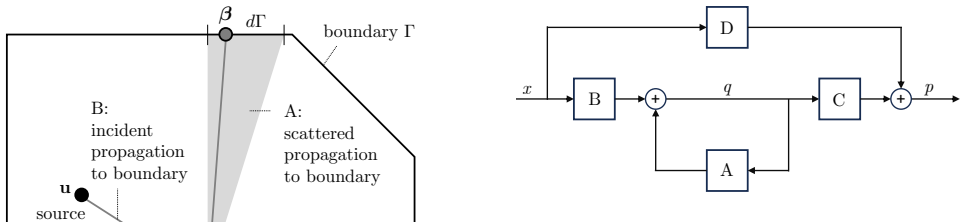
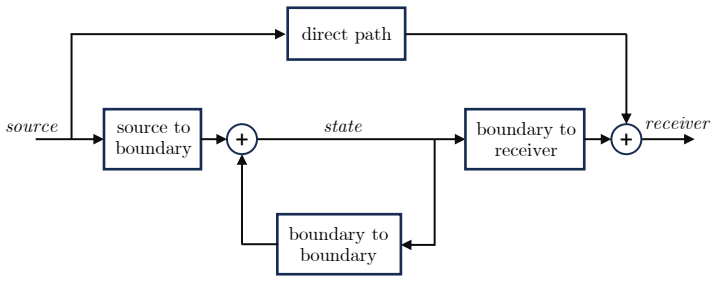
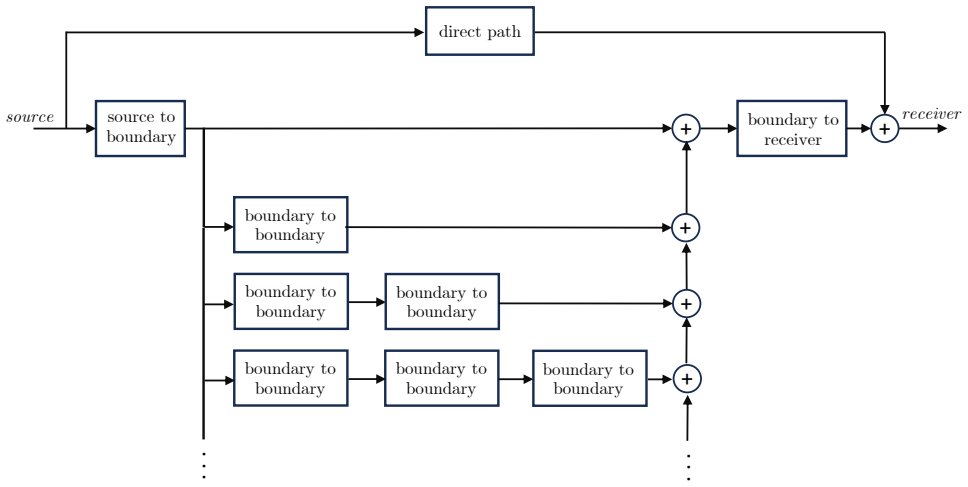
We introduce the boundary integral operator state-space (BIOSS) model whose state function is the pressure distribution at the room boundary and whose 4-tuple consists of integral operators that encode the physical interactions of the sound field. Standard algebraic manipulations on this operator tuple produce two transfer-function representations, one with feedback and one with parallel feedforward structure. The same BIOSS object therefore yields multiple equivalent descriptions of room acoustics in the time or frequency domain and in continuous or discrete space.
What carries the argument
The BIOSS model: a state function for boundary pressure together with a 4-tuple of integral operators that replace the usual system matrices.
If this is right
- Transfer functions with either feedback or parallel feedforward structure can be obtained directly from the BIOSS operators.
- Equivalent room-acoustic representations exist in the time domain, frequency domain, continuous space, and discrete space.
- Explicit equivalences can be written between the BIOSS model and boundary-element, delay-network, and geometric-acoustics models.
- State-space notions such as observability, controllability, and minimal realization become applicable to room-acoustic inference and control.
Where Pith is reading between the lines
- Control-theoretic reduction methods could produce lower-order room models suitable for real-time auralization.
- Observability analysis might identify the smallest microphone array that fully determines the boundary pressure state.
- Hybrid models that mix wave-based and geometric methods could be derived rigorously by equating the corresponding operator expressions.
- Active acoustic control systems might be designed by treating the room as a controllable state-space plant whose input is loudspeaker signals.
Load-bearing premise
The boundary integral equation for the sound field inside a room can be written exactly as a state function on the boundary pressure paired with four integral operators while preserving the underlying wave physics.
What would settle it
A direct numerical check on a rectangular room in which the frequency response computed from the BIOSS-derived transfer function deviates measurably from the response obtained by a standard boundary-element discretization or by physical measurement.
Figures


read the original abstract
We introduce a new framework for room acoustics modelling based on a state-space model of the boundary integral equation representing the sound field in a room. Whereas state-space models of linear time-invariant systems are traditionally constructed by means of a state vector and a 4-tuple of system matrices, the state-space representation introduced in this work consists of a state function representing the pressure distribution at the room boundary, and a 4-tuple of integral operators. We refer to this representation as a boundary integral operator state-space (BIOSS) model and provide a physical interpretation for each of the integral operators. As many mathematical operations on vectors and matrices translate to functions and operators, the BIOSS representation can be manipulated to obtain two transfer function representations, having either a feedback or a parallel feedforward structure. Consequently, various equivalent representations for room acoustics are obtained in the BIOSS framework, in the time or frequency domain, and in continuous or discrete space. We discuss two future directions for how the proposed framework can be fertile for research on room acoustics modelling. Firstly, we identify equivalences between the BIOSS framework and various existing room acoustics models (boundary element models, delay networks, geometric models), which may be used to establish relations between existing models and to develop novel room acoustics models. Secondly, we postulate on how concepts from state-space theory, such as observability, controllability, and state realization, can be used for developing new inference and control methods for room acoustics.
Editorial analysis
A structured set of objections, weighed in public.
Referee Report
Summary. The manuscript introduces a boundary integral operator state-space (BIOSS) model for room acoustics based on the boundary integral equation. The state is defined as the pressure distribution function on the room boundary, represented via a 4-tuple of integral operators rather than matrices. Physical interpretations are assigned to each operator. Algebraic manipulations of the BIOSS form are used to derive equivalent transfer-function representations with either feedback or parallel feedforward structures, valid in both time and frequency domains as well as continuous and discrete settings. The work positions the framework for establishing equivalences with existing models (BEM, delay networks, geometric acoustics) and for applying state-space concepts such as observability and controllability to acoustics inference and control.
Significance. If the operator definitions and algebraic equivalences are rigorously derived, the BIOSS framework could provide a unifying theoretical language for room acoustics models, enabling systematic transfer of techniques across paradigms and the application of control-theoretic tools. As a purely conceptual contribution without new numerical results or closed-form solutions, its value lies in opening directions for hybrid modeling and analysis rather than immediate practical deployment.
major comments (2)
- [Introduction and Section on BIOSS definition] The central claim that standard matrix operations on the 4-tuple translate directly to operator manipulations while preserving physical accuracy (abstract and introduction) is load-bearing but presented at a high level; an explicit step-by-step derivation of at least one transfer-function equivalence (e.g., from BIOSS to feedback form) with verification against a known acoustic property is needed to substantiate the framework.
- [Section defining the 4-tuple of operators] The physical interpretations assigned to the four integral operators must be shown to be consistent with the underlying boundary integral equation; without this, the state-space analogy risks being formal rather than physically grounded.
minor comments (2)
- Notation for the integral operators could be clarified with explicit functional notation (e.g., distinguishing the action on the state function) to avoid confusion with matrix notation.
- [Future directions] The future-directions section on model equivalences would benefit from a table or diagram summarizing how BIOSS components map to at least one existing model (e.g., delay networks).
Simulated Author's Rebuttal
We thank the referee for the constructive review and the recommendation of minor revision. The comments identify key areas where additional explicit detail will strengthen the manuscript. We address each major comment below and have made corresponding revisions to the paper.
read point-by-point responses
-
Referee: [Introduction and Section on BIOSS definition] The central claim that standard matrix operations on the 4-tuple translate directly to operator manipulations while preserving physical accuracy (abstract and introduction) is load-bearing but presented at a high level; an explicit step-by-step derivation of at least one transfer-function equivalence (e.g., from BIOSS to feedback form) with verification against a known acoustic property is needed to substantiate the framework.
Authors: We agree that an explicit derivation strengthens the central claim. In the revised manuscript we have added a dedicated subsection that walks through the algebraic steps converting the BIOSS 4-tuple (state, input, output, and feedthrough operators) into the feedback transfer-function form. The derivation begins from the operator state equation, applies the resolvent identity for the feedback loop, and arrives at the closed-form transfer operator. Physical accuracy is verified by substituting a known Green's function solution for a point source in a rectangular enclosure and confirming that the resulting boundary pressure satisfies the original boundary integral equation to machine precision in the discrete case. revision: yes
-
Referee: [Section defining the 4-tuple of operators] The physical interpretations assigned to the four integral operators must be shown to be consistent with the underlying boundary integral equation; without this, the state-space analogy risks being formal rather than physically grounded.
Authors: We concur that explicit consistency with the boundary integral equation is necessary. The revised manuscript now contains a direct term-by-term correspondence: each of the four operators is obtained by applying Green's second identity to the Helmholtz equation and isolating the boundary contributions. For example, the state-transition operator is shown to be the double-layer potential restricted to the boundary, the input operator corresponds to the single-layer potential from an interior source, and the output and feedthrough operators recover the direct and normal-derivative terms, respectively. This mapping is presented immediately after the operator definitions, grounding the physical interpretations in the underlying acoustics. revision: yes
Circularity Check
No significant circularity: definitional re-framing of established BIE with independent algebraic equivalences
full rationale
The paper starts from the standard boundary integral equation (BIE) for room acoustics and defines the BIOSS model by introducing a state function (boundary pressure) together with a 4-tuple of integral operators that inherit their physical meaning directly from the BIE kernels. All subsequent steps consist of applying standard operator algebra to derive equivalent transfer-function forms (feedback or parallel) in time/frequency and continuous/discrete domains; these are mathematical identities that hold by construction once the operators are defined, not fitted predictions or self-referential closures. No load-bearing self-citations, uniqueness theorems, or ansatzes imported from prior author work appear in the provided text. The framework is explicitly positioned as a conceptual bridge for future equivalences rather than a numerical or predictive claim, rendering the derivation self-contained against external benchmarks.
Axiom & Free-Parameter Ledger
axioms (2)
- domain assumption The sound field in a room is represented by the boundary integral equation.
- standard math Mathematical operations on vectors and matrices translate to functions and integral operators.
invented entities (1)
-
BIOSS model
no independent evidence
Reference graph
Works this paper leans on
-
[1]
Vorländer
M. Vorländer. Computer simulations in room acous- tics: Concepts and uncertainties.J. Acoust. Soc. Amer., 133(3):1203–1213, March 2013
2013
-
[2]
Antonello, E
N. Antonello, E. De Sena, M. Moonen, P. A. Naylor, and T. van Waterschoot. Joint acoustic localization and dere- verberation through plane wave decomposition and sparse regularization.IEEE/ACM Trans. Audio Speech Lang. Process., 27(12):1893–1905, 2019
1905
-
[3]
Dokmanić, R
I. Dokmanić, R. Parhizkar, A. Walther, Y. M. Lu, and M. Vetterli. Acoustic echoes reveal room shape.Proc. Natl. Acad. Sci., 110(30):12186–12191, 2013
2013
-
[4]
Long.Architectural acoustics
M. Long.Architectural acoustics. Elsevier, 2005
2005
-
[5]
Vorländer.Auralization
M. Vorländer.Auralization. Springer, 2020
2020
-
[6]
Raghuvanshi, C
N. Raghuvanshi, C. Lauterbach, A. Chandak, D. Manocha, and M. C. Lin. Real-time sound syn- thesis and propagation for games.Commun. ACM, 50(7):66–73, 2007
2007
-
[7]
Välimäki, J
V. Välimäki, J. D. Parker, L. Savioja, J. O. Smith, and J. S. Abel. Fifty years of artificial reverberation. IEEE Trans. Audio Speech Lang. Process., 20(5):1421– 1448, 2012
2012
-
[8]
H. Kim, L. Remaggi, P. J. B. Jackson, and A. Hilton. Immersive spatial audio reproduction for VR/AR using room acoustic modelling from 360 images. InProc. 2019 IEEE Conf. Virtual Reality 3D User Interfaces (VR ’19), pages 120–126, 2019
2019
-
[9]
Hamilton.Finite difference and finite volume methods for wave-based modelling of room acoustics
B. Hamilton.Finite difference and finite volume methods for wave-based modelling of room acoustics. PhD thesis, University of Edinburgh, Edinburgh, Scotland, UK, 2016
2016
-
[10]
Savioja and U
L. Savioja and U. P. Svensson. Overview of geometri- cal room acoustic modeling techniques.J. Acoust. Soc. Amer., 138(2):708–730, August 2015
2015
-
[11]
Springer Science & Business Media, 1997
J.W.PoldermanandJ.C.Willems.Introduction to math- ematical systems theory: a behavioral approach. Springer Science & Business Media, 1997
1997
-
[12]
Scerbo, S
M. Scerbo, S. J. Schlecht, R. Ali, L. Savioja, and E. De Sena. Modeling nonuniform energy decay through the modal decomposition of acoustic radiance transfer (MoD- ART).IEEE Trans. Audio Speech Lang. Process., 2025
2025
-
[13]
Jacobsen and P
F. Jacobsen and P. M. Juhl.Fundamentals of General Linear Acoustics. Wiley, 2013
2013
-
[14]
A. D. Pierce.Acoustics: An introduction to its physical principles and applications. McGraw-Hill, 1981
1981
-
[15]
D. R. Bergman.Computational acoustics: theory and im- plementation. John Wiley & Sons, 2018
2018
-
[16]
Kuttruff.Room Acoustics
H. Kuttruff.Room Acoustics. Taylor & Francis, 5th edi- tion, 2009
2009
-
[17]
Imagemethodforefficiently simulating small-room acoustics.J
J.B.AllenandD.A.Berkley. Imagemethodforefficiently simulating small-room acoustics.J. Acoust. Soc. Amer., 65(4):943–950, 1979
1979
-
[18]
Krokstad, S
A. Krokstad, S. Strom, and S. Sørsdal. Calculating the acoustical room response by the use of a ray tracing tech- nique.J. Sound Vib., 8(1):118–125, 1968
1968
-
[19]
Funkhouser, N
T. Funkhouser, N. Tsingos, I. Carlbom, G. Elko, M. Sondhi, J. E. West, G. Pingali, P. Min, and A. Ngan. A beam tracing method for interactive architectural acous- tics.J. Acoust. Soc. Amer., 115(2):739–756, 2004
2004
-
[20]
Siltanen, T
S. Siltanen, T. Lokki, S. Kiminki, and L. Savioja. The room acoustic rendering equation.J. Acoust. Soc. Amer., 12 122(3):1624–1635, 2007
2007
-
[21]
Aretz, R
M. Aretz, R. Nöthen, M. Vorländer, and D. Schröder. Combined broadband impulse responses using FEM and hybrid ray-based methods. InProc. 2009 EAA Symp. Auralization, pages 1–6, 2009
2009
-
[22]
Wittebol, H
W. Wittebol, H. Wang, M. Hornikx, and P. Calamia. A hybrid room acoustic modeling approach combining im- age source, acoustic diffusion equation, and time-domain discontinuous galerkin methods.Acta Acust., 223, 2024
2024
-
[23]
R. Ali, T. Dietzen, M. Scerbo, L. Vinceslas, T. van Waterschoot, and E. De Sena. Relating wave-based and geometric acoustics using a stationary phase approxima- tion. InProc. 10th Conv. Eur. Acoust. Assoc. (Forum Acusticum ’23), 2023
2023
-
[24]
C.-H. Jeong. Design, simulation, and virtual prototyping of room acoustics: Challenges and opportunities. InProc. 24th Int. Congr. Acoust. (ICA ’22), 2022
2022
-
[25]
Merimaa and V
J. Merimaa and V. Pulkki. Spatial impulse response ren- dering I: Analysis and synthesis.J. Audio Eng. Soc., 53(12):1115–1127, 2005
2005
-
[26]
A. Farina. Advancements in impulse response mea- surements by sine sweeps. InPreprints AES 122nd Convention, 2007. AES Preprint 7121
2007
-
[27]
A. V. Oppenheim and R. W. Schafer.Discrete-Time Signal Processing. Prentice Hall, 3rd edition, 2009
2009
-
[28]
Haneda, S
Y. Haneda, S. Makino, and Y. Kaneda. Common acous- tical pole and zero modeling of room transfer functions. IEEE Trans. Speech Audio Process., 2(2):320–328, 1994
1994
-
[29]
Vairetti, E
G. Vairetti, E. De Sena, M. Catrysse, S. H. Jensen, M. Moonen, and T. van Waterschoot. A scalable algo- rithm for physically motivated and sparse approximation of room impulse responses with orthonormal basis func- tions.IEEE/ACM Trans. Audio Speech Lang. Process., 25(7):1547–1561, 2017
2017
-
[30]
J. Rämö, V. Välimäki, and B. Bank. High-precision par- allel graphic equalizer.IEEE/ACM Trans. Audio Speech Lang. Process., 22(12):1894–1904, 2014
1904
-
[31]
van Waterschoot, G
T. van Waterschoot, G. Rombouts, and M. Moonen. Optimally regularized adaptive filtering algorithms for room acoustic signal enhancement.Signal Processing, 88(3):594–611, 2008
2008
-
[32]
Tervo, J
S. Tervo, J. Pätynen, A. Kuusinen, and T. Lokki. Spatial decomposition method for room impulse responses.J. Audio Eng. Soc., 61(1/2):17–28, 2013
2013
-
[33]
A. J. Berkhout, D. de Vries, and J. J. Sonke. Array tech- nology for acoustic wave field analysis in enclosures.J. Acoust. Soc. Amer., 102(5):2757–2770, 1997
1997
-
[34]
Pinto and M
F. Pinto and M. Vetterli. Space-time-frequency process- ing of acoustic wave fields: Theory, algorithms, and appli- cations.IEEE Trans. Signal Process., 58(9):4608–4620, 2010
2010
-
[35]
D. P. Jarrett, E. A. P. Habets, and P. A. Naylor.Theory and applications of spherical microphone array processing. Springer, 2017
2017
-
[36]
Jot and A
J.-M. Jot and A. Chaigne. Digital delay networks for designing artificial reverberators.Preprints AES 90th Convention, February 1991. AES Preprint 3030
1991
-
[37]
De Sena, H
E. De Sena, H. Hacıhabiboğlu, Z. Cvetković, and J. O. Smith. Efficient synthesis of room acoustics via scattering delay networks.IEEE/ACM Trans. Audio Speech Lang. Process., 23(9):1478–1492, 2015
2015
-
[38]
Scerbo, S
M. Scerbo, S. Schlecht, R. Ali, L. Savioja, and E. De Sena. A common-slopes late reverberation model based on acoustic radiance transfer. InProc. 27th Int. Conf. Digital Audio Effects (DAFx ’24), pages 270–277, 2024
2024
-
[39]
A. I. Mezza, R. Giampiccolo, E. De Sena, and A. Bernardini. Data-driven room acoustic modeling via differentiable feedback delay networks with learnable de- lay lines.EURASIP J. Audio, Speech, Music Process., 2024, Article No. 51, 20 pages, 2024
2024
-
[40]
Dal Santo, K
G. Dal Santo, K. Prawda, S. J. Schlecht, and V. Välimäki. Optimizing tiny colorless feedback delay networks. EURASIP J. Audio, Speech, Music Process., 2024, Article No. 13, 15 pages, 2024
2024
-
[41]
MacWilliam, T
K. MacWilliam, T. Dietzen, R. Ali, and T. van Waterschoot. State-space estimation of spatially dynamic room impulse responses using a room acoustic model- based prior.Front. Signal Process., 4, 2024
2024
-
[42]
G. Enzner. Bayesian inference model for applications of time-varying acoustic system identification. InProc. 18th European Signal Process. Conf. (EUSIPCO ’10), pages 2126–2130, 2010
2010
-
[43]
T. W. Wu.Boundary Element Acoustics: Fundamentals and Computer Codes. Advances in boundary elements series. WIT, 2000
2000
-
[44]
J. A. Hargreaves.Time domain boundary element method for room acoustics. PhD thesis, University of Salford, Salford, UK, 2007
2007
-
[45]
B. P. Rynne. Stability and convergence of time marching methods in scattering problems.IMA J. Appl. Math., 35(3):297–310, November 1985
1985
-
[46]
P. D. Smith. Instabilities in time marching methods for scattering: Cause and rectification.Electromagnetics, 10(4):439–451, 1990
1990
-
[47]
Sadigh and E
A. Sadigh and E. Arvas. Treating the instabilities in marching-on-in-time method from a different perspec- tive (electromagnetic scattering).IEEE Trans. Antennas Propag., 41(12):1695–1702, 1993
1993
-
[48]
A. A. Ergin, B. Shanker, and E. Michielssen. The plane- wave time-domain algorithm for the fast analysis of tran- sient wave phenomena.IEEE Antennas Propagat. Mag., 41(4):39–52, 2002
2002
-
[49]
C. Lubich. On the multistep time discretization of linear initial-boundary value problems and their boundary inte- gral equations.Numerische Mathematik, 67(3):365–389, 1994
1994
-
[50]
Banjai and M
L. Banjai and M. Kachanovska. Fast convolution quadra- ture for the wave equation in three dimensions.J. Comput. Phys., 279:103–126, 2014
2014
-
[51]
S. A. Sauter and M. Schanz. Convolution quadrature for the wave equation with impedance boundary conditions. J. Comput. Phys., 334:442–459, 2017
2017
-
[52]
R. F. Hoskins.Delta Functions. Woodhead Publishing, 2nd edition, 2011
2011
-
[53]
CRC Press, 2016
T.CoxandP.d’Antonio.Acoustic absorbers and diffusers: theory, design and application. CRC Press, 2016
2016
-
[54]
Deleforge
A. Deleforge. Can one hear the walls of a room? Physics- and data-driven inverse methods for acoustic sig- nal processing. HDR Thesis, University of Strasbourg, Strasbourg, France, 2025
2025
-
[55]
A. V. Oppenheim, A. S. Willsky, and S. H. Nawab.Signals & systems. Prentice-Hall, USA, 2nd edition, 1996
1996
-
[56]
The boundary element method in acous- tics: A survey.Applied Sciences, 9(8):1642, 2019
Stephen Kirkup. The boundary element method in acous- tics: A survey.Applied Sciences, 9(8):1642, 2019
2019
-
[57]
Sasane.A friendly approach to functional analysis
A. Sasane.A friendly approach to functional analysis. World Scientific, 2017
2017
-
[58]
Sakuma, S
T. Sakuma, S. Schneider, and Y. Yasuda. Fast solu- tion methods. In S. Marburg and B. Nolte, editors, Computational Acoustics of Noise Propagation in Fluids - Finite and Boundary Element Methods. Springer, 2008. 13
2008
-
[59]
Panagiotopoulos, E
D. Panagiotopoulos, E. Deckers, and W. Desmet. A two- stepreductionmethodforacousticBEMsystems. InProc. 9th Conv. Eur. Acoust. Assoc. (Forum Acusticum ’20), pages 2291–2298, 2020
2020
-
[60]
Springer, 1970
N.P.BhatiaandG.P.Szegö.Stability theory of dynamical systems. Springer, 1970
1970
-
[61]
Krokstad, S
A. Krokstad, S. Strøm, and S. Sørsdal. Calculating the acoustical room response by the use of a ray tracing tech- nique.J. Sound Vib., 8(1):118–125, 1968
1968
-
[62]
Antonello et al
N. Antonello et al. Room impulse response interpolation usingasparsespatio-temporalrepresentationofthesound field.IEEE/ACM Trans. Audio Speech Lang. Process., 25(10):1929–1941, 2017
1929
-
[63]
Niebler, P
K. Niebler, P. Bonnaire, N. A. K. Doan, and C. F. Silva. Towards reconstruction of acoustic fields via physics- informed neural networks. InProc. 51st Int. Congress & Exposition Noise Control Eng. (INTER-NOISE ’22), volume 265, Glasgow, Scotland, UK, 2022
2022
-
[64]
Karakonstantis, D
X. Karakonstantis, D. Caviedes-Nozal, A. Richard, and E.Fernandez-Grande. Roomimpulseresponsereconstruc- tion with physics-informed deep learning.J. Acoust. Soc. Amer., 155(2):1048–1059, 2024
2024
-
[65]
Pezzoli, F
M. Pezzoli, F. Antonacci, and A. Sarti. Implicit neural representation with physics-informed neural networks for the reconstruction of the early part of room impulse re- sponses. InProc. 10th Conv. Eur. Acoust. Assoc. (Forum Acusticum ’23), Turin, Italy, 2023
2023
-
[66]
Tsunokini, G
I. Tsunokini, G. Sato, Y. Ikeda, and Y. Oikawa. Spatial extrapolation of early room impulse responses with noise- robust physics-informed neural network.IEICE Trans. Fundam. Electron. Commun. Comput. Sci., Article No. 2024EAL2015, 2024
2024
-
[67]
Olivieri, X
M. Olivieri, X. Karakonstantis, M. Pezzoli, F. Antonacci, A. Sarti, and E. Fernandez-Grande. Physics-informed neural network for volumetric sound field reconstruction of speech signals.EURASIP J. Audio, Speech, Music Process., 2024, 2024. Article No. 42
2024
-
[68]
F. Ma, S. Zhao, and I. S. Burnett. Sound field reconstruc- tion using a compact acoustics-informed neural network. J. Acoust. Soc. Amer., 156(3):2009–2021, 2024
2009
-
[69]
Sundström, S
D. Sundström, S. Koyama, and A. Jakobsson. Sound field estimation using deep kernel learning regularized by the wave equation. InProc. 2024 Int. Workshop Acoustic Signal Enhancement (IWAENC ’24), pages 319– 323, Aalborg, Denmark, 2024
2024
-
[70]
Karakonstantis and E
X. Karakonstantis and E. Fernandez-Grande. Generative adversarial networks with physical sound field priors.J. Acoust. Soc. Amer., 154(2):1226–1238, 2023
2023
-
[71]
Fernandez-Grande, X
E. Fernandez-Grande, X. Karakonstantis, D. Caviedes- Nozal, and P. Gerstoft. Generative models for sound field reconstruction.J. Acoust. Soc. Amer., 153(2):1179–1190, 2023
2023
-
[72]
Damiano and T
S. Damiano and T. van Waterschoot. Sound field recon- struction using physics-informed boundary integral net- works. InProc. 31st European Signal Process. Conf. (EUSIPCO ’25), pages 76–80, Palermo, Italy, 2025
2025
-
[73]
De Schutter
B. De Schutter. Minimal state-space realization in lin- ear system theory: an overview.J. Comput. Appl. Math., 121(1–2):331–354, 2000
2000
-
[74]
B. L. Ho and R. E. Kalman. Effective construction of linear, state-variable models from input-output functions. Regelungstechnik, 14(12):545–548, 1966
1966
-
[75]
Moonen and J
M. Moonen and J. Ramos. A subspace algorithm for balanced state space system identification.IEEE Trans. Autom. Control, 38(11):1727–1729, 1993
1993
-
[76]
Van Overschee and B
P. Van Overschee and B. De Moor.Subspace identi- fication for linear systems: Theory – Implementation – Applications. Kluwer Academic Publishers, 1996
1996
-
[77]
Kujawski, A
A. Kujawski, A. J. R. Pelling, and E. Sarradj. MIRACLE—amicrophonearrayimpulseresponsedataset for acoustic learning.EURASIP J. Audio, Speech, Music Process., 2024, 2024. Article No. 32
2024
-
[78]
Shen and R
J. Shen and R. Duraiswami. Data-driven feedback delay network construction for real-time virtual room acoustics. InProc. 15th Int. Audio Mostly Conf. (AM ’20), pages 46–52, Graz, Austria, 2020
2020
-
[79]
S. V. Lyster and C. Erkut. A differentiable neural network approach to parameter estimation of reverberation. In Proc. 19th Sound Music Comput. Conf. (SMC ’22), pages 358–364, Saint-Étienne, France, 2022
2022
-
[80]
R. Bona, D. Fantini, G. Presti, M. Tiraboschi, I. Engel, and F. Avanzini. Automatic parameters tuning of late reverberation algorithms for audio augmented reality. In Proc. 17th Int. Audio Mostly Conf. (AM ’22), pages 36– 43, St. Pölten, Austria, 2022
2022
discussion (0)
Sign in with ORCID, Apple, or X to comment. Anyone can read and Pith papers without signing in.