Recognition: unknown
Light-Adapted Electroretinogram and Oscillatory Potentials (LEOPs) Dataset for Autism Spectrum Disorder and Typically Developing Individuals
Pith reviewed 2026-05-10 06:49 UTC · model grok-4.3
The pith
The LEOPs dataset supplies 5309 light-adapted ERG waveforms and 4434 oscillatory potential recordings from autism spectrum disorder and control children.
A machine-rendered reading of the paper's core claim, the machinery that carries it, and where it could break.
Core claim
The LEOPs dataset contains 5309 single-flash ERG waveforms and 4434 OPs waveforms collected from control, ASD, and ASD+ADHD participants using a 9-step randomized flash series from -0.37 to 1.20 Td.s, plus 2-step and LA3 standard flashes, together with electrode position images, time-domain values, summed OPs values, and participant-level JSON files.
What carries the argument
The LEOPs dataset, which bundles the full set of waveforms, electrode images, demographics, and stimulus protocol files from the RETeval device for reuse in classification and comparison tasks.
Load-bearing premise
Participant diagnostic labels as control, ASD, or ASD+ADHD are accurate and skin-electrode recordings introduce no systematic site-specific or artifactual biases.
What would settle it
Re-recording a subset of the same participants and finding that a substantial fraction of waveforms differ markedly from those in the dataset or that diagnostic labels cannot be independently confirmed.
Figures


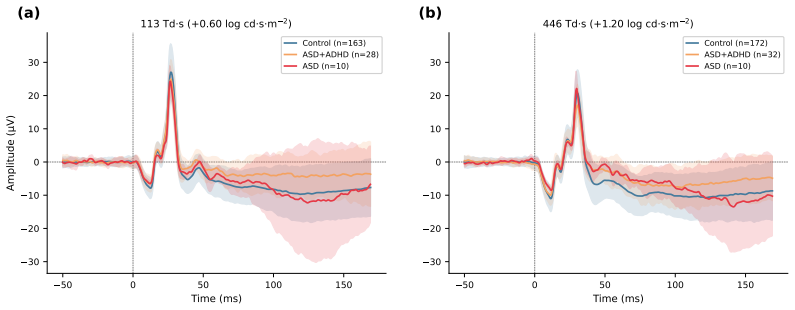
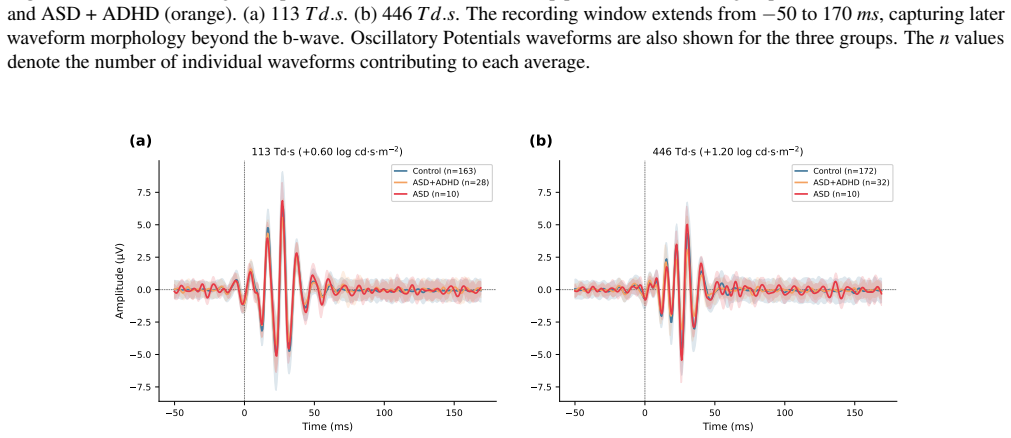
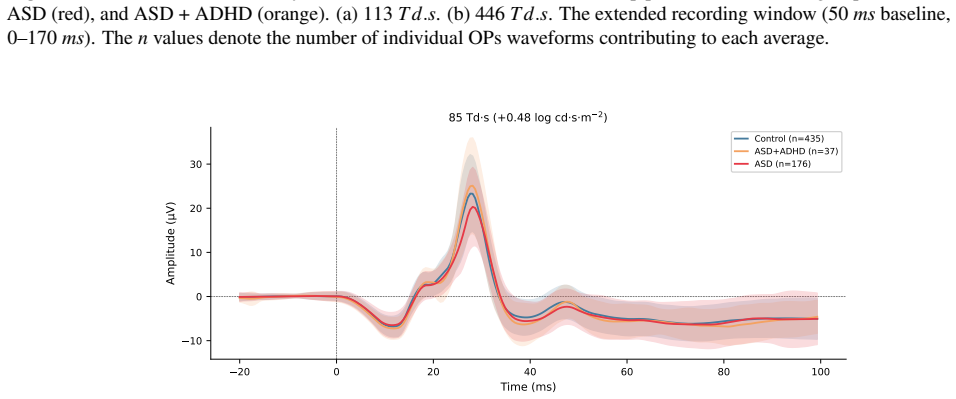

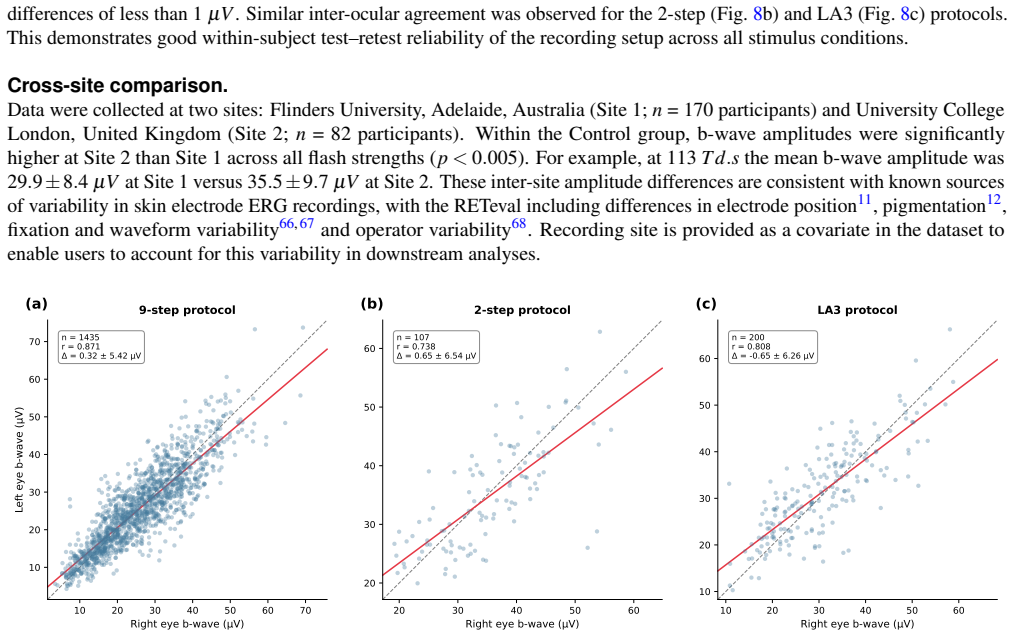
read the original abstract
The LEOPs (Light-ERG-Oscillatory Potentials) dataset provides light-adapted (LA) electroretinogram (ERG) and Oscillatory Potentials (OPs) waveforms for typically developing Control, Autism Spectrum Disorder (ASD) and ASD + Attention Deficit Hyperactivity Disorder (ADHD) childhood and adolescent populations. The ERGs were recorded in the Right And Left eyes with skin electrodes using the handheld RETeval device at two sites in Australia and the United Kingdom. The LEOPs dataset includes 5309 single flash ERG and 4434 OPs waveforms as well as images selected from each participant showing the position of the skin electrode. The LEOPs dataset is constructed from recordings using a 9 step randomized flash series from $-0.37$ to $1.20$~$Td.s$, a 2 step at 113 and 446 $Td.s$ flash strengths (2500 Control, 1730 ASD and 451 ASD + ADHD samples), as well as the $85$~$Td.s$ (Light Adapted 3 $cd.s.m^{-2}$ (LA3)) equivalent International Society of Clinical Electrophysiology of Vision (ISCEV) Standard flash with 435 Control, 176 ASD and 37 ASD + ADHD waveform samples. Code for the stimulus is provided along with participant demographics, date and time of testing, and where available diagnostic scores for the ASD and ASD + ADHD groups, alongside iris color, electrode position with image files and time domain values for the ERG and summed values for the OPs. The repository contains excel file, exported JSON files on the patient level that are more suitable for machine learning tasks, images of electrode position for each recording and the protocol files for use with the RETeval.
Editorial analysis
A structured set of objections, weighed in public.
Referee Report
Summary. The manuscript describes the LEOPs dataset of light-adapted ERG and oscillatory potentials (OPs) waveforms recorded from control, ASD, and ASD+ADHD children and adolescents using skin electrodes on the RETeval device at two sites. It reports 5309 single-flash ERG waveforms and 4434 OPs waveforms generated from a 9-step randomized flash series (-0.37 to 1.20 Td.s) plus additional standard flashes at 85, 113, and 446 Td.s, together with electrode-position images, participant demographics, diagnostic scores, iris color, time-domain ERG values, summed OPs values, Excel/JSON files, and RETeval protocol files with stimulus code.
Significance. If the data are as described, the release supplies a sizable, openly accessible collection of LA-ERG and OPs recordings from neurodevelopmental cohorts that can support biomarker discovery, group-difference analyses, and machine-learning applications. Strengths include the randomized multi-step flash protocol, provision of participant-level JSON files optimized for ML reuse, electrode-position images, protocol files, and stimulus code, all of which enhance reproducibility and downstream utility.
minor comments (3)
- [Methods] Methods section: the protocol description does not specify the artifact-rejection criteria or automated/manual selection rules applied to retain the 5309 ERG and 4434 OPs waveforms; adding this information would allow users to assess potential selection bias.
- [Dataset description] Results/Dataset description: no table or text breakdown is given of the number of participants or waveforms per diagnostic group and per recording site (Australia vs. UK), which would help evaluate possible site-specific calibration or population effects.
- [Dataset description] The manuscript states that diagnostic scores are included 'where available' but does not report the proportion of ASD/ASD+ADHD cases with scores or the instruments used; clarifying this would strengthen the dataset documentation.
Simulated Author's Rebuttal
We thank the referee for their positive summary and assessment of the significance of the LEOPs dataset. The recommendation for minor revision is noted, but no specific major comments were provided in the report.
Circularity Check
No significant circularity
full rationale
The manuscript is a pure dataset release paper. It describes the LEOPs collection of 5309 single-flash ERG and 4434 OPs waveforms recorded under a stated 9-step randomized flash protocol plus standard flashes, supplies participant demographics, electrode images, JSON/Excel exports, and stimulus code, and states the diagnostic groupings. No equations, predictions, first-principles derivations, or load-bearing claims appear anywhere in the text; the central assertions are factual descriptions of data provenance and file contents. Consequently no step reduces to its own inputs by construction, self-citation, or fitted-parameter renaming.
Axiom & Free-Parameter Ledger
Reference graph
Works this paper leans on
-
[1]
Constable, P.et al.Light-adapted electroretinogram and oscillatory potentials (leops) dataset for autism spectrum disorder and typically developing individuals, 10.17632/w3yx7hdds7.1, (2026). [Data set]
-
[2]
G., Saszik, S
Robson, J. G., Saszik, S. M., Ahmed, J. & Frishman, L. J. Rod and cone contributions to the a-wave of the electroretinogram of the macaque.The J. physiology547, 509–530, (2003)
2003
-
[3]
Oscillatory potentials in the retina: what do they reveal.Prog
Wachtmeister, L. Oscillatory potentials in the retina: what do they reveal.Prog. retinal eye research17, 485–521, (1998)
1998
-
[4]
J., Robson, J
Viswanathan, S., Frishman, L. J., Robson, J. G. & Walters, J. W. The photopic negative response of the flash electroretino- gram in primary open angle glaucoma.Investig. ophthalmology & visual science42, 514–522, (2001)
2001
-
[5]
& Lamb, T
Friedburg, C., Allen, C., Mason, P. & Lamb, T. D. Contribution of cone photoreceptors and post-receptoral mechanisms to the human photopic electroretinogram.The J. physiology556, 819–834, (2004)
2004
-
[6]
G.et al.Iscev standard for full-field clinical electroretinography (2022 update).Documenta Ophthalmol.144, 165–177, (2022)
Robson, A. G.et al.Iscev standard for full-field clinical electroretinography (2022 update).Documenta Ophthalmol.144, 165–177, (2022). 9/12
2022
-
[7]
Clinical electrophysiology of vision—commentary on current status and future prospects.Eye35, 2341–2343, (2021)
Hamilton, R. Clinical electrophysiology of vision—commentary on current status and future prospects.Eye35, 2341–2343, (2021)
2021
-
[8]
& Leguire, L
Wali, N. & Leguire, L. E. The photopic hill: a new phenomenon of the light adapted electroretinogram.Documenta Ophthalmol.80, 335–342, (1992)
1992
-
[9]
Gauvin, M.et al.Assessing the contribution of the oscillatory potentials to the genesis of the photopic erg with the discrete wavelet transform.BioMed research international2016, 2790194, (2016)
2016
-
[10]
A., Shannon, J., Soares, N
Patel, R., Jerskey, B. A., Shannon, J., Soares, N. & Fogler, J. M. Ai-enabled technologies and biomarker analysis for the early identification of autism and related neurodevelopmental disorders.Children12, 1670, (2025)
2025
-
[11]
Hobby, A. E.et al.Effect of varying skin surface electrode position on electroretinogram responses recorded using a handheld stimulating and recording system.Documenta Ophthalmol.137, 79–86, (2018)
2018
-
[12]
& McCulloch, D
Al Abdlseaed, A., McTaggart, Y ., Ramage, T., Hamilton, R. & McCulloch, D. L. Light-and dark-adapted electroretinograms (ergs) and ocular pigmentation: comparison of brown-and blue-eyed cohorts.Documenta ophthalmologica121, 135–146, (2010)
2010
-
[13]
& Ishikawa, S
Nozaki, S., Wakakura, M. & Ishikawa, S. Circadian rhythm of human electroretinogram.Jpn. journal ophthalmology27, 346–352, (1983)
1983
-
[14]
& Ruddock, K
Hankins, M., Jones, R. & Ruddock, K. Diurnal variation in the b-wave implicit time of the human electroretinogram.Vis. neuroscience15, 55–67, (1998)
1998
-
[15]
Neuro- Psychopharmacology Biol
Dubois, M.-A.et al.Validating skin electrodes: paving the way for non-invasive erg use in psychiatry.Prog. Neuro- Psychopharmacology Biol. Psychiatry137, 111305, (2025)
2025
-
[16]
Manjur, S. M.et al.Detecting autism spectrum disorder and attention deficit hyperactivity disorder using multimodal time-frequency analysis with machine learning using the electroretinogram from two flash strengths.J. Autism Dev. Disord. 55, 1365–1378, (2025)
2025
-
[17]
M.et al.Detecting autism spectrum disorder using spectral analysis of electroretinogram and machine learning: Preliminary results
Manjur, S. M.et al.Detecting autism spectrum disorder using spectral analysis of electroretinogram and machine learning: Preliminary results. In2022 44th Annual International Conference of the IEEE Engineering in Medicine & Biology Society (EMBC), 3435–3438 (IEEE, 2022)
2022
-
[18]
F.et al.Autism spectrum disorder detection using variable frequency complex demodulation of the electroretinogram.Res
Posada-Quintero, H. F.et al.Autism spectrum disorder detection using variable frequency complex demodulation of the electroretinogram.Res. Autism Spectr. Disord.109, 102258, (2023)
2023
-
[19]
A.et al.Spectral analysis of light-adapted electroretinograms in neurodevelopmental disorders: Classification with machine learning.Bioengineering12, 15, (2024)
Constable, P. A.et al.Spectral analysis of light-adapted electroretinograms in neurodevelopmental disorders: Classification with machine learning.Bioengineering12, 15, (2024)
2024
-
[20]
Bioengineering12, 951, (2025)
Chistiakov, S.et al.Time series classification of autism spectrum disorder using the light-adapted electroretinogram. Bioengineering12, 951, (2025)
2025
-
[21]
Kulyabin, M.et al.Attention to the electroretinogram: Gated multilayer perceptron for asd classification.IEEE access12, 52352–52362, (2024)
2024
-
[22]
Bioengineering11, 866, (2024)
Albasu, F.et al.Electroretinogram analysis using a short-time fourier transform and machine learning techniques. Bioengineering11, 866, (2024)
2024
-
[23]
Documenta Ophthalmol.151, 161–177, (2025)
Kulyabin, M.et al.Synthetic electroretinogram signal generation using a conditional generative adversarial network. Documenta Ophthalmol.151, 161–177, (2025)
2025
-
[24]
Ophthalmol.2024, 1990419, (2024)
Kulyabin, M.et al.Generating synthetic light-adapted electroretinogram waveforms using artificial intelligence to improve classification of retinal conditions in under-represented populations.J. Ophthalmol.2024, 1990419, (2024)
2024
-
[25]
Documenta Ophthalmol.1–11, (2026)
Brabec, M.et al.contour plot visualization of the light adapted electroretinogram using a generalized additive model. Documenta Ophthalmol.1–11, (2026)
2026
-
[26]
A., Thompson, D
Brabec, M., Constable, P. A., Thompson, D. A. & Marmolejo-Ramos, F. Group comparisons of the individual electroretino- gram time trajectories for the ascending limb of the b-wave using a raw and registered time series.BMC Res. Notes16, 238, (2023)
2023
-
[27]
Notes 18, 33, (2025)
Brabec, M.et al.Remodeling the light-adapted electroretinogram using a bayesian statistical approach.BMC Res. Notes 18, 33, (2025)
2025
-
[28]
O.et al.Global motion coherent deficits in individuals with autism spectrum disorder and their family members are associated with retinal function.Sci
Lee, I. O.et al.Global motion coherent deficits in individuals with autism spectrum disorder and their family members are associated with retinal function.Sci. Reports15, 28249, (2025). 10/12
2025
-
[29]
O.et al.The electroretinogram b-wave amplitude: a differential physiological measure for attention deficit hyperactivity disorder and autism spectrum disorder.J
Lee, I. O.et al.The electroretinogram b-wave amplitude: a differential physiological measure for attention deficit hyperactivity disorder and autism spectrum disorder.J. neurodevelopmental disorders14, 30, (2022)
2022
-
[30]
A.et al.Discrete wavelet transform analysis of the electroretinogram in autism spectrum disorder and attention deficit hyperactivity disorder.Front
Constable, P. A.et al.Discrete wavelet transform analysis of the electroretinogram in autism spectrum disorder and attention deficit hyperactivity disorder.Front. Neurosci.16, 890461, (2022)
2022
-
[31]
M.et al.Spectral analysis of electroretinography to differentiate autism spectrum disorder and attention deficit hyperactivity disorder
Manjur, S. M.et al.Spectral analysis of electroretinography to differentiate autism spectrum disorder and attention deficit hyperactivity disorder. In2023 IEEE EMBS International Conference on Biomedical and Health Informatics (BHI), 1–4 (IEEE, 2023)
2023
-
[32]
Neuro- Psychopharmacology Biol
Dubois, M.-A.et al.Evaluation of electroretinography (erg) parameters as a biomarker for adhd.Prog. Neuro- Psychopharmacology Biol. Psychiatry127, 110807, (2023). 33.Huang, Q.et al.Retinal gabaergic alterations in adults with autism spectrum disorder.J. Neurosci.44, (2024)
2023
-
[33]
A., Skuse, D
Constable, P. A., Skuse, D. H., Thompson, D. A. & Lee, I. O. Brief report: effects of methylphenidate on the light adapted electroretinogram.Documenta Ophthalmol.150, 25–32, (2025)
2025
-
[34]
Ergun Yildiz, M.et al.Retinal electrophysiological responses to dopaminergic therapy in treatment naïve parkinson’s disease.Documenta Ophthalmol.1–13, (2026)
2026
-
[35]
A., Lee, I
Constable, P. A., Lee, I. O., Marmolejo-Ramos, F., Skuse, D. H. & Thompson, D. A. The photopic negative response in autism spectrum disorder.Clin. Exp. Optom.104, 841–847, (2021)
2021
-
[36]
B.et al.Electroretinography in adults with high-functioning autism spectrum disorder.Autism Res.15, 2026–2037, (2022)
Friedel, E. B.et al.Electroretinography in adults with high-functioning autism spectrum disorder.Autism Res.15, 2026–2037, (2022)
2026
-
[37]
A., Lim, J
Constable, P. A., Lim, J. K. & Thompson, D. A. Retinal electrophysiology in central nervous system disorders. a review of human and mouse studies.Front. Neurosci.17, 1215097, (2023)
2023
-
[38]
& Levesque, M
Soto Linan, V ., Hebert, M. & Levesque, M. Enhancing the diagnostic potential of electroretinography in parkinson’s disease: A review of protocol and cohort criteria.J. Park. Dis.15, 694–709, (2025)
2025
-
[39]
psychiatry87, 263–270, (2020)
Hebert, M.et al.The electroretinogram may differentiate schizophrenia from bipolar disorder.Biol. psychiatry87, 263–270, (2020)
2020
-
[40]
& Lachapelle, P
Gauthier, M., Polosa, A., Lina, J.-M. & Lachapelle, P. Hilbert transform analysis of the mouse scotopic electroretinogram reveals two distinct bursts of oscillatory potentials with progressively dimmer flashes.Documenta Ophthalmol.150, 1–15, (2025)
2025
-
[41]
Hamilton, R., Bees, M., Chaplin, C. A. & McCulloch, D. L. The luminance–response function of the human photopic electroretinogram: A mathematical model.Vis. research47, 2968–2972, (2007)
2007
-
[42]
L.et al.Iscev extended protocol for the stimulus–response series for light-adapted full-field erg.Documenta Ophthalmol.138, 205–215, (2019)
McCulloch, D. L.et al.Iscev extended protocol for the stimulus–response series for light-adapted full-field erg.Documenta Ophthalmol.138, 205–215, (2019)
2019
-
[43]
& Lamb, T
Mahroo, O. & Lamb, T. D. Recovery of the human photopic electroretinogram after bleaching exposures: estimation of pigment regeneration kinetics.The J. physiology554, 417–437, (2004)
2004
-
[44]
& Safari, S
Tzekov, R., Kremers, J. & Safari, S. The area under the waveform as an alternative measure of the photopic negative response.Documenta Ophthalmol.1–12, (2026)
2026
-
[45]
& Perossini, M
Prencipe, M., Perossini, T., Brancoli, G. & Perossini, M. The photopic negative response (phnr): measurement approaches and utility in glaucoma.Int. Ophthalmol.40, 3565–3576, (2020)
2020
-
[46]
M., Fradkin, S
Silverstein, S. M., Fradkin, S. I. & Demmin, D. L. Schizophrenia and the retina: towards a 2020 perspective.Schizophr. research219, 84–94, (2020)
2020
-
[47]
A., Gaigg, S
Constable, P. A., Gaigg, S. B., Bowler, D. M., Jägle, H. & Thompson, D. A. Full-field electroretinogram in autism spectrum disorder.Documenta Ophthalmol.132, 83–99, (2016)
2016
-
[48]
R.et al.Electroretinograms in autism: a pilot study of b-wave amplitudes.Am J Psychiatry145, 229–32, (1988)
Ritvo, E. R.et al.Electroretinograms in autism: a pilot study of b-wave amplitudes.Am J Psychiatry145, 229–32, (1988)
1988
-
[49]
Hosseinzadeh, N.et al.Optical coherence tomography measurements of retina and choroid in autism spectrum disorder: a systematic review and meta-analysis.Ophthalmic Res.68, 531–554, (2025)
2025
-
[50]
Kulyabin, M.et al.Enhancing electroretinogram classification with multi-wavelet analysis and visual transformer.Sensors 23, 8727, (2023)
2023
-
[51]
& Maier, A
Kulyabin, M., Zhdanov, A., Dolganov, A. & Maier, A. Optimal combination of mother wavelet and ai model for precise classification of pediatric electroretinogram signals.Sensors23, 5813, (2023). 11/12
2023
-
[52]
Peredo, R., Hébert, M. & Mérette, C. Developing a clinical decision tool based on electroretinogram to monitor the risk of severe mental illness.BMC psychiatry22, 718, (2022). 54.Constable, P. Erg dataset, 10.25451/flinders.14747349, (2021)
-
[53]
& Coco-Martín, R
Fernández, I., Cuadrado-Asensio, R., Larriba, Y ., Rueda, C. & Coco-Martín, R. M. A comprehensive dataset of pattern electroretinograms for ocular electrophysiology research.Sci. Data11, 1013, (2024)
2024
-
[54]
& Zhao, Y .-E
Wang, J., Wang, Y ., Guan, W. & Zhao, Y .-E. Full-field electroretinogram recorded with skin electrodes in 6-to 12-year-old children.Documenta Ophthalmol.147, 179–188, (2023)
2023
-
[55]
Chan, S. S.-h.et al.Reference ranges of light-adapted full-field electroretinogram and associated factors in a large cohort of healthy school-aged children and adolescents.Documenta Ophthalmol.151, 3–17, (2025)
2025
-
[56]
Baker, R. A.et al.Iscev standard full-field erg reference limits from 407 healthy subjects, derived from transference and validation of reference data between electrode types and centres.Documenta Ophthalmol.150, 47–64, (2025)
2025
-
[57]
Kulyabin, M.et al.Synthetic electroretinogram signals for enhancing classification of autism spectrum disorder, 10.21227/ npv7-8063, (2024)
2024
-
[58]
A.et al.Light-adapted electroretinogram differences in autism spectrum disorder.J
Constable, P. A.et al.Light-adapted electroretinogram differences in autism spectrum disorder.J. Autism Dev. Disord.50, 2874–2885, (2020)
2020
-
[59]
& Lord, C
Gotham, K., Pickles, A. & Lord, C. Standardizing ados scores for a measure of severity in autism spectrum disorders.J. autism developmental disorders39, 693–705, (2009)
2009
-
[60]
Schopler, E., Reichler, R. J. & Renner, B. R.The childhood autism rating scale (CARS)(Western Psychological Services Los Angeles, CA, 2010). 63.APA.Diagnostic and statistical manual of mental disorders V(American Psychiatric Association Publishing, 2022). 64.APA. Diagnostic and statistical manual of mental disorders 4th edition.Am Psychiatr. Assoc21, 591–...
2010
-
[61]
& Pinilla, I
Arias-Alvarez, M., Sopena-Pinilla, M., Rodriguez-Mena, D. & Pinilla, I. The mydriasis-free handheld erg device and its utility in clinical practice: A review.Biomedicines14, 384, (2026)
2026
-
[62]
You, J. Y .et al.Comparing the reteval portable erg device with more traditional tabletop erg systems in normal subjects and selected retinopathies.Documenta Ophthalmol.146, 137–150, (2023)
2023
-
[63]
& Ventura, L
Porciatti, V . & Ventura, L. M. Normative data for a user-friendly paradigm for pattern electroretinogram recording. Ophthalmology111, 161–168, (2004). Author contributions statement Data collection, P.C, I.L, L.L. and D.T. conceptualization, P.C and M.K. software, M.K, A.M. and A.Z. writing-original draft preparation, P.C., and M.K writing—review and edi...
2004
discussion (0)
Sign in with ORCID, Apple, or X to comment. Anyone can read and Pith papers without signing in.