Recognition: unknown
MobileAgeNet: Lightweight Facial Age Estimation for Mobile Deployment
Pith reviewed 2026-05-10 07:28 UTC · model grok-4.3
The pith
MobileAgeNet shows a compact network can estimate facial age accurately enough for mobile phones while keeping inference fast after format conversion.
A machine-rendered reading of the paper's core claim, the machinery that carries it, and where it could break.
Core claim
MobileAgeNet is a lightweight age-regression framework built on a pretrained mobile backbone network with a compact regression head. It reaches a mean absolute error of 4.65 years on a held-out test set of face images while delivering an average inference latency of 14.4 milliseconds under on-device conditions. Bounded age regression combined with two-stage fine-tuning supplies the training stability and generalization needed to reach this balance. The full model contains 3.23 million parameters, and the conversion process to a mobile-compatible format preserves the original predictive behavior without degradation.
What carries the argument
The MobileAgeNet framework, which pairs a pretrained mobile-efficient backbone network with a compact regression head and applies bounded age regression plus two-stage fine-tuning to produce stable age predictions suitable for on-device use.
If this is right
- Real-time age estimation becomes feasible on mobile hardware without sending images to remote servers.
- The 3.23-million-parameter size offers a practical baseline for other on-device facial analysis tasks.
- The export pipeline demonstrates that predictive accuracy can survive conversion to mobile inference formats.
- Staged fine-tuning and bounded regression provide a repeatable way to train lightweight regression models for age labels.
Where Pith is reading between the lines
- The same backbone and training pattern could be reused for other single-value facial attributes such as apparent expression intensity.
- On-device deployment would allow mobile apps to perform age-related filtering or personalization while keeping image data local.
- Further tests on datasets containing extreme ages or heavy occlusions would clarify whether the bounded regression limits accuracy at the tails of the distribution.
- The two-stage fine-tuning schedule might transfer to other lightweight vision regression problems beyond faces.
Load-bearing premise
That bounded age regression and two-stage fine-tuning improve generalization and training stability on face image data without introducing bias or restricting the approach to only similar datasets and conditions.
What would settle it
A direct measurement showing mean absolute error rising above 5 years on a separate face dataset with wider age distribution or varied lighting, or a latency test after mobile-format conversion that exceeds 20 milliseconds on the same hardware.
Figures


read the original abstract
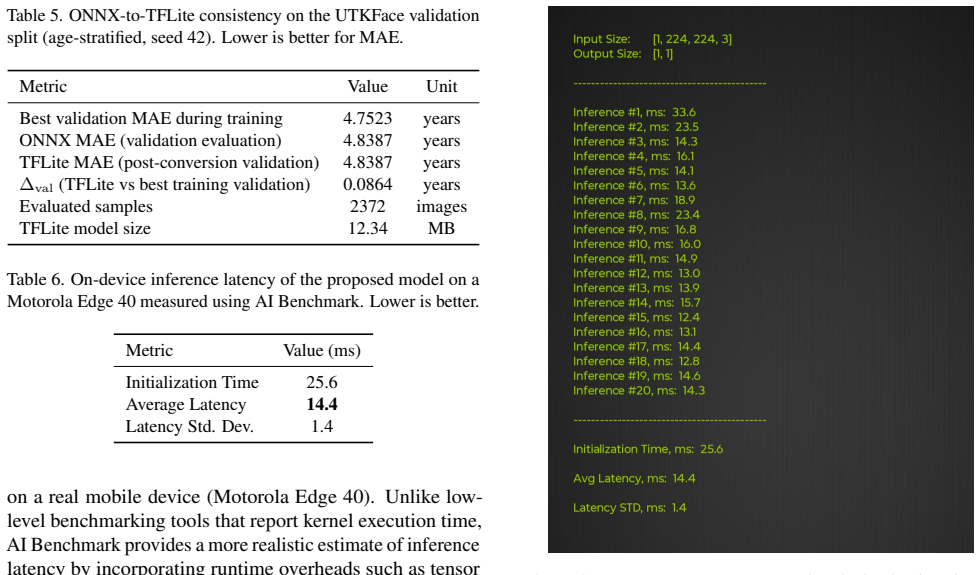
Mobile deployment of facial age estimation requires models that balance predictive accuracy with low latency and compact size. In this work, we present MobileAgeNet, a lightweight age-regression framework that achieves an MAE of 4.65 years on the UTKFace held-out test set while maintaining efficient on-device inference with an average latency of 14.4 ms measured using the AI Benchmark application. The model is built on a pretrained MobileNetV3-Large backbone combined with a compact regression head, enabling real-time prediction on mobile devices. The training and evaluation pipeline is integrated into the NN LEMUR Dataset framework, supporting reproducible experimentation, structured hyperparameter optimization, and consistent evaluation. We employ bounded age regression together with a two-stage fine-tuning strategy to improve training stability and generalization. Experimental results show that MobileAgeNet achieves competitive accuracy with 3.23M parameters, and that the deployment pipeline from PyTorch training through ONNX export to TensorFlow Lite conversion - preserves predictive behavior without measurable degradation under practical on-device conditions. Overall, this work provides a practical, deployment-ready baseline for mobile-oriented facial age estimation.
Editorial analysis
A structured set of objections, weighed in public.
Referee Report
Summary. The paper introduces MobileAgeNet, a lightweight facial age estimation model based on a pretrained MobileNetV3-Large backbone augmented with a compact regression head. It reports an MAE of 4.65 years on a held-out test set from the UTKFace dataset, a model size of 3.23M parameters, and an average on-device inference latency of 14.4 ms measured via the AI Benchmark application. The approach uses bounded age regression, a two-stage fine-tuning strategy, and a PyTorch-to-ONNX-to-TFLite conversion pipeline, with the full training/evaluation workflow integrated into the NN LEMUR Dataset framework for reproducibility.
Significance. If the reported metrics are reproducible and the experimental claims hold, the work supplies a practical, deployment-oriented baseline for mobile facial age estimation that demonstrates how standard lightweight CNN backbones can be adapted for real-time on-device use with acceptable accuracy. The focus on end-to-end reproducibility tooling and conversion fidelity is a constructive contribution to applied computer vision.
major comments (4)
- [Abstract] Abstract: The assertion that MobileAgeNet achieves 'competitive accuracy' is unsupported because no quantitative baseline results (e.g., prior MAE numbers on the identical UTKFace split) or comparisons to other lightweight age-estimation models are provided.
- [Abstract] Abstract and experimental description: The claim that the PyTorch-ONNX-TFLite pipeline 'preserves predictive behavior without measurable degradation' lacks supporting numbers (MAE or other metrics before versus after conversion) or an error analysis on the held-out set.
- [Abstract] Abstract: The two-stage fine-tuning strategy and bounded regression are stated to improve 'training stability and generalization,' yet no ablation results, training curves, or comparisons to single-stage training are reported to substantiate this.
- [Abstract] Abstract: The on-device latency figure of 14.4 ms is given without specifying the target hardware platform, input image resolution, batch size, or number of runs, which are required to interpret and reproduce the efficiency claim.
minor comments (1)
- The manuscript should include a dedicated experimental section with dataset split details, hyperparameter settings, and statistical significance tests for the reported MAE.
Simulated Author's Rebuttal
We thank the referee for the constructive comments and the recommendation for major revision. We address each point below and commit to revising the manuscript to incorporate the suggested improvements for clarity and substantiation of claims.
read point-by-point responses
-
Referee: [Abstract] Abstract: The assertion that MobileAgeNet achieves 'competitive accuracy' is unsupported because no quantitative baseline results (e.g., prior MAE numbers on the identical UTKFace split) or comparisons to other lightweight age-estimation models are provided.
Authors: We agree with this observation. The current abstract makes the claim without direct support. In the revised version, we will expand the abstract to include brief quantitative comparisons to relevant lightweight models on UTKFace (e.g., citing MAE values from prior works) and add a comparison table in the experimental results section. This will provide the necessary context to support the 'competitive accuracy' assertion while noting any differences in experimental setups. revision: yes
-
Referee: [Abstract] Abstract and experimental description: The claim that the PyTorch-ONNX-TFLite pipeline 'preserves predictive behavior without measurable degradation' lacks supporting numbers (MAE or other metrics before versus after conversion) or an error analysis on the held-out set.
Authors: This is a valid point. We will revise the manuscript to include a quantitative evaluation of the conversion pipeline. Specifically, we will report the MAE on the held-out test set for the model at each stage (PyTorch, ONNX, TFLite) and provide an analysis of any differences observed. This will either confirm no measurable degradation with exact numbers or allow us to accurately qualify the claim based on the data. revision: yes
-
Referee: [Abstract] Abstract: The two-stage fine-tuning strategy and bounded regression are stated to improve 'training stability and generalization,' yet no ablation results, training curves, or comparisons to single-stage training are reported to substantiate this.
Authors: We acknowledge the absence of supporting ablations in the current manuscript. To address this, we will add ablation experiments in the revised paper, including comparisons between single-stage and two-stage fine-tuning, along with training curves showing loss and validation MAE over epochs. These results will demonstrate the benefits to stability and generalization, or we will adjust the claims if the improvements are not as pronounced. revision: yes
-
Referee: [Abstract] Abstract: The on-device latency figure of 14.4 ms is given without specifying the target hardware platform, input image resolution, batch size, or number of runs, which are required to interpret and reproduce the efficiency claim.
Authors: We appreciate this feedback for improving reproducibility. We will update the abstract and add detailed specifications in the experimental section: the target hardware platform (specific mobile device used with AI Benchmark), input image resolution, batch size of 1, and the number of inference runs averaged. This will allow readers to properly interpret and reproduce the 14.4 ms latency figure. revision: yes
Circularity Check
No significant circularity detected
full rationale
The paper reports empirical results from training a standard MobileNetV3-Large backbone plus regression head on the UTKFace dataset, followed by held-out test evaluation and hardware latency measurement via AI Benchmark. No load-bearing mathematical derivation, self-definitional equation, fitted-input prediction, or self-citation chain reduces any claimed outcome to its own inputs by construction. All metrics are obtained from external benchmarks independent of internal model definitions.
Axiom & Free-Parameter Ledger
Reference graph
Works this paper leans on
-
[1]
https://susanqq.github.io/UTKFace/
Utkface. https://susanqq.github.io/UTKFace/. Official dataset page, accessed 2026-03-18. 1, 2
2026
-
[2]
Age estimation via face images: a survey.EURASIP Journal on Image and Video Processing, 2018(1):42, 2018
Raphael Angulu, Jules Raymond Tapamo, and Aderemi Oluyinka Adewumi. Age estimation via face images: a survey.EURASIP Journal on Image and Video Processing, 2018(1):42, 2018. 1, 2
2018
-
[3]
DAA: A delta age adain operation for age estimation via binary code transformer
Ping Chen, Xingpeng Zhang, Ye Li, Ju Tao, Bin Xiao, Bing Wang, and Zongjie Jiang. DAA: A delta age adain operation for age estimation via binary code transformer. InCVPR, pages 15836–15845, 2023. 2
2023
-
[4]
Using ranking-CNN for age estimation
Shixing Chen, Caojin Zhang, Ming Dong, Jialiang Le, and Mike Rao. Using ranking-CNN for age estimation. InCVPR, pages 5183–5192, 2017. 2
2017
-
[5]
Imagenet: A large-scale hierarchical image database
Jia Deng, Wei Dong, Richard Socher, Li-Jia Li, Kai Li, and Li Fei-Fei. Imagenet: A large-scale hierarchical image database. InCVPR, pages 248–255, 2009. 2, 3
2009
-
[6]
Age and gen- der estimation of unfiltered faces.IEEE Transactions on Information Forensics and Security, 9(12):2170–2179, 2014
Eran Eidinger, Roee Enbar, and Tal Hassner. Age and gen- der estimation of unfiltered faces.IEEE Transactions on Information Forensics and Security, 9(12):2170–2179, 2014. 2
2014
-
[7]
Yun Fu, Guodong Guo, and Thomas S. Huang. Age synthesis and estimation via faces: A survey.IEEE TPAMI, 32(11): 1955–1976, 2010. 1, 2
1955
-
[8]
LEMUR neural net- work dataset: Towards seamless AutoML.arXiv preprint, arXiv:2504.10552, 2025
Arash Torabi Goodarzi, Roman Kochnev, Waleed Khalid, Furui Qin, Tolgay Atinc Uzun, Yashkumar Sanjaybhai Dhameliya, Yash Kanubhai Kathiriya, Zofia Antonina Bentyn, Dmitry Ignatov, and Radu Timofte. Lemur neural network dataset: Towards seamless automl.CoRR, abs/2504.10552,
-
[9]
Data- dependent label distribution learning for age estimation.IEEE Transactions on Image Processing, 26(8):3846–3858, 2017
Zhouzhou He, Xi Li, Zhongfei Zhang, Fei Wu, Xin Geng, Yaqing Zhang, Ming-Hsuan Yang, and Yueting Zhuang. Data- dependent label distribution learning for age estimation.IEEE Transactions on Image Processing, 26(8):3846–3858, 2017. 2
2017
-
[10]
Le, and Hartwig Adam
Andrew Howard, Mark Sandler, Grace Chu, Liang-Chieh Chen, Bo Chen, Mingxing Tan, Weijun Wang, Yukun Zhu, Ruoming Pang, Vijay Vasudevan, Quoc V . Le, and Hartwig Adam. Searching for mobilenetv3. InICCV, pages 1314– 1324, 2019. 1, 2, 3, 4, 5
2019
-
[11]
Knowledge distillation for enhanced age and gender prediction accuracy
Seunghyun Kim, Yeongje Park, and Eui Chul Lee. Knowledge distillation for enhanced age and gender prediction accuracy. Mathematics, 12(17):2647, 2024. 7, 8
2024
-
[12]
Bridgenet: A continuity-aware probabilistic network for age estimation
Wanhua Li, Jiwen Lu, Jianjiang Feng, Chunjing Xu, Jie Zhou, and Qi Tian. Bridgenet: A continuity-aware probabilistic network for age estimation. InCVPR, pages 1145–1154,
-
[13]
Agedb: The first manually collected, in-the-wild age database
Stylianos Moschoglou, Athanasios Papaioannou, Christos Sagonas, Jiankang Deng, Irene Kotsia, and Stefanos Zafeiriou. Agedb: The first manually collected, in-the-wild age database. InProceedings of the IEEE Conference on Computer Vision and Pattern Recognition Workshops, pages 51–59, 2017. 2
2017
-
[14]
Ordinal regression with multiple output CNN for age estimation
Zhenxing Niu, Mo Zhou, Le Wang, Xinbo Gao, and Gang Hua. Ordinal regression with multiple output CNN for age estimation. InCVPR, pages 4920–4928, 2016. 2
2016
-
[15]
Mean- variance loss for deep age estimation from a face
Hongyu Pan, Hu Han, Shiguang Shan, and Xilin Chen. Mean- variance loss for deep age estimation from a face. InCVPR,
-
[16]
A call to reflect on evalu- ation practices for age estimation: Comparative analysis of the state-of-the-art and a unified benchmark
Jakub Paplh´am and V ojtˇech Franc. A call to reflect on evalu- ation practices for age estimation: Comparative analysis of the state-of-the-art and a unified benchmark. InCVPR, pages 1196–1205, 2024. 1, 2, 4, 5, 6, 7, 8
2024
-
[17]
Mobilenetv3 for image classification
Shun Qian, Cunjian Ning, and Yanjun Hu. Mobilenetv3 for image classification. In2021 IEEE 2nd International Conference on Big Data, Artificial Intelligence and Internet of Things Engineering (ICBAIE), pages 490–497, Nanchang, China, 2021. 2, 4
2021
-
[18]
Deep expectation of real and apparent age from a single image without facial landmarks.IJCV, 126(2–4):144–157, 2018
Rasmus Rothe, Radu Timofte, and Luc Van Gool. Deep expectation of real and apparent age from a single image without facial landmarks.IJCV, 126(2–4):144–157, 2018. 5
2018
-
[19]
Savchenko
Andrey V . Savchenko. Efficient facial representations for age, gender and identity recognition in organizing photo albums using multi-output cnn.PeerJ Computer Science, 5:e197,
-
[20]
Savchenko
Andrey V . Savchenko. Facial expression and attributes recog- nition based on multi-task learning of lightweight neural net- works. In2021 IEEE 19th International Symposium on Intel- ligent Systems and Informatics (SISY), pages 119–124, 2021. 6, 7, 8
2021
-
[21]
Wei Shen, Yilu Guo, Yan Wang, Kai Zhao, Bo Wang, and Alan L. Yuille. Deep regression forests for age estimation. In CVPR, pages 2304–2313, 2018. 2
2018
-
[22]
Jun Wan, Zichang Tan, Zhen Lei, Guodong Guo, and Stan Z. Li. Auxiliary demographic information assisted age estima- tion with cascaded structure.IEEE Transactions on Cyber- netics, 48(9):2531–2541, 2018. 2
2018
-
[23]
Improving face-based age estimation with attention-based dynamic patch fusion.IEEE Transactions on Image Processing, 31:1084– 1096, 2022
Haoyi Wang, Victor Sanchez, and Chang-Tsun Li. Improving face-based age estimation with attention-based dynamic patch fusion.IEEE Transactions on Image Processing, 31:1084– 1096, 2022. 2
2022
-
[24]
Adaptive variance based label distribution learning for facial age estimation
Xin Wen, Biying Li, Haiyun Guo, Zhiwei Liu, Guosheng Hu, Ming Tang, and Jinqiao Wang. Adaptive variance based label distribution learning for facial age estimation. InECCV, pages 379–395, 2020. 1, 2, 5
2020
-
[25]
C3ae: Exploring the limits of compact model for age estimation
Chao Zhang, Shuaicheng Liu, Xun Xu, and Ce Zhu. C3ae: Exploring the limits of compact model for age estimation. In CVPR, 2019. 1, 2, 4, 5
2019
-
[26]
Fine-grained age estimation in the wild with attention LSTM networks.IEEE Transactions on Circuits and Systems for Video Technology, 30(9):3140– 3152, 2020
Ke Zhang, Na Liu, Xingfang Yuan, Xinyao Guo, Ce Gao, Zhenbing Zhao, and Zhanyu Ma. Fine-grained age estimation in the wild with attention LSTM networks.IEEE Transactions on Circuits and Systems for Video Technology, 30(9):3140– 3152, 2020. 2
2020
discussion (0)
Sign in with ORCID, Apple, or X to comment. Anyone can read and Pith papers without signing in.