Recognition: unknown
Stability-Weighted Decoding for Diffusion Language Models
Pith reviewed 2026-05-10 06:08 UTC · model grok-4.3
The pith
A token's change in prediction distribution over denoising steps lower-bounds its mutual information with the masked context, so unstable tokens should remain masked.
A machine-rendered reading of the paper's core claim, the machinery that carries it, and where it could break.
Core claim
We theoretically establish that a token's temporal instability, quantified by the KL divergence between consecutive prediction distributions, provides a strict lower bound on its mutual information with the remaining masked context, indicating that temporally unstable tokens are inherently unsafe to unmask. Based on this insight, we propose Stability-Weighted Decoding (SWD), a training-free, plug-and-play strategy that incorporates temporal stability into token scoring and acts as a universal modulator for arbitrary score-based decoding policies.
What carries the argument
The KL divergence between consecutive prediction distributions, used as a lower bound on mutual information to weight token unmasking scores in Stability-Weighted Decoding.
Load-bearing premise
The information-theoretic lower bound translates into practical unsafe unmasking decisions within the finite-step and finite-vocabulary constraints of real diffusion language models.
What would settle it
A demonstration that high KL divergence tokens can be unmasked early without harming final output quality, or that the actual mutual information is not bounded as claimed in model predictions.
Figures



read the original abstract
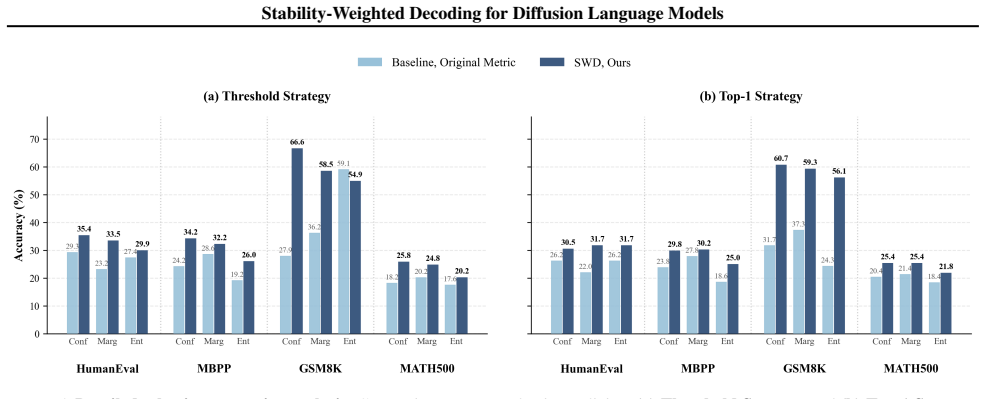
Diffusion large language models (dLLMs) enable parallel text generation by iteratively denoising a fully masked sequence, unmasking a subset of masked tokens at each step. Existing decoding strategies rely on static confidence metrics computed at a single denoising step, ignoring temporal history and often leading to premature unmasking of unstable tokens. In this work, we theoretically establish that a token's temporal instability, quantified by the KL divergence between consecutive prediction distributions, provides a strict lower bound on its mutual information with the remaining masked context, indicating that temporally unstable tokens are inherently unsafe to unmask. Based on this insight, we propose Stability-Weighted Decoding (SWD), a training-free, plug-and-play strategy that incorporates temporal stability into token scoring and acts as a universal modulator for arbitrary score-based decoding policies. Experiments on code generation and mathematical reasoning benchmarks demonstrate that SWD consistently improves generation accuracy across representative scoring metrics and selection policies, and exhibits exceptional robustness, maintaining a significant performance lead over standard baselines across varying acceleration ratios.
Editorial analysis
A structured set of objections, weighed in public.
Referee Report
Summary. The paper claims that in diffusion LLMs, the KL divergence between a token's consecutive denoising-step prediction distributions forms a strict lower bound on its mutual information with the remaining masked positions, implying that temporally unstable tokens are inherently unsafe to unmask. It introduces Stability-Weighted Decoding (SWD), a training-free modulator that reweights arbitrary score-based policies by this stability measure, and reports consistent accuracy gains on code-generation and mathematical-reasoning benchmarks across acceleration ratios.
Significance. If the information-theoretic bound holds under the model's approximation, SWD supplies a principled, plug-and-play improvement to existing decoding heuristics for parallel generation in dLLMs. The training-free design and reported robustness across selection policies and acceleration factors are practical strengths; reproducible code or parameter-free derivations would further strengthen the contribution.
major comments (3)
- [Theoretical Analysis (around the mutual-information claim)] The abstract and theoretical section assert that KL(p_t || p_{t-1}) is a strict lower bound on I(token; masked context), yet no derivation, intermediate steps, or proof is supplied. Without this, it is impossible to assess whether the inequality survives the finite-step, finite-vocabulary schedule or the gap between the trained reverse process and the true data conditional.
- [§3 (theoretical bound) and §4 (experiments)] The skeptic concern is load-bearing: any mismatch between the model's conditional p_θ and the true p(data) can render the observed KL unrelated to the true MI. The manuscript provides no control experiments (e.g., oracle vs. model KL, or synthetic data where the bound can be checked exactly) to quantify this approximation error.
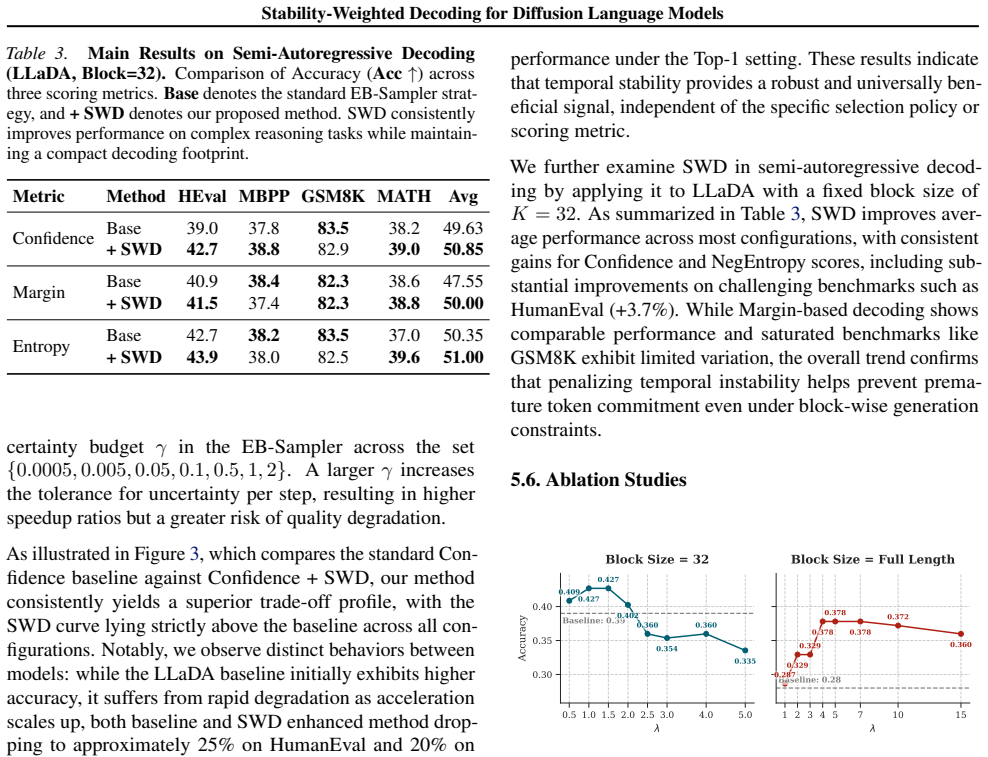
- [Experimental results (Tables 1–3, Figures 2–4)] Table 1 and Figure 2 report accuracy lifts for SWD, but no error bars, multiple random seeds, or statistical tests are shown. The claim of “consistent” and “significant” improvement therefore rests on single-run point estimates whose variability is unknown.
minor comments (2)
- [§3] The notation for consecutive prediction distributions (p_t and p_{t-1}) should be defined explicitly with an equation number the first time it appears.
- [§4.1] The description of how SWD modulates an arbitrary base score (e.g., the exact functional form of the weighting) is terse; a short pseudocode block or explicit formula would improve clarity.
Simulated Author's Rebuttal
We thank the referee for their constructive and detailed comments, which have helped clarify several aspects of our work. We address each major comment below and have revised the manuscript to incorporate the requested clarifications, derivations, and additional analyses.
read point-by-point responses
-
Referee: The abstract and theoretical section assert that KL(p_t || p_{t-1}) is a strict lower bound on I(token; masked context), yet no derivation, intermediate steps, or proof is supplied. Without this, it is impossible to assess whether the inequality survives the finite-step, finite-vocabulary schedule or the gap between the trained reverse process and the true data conditional.
Authors: We appreciate the referee highlighting the need for a complete derivation. The original submission provided a high-level argument but omitted the full step-by-step proof for space reasons. In the revised manuscript, we have added the complete derivation in Appendix A. It proceeds from the definition of mutual information, applies the chain rule to I(token; remaining masked positions), and uses the non-negativity of KL divergence together with the Markov structure of the diffusion process. We explicitly verify that the inequality holds for finite denoising steps and finite vocabulary size, and we include a dedicated paragraph discussing the approximation gap between the learned p_θ and the true data conditional. revision: yes
-
Referee: The skeptic concern is load-bearing: any mismatch between the model's conditional p_θ and the true p(data) can render the observed KL unrelated to the true MI. The manuscript provides no control experiments (e.g., oracle vs. model KL, or synthetic data where the bound can be checked exactly) to quantify this approximation error.
Authors: We acknowledge that quantifying the approximation error is valuable. While an oracle conditional is intractable on real language data, we have added a new subsection in §3.2 that analyzes the effect of model mismatch on the bound. In addition, we include a controlled synthetic experiment on a small Markov chain where the true data distribution is known exactly. In this setting we compute both the model KL and the exact mutual information, confirming that the KL remains a valid lower bound with a quantifiable gap. These results appear in the revised §4 and new Figure 5. revision: yes
-
Referee: Table 1 and Figure 2 report accuracy lifts for SWD, but no error bars, multiple random seeds, or statistical tests are shown. The claim of “consistent” and “significant” improvement therefore rests on single-run point estimates whose variability is unknown.
Authors: We agree that reporting variability strengthens the experimental claims. The original results were single-run due to the high computational cost of diffusion generation on the full benchmarks. In the revision we have rerun the primary experiments with three independent random seeds, added error bars to Tables 1–3 and Figures 2–4, and performed paired t-tests. The improvements remain consistent across seeds and reach statistical significance (p < 0.05) in the majority of settings. revision: yes
Circularity Check
No significant circularity; derivation relies on standard information-theoretic relations
full rationale
The paper's central theoretical claim establishes via information theory that KL divergence between consecutive token prediction distributions lower-bounds mutual information with the remaining masked context. This is presented as a direct derivation without self-referential definitions, fitted parameters renamed as predictions, or load-bearing self-citations. No equations or steps in the provided abstract and description reduce the bound to its own inputs by construction; the argument invokes standard KL-MI properties in the diffusion setting. The derivation chain remains self-contained against external benchmarks and does not exhibit any of the enumerated circularity patterns.
Axiom & Free-Parameter Ledger
axioms (1)
- standard math Standard properties of KL divergence and mutual information hold for the discrete token distributions produced by the diffusion model.
Reference graph
Works this paper leans on
-
[1]
URL https://arxiv.org/abs/2503.09573. Austin, J., Johnson, D. D., Ho, J., Tarlow, D., and van den Berg, R. Structured denoising diffusion models in discrete state-spaces. InProceedings of the 35th International Conference on Neural Information Processing Systems, NIPS ’21, Red Hook, NY , USA, 2021a. Curran Asso- ciates Inc. ISBN 9781713845393. Austin, J.,...
-
[2]
URL https: //arxiv.org/abs/2505.24857. Bie, T., Cao, M., Chen, K., Du, L., Gong, M., Gong, Z., Gu, Y ., Hu, J., Huang, Z., Lan, Z., Li, C., Li, C., Li, J., Li, Z., Liu, H., Liu, L., Lu, G., Lu, X., Ma, Y ., Tan, J., Wei, L., Wen, J.-R., Xing, Y ., Zhang, X., Zhao, J., Zheng, D., Zhou, J., Zhou, J., Zhou, Z., Zhu, L., and Zhuang, Y . Llada2.0: Scaling up d...
-
[3]
LLaDA2.0: Scaling Up Diffusion Language Models to 100B
URL https://arxiv.org/ abs/2512.15745. Campbell, A., Benton, J., De Bortoli, V ., Rainforth, T., Deligiannidis, G., and Doucet, A. A continuous time framework for discrete denoising models. InProceedings of the 36th International Conference on Neural Informa- tion Processing Systems, NIPS ’22, Red Hook, NY , USA,
work page internal anchor Pith review arXiv
-
[4]
Training Verifiers to Solve Math Word Problems
URL https://arxiv. org/abs/2110.14168. Feng, G., Geng, Y ., Guan, J., Wu, W., Wang, L., and He, D. Theoretical benefit and limitation of diffusion lan- guage model,
work page internal anchor Pith review Pith/arXiv arXiv
-
[5]
Theoretical benefit and limitation of diffusion language model.arXiv preprint arXiv:2502.09622,
URL https://arxiv.org/ abs/2502.09622. Gong, S., Zhang, R., Zheng, H., Gu, J., Jaitly, N., Kong, L., and Zhang, Y . Diffucoder: Understanding and improving masked diffusion models for code generation,
-
[6]
URL https://arxiv.org/abs/2506.20639. Huang, P., Liu, T., Liu, Z., Yan, Y ., Wang, S., Xiao, T., Chen, Z., and Sun, M. Empirical analysis of decoding biases in masked diffusion models, 2026a. URL https: //arxiv.org/abs/2508.13021. Huang, P., Liu, T., Liu, Z., Yan, Y ., Wang, S., Xiao, T., Chen, Z., and Sun, M. Empirical analysis of decoding biases in mask...
-
[7]
URL https://arxiv. org/abs/2509.23094. Kim, J., Shah, K., Kontonis, V ., Kakade, S. M., and Chen, S. Train for the worst, plan for the best: Understanding token ordering in masked diffusions. InForty-second International Conference on Machine Learning, ICML 2025, Vancouver, BC, Canada, July 13-19,
-
[8]
Klass: Kl-guided fast inference in masked diffusion models.arXiv preprint arXiv:2511.05664,
OpenRe- view.net, 2025a. URL https://openreview.net/ forum?id=DjJmre5IkP. Kim, S. H., Hong, S., Jung, H., Park, Y ., and Yun, S.- Y . Klass: Kl-guided fast inference in masked diffusion models, 2025b. URL https://arxiv.org/abs/ 2511.05664. Koh, H., Jhang, M., Kim, D., Lee, S., and Jung, K. Con- ditional [mask] discrete diffusion language model,
-
[9]
Li, J., Dong, X., Zang, Y ., Cao, Y ., Wang, J., and Lin, D
URLhttps://arxiv.org/abs/2411.06438. Li, J., Dong, X., Zang, Y ., Cao, Y ., Wang, J., and Lin, D. Beyond fixed: Training-free variable-length denois- ing for diffusion large language models.arXiv preprint arXiv:2508.00819,
-
[10]
URL https: //arxiv.org/abs/2305.20050. Lou, A., Meng, C., and Ermon, S. Discrete diffusion mod- eling by estimating the ratios of the data distribution. In Proceedings of the 41st International Conference on Ma- chine Learning, ICML’24. JMLR.org,
work page internal anchor Pith review arXiv
-
[11]
dkv-cache: The cache for diffusion language models.arXiv preprint arXiv:2505.15781,
URLhttps: //arxiv.org/abs/2505.15781. Nie, S., Zhu, F., You, Z., Zhang, X., Ou, J., Hu, J., Zhou, J., Lin, Y ., Wen, J.-R., and Li, C. Large language dif- fusion models,
-
[12]
Large Language Diffusion Models
URL https://arxiv.org/ abs/2502.09992. Ou, J., Nie, S., Xue, K., Zhu, F., Sun, J., Li, Z., and Li, C. Your absorbing discrete diffusion secretly models the conditional distributions of clean data,
work page internal anchor Pith review arXiv
-
[13]
URL https://arxiv.org/abs/2502.03540. Sahoo, S. S., Arriola, M., Schiff, Y ., Gokaslan, A., Marro- quin, E., Chiu, J. T., Rush, A., and Kuleshov, V . Sim- ple and effective masked diffusion language models. In Proceedings of the 38th International Conference on Neural Information Processing Systems, NIPS ’24, Red Hook, NY , USA,
-
[14]
URL https://arxiv.org/abs/ 2508.02193. Wang, K., Jiang, Z., Feng, H., Zhao, W., Liu, L., Li, J., Lan, Z., and Lin, W. Creditdecoding: Accelerating parallel 10 Stability-Weighted Decoding for Diffusion Language Models decoding in diffusion large language models with trace credits, 2025a. URL https://arxiv.org/abs/ 2510.06133. Wang, W., Fang, B., Jing, C., ...
-
[15]
Mmada: Multimodal large diffusion language models.arXiv preprint arXiv:2505.15809,
URL https://arxiv.org/ abs/2505.15809. Ye, J., Xie, Z., Zheng, L., Gao, J., Wu, Z., Jiang, X., Li, Z., and Kong, L. Dream 7b: Diffusion large language models.arXiv preprint arXiv:2508.15487,
-
[16]
URL https:// arxiv.org/abs/2505.16933. Yu, R., Ma, X., and Wang, X. Dimple: Discrete diffusion multimodal large language model with parallel decod- ing,
-
[17]
URL https://arxiv.org/abs/2505. 16990. Zheng, K., Chen, Y ., Mao, H., Liu, M., Zhu, J., and Zhang, Q. Masked diffusion models are secretly time-agnostic masked models and exploit inaccurate categorical sam- pling. InThe Thirteenth International Conference on Learning Representations, ICLR 2025, Singapore, April 24-28,
2025
-
[18]
LLaDA 1.5: Variance-Reduced Preference Optimization for Large Language Diffusion Models
URL https://arxiv.org/abs/2505.19223. 11 Stability-Weighted Decoding for Diffusion Language Models A. Appendix A: Information-Theoretic Foundation of Stability-Weighted Decoding In this section, we provide a rigorous information-theoretic justification for SWD. We demonstrate that the observed temporal instability (KL divergence) serves as a strict lower ...
work page internal anchor Pith review arXiv
-
[19]
+I(x i 0;U t |x t,x t+1)| {z } Residual Dependency (19) From Lemma 1, the first term is exactly E[D(i) temp]. By the non-negativity of mutual information, the second term is non-negative: I(x i 0;U t |x t)≥0.(20) Therefore, we obtain the lower bound: I(x i 0;U t+1 |x t+1)≥I(x i 0;x t |x t+1) =E h D(i) temp i .(21) A.4. Formulation of Stability-Weighted De...
-
[20]
12.20 179.65 29.40 212.37 29.34 286.60 10.80 364.08 + SWD (λ= 1.0) 14.02 160.84 39.40 154.71 29.04 249.50 12.20 305.93 + SWD (λ= 1.5) 14.63 154.23 41.40 152.61 31.24 224.87 13.80 277.19 + SWD (λ= 5.0) 17.07 73.5644.4087.57 52.69 123.84 25.80 115.06 + SWD (λ= 15.0) 22.56 67.73 26.60 86.81 59.29 116.94 34.40 136.58 + SWD (λ= 30.0)24.3967.41 26.20 86.2461.64...
- [21]
- [22]
-
[23]
Bold indicates the best result in each group
28.05 154.5343.20204.61 56.03 155.55 29.80 214.48 + SWD (λ= 30)40.8584.93 42.60 109.3964.97132.0938.60181.55 Table 10.Dream-7B Block-32 Results.Performance comparison with a local block constraint ( K= 32 ). Bold indicates the best result in each group. Metric Strategy HumanEval MBPP GSM8K MATH500 Acc NFE Acc NFE Acc NFE Acc NFE Confidence EB (baseline)50...
-
[24]
Code Impletation Key code are illustrated in Figure
50.61 57.22 46.40 53.36 73.62 112.11 40.00 176.26 + SWD (λ= 0.5) 50.00 56.7547.20 52.8773.39 110.8041.20172.89 + SWD (λ= 1.0)52.4455.9847.2054.7574.15109.66 40.80 170.47 B.3. Code Impletation Key code are illustrated in Figure
discussion (0)
Sign in with ORCID, Apple, or X to comment. Anyone can read and Pith papers without signing in.