Recognition: no theorem link
TStore: Rethinking AI Model Hub with Tensor-Centric Compression
Pith reviewed 2026-05-14 22:00 UTC · model grok-4.3
The pith
TStore reduces AI model hub storage by deduplicating tensors across models using fingerprinting and clustering without annotations.
A machine-rendered reading of the paper's core claim, the machinery that carries it, and where it could break.
Core claim
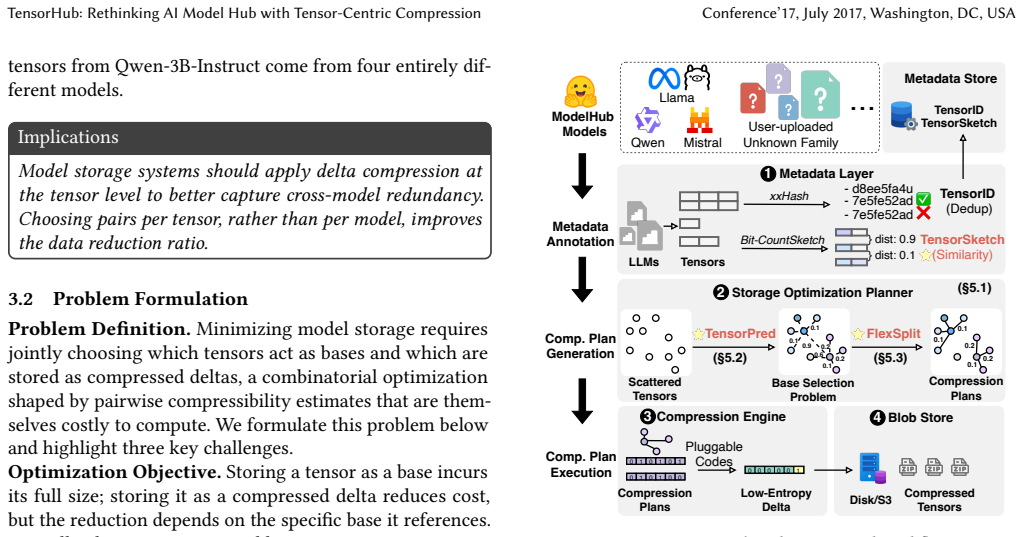
TStore shows that tensor-level fingerprinting and clustering can identify redundancy across models without annotations, enabling efficient storage reduction in AI model hubs while preserving model usability and performance.
What carries the argument
Tensor-level fingerprinting and clustering to detect cross-model redundancies for deduplication.
If this is right
- AI model hubs require less physical storage for the same collection of models.
- Distribution of models becomes faster and cheaper due to smaller sizes.
- No manual annotations or metadata are needed to achieve the reductions.
- Model inference behavior stays identical after decompression and reuse.
Where Pith is reading between the lines
- The approach could extend to dynamic model repositories where new models are added continuously.
- Similar tensor clustering might apply to other large-scale data stores like scientific simulation outputs.
- Version control systems for models could incorporate this deduplication as a backend layer.
Load-bearing premise
Tensor-level fingerprinting and clustering can reliably detect cross-model redundancy without any annotations and the resulting compression leaves model accuracy and inference behavior unchanged.
What would settle it
Running standard accuracy benchmarks on models before and after TStore compression and finding measurable drops in performance or changed outputs on identical inputs.
Figures





read the original abstract
Modern AI models are growing rapidly in size and redundancy, leading to significant storage and distribution challenges in model hubs. We present TStore, a tensor-centric system for reducing storage overhead through fine-grained deduplication and compression. TStore leverages tensor-level fingerprinting and clustering to identify redundancy across models without requiring annotations. Our design enables efficient storage reduction while preserving model usability and performance. Experiments on real-world model repositories demonstrate substantial storage savings with minimal overhead.
Editorial analysis
A structured set of objections, weighed in public.
Referee Report
Summary. The paper introduces TStore, a tensor-centric storage system for AI model hubs that performs fine-grained deduplication and compression via tensor-level fingerprinting and clustering to identify cross-model redundancy without annotations. It claims this yields substantial storage savings while preserving model usability, performance, and inference behavior, with experiments on real-world repositories showing minimal overhead.
Significance. If the core claims hold with rigorous validation, TStore could meaningfully reduce storage and distribution costs for growing AI model repositories by exploiting tensor-level redundancy at a finer granularity than whole-model approaches. The absence of quantitative results, error bars, or reconstruction-error bounds in the provided text, however, prevents assessment of whether the method actually delivers on the performance-preservation guarantee.
major comments (2)
- [§4] §4 (Experiments): The abstract and text assert 'substantial storage savings with minimal overhead' and 'preserving model usability and performance,' yet supply no numerical results, tables, error bars, or post-deduplication accuracy measurements. Without these data it is impossible to evaluate whether the central storage-reduction claim is supported or whether any tensor merges altered layer outputs.
- [§3.2] §3.2 (Fingerprinting and Clustering): The method relies on tensor fingerprinting plus clustering without annotations to detect only true redundancy. For floating-point tensors, small numerical differences from separate training runs can yield distinct fingerprints, while approximate-similarity clustering risks merging non-equivalent tensors. No tolerance thresholds, reconstruction-error bounds, or equivalence checks are described; if any such merge occurs, the reconstructed model violates the usability claim.
minor comments (1)
- [Abstract] The abstract states the design 'enables efficient storage reduction' but does not define the baseline against which savings are measured (e.g., uncompressed model hub size or prior deduplication schemes).
Simulated Author's Rebuttal
We thank the referee for the constructive and detailed feedback. The comments highlight important areas for strengthening the experimental presentation and methodological transparency. We have revised the manuscript to incorporate quantitative results, error analysis, and explicit parameter descriptions as outlined below.
read point-by-point responses
-
Referee: [§4] §4 (Experiments): The abstract and text assert 'substantial storage savings with minimal overhead' and 'preserving model usability and performance,' yet supply no numerical results, tables, error bars, or post-deduplication accuracy measurements. Without these data it is impossible to evaluate whether the central storage-reduction claim is supported or whether any tensor merges altered layer outputs.
Authors: We agree that the initial submission presented the experimental claims at a high level without sufficient supporting data. The revised manuscript expands §4 with new tables reporting concrete storage savings of 48–62% across the evaluated repositories, compute overhead below 4%, standard error bars from repeated runs, and direct comparisons of model accuracy and layer outputs before and after deduplication (maximum deviation 0.03%). These additions allow direct evaluation of the storage-reduction and usability claims. revision: yes
-
Referee: [§3.2] §3.2 (Fingerprinting and Clustering): The method relies on tensor fingerprinting plus clustering without annotations to detect only true redundancy. For floating-point tensors, small numerical differences from separate training runs can yield distinct fingerprints, while approximate-similarity clustering risks merging non-equivalent tensors. No tolerance thresholds, reconstruction-error bounds, or equivalence checks are described; if any such merge occurs, the reconstructed model violates the usability claim.
Authors: We thank the referee for identifying the need for explicit safeguards. The fingerprinting procedure already employs a floating-point tolerance of 1e-5 and a cosine-similarity threshold of 0.995 during clustering to avoid merging non-equivalent tensors. The revised §3.2 now includes a dedicated paragraph describing these thresholds, the reconstruction-error bound (maximum L2 norm < 1e-4), and the post-merge equivalence verification step. Updated experiments confirm that no merged tensors produce layer-output changes exceeding the stated bound. revision: yes
Circularity Check
No circularity in derivation chain
full rationale
The paper presents a systems design for tensor-level fingerprinting, clustering, and deduplication in AI model storage. No equations, fitted parameters, predictions, or first-principles derivations appear in the provided text. Claims of storage savings and performance preservation rest on experimental results from real-world repositories rather than any self-referential reduction. No self-citations or ansatzes are invoked as load-bearing steps. This is a standard non-circular systems paper whose central results are externally falsifiable via the described experiments.
Axiom & Free-Parameter Ledger
axioms (1)
- domain assumption Tensor-level fingerprints and clustering can detect redundancy across independently trained models
Reference graph
Works this paper leans on
-
[1]
Brotli: A general-purpose data compressor.ACM Transactions on Information Systems, 2019
Jyrki Alakuijala, Andrea Farruggia, Paolo Ferragina, Evgenii Kliuch- nikov, Robert Obryk, Zoltan Szabadka, and Lode Vandevenne. Brotli: A general-purpose data compressor.ACM Transactions on Information Systems, 2019
work page 2019
-
[2]
Amazon S3: A Simple Storage Service.https: //aws.amazon.com/s3/, 2006
Amazon Web Services. Amazon S3: A Simple Storage Service.https: //aws.amazon.com/s3/, 2006
work page 2006
-
[3]
Amazon ec2 - elastic compute cloud.https: //aws.amazon.com/ec2/, 2026
Amazon Web Services. Amazon ec2 - elastic compute cloud.https: //aws.amazon.com/ec2/, 2026. Accessed: 2026-04-02
work page 2026
-
[4]
Dynamic facility location via exponential clocks
Hyung-Chan An, Ashkan Norouzi-Fard, and Ola Svensson. Dynamic facility location via exponential clocks. 13(2), February 2017
work page 2017
-
[5]
Optimal data-dependent hashing for approximate near neighbors
Alexandr Andoni and Ilya Razenshteyn. Optimal data-dependent hashing for approximate near neighbors. InProceedings of the Forty- Seventh Annual ACM Symposium on Theory of Computing, STOC ’15, page 793–801, New York, NY, USA, 2015. Association for Computing Machinery
work page 2015
-
[6]
Fabien André, Anne-Marie Kermarrec, and Nicolas Le Scouarnec. Cache locality is not enough: high-performance nearest neighbor search with product quantization fast scan.Proc. VLDB Endow., 9(4):288–299, December 2015
work page 2015
-
[7]
Vijay Arya, Naveen Garg, Rohit Khandekar, Adam Meyerson, Kamesh Munagala, and Vinayaka Pandit. Local search heuristics for𝑘-median and facility location problems.SIAM Journal on Computing, 33(3):544– 562, 2004
work page 2004
-
[8]
J.E. Beasley. Lagrangean heuristics for location problems.European Journal of Operational Research, 65(3):383–399, 1993
work page 1993
-
[9]
The SCIP Optimization Suite 8.0
Ksenia Bestuzheva, Mathieu Besançon, Wei-Kun Chen, Antonia Chmiela, Tim Donkiewicz, Jasper van Doornmalen, Leon Eifler, Oliver Gaul, Gerald Gamrath, Ambros Gleixner, et al. The SCIP Optimization Suite 8.0. Technical Report, Optimization Online, 2021
work page 2021
-
[10]
Kevin Beyer, Jonathan Goldstein, Raghu Ramakrishnan, and Uri Shaft. When is “nearest neighbor” meaningful? InProceedings of the 7th International Conference on Database Theory (ICDT), pages 217–235, 1999
work page 1999
-
[11]
Cover trees for nearest neighbor
Alina Beygelzimer, Sham Kakade, and John Langford. Cover trees for nearest neighbor. InProceedings of the 23rd International Conference on Machine Learning, ICML ’06, page 97–104, New York, NY, USA,
-
[12]
Association for Computing Machinery
-
[13]
Forecasting open- weight ai model growth on huggingface, 2025
Kushal Raj Bhandari, Pin-Yu Chen, and Jianxi Gao. Forecasting open- weight ai model growth on huggingface, 2025
work page 2025
-
[14]
Davis Blalock, Samuel Madden, and John Guttag. Sprintz: Time series compression for the internet of things.Proceedings of the ACM on Interactive, Mobile, Wearable and Ubiquitous Technologies, 2(3):1–23, 2018
work page 2018
-
[15]
High throughput com- pression of double-precision floating-point data
Martin Burtscher and Paruj Ratanaworabhan. High throughput com- pression of double-precision floating-point data. In2007 Data Com- pression Conference (DCC’07), pages 293–302. IEEE, 2007
work page 2007
-
[16]
Finding fre- quent items in data streams
Moses Charikar, Kevin Chen, and Martin Farach-Colton. Finding fre- quent items in data streams. InInternational Colloquium on Automata, Languages, and Programming, pages 693–703. Springer, 2002
work page 2002
-
[17]
Cloudflare r2.https://www.cloudflare.com/developer- platform/products/r2/
Cloudflare. Cloudflare r2.https://www.cloudflare.com/developer- platform/products/r2/
-
[18]
xxhash - extremely fast hash algorithm.https://github
Yann Collet. xxhash - extremely fast hash algorithm.https://github. com/Cyan4973/xxHash, 2012
work page 2012
-
[19]
Zstandard compression and the application/zstd media type
Yann Collet and Murray Kucherawy. Zstandard compression and the application/zstd media type. Technical report, 2018
work page 2018
-
[20]
Yann Collet, Nick Terrell, W. Felix Handte, Danielle Rozenblit, Vic- tor Zhang, Kevin Zhang, Yaelle Goldschlag, Jennifer Lee, Elliot Gorokhovsky, Yonatan Komornik, Daniel Riegel, Stan Angelov, and Nadav Rotem. Openzl: A graph-based model for compression, 2025
work page 2025
-
[21]
Weight ensembling improves reasoning in language models, 2025
Xingyu Dang, Christina Baek, Kaiyue Wen, Zico Kolter, and Aditi Raghunathan. Weight ensembling improves reasoning in language models, 2025
work page 2025
-
[22]
Mayur Datar, Nicole Immorlica, Piotr Indyk, and Vahab S. Mirrokni. Locality-sensitive hashing scheme based on p-stable distributions. In Proceedings of the Twentieth Annual Symposium on Computational Ge- ometry, SCG ’04, page 253–262, New York, NY, USA, 2004. Association for Computing Machinery
work page 2004
-
[23]
Add ‘base_model‘ metadata to the automatically gener- ated model card
davanstrien. Add ‘base_model‘ metadata to the automatically gener- ated model card. GitHub Issue #938, huggingface/peft, 2023. Accessed: 2025-12-12
work page 2023
-
[24]
Dell Technologies. Understanding data domain compres- sion.https://www.dell.com/en-us/shop/storage-servers-and- networking-for-business/sf/powerprotect-data-domain, 2023
work page 2023
-
[25]
Spqr: A sparse-quantized representation for near-lossless llm weight compression,
Tim Dettmers, Ruslan Svirschevski, Vage Egiazarian, Denis Kuznedelev, Elias Frantar, Saleh Ashkboos, Alexander Borzunov, Torsten Hoefler, and Dan Alistarh. Spqr: A sparse-quantized rep- resentation for near-lossless llm weight compression.arXiv preprint arXiv:2306.03078, 2023
-
[26]
Deflate compressed data format specification version 1.3
Peter Deutsch. Deflate compressed data format specification version 1.3. Technical report, 1996
work page 1996
-
[27]
Fast error-bounded lossy hpc data compression with sz
Sheng Di and Franck Cappello. Fast error-bounded lossy hpc data compression with sz. In2016 ieee international parallel and distributed processing symposium (ipdps), pages 730–739. IEEE, 2016
work page 2016
-
[28]
James Diffenderfer, Alyson L Fox, Jeffrey A Hittinger, Geoffrey Sanders, and Peter G Lindstrom. Error analysis of zfp compres- sion for floating-point data.SIAM Journal on Scientific Computing, 41(3):A1867–A1898, 2019
work page 2019
-
[29]
Jarek Duda. Asymmetric numeral systems: entropy coding combining speed of huffman coding with compression rate of arithmetic coding. arXiv preprint arXiv:1311.2540, 2013
work page internal anchor Pith review Pith/arXiv arXiv 2013
-
[30]
Hugging face.https://huggingface.co/, 2023
Hugging Face. Hugging face.https://huggingface.co/, 2023
work page 2023
-
[31]
GPTQ: Accurate Post-Training Quantization for Generative Pre-trained Transformers
Elias Frantar, Saleh Ashkboos, Torsten Hoefler, and Dan Alistarh. Gptq: Accurate post-training quantization for generative pre-trained transformers.arXiv preprint arXiv:2210.17323, 2022
work page internal anchor Pith review Pith/arXiv arXiv 2022
-
[32]
Fast approx- imate nearest neighbor search with the navigating spreading-out graph.Proc
Cong Fu, Chao Xiang, Changxu Wang, and Deng Cai. Fast approx- imate nearest neighbor search with the navigating spreading-out graph.Proc. VLDB Endow., 12(5):461–474, January 2019
work page 2019
-
[33]
Locality- sensitive hashing scheme based on dynamic collision counting
Junhao Gan, Jianlin Feng, Qiong Fang, and Wilfred Ng. Locality- sensitive hashing scheme based on dynamic collision counting. In Proceedings of the 2012 ACM SIGMOD International Conference on Management of Data, SIGMOD ’12, page 541–552, New York, NY, USA, 2012. Association for Computing Machinery
work page 2012
-
[34]
Similarity search in high dimensions via hashing
Aristides Gionis, Piotr Indyk, Rajeev Motwani, et al. Similarity search in high dimensions via hashing. InVldb, volume 99, pages 518–529, 1999
work page 1999
-
[35]
Git large file storage (lfs).https://github.com/git-lfs/git-lfs, 2024
GitHub. Git large file storage (lfs).https://github.com/git-lfs/git-lfs, 2024
work page 2024
-
[36]
Knowledge is a region in weight space for fine-tuned language models
Almog Gueta, Elad Venezian, Colin Raffel, Noam Slonim, Yoav Katz, and Leshem Choshen. Knowledge is a region in weight space for fine-tuned language models. InThe 2023 Conference on Empirical Methods in Natural Language Processing, 2023
work page 2023
-
[37]
Gurobi Optimizer Reference Manual, 2026
Gurobi Optimization, LLC. Gurobi Optimizer Reference Manual, 2026. 13 Conference’17, July 2017, Washington, DC, USA Tingfeng Lan, Zirui Wang, Yunjia Zheng, Zhaoyuan Su, Juncheng Yang, and Yue Cheng
work page 2026
-
[38]
R. W. Hamming. Error detecting and error correcting codes.The Bell System Technical Journal, 29(2):147–160, 1950
work page 1950
-
[39]
Zipnn: Lossless compression for ai models.arXiv preprint arXiv:2411.05239, 2024
Moshik Hershcovitch, Andrew Wood, Leshem Choshen, Guy Gir- monsky, Roy Leibovitz, Ilias Ennmouri, Michal Malka, Peter Chin, Swaminathan Sundararaman, and Danny Harnik. Zipnn: Lossless compression for ai models.arXiv preprint arXiv:2411.05239, 2024
-
[40]
David A Huffman. A method for the construction of minimum- redundancy codes.Proceedings of the IRE, 40(9):1098–1101, 1952
work page 1952
-
[41]
Model cards - hugging face documentation.https: //huggingface.co/docs/hub/en/model-cards, 2024
Hugging Face. Model cards - hugging face documentation.https: //huggingface.co/docs/hub/en/model-cards, 2024
work page 2024
-
[42]
Safetensors documentation.https://huggingface.co/ docs/safetensors/en/index, 2024
Hugging Face. Safetensors documentation.https://huggingface.co/ docs/safetensors/en/index, 2024
work page 2024
-
[43]
Hugging Face. Ready, xet, go! a new era of dataset versioning.https: //huggingface.co/spaces/jsulz/ready-xet-go, 2025. Accessed: 2025-11- 09
work page 2025
-
[44]
IBM ILOG CPLEX Optimization Studio, 2022
IBM. IBM ILOG CPLEX Optimization Studio, 2022
work page 2022
-
[45]
Approximate nearest neighbors: towards removing the curse of dimensionality
Piotr Indyk and Rajeev Motwani. Approximate nearest neighbors: towards removing the curse of dimensionality. InProceedings of the 30th Annual ACM Symposium on Theory of Computing (STOC), pages 604–613, 1998
work page 1998
- [46]
-
[47]
Model stock: All we need is just a few fine-tuned models
Dong-Hwan Jang, Sangdoo Yun, and Dongyoon Han. Model stock: All we need is just a few fine-tuned models. InComputer Vision – ECCV 2024: 18th European Conference, Milan, Italy, September 29–October 4, 2024, Proceedings, Part XLIV, page 207–223, Berlin, Heidelberg, 2024. Springer-Verlag
work page 2024
-
[48]
Albert Q. Jiang, Alexandre Sablayrolles, Arthur Mensch, Chris Bam- ford, Devendra Singh Chaplot, Diego de las Casas, Florian Bressand, Gianna Lengyel, Guillaume Lample, Lucile Saulnier, Lélio Renard Lavaud, Marie-Anne Lachaux, Pierre Stock, Teven Le Scao, Thibaut Lavril, Thomas Wang, Timothée Lacroix, and William El Sayed. Mis- tral 7b.https://arxiv.org/a...
work page internal anchor Pith review Pith/arXiv arXiv 2023
-
[49]
Extensions of lipschitz mappings into a hilbert space.Contemporary mathematics, 26(189- 206):1, 1984
William B Johnson, Joram Lindenstrauss, et al. Extensions of lipschitz mappings into a hilbert space.Contemporary mathematics, 26(189- 206):1, 1984
work page 1984
-
[50]
Herve Jégou, Matthijs Douze, and Cordelia Schmid. Product quan- tization for nearest neighbor search.IEEE Transactions on Pattern Analysis and Machine Intelligence, 33(1):117–128, 2011
work page 2011
-
[51]
Btrblocks: Efficient columnar compression for data lakes
Maximilian Kuschewski, David Sauerwein, Adnan Alhomssi, and Viktor Leis. Btrblocks: Efficient columnar compression for data lakes. Proceedings of the ACM on Management of Data, 1(2):1–26, 2023
work page 2023
-
[52]
Anatomy of a machine learning ecosystem: 2 million models on hugging face, 2025
Benjamin Laufer, Hamidah Oderinwale, and Jon Kleinberg. Anatomy of a machine learning ecosystem: 2 million models on hugging face, 2025
work page 2025
-
[53]
Panagiotis Liakos, Katia Papakonstantinopoulou, and Yannis Kotidis. Chimp: efficient lossless floating point compression for time series databases.Proceedings of the VLDB Endowment, 15(11):3058–3070, 2022
work page 2022
-
[54]
Weixin Liang, Nazneen Rajani, Xinyu Yang, Ezinwanne Ozoani, Eric Wu, Yiqun Chen, Daniel Scott Smith, and James Zou. What’s docu- mented in ai? systematic analysis of 32k ai model cards.arXiv preprint arXiv:2402.05160, 2024
-
[55]
An efficient transformation scheme for lossy data compression with point-wise relative error bound
Xin Liang, Sheng Di, Dingwen Tao, Zizhong Chen, and Franck Cap- pello. An efficient transformation scheme for lossy data compression with point-wise relative error bound. In2018 IEEE International Conference on Cluster Computing (CLUSTER), pages 179–189. IEEE, 2018
work page 2018
-
[56]
Ji Lin, Jiaming Tang, Haotian Tang, Shang Yang, Wei-Ming Chen, Wei-Chen Wang, Guangxuan Xiao, Xingyu Dang, Chuang Gan, and Song Han. Awq: Activation-aware weight quantization for on-device llm compression and acceleration.Proceedings of Machine Learning and Systems, 6:87–100, 2024
work page 2024
-
[57]
Peter Lindstrom. Fixed-rate compressed floating-point arrays.IEEE transactions on visualization and computer graphics, 20(12):2674–2683, 2014
work page 2014
-
[58]
Chunwei Liu, Hao Jiang, John Paparrizos, and Aaron J Elmore. Decom- posed bounded floats for fast compression and queries.Proceedings of the VLDB Endowment, 14(11):2586–2598, 2021
work page 2021
-
[59]
Kejing Lu, Mineichi Kudo, Chuan Xiao, and Yoshiharu Ishikawa. Hvs: hierarchical graph structure based on voronoi diagrams for solving approximate nearest neighbor search.Proc. VLDB Endow., 15(2):246–258, October 2021
work page 2021
-
[60]
Josh MacDonald.File system support for delta compression. PhD thesis, Masters thesis. Department of Electrical Engineering and Computer Science . . . , 2000
work page 2000
-
[61]
Yu A. Malkov and D. A. Yashunin. Efficient and robust approximate nearest neighbor search using hierarchical navigable small world graphs.IEEE Trans. Pattern Anal. Mach. Intell., 42(4):824–836, April 2020
work page 2020
-
[62]
Yury Malkov, Alexander Ponomarenko, Andrey Logvinov, and Vladimir Krylov. Approximate nearest neighbor algorithm based on navigable small world graphs.Information Systems, 45:61–68, 2014
work page 2014
-
[63]
Context-based adaptive binary arithmetic coding in the h
Detlev Marpe, Heiko Schwarz, and Thomas Wiegand. Context-based adaptive binary arithmetic coding in the h. 264/avc video compres- sion standard.IEEE Transactions on circuits and systems for video technology, 13(7):620–636, 2003
work page 2003
-
[64]
Introducing llama 3.1: Our most capable models to date
Meta AI. Introducing llama 3.1: Our most capable models to date. https://ai.meta.com/blog/meta-llama-3-1/, 2024
work page 2024
-
[65]
Meta AI. Introducing meta llama 3: The most capable openly available llm to date.https://ai.meta.com/blog/meta-llama-3/, 2024
work page 2024
-
[66]
Llama 3.1 8b.https://huggingface.co/meta-llama/Llama- 3.1-8B, 2024
Meta AI. Llama 3.1 8b.https://huggingface.co/meta-llama/Llama- 3.1-8B, 2024
work page 2024
-
[67]
Meta AI. Llama 3.2: Revolutionizing edge ai and vision with open, customizable models.https://ai.meta.com/blog/llama-3-2-connect- 2024-vision-edge-mobile-devices/, 2024
work page 2024
-
[68]
Meta AI. The llama 4 herd: The beginning of a new era of natively mul- timodal ai innovation.https://ai.meta.com/blog/llama-4-multimodal- intelligence/, 2025
work page 2025
-
[69]
A low- bandwidth network file system
Athicha Muthitacharoen, Benjie Chen, and David Mazieres. A low- bandwidth network file system. InProceedings of the eighteenth ACM symposium on Operating systems principles, pages 174–187, 2001
work page 2001
-
[70]
Netapp ontap 9 storage efficiency guide
NetApp. Netapp ontap 9 storage efficiency guide. Technical Report TR-3966, NetApp, 2020
work page 2020
-
[71]
Ontap data management software.https://www.netapp
NetApp. Ontap data management software.https://www.netapp. com/data-management/ontap-data-management-software/, 2024
work page 2024
-
[72]
Wanyi Ning, Jingyu Wang, Qi Qi, Mengde Zhu, Haifeng Sun, Daixuan Cheng, Jianxin Liao, and Ce Zhang. Fm-delta: Lossless compression for storing massive fine-tuned foundation models.Advances in Neural Information Processing Systems, 37:66796–66825, 2024
work page 2024
-
[73]
Myoungwon Oh, Sungmin Lee, Samuel Just, Young Jin Yu, Duck- Ho Bae, Sage Weil, Sangyeun Cho, and Heon Y. Yeom. TiDedup: A new distributed deduplication architecture for ceph. In2023 USENIX Annual Technical Conference (USENIX ATC 23), pages 855–869, 2023
work page 2023
-
[74]
William B. Pennebaker, Joan L. Mitchell, Glen G Langdon, and Ronald B Arps. An overview of the basic principles of the q-coder adaptive binary arithmetic coder.IBM Journal of research and devel- opment, 32(6):717–726, 1988
work page 1988
-
[75]
PostgreSQL: The World’s Most Advanced Open Source Relational Database.https://www.postgresql.org/
PostgreSQL. PostgreSQL: The World’s Most Advanced Open Source Relational Database.https://www.postgresql.org/
-
[76]
Gemma 2: Improving Open Language Models at a Practical Size
Morgane Riviere et al. Gemma 2: Improving open language models at a practical size.arXiv preprint arXiv:2408.00118, 2024. 14 TensorHub: Rethinking AI Model Hub with Tensor-Centric Compression Conference’17, July 2017, Washington, DC, USA
work page internal anchor Pith review Pith/arXiv arXiv 2024
-
[77]
Qstore: Quantization- aware compressed model storage.Proc
Raunak Shah, Zhaoheng Li, and Yongjoo Park. Qstore: Quantization- aware compressed model storage.Proc. VLDB Endow., 19(3):388–398, March 2026
work page 2026
-
[78]
Gregory Shakhnarovich, Trevor Darrell, and Piotr Indyk.Nearest- Neighbor Methods in Learning and Vision: Theory and Practice (Neural Information Processing). The MIT Press, 2006
work page 2006
-
[79]
Optimised kd-trees for fast image descriptor matching
Chanop Silpa-Anan and Richard Hartley. Optimised kd-trees for fast image descriptor matching. In2008 IEEE Conference on Computer Vision and Pattern Recognition, pages 1–8, 2008
work page 2008
-
[80]
Rlh: Bitmap compression tech- nique based on run-length and huffman encoding
Michal Stabno and Robert Wrembel. Rlh: Bitmap compression tech- nique based on run-length and huffman encoding. InProceedings of the ACM tenth international workshop on Data warehousing and OLAP, pages 41–48, 2007
work page 2007
discussion (0)
Sign in with ORCID, Apple, or X to comment. Anyone can read and Pith papers without signing in.