Recognition: unknown
Region-Affinity Attention for Whole-Slide Breast Cancer Classification in Deep Ultraviolet Imaging
Pith reviewed 2026-05-10 06:57 UTC · model grok-4.3
The pith
Region-Affinity Attention processes full deep ultraviolet whole-slide images for breast cancer classification without patching.
A machine-rendered reading of the paper's core claim, the machinery that carries it, and where it could break.
Core claim
The central claim is that modeling local neighbor distances to form a complete affinity matrix, combined with contrastive loss, lets a network dynamically emphasize diagnostically relevant regions across an unbroken whole-slide image, preserving spatial context and delivering higher accuracy and AUC than Spatial, Squeeze-and-Excitation, Global Context, or Guided Context Gating attention on DUV-WSI breast cancer data.
What carries the argument
Region-Affinity Attention, which constructs a full affinity matrix from local neighbor distances to capture multi-scale regional relationships and applies contrastive loss to increase feature discriminability across the full slide.
If this is right
- Full-slide processing without patches maintains spatial integrity and reduces preprocessing overhead for clinical DUV imaging workflows.
- The affinity-matrix approach outperforms standard attention blocks in highlighting regions tied to breast cancer diagnosis.
- Contrastive loss improves separation of malignant versus benign feature distributions in label-free ultraviolet data.
- Reported accuracy of 92.67 percent and AUC of 95.97 percent on 136 samples suggests viability for rapid intra-operative classification.
- The method directly addresses the gap between patch-based deep learning and the need for context-preserving analysis of high-resolution whole slides.
Where Pith is reading between the lines
- The same local-distance affinity construction could be tested on other label-free modalities such as optical coherence tomography or Raman imaging where spatial neighborhood structure matters.
- If the mechanism scales, it may shorten the time from slide acquisition to diagnosis by eliminating patch extraction and stitching steps.
- Performance on the current dataset leaves open whether the affinity weighting generalizes when staining artifacts, tissue thickness, or scanner calibration vary.
- Adding explicit multi-scale pyramid levels inside the affinity computation might further strengthen capture of both cellular and architectural patterns.
Load-bearing premise
That an affinity matrix built from local neighbor distances plus contrastive loss will reliably surface diagnostically relevant regions in varied DUV-WSI data, and that the 136-sample collection is large and diverse enough for the reported numbers to hold in practice.
What would settle it
Running the model on an independent set of at least several hundred DUV-WSI cases acquired under different conditions or from additional cancer subtypes and observing whether accuracy falls substantially below 92 percent or AUC below 95 percent.
Figures

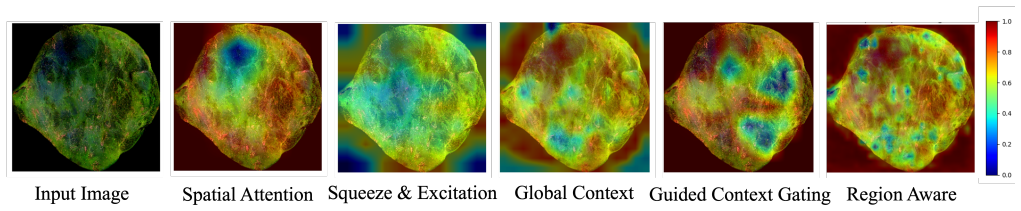
read the original abstract
Breast cancer diagnosis demands rapid and precise tools, yet traditional histopathological methods often fall short in intra-operative settings. Deep Ultraviolet (DUV) fluorescence imaging emerges as a transformative approach, offering high-contrast, label-free visualization of whole-slide images (WSIs) with unprecedented detail, surpassing conventional hematoxylin and eosin (H&E) staining in speed and resolution. However, existing deep learning methods for breast cancer classification, predominantly patch-based, fragment spatial context and incur significant preprocessing overhead, limiting their clinical utility. Moreover, standard attention mechanisms, such as Spatial, Squeeze-and-Excitation, Global Context and Guided Context Gating, fail to fully exploit the rich, multi-scale regional relationships inherent in DUV-WSI data, often prioritizing generic feature recalibration over diagnostic specificity. This study introduces a novel Region-Affinity Attention mechanism tailored for DUV-WSI breast cancer classification, processing entire slides without patching to preserve spatial integrity. By modeling local neighbor distances and constructing a full affinity matrix, our method dynamically highlights diagnostically relevant regions, augmented by a contrastive loss to enhance feature discriminability. Evaluated on a dataset of 136 DUV-WSI samples, our approach achieves an accuracy of 92.67 +/- 0.73% and an AUC of 95.97%, outperforming existing attention methods.
Editorial analysis
A structured set of objections, weighed in public.
Referee Report
Summary. The manuscript introduces a Region-Affinity Attention mechanism for classifying whole-slide Deep Ultraviolet (DUV) fluorescence images of breast cancer. The approach processes entire slides without patching by modeling local neighbor distances to construct a full affinity matrix, dynamically highlighting diagnostically relevant regions, and augments this with a contrastive loss to improve feature discriminability. Evaluated on 136 DUV-WSI samples, the method reports 92.67 ± 0.73% accuracy and 95.97% AUC, claiming to outperform standard attention mechanisms including Spatial, Squeeze-and-Excitation, Global Context, and Guided Context Gating.
Significance. If the performance claims are substantiated through rigorous validation on larger cohorts, the method could offer a clinically useful, rapid, label-free tool for intra-operative breast cancer assessment that preserves full spatial context in DUV-WSI data, addressing key limitations of patch-based deep learning and generic attention modules.
major comments (2)
- [Abstract] Abstract and evaluation description: the central accuracy (92.67 ± 0.73%) and AUC (95.97%) claims rest on a 136-sample cohort with no reported train/test partitioning, cross-validation folds, patient-level stratification, or external validation. This is load-bearing for the outperformance assertion over attention baselines, as the small size raises a high risk that results reflect dataset-specific artifacts rather than reliable region highlighting by the affinity matrix plus contrastive loss.
- [Methods] Methods (affinity matrix construction): the claim that modeling local neighbor distances to build a full affinity matrix reliably highlights diagnostically relevant regions lacks sufficient detail on matrix computation, distance metric, scaling, or integration with the contrastive loss; without these, it is impossible to determine whether the reported gains are reproducible or generalizable beyond the current data.
minor comments (2)
- [Abstract] The abstract mentions outperforming 'existing attention methods' but provides no quantitative baseline numbers or specific method names in the results summary; adding a comparison table would improve clarity.
- [Methods] No implementation details (e.g., network architecture, optimizer, hyperparameters) or code availability statement are mentioned, which hinders reproducibility even if the dataset size concern is addressed.
Simulated Author's Rebuttal
We thank the referee for the constructive and detailed feedback on our manuscript. We have addressed each major comment point by point below and will incorporate revisions to enhance the clarity, reproducibility, and rigor of the work.
read point-by-point responses
-
Referee: [Abstract] Abstract and evaluation description: the central accuracy (92.67 ± 0.73%) and AUC (95.97%) claims rest on a 136-sample cohort with no reported train/test partitioning, cross-validation folds, patient-level stratification, or external validation. This is load-bearing for the outperformance assertion over attention baselines, as the small size raises a high risk that results reflect dataset-specific artifacts rather than reliable region highlighting by the affinity matrix plus contrastive loss.
Authors: We agree that the abstract does not explicitly describe the evaluation protocol. The reported mean and standard deviation are computed across multiple runs with patient-level stratification to avoid leakage. We will revise the abstract and add a dedicated subsection in Methods to detail the train/test partitioning, cross-validation procedure, and stratification approach. We also acknowledge the modest cohort size and will expand the discussion to address the risk of dataset-specific effects and the value of future external validation on larger cohorts. revision: yes
-
Referee: [Methods] Methods (affinity matrix construction): the claim that modeling local neighbor distances to build a full affinity matrix reliably highlights diagnostically relevant regions lacks sufficient detail on matrix computation, distance metric, scaling, or integration with the contrastive loss; without these, it is impossible to determine whether the reported gains are reproducible or generalizable beyond the current data.
Authors: We apologize for the lack of implementation specifics. The affinity matrix is built from Euclidean distances between local neighbor feature vectors extracted from the full WSI, scaled by a median-based sigma, normalized via row-wise softmax, and then used to weight the feature map before the contrastive loss is applied on the resulting embeddings. We will revise the Methods section to include the exact mathematical formulation, distance metric, scaling details, normalization, and the joint optimization with the contrastive loss, along with pseudocode for reproducibility. revision: yes
Circularity Check
No circularity: empirical method proposal with independent evaluation results
full rationale
The paper describes a novel Region-Affinity Attention mechanism that constructs an affinity matrix from local neighbor distances and adds contrastive loss for DUV-WSI breast cancer classification. Performance (92.67% accuracy, 95.97% AUC) is reported as an evaluation outcome on 136 samples rather than a quantity defined by or fitted from the method itself. No equations, derivation steps, or self-citations appear in the abstract or described content that would reduce the central claim to its inputs by construction. The approach is presented as a proposed architecture evaluated empirically, with no load-bearing self-referential definitions, uniqueness theorems, or renamed known results.
Axiom & Free-Parameter Ledger
Reference graph
Works this paper leans on
-
[1]
Global cancer statistics 2020: GLOBOCAN estimates of incidence and mortality worldwide for 36 cancers in 185 countries
Hyuna Sung et al. “Global cancer statistics 2020: GLOBOCAN estimates of incidence and mortality worldwide for 36 cancers in 185 countries”. In:CA: a cancer journal for clinicians71.3 (2021), pp. 209– 249
2020
-
[2]
Unique Molecular Al- teration of Lobular Breast Cancer: Association with Pathological Classification, Tumor Biology and Be- havior, and Clinical Management
Huina Zhang and Yan Peng. “Unique Molecular Al- teration of Lobular Breast Cancer: Association with Pathological Classification, Tumor Biology and Be- havior, and Clinical Management”. In:Cancers17.3 (2025), p. 417
2025
-
[3]
Emerging technologies for real-time intraoperative margin assessment in future breast-conserving surgery
Ambara R Pradipta et al. “Emerging technologies for real-time intraoperative margin assessment in future breast-conserving surgery”. In:Advanced science7.9 (2020), p. 1901519
2020
-
[4]
Mitosis detection in breast cancer histology images with deep neural networks
Dan C Cires ¸an et al. “Mitosis detection in breast cancer histology images with deep neural networks”. In:Medical Image Computing and Computer-Assisted Intervention–MICCAI 2013: 16th International Con- ference, Nagoya, Japan, September 22-26, 2013, Pro- ceedings, Part II 16. Springer. 2013, pp. 411–418
2013
-
[5]
Deep learning for breast cancer classification of deep ultraviolet fluorescence images toward intra- operative margin assessment
Tyrell To, Saba Heidari Gheshlaghi, and Dong Hye Ye. “Deep learning for breast cancer classification of deep ultraviolet fluorescence images toward intra- operative margin assessment”. In:2022 44th Annual International Conference of the IEEE Engineering in Medicine & Biology Society (EMBC). IEEE. 2022, pp. 1891–1894
2022
-
[6]
Deep learning-based image analysis predicts PD-L1 status from H&E-stained histopathol- ogy images in breast cancer
Gil Shamai et al. “Deep learning-based image analysis predicts PD-L1 status from H&E-stained histopathol- ogy images in breast cancer”. In:Nature Communica- tions13.1 (2022), p. 6753
2022
-
[7]
Deep learning for automated detection of breast cancer in deep ultravi- olet fluorescence images with diffusion probabilistic model
Sepehr Salem Ghahfarokhi et al. “Deep learning for automated detection of breast cancer in deep ultravi- olet fluorescence images with diffusion probabilistic model”. In:2024 IEEE International Symposium on Biomedical Imaging (ISBI). IEEE. 2024, pp. 1–5
2024
-
[8]
Breast cancer histopathology image analysis: A review
Mitko Veta et al. “Breast cancer histopathology image analysis: A review”. In:IEEE transactions on biomed- ical engineering61.5 (2014), pp. 1400–1411
2014
-
[9]
An empirical study of spatial attention mechanisms in deep networks
Xizhou Zhu et al. “An empirical study of spatial attention mechanisms in deep networks”. In:Proceed- ings of the IEEE/CVF international conference on computer vision. 2019, pp. 6688–6697
2019
-
[10]
Squeeze-and- excitation networks
Jie Hu, Li Shen, and Gang Sun. “Squeeze-and- excitation networks”. In:Proceedings of the IEEE con- ference on computer vision and pattern recognition. 2018, pp. 7132–7141
2018
-
[11]
Global context networks
Yue Cao et al. “Global context networks”. In:IEEE Transactions on Pattern Analysis and Machine Intel- ligence45.6 (2020), pp. 6881–6895
2020
-
[12]
Guided Context Gating: Learning To Leverage Salient Lesions in Retinal Fundus Images
Teja Krishna Cherukuri, Nagur Shareef Shaik, and Dong Hye Ye. “Guided Context Gating: Learning To Leverage Salient Lesions in Retinal Fundus Images”. In:2024 IEEE International Conference on Image Processing (ICIP). IEEE. 2024, pp. 3098–3104
2024
-
[13]
Teja Krishna Cherukuri et al. “Dynamic Contextual Attention Network: Transforming Spatial Representa- tions into Adaptive Insights for Endoscopic Polyp Di- agnosis”. In:arXiv preprint arXiv:2504.20306(2025)
-
[14]
Spatial sequence attention network for schizophrenia classification from struc- tural brain mr images
Nagur Shareef Shaik et al. “Spatial sequence attention network for schizophrenia classification from struc- tural brain mr images”. In:2024 IEEE International Symposium on Biomedical Imaging (ISBI). IEEE. 2024, pp. 1–5
2024
-
[15]
An Image is Worth 16x16 Words: Transformers for Image Recognition at Scale
Alexey Dosovitskiy et al. “An Image is Worth 16x16 Words: Transformers for Image Recognition at Scale”. In:International Conference on Learning Representa- tions. 2021.URL:https://openreview.net/ forum?id=Yp3h26vFh7B
2021
-
[16]
Pouya Afshin et al. “Breast Cancer Classification in Deep Ultraviolet Fluorescence Images Using a Patch- Level Vision Transformer Framework”. In:arXiv preprint arXiv:2505.07654(2025)
-
[17]
Label-aware attention network with multi-scale boosting for medical image segmen- tation
Linbo Wang et al. “Label-aware attention network with multi-scale boosting for medical image segmen- tation”. In:Expert Systems with Applications255 (2024), p. 124698
2024
-
[18]
Contrastive learning of global and local features for medical image seg- mentation with limited annotations
Krishna Chaitanya et al. “Contrastive learning of global and local features for medical image seg- mentation with limited annotations”. In:Advances in Neural Information Processing Systems. V ol. 33. 2020, pp. 12546–12556
2020
-
[19]
Efficientnetv2: Smaller models and faster training
Mingxing Tan and Quoc Le. “Efficientnetv2: Smaller models and faster training”. In:International confer- ence on machine learning. PMLR. 2021, pp. 10096– 10106
2021
-
[20]
Imagenet: A large-scale hierarchi- cal image database
Jia Deng et al. “Imagenet: A large-scale hierarchi- cal image database”. In:2009 IEEE conference on computer vision and pattern recognition. Ieee. 2009, pp. 248–255
2009
-
[21]
Gaussian Error Linear Units (GELUs)
Dan Hendrycks and Kevin Gimpel. “Gaussian error linear units (gelus)”. In:arXiv preprint arXiv:1606.08415(2016)
work page Pith review arXiv 2016
-
[22]
Understanding batch normaliza- tion
Nils Bjorck et al. “Understanding batch normaliza- tion”. In:Advances in neural information processing systems31 (2018)
2018
-
[23]
Petar Veli ˇckovi´c et al. “Graph attention networks”. In: arXiv preprint arXiv:1710.10903(2017)
work page internal anchor Pith review arXiv 2017
-
[24]
Attention is all you need
Ashish Vaswani et al. “Attention is all you need”. In: Advances in neural information processing systems30 (2017)
2017
-
[25]
Supervised contrastive learn- ing
Prannay Khosla et al. “Supervised contrastive learn- ing”. In:Advances in Neural Information Processing Systems. V ol. 33. 2020, pp. 18661–18673
2020
-
[26]
Grad-cam++: Generalized gradient-based visual explanations for deep convolu- tional networks
Aditya Chattopadhay et al. “Grad-cam++: Generalized gradient-based visual explanations for deep convolu- tional networks”. In:2018 IEEE winter conference on applications of computer vision (WACV). IEEE. 2018, pp. 839–847
2018
discussion (0)
Sign in with ORCID, Apple, or X to comment. Anyone can read and Pith papers without signing in.