Recognition: unknown
SpatialImaginer: Towards Adaptive Visual Imagination for Spatial Reasoning
Pith reviewed 2026-05-10 06:27 UTC · model grok-4.3
The pith
Multimodal models achieve more reliable spatial reasoning by selectively generating visual images to track geometric states during text-based planning.
A machine-rendered reading of the paper's core claim, the machinery that carries it, and where it could break.
Core claim
The paper establishes that effective spatial reasoning requires low-level geometric structure to be preserved and updated throughout the process, which text representations alone cannot achieve reliably. By adopting a divide-and-conquer framework that pairs textual planning with visual imagination for state transformations, and training this behavior via a targeted data engine, the model learns to invoke visual generation only when needed for stable tracking.
What carries the argument
The divide-and-conquer strategy that delegates high-level semantic planning to text chain-of-thought while reserving visual imagination for geometry-sensitive state transformation and consistency preservation.
If this is right
- The model maintains geometric details that text abstractions normally lose, enabling longer and more stable reasoning chains.
- Selective use of visual imagination occurs only on tasks requiring stable spatial state tracking, avoiding unnecessary computation on simpler problems.
- Unified multimodal generation produces both text plans and visual state updates within a single framework.
- Robustness gains appear most clearly on complex multi-step spatial tasks across diverse benchmarks.
Where Pith is reading between the lines
- The same selective-imagination pattern could be tested on other structured reasoning domains that require maintaining hidden states over multiple steps.
- Integration with external simulators or 3D environments might further reduce errors in tasks where pure generation of images is insufficient.
- The approach implies that future models could learn to switch between representation modes based on detected instability in their own reasoning traces.
Load-bearing premise
The difficulty-aware data engine with closed-loop verification trains the model to invoke visual imagination selectively without introducing new errors into the overall reasoning trace.
What would settle it
An ablation study that removes the visual imagination component while keeping the text chain-of-thought and data engine, then measures accuracy drops specifically on multi-step spatial reasoning benchmarks.
Figures



read the original abstract
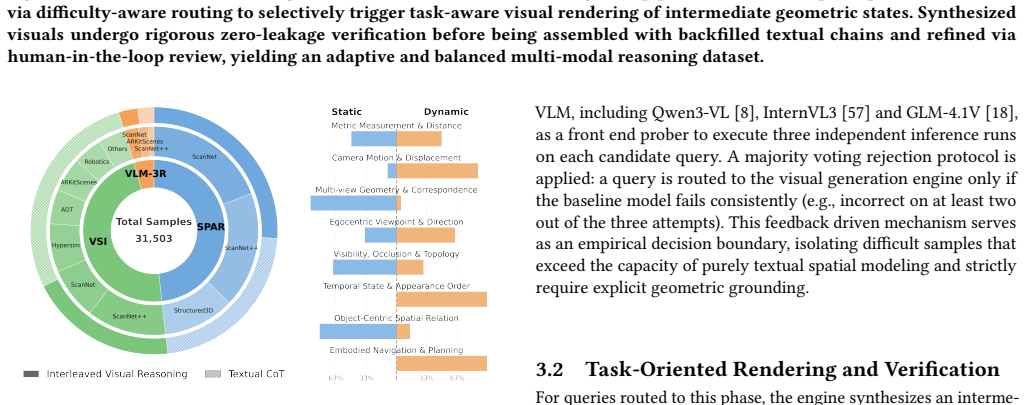
Spatial intelligence, which refers to the ability to reason about geometric and physical structure from visual observations, remains a core challenge for multimodal large language models. Despite promising performance, recent multimodal large language models (MLLMs) often exhibit fragile reasoning traces in spatial intelligence tasks that involve consistent spatial state recognition. We argue that these failures stem from a mismatch between the spatial recognition mechanism and the text-only reasoning behavior of these MLLMs. Effective spatial reasoning requires low-level geometric structure to be faithfully preserved and updated throughout the reasoning process, whereas textual representations tend to abstract away precisely these critical details. To address this issue, we propose SpatialImaginer, a unified multimodal generation framework that integrates textual reasoning with visual imagination. Our framework adopts a divide-and-conquer strategy, using text chain-of-thought for high-level semantic planning and the visual imagination for geometry-sensitive state transformation and consistency preservation. To support this capability, we further introduce a difficulty-aware data engine with closed-loop verification to train the model to invoke visual imagination selectively when stable spatial state tracking is required. Extensive experiments on diverse spatial intelligence benchmarks show that SpatialImaginer achieves state-of-the-art performance and substantially improves robustness on complex multi-step spatial reasoning tasks.
Editorial analysis
A structured set of objections, weighed in public.
Referee Report
Summary. The paper proposes SpatialImaginer, a unified multimodal generation framework for spatial reasoning in MLLMs. It integrates textual chain-of-thought reasoning for high-level semantic planning with visual imagination for geometry-sensitive state transformation and consistency preservation via a divide-and-conquer strategy. A difficulty-aware data engine with closed-loop verification is introduced to train selective invocation of visual imagination for stable spatial state tracking. The authors claim that extensive experiments on diverse spatial intelligence benchmarks demonstrate state-of-the-art performance and substantially improved robustness on complex multi-step tasks.
Significance. If the central claims hold, the work could meaningfully advance multimodal spatial reasoning by addressing the abstraction gap in text-only traces. The selective visual imagination mechanism offers a plausible adaptive strategy for tasks requiring geometric fidelity, and the data engine concept provides a training paradigm worth exploring in related multimodal settings.
major comments (2)
- [Difficulty-aware data engine with closed-loop verification] In the description of the difficulty-aware data engine and closed-loop verification, the manuscript does not demonstrate that the verification explicitly measures preservation of low-level geometric invariants (object positions, orientations, containment relations) across multi-step updates, as opposed to high-level semantic consistency or downstream task accuracy. This is load-bearing for the claim that the engine trains selective invocation without injecting new inconsistencies in visual imagination outputs.
- [Experimental evaluation] The experimental results section asserts SOTA performance and robustness gains but supplies no quantitative metrics, baseline comparisons, ablation studies isolating the visual imagination component, or error analysis on multi-step traces. Without these, the central empirical claim cannot be evaluated.
minor comments (2)
- [Abstract] The abstract would benefit from naming the specific benchmarks and reporting key quantitative improvements to ground the SOTA claim.
- [Method] Notation and component names (e.g., for the visual imagination module and verification loop) should be introduced with explicit definitions or pseudocode for clarity.
Simulated Author's Rebuttal
We thank the referee for the thoughtful and constructive comments on our manuscript. We address each major point below and commit to revisions that strengthen the presentation of the data engine and experimental results without altering the core contributions.
read point-by-point responses
-
Referee: In the description of the difficulty-aware data engine and closed-loop verification, the manuscript does not demonstrate that the verification explicitly measures preservation of low-level geometric invariants (object positions, orientations, containment relations) across multi-step updates, as opposed to high-level semantic consistency or downstream task accuracy. This is load-bearing for the claim that the engine trains selective invocation without injecting new inconsistencies in visual imagination outputs.
Authors: We acknowledge that the current manuscript description emphasizes high-level semantic consistency and downstream task accuracy in the closed-loop verification. The engine does incorporate geometric checks via rendered state comparisons in the data generation pipeline, but these are not explicitly quantified as low-level invariant preservation metrics. To address this, we will revise the relevant section to include explicit verification of object positions, orientations, and containment relations across multi-step updates, supported by additional quantitative analysis of invariant preservation rates. This will better substantiate the selective invocation claim. revision: yes
-
Referee: The experimental results section asserts SOTA performance and robustness gains but supplies no quantitative metrics, baseline comparisons, ablation studies isolating the visual imagination component, or error analysis on multi-step traces. Without these, the central empirical claim cannot be evaluated.
Authors: We agree that the experimental section requires more detailed substantiation. While the manuscript reports overall benchmark results supporting the SOTA and robustness claims, it does not sufficiently present the requested quantitative breakdowns, full baseline tables, ablations focused on the visual imagination module, or multi-step error analysis. We will expand this section in the revision with additional tables, ablation studies, and error categorization to allow proper evaluation of the contributions. revision: yes
Circularity Check
No circularity; empirical framework with independent benchmark validation
full rationale
The paper describes a proposed framework (SpatialImaginer) using a divide-and-conquer strategy and a difficulty-aware data engine, supported by experimental results on spatial intelligence benchmarks. No equations, derivations, or first-principles reductions are present in the abstract or described text. Claims of SOTA performance and improved robustness are tied to external evaluations rather than self-referential definitions, fitted parameters renamed as predictions, or self-citation chains. The verification loop is presented as a training component without reducing to tautological inputs by construction. This is a standard empirical proposal without load-bearing circular steps.
Axiom & Free-Parameter Ledger
axioms (1)
- domain assumption Textual representations in MLLMs abstract away critical low-level geometric details necessary for consistent spatial reasoning.
invented entities (1)
-
Visual imagination mechanism
no independent evidence
Reference graph
Works this paper leans on
-
[1]
Iro Armeni, Ozan Sener, Amir R Zamir, Helen Jiang, Ioannis Brilakis, Martin Fischer, and Silvio Savarese. 2016. 3D Semantic Parsing of Large-Scale Indoor Spaces. InProceedings of the IEEE Conference on Computer Vision and Pattern Recognition (CVPR)
2016
-
[2]
Shuai Bai, Yuxuan Cai, Ruizhe Chen, Keqin Chen, Xionghui Chen, Zesen Cheng, Lianghao Deng, Wei Ding, Chang Gao, Chunjiang Ge, et al . 2025. Qwen3-vl technical report.arXiv preprint arXiv:2511.21631(2025)
work page internal anchor Pith review Pith/arXiv arXiv 2025
-
[3]
Shuai Bai, Keqin Chen, Xuejing Liu, Jialin Wang, Wenbin Ge, Sibo Song, Kai Dang, Peng Wang, Shijie Wang, Jun Tang, Humen Zhong, Yuanzhi Zhu, Mingkun Yang, Zhaohai Li, Jianqiang Wan, Pengfei Wang, Wei Ding, Zheren Fu, Yiheng Xu, Jiabo Ye, Xi Zhang, Tianbao Xie, Zesen Cheng, Hang Zhang, Zhibo Yang, Haiyang Xu, and Junyang Lin. 2025. Qwen2.5-VL Technical Rep...
work page internal anchor Pith review Pith/arXiv arXiv 2025
-
[4]
Gilad Baruch, Zhuoyuan Chen, Afshin Dehghan, Tal Dimry, Yuri Feigin, Peter Fu, Thomas Gebauer, Brandon Joffe, Daniel Kurz, Arik Schwartz, and Elad Shul- man. 2021. ARKitScenes - A Diverse Real-World Dataset for 3D Indoor Scene Understanding Using Mobile RGB-D Data. InAdvances in Neural Information Processing Systems (NeurIPS)
2021
- [5]
-
[6]
Zhongang Cai, Yubo Wang, Qingping Sun, Ruisi Wang, Chenyang Gu, Wanqi Yin, Zhiqian Lin, Zhitao Yang, Chen Wei, Xuanke Shi, Kewang Deng, Xiaoyang Han, Zukai Chen, Jiaqi Li, Xiangyu Fan, Hanming Deng, Lewei Lu, Bo Li, Ziwei Liu, Quan Wang, Dahua Lin, and Lei Yang. 2025. Holistic Evaluation of Multimodal LLMs on Spatial Intelligence.arXiv preprint arXiv:2508...
-
[7]
Boyuan Chen, Zhuo Xu, Sean Kirmani, Brain Ichter, Dorsa Sadigh, Leonidas Guibas, and Fei Xia. 2024. Spatialvlm: Endowing vision-language models with spatial reasoning capabilities. InProceedings of the IEEE/CVF Conference on Com- puter Vision and Pattern Recognition. 14455–14465
2024
-
[8]
QwenLM Team (Alibaba Cloud). 2025. Qwen3-VL: Multimodal large language model series. https://github.com/QwenLM/Qwen3-VL. GitHub repository; accessed: 2025-11-14
2025
-
[9]
Angela Dai, Angel X Chang, Manolis Savva, Maciej Halber, Thomas Funkhouser, and Matthias Nießner. 2017. ScanNet: Richly-Annotated 3D Reconstructions of Indoor Scenes. InProceedings of the IEEE Conference on Computer Vision and Pattern Recognition (CVPR)
2017
-
[10]
Mostafa Dehghani, Basil Mustafa, Josip Djolonga, Jonathan Heek, Matthias Minderer, Mathilde Caron, Andreas Steiner, Joan Puigcerver, Robert Geirhos, Ibrahim M Alabdulmohsin, et al. 2023. Patch n’pack: Navit, a vision transformer for any aspect ratio and resolution.Advances in Neural Information Processing Systems36 (2023), 2252–2274
2023
-
[11]
Matt Deitke, Eli VanderBilt, Alvaro Herrasti, Luca Weihs, Kiana Ehsani, Jordi Salvador, Winson Han, Eric Kolve, Aniruddha Kembhavi, and Roozbeh Mottaghi
-
[12]
In Advances in Neural Information Processing Systems (NeurIPS)
ProcTHOR: Large-Scale Embodied AI Using Procedural Generation. In Advances in Neural Information Processing Systems (NeurIPS)
-
[13]
Chaorui Deng, Deyao Zhu, Kunchang Li, Chenhui Gou, Feng Li, Zeyu Wang, Shu Zhong, Weihao Yu, Xiaonan Nie, Ziang Song, Guang Shi, and Haoqi Fan
-
[14]
Emerging Properties in Unified Multimodal Pretraining.arXiv preprint arXiv:2505.14683(2025)
work page internal anchor Pith review arXiv 2025
-
[15]
Mengfei Du, Binhao Wu, Zejun Li, Xuan-Jing Huang, and Zhongyu Wei. 2024. Embspatial-bench: Benchmarking spatial understanding for embodied tasks with large vision-language models. InProceedings of the 62nd Annual Meeting of the Association for Computational Linguistics (Volume 2: Short Papers). 346–355
2024
-
[16]
Zhiwen Fan, Jian Zhang, Renjie Li, Junge Zhang, Runjin Chen, Hezhen Hu, Kevin Wang, Huaizhi Qu, Dilin Wang, Zhicheng Yan, et al. 2025. Vlm-3r: Vision- language models augmented with instruction-aligned 3d reconstruction.arXiv preprint arXiv:2505.20279(2025)
work page internal anchor Pith review Pith/arXiv arXiv 2025
-
[17]
Xingyu Fu, Yushi Hu, Bangzheng Li, Yu Feng, Haoyu Wang, Xudong Lin, Dan Roth, Noah A Smith, Wei-Chiu Ma, and Ranjay Krishna. 2024. Blink: Multimodal large language models can see but not perceive. InEuropean Conference on Computer Vision. Springer, 148–166
2024
-
[18]
Gemini. 2025. Gemini 3 Pro Model Card. Technical report, Gemini. Accessed: 2025-11-18
2025
- [19]
-
[20]
Wenyi Hong, Wenmeng Yu, Xiaotao Gu, Guo Wang, Guobing Gan, Haomiao Tang, Jiale Cheng, Ji Qi, Junhui Ji, Lihang Pan, et al. 2025. Glm-4.5 v and glm-4.1 v-thinking: Towards versatile multimodal reasoning with scalable reinforcement learning.arXiv preprint arXiv:2507.01006(2025)
work page internal anchor Pith review arXiv 2025
-
[21]
Aaron Jaech, Adam Kalai, Adam Lerer, Adam Richardson, Ahmed El-Kishky, Aiden Low, Alec Helyar, Aleksander Madry, Alex Beutel, Alex Carney, et al. 2024. Openai o1 system card.arXiv preprint arXiv:2412.16720(2024)
work page internal anchor Pith review Pith/arXiv arXiv 2024
-
[22]
Yang Jiao, Haibo Qiu, Zequn Jie, Shaoxiang Chen, Jingjing Chen, Lin Ma, and Yu-Gang Jiang. 2025. Unitoken: Harmonizing multimodal understanding and generation through unified visual encoding. InProceedings of the Computer Vision and Pattern Recognition Conference. 3600–3610
2025
-
[23]
Black Forest Labs. 2024. FLUX. https://github.com/black-forest-labs/flux
2024
- [24]
- [25]
- [26]
-
[27]
Haoyuan Li, Qihang Cao, Tao Tang, Kun Xiang, Zihan Guo, Jianhua Han, Hang Xu, and Xiaodan Liang. 2026. Thinking with Geometry: Active Geometry Integration for Spatial Reasoning.arXiv preprint arXiv:2602.06037(2026)
work page internal anchor Pith review Pith/arXiv arXiv 2026
- [28]
- [29]
-
[30]
Yian Li, Wentao Tian, Yang Jiao, Tianwen Qian, Na Zhao, Bin Zhu, Jingjing Chen, and Yu-Gang Jiang. 2025. Look before you decide: Prompting active deduction of mllms for assumptive reasoning. InProceedings of the 33rd ACM International Conference on Multimedia. 2713–2722
2025
- [31]
-
[32]
Haotian Liu, Chunyuan Li, Qingyang Wu, and Yong Jae Lee. 2023. Visual in- struction tuning.Advances in neural information processing systems36 (2023), 34892–34916
2023
-
[33]
Xingchao Liu, Chengyue Gong, and Qiang Liu. 2022. Flow straight and fast: Learning to generate and transfer data with rectified flow.arXiv preprint arXiv:2209.03003(2022). Conference’17, July 2017, Washington, DC, USA Yian Li et al
work page internal anchor Pith review arXiv 2022
-
[34]
Ilya Loshchilov and Frank Hutter. 2017. Decoupled weight decay regularization. arXiv preprint arXiv:1711.05101(2017)
work page internal anchor Pith review Pith/arXiv arXiv 2017
-
[35]
Wufei Ma, Haoyu Chen, Guofeng Zhang, Yu-Cheng Chou, Jieneng Chen, Celso de Melo, and Alan Yuille. 2025. 3dsrbench: A comprehensive 3d spatial reasoning benchmark. InProceedings of the IEEE/CVF International Conference on Computer Vision. 6924–6934
2025
-
[36]
OpenAI. 2025. GPT-5 System Card. Technical report, OpenAI. Accessed: 2025-08-10
2025
- [37]
-
[38]
Xiaqing Pan, Nicholas Charron, Yongqian Yang, Scott Peters, Thomas Whelan, Chen Kong, Omkar Parkhi, Richard Newcombe, and Yuheng Carl Ren. 2023. Aria Digital Twin: A New Benchmark Dataset for Egocentric 3D Machine Percep- tion. InProceedings of the IEEE/CVF International Conference on Computer Vision (ICCV)
2023
-
[39]
Mike Roberts, Jason Ramapuram, Anurag Ranjan, Atulit Kumar, Miguel Angel Bautista, Nathan Paczan, Russ Webb, and Joshua M Susskind. 2021. Hypersim: A Photorealistic Synthetic Dataset for Holistic Indoor Scene Understanding. In Proceedings of the IEEE/CVF International Conference on Computer Vision (ICCV)
2021
-
[40]
Shenna Shepard and Douglas Metzler. 1988. Mental rotation: effects of dimen- sionality of objects and type of task.Journal of experimental psychology: Human perception and performance14, 1 (1988), 3
1988
-
[41]
ByteDance Seed Team. 2025. Seed1.5-VL Technical Report.arXiv preprint arXiv:2505.07062(2025)
work page internal anchor Pith review arXiv 2025
-
[42]
Chameleon Team. 2024. Chameleon: Mixed-modal early-fusion foundation mod- els.arXiv preprint arXiv:2405.09818(2024)
work page internal anchor Pith review arXiv 2024
-
[43]
Michael Tschannen, Alexey Gritsenko, Xiao Wang, Muhammad Ferjad Naeem, Ibrahim Alabdulmohsin, Nikhil Parthasarathy, Talfan Evans, Lucas Beyer, Ye Xia, Basil Mustafa, et al. 2025. Siglip 2: Multilingual vision-language encoders with improved semantic understanding, localization, and dense features.arXiv preprint arXiv:2502.14786(2025)
work page internal anchor Pith review arXiv 2025
-
[44]
Jianyuan Wang, Minghao Chen, Nikita Karaev, Andrea Vedaldi, Christian Rup- precht, and David Novotny. 2025. VGGT: Visual geometry grounded transformer. InProceedings of the IEEE/CVF Conference on Computer Vision and Pattern Recog- nition,. 5294–5306
2025
-
[45]
Weiyun Wang, Zhangwei Gao, Lixin Gu, Hengjun Pu, Long Cui, Xingguang Wei, Zhaoyang Liu, Linglin Jing, Shenglong Ye, Jie Shao, et al. 2025. Internvl3. 5: Ad- vancing open-source multimodal models in versatility, reasoning, and efficiency. arXiv preprint arXiv:2508.18265(2025)
work page internal anchor Pith review arXiv 2025
-
[46]
Jason Wei, Xuezhi Wang, Dale Schuurmans, Maarten Bosma, Fei Xia, Ed Chi, Quoc V Le, Denny Zhou, et al. 2022. Chain-of-thought prompting elicits reasoning in large language models.Advances in Neural Information Processing Systems35 (2022), 24824–24837
2022
- [47]
- [48]
-
[49]
Wenshan Wu, Shaoguang Mao, Yadong Zhang, Yan Xia, Li Dong, Lei Cui, and Furu Wei. 2024. Mind’s eye of LLMs: visualization-of-thought elicits spatial reasoning in large language models.Advances in Neural Information Processing Systems37 (2024), 90277–90317
2024
-
[50]
2025.Grok 4
xAI. 2025.Grok 4. https://x.ai/news/grok-4 Model announcement
2025
-
[51]
Jihan Yang, Shusheng Yang, Anjali W Gupta, Rilyn Han, Li Fei-Fei, and Saining Xie
-
[52]
InProceedings of the Computer Vision and Pattern Recognition Conference
Thinking in space: How multimodal large language models see, remember, and recall spaces. InProceedings of the Computer Vision and Pattern Recognition Conference. 10632–10643
- [53]
- [54]
-
[55]
Chandan Yeshwanth, Yueh-Cheng Liu, Matthias Nießner, and Angela Dai. 2023. ScanNet++: A High-Fidelity Dataset of 3D Indoor Scenes. InProceedings of the IEEE/CVF International Conference on Computer Vision (ICCV)
2023
-
[56]
Baiqiao Yin, Qineng Wang, Pingyue Zhang, Jianshu Zhang, Kangrui Wang, Zihan Wang, Jieyu Zhang, Keshigeyan Chandrasegaran, Han Liu, Ranjay Krishna, et al
-
[57]
InProceedings of the IEEE/CVF International Conference on Computer Vision Workshop
Spatial mental modeling from limited views. InProceedings of the IEEE/CVF International Conference on Computer Vision Workshop
- [58]
- [59]
-
[60]
Jia Zheng, Junfei Zhang, Jing Li, Rui Tang, Shenghua Gao, and Zihan Zhou. 2020. Structured3D: A Large Photo-realistic Dataset for Structured 3D Modeling. In Proceedings of The European Conference on Computer Vision (ECCV)
2020
-
[61]
Jinguo Zhu, Weiyun Wang, Zhe Chen, Zhaoyang Liu, Shenglong Ye, Lixin Gu, Hao Tian, Yuchen Duan, Weijie Su, Jie Shao, et al. 2025. Internvl3: Exploring advanced training and test-time recipes for open-source multimodal models. arXiv preprint arXiv:2504.10479(2025)
work page internal anchor Pith review arXiv 2025
discussion (0)
Sign in with ORCID, Apple, or X to comment. Anyone can read and Pith papers without signing in.