Recognition: unknown
TransXion: A High-Fidelity Graph Benchmark for Realistic Anti-Money Laundering
Pith reviewed 2026-05-10 07:20 UTC · model grok-4.3
The pith
TransXion benchmark produces substantially lower AML detection rates than existing datasets across multiple model types.
A machine-rendered reading of the paper's core claim, the machinery that carries it, and where it could break.
Core claim
TransXion jointly models persistent entity profiles and conditional transaction behavior to generate a dataset of approximately three million transactions among fifty thousand entities with rich demographic and behavioral attributes; the dataset reproduces key structural properties of payment networks while producing substantially lower detection performance than widely used benchmarks across diverse algorithmic paradigms, thereby serving as a more faithful testbed for context-aware AML methods.
What carries the argument
Profile-aware simulation of normal activity paired with stochastic non-template synthesis of illicit subgraphs, which generates out-of-character anomalies based on entity context rather than fixed motifs.
If this is right
- AML models must incorporate entity socio-economic profiles to detect contradictions in observed behavior.
- Template-based anomaly injection in benchmarks overestimates the robustness of current detection algorithms.
- Development efforts should prioritize methods that handle non-repeating, context-dependent laundering patterns.
- The benchmark enables more reliable comparison of model families under realistic difficulty levels.
Where Pith is reading between the lines
- Organizations relying on older benchmarks may currently overestimate how well their deployed systems would catch real laundering.
- The same profile-plus-stochastic synthesis approach could generate testbeds for related tasks such as credit-card fraud or insider trading detection.
- Releasing the generation code allows independent teams to create variants with different entity attribute distributions for domain-specific validation.
Load-bearing premise
The simulated normal and illicit activity matches real banking transaction statistics closely enough that lower model performance indicates genuine robustness rather than artifacts of the generation process.
What would settle it
A side-by-side statistical comparison of heavy-tailed degree distributions, clustering coefficients, and subgraph motifs between TransXion and anonymized real payment-network data that reveals large mismatches would undermine the realism claim.
Figures



read the original abstract
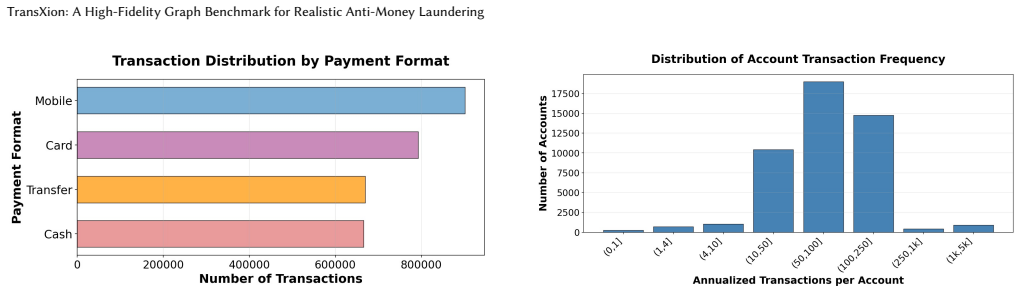
Money laundering poses severe risks to global financial systems, driving the widespread adoption of machine learning for transaction monitoring. However, progress remains stifled by the lack of realistic benchmarks. Existing transaction-graph datasets suffer from two pervasive limitations: (i) they provide sparse node-level semantics beyond anonymized identifiers, and (ii) they rely on template-driven anomaly injection, which biases benchmarks toward static structural motifs and yields overly optimistic assessments of model robustness. We propose TransXion, a benchmark ecosystem for Anti-Money Laundering (AML) research that integrates profile-aware simulation of normal activity with stochastic, non-template synthesis of illicit subgraphs.TransXion jointly models persistent entity profiles and conditional transaction behavior, enabling evaluation of "out-of-character" anomalies where observed activity contradicts an entity's socio-economic context. The resulting dataset comprises approximately 3 million transactions among 50,000 entities, each endowed with rich demographic and behavioral attributes. Empirical analyses show that TransXion reproduces key structural properties of payment networks, including heavy-tailed activity distributions and localized subgraph structure. Across a diverse array of detection models spanning multiple algorithmic paradigms, TransXion yields substantially lower detection performance than widely used benchmarks, demonstrating increased difficulty and realism. TransXion provides a more faithful testbed for developing context-aware and robust AML detection methods. The dataset and code are publicly available at https://github.com/chaos-max/TransXion.
Editorial analysis
A structured set of objections, weighed in public.
Referee Report
Summary. The paper introduces TransXion, a new graph benchmark for anti-money laundering (AML) research consisting of approximately 3 million transactions among 50,000 entities with rich demographic and behavioral attributes. It combines profile-aware simulation of normal activity with stochastic, non-template synthesis of illicit subgraphs to address limitations in existing datasets (sparse semantics and template-driven anomalies). The manuscript claims that the resulting graphs reproduce heavy-tailed degree distributions and localized subgraph structure, and that a range of detection models spanning multiple paradigms achieve substantially lower performance on TransXion than on prior benchmarks, indicating greater difficulty and realism for developing context-aware AML methods. The dataset and code are released publicly.
Significance. If the fidelity claims hold, TransXion could provide a valuable, more challenging testbed for AML detection research, encouraging development of models that handle out-of-character anomalies and realistic laundering patterns rather than static motifs. The public release of data and code strengthens reproducibility. However, the significance is limited by the absence of direct validation linking the synthetic illicit patterns to real-world AML statistics, which weakens the transferability of robustness claims.
major comments (2)
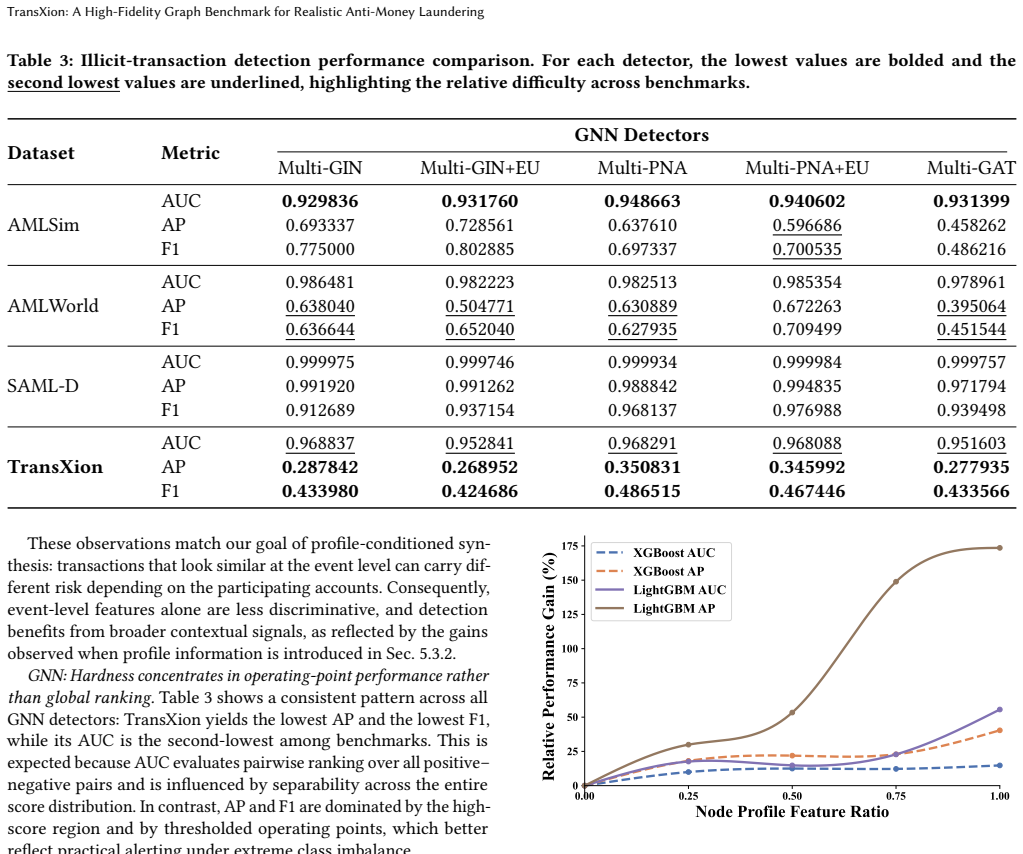
- [Empirical analyses / abstract] Empirical analyses (as described in the abstract and results): The claim that TransXion reproduces 'key structural properties of payment networks' and demonstrates 'increased difficulty and realism' rests on global statistics such as heavy-tailed activity distributions and localized structure, but no quantitative tables or metrics compare the generated illicit subgraphs (e.g., laundering-chain lengths, amount distributions, entity-type involvement, or motif frequencies) to statistics from actual AML cases or regulatory reports. This leaves open the possibility that lower model performance arises from an arbitrarily harder synthetic distribution rather than fidelity to real laundering behavior.
- [Results / abstract] Abstract and results section: The performance comparison across models reports 'substantially lower detection performance' without providing quantitative tables, error bars, ablation studies on simulation parameters, or statistical significance tests. This makes it difficult to assess whether the observed gap is robust or sensitive to specific choices in the stochastic synthesis process.
minor comments (2)
- [Methods] The abstract mentions 'persistent entity profiles and conditional transaction behavior' but does not define the exact profile attributes or conditional distributions used in the simulation; adding a table or pseudocode in the methods section would improve clarity.
- [Discussion] No discussion of potential limitations of the stochastic synthesis approach (e.g., risk of introducing artifacts not present in real data) is provided, which would help readers evaluate the benchmark's scope.
Simulated Author's Rebuttal
We thank the referee for the constructive and detailed review. We address the major comments point by point below, indicating where revisions will be made.
read point-by-point responses
-
Referee: Empirical analyses (as described in the abstract and results): The claim that TransXion reproduces 'key structural properties of payment networks' and demonstrates 'increased difficulty and realism' rests on global statistics such as heavy-tailed activity distributions and localized subgraph structure, but no quantitative tables or metrics compare the generated illicit subgraphs (e.g., laundering-chain lengths, amount distributions, entity-type involvement, or motif frequencies) to statistics from actual AML cases or regulatory reports. This leaves open the possibility that lower model performance arises from an arbitrarily harder synthetic distribution rather than fidelity to real laundering behavior.
Authors: We acknowledge that direct quantitative comparisons of illicit subgraph statistics (chain lengths, amount distributions, motifs) to real AML cases would strengthen the fidelity argument. Such granular regulatory or case-level statistics are not publicly available due to confidentiality. Our validation instead reproduces documented structural properties of payment networks from the literature and uses stochastic synthesis to avoid template bias. We will add an explicit limitations paragraph in the revised manuscript discussing this constraint and the rationale for our approach. revision: partial
-
Referee: Abstract and results section: The performance comparison across models reports 'substantially lower detection performance' without providing quantitative tables, error bars, ablation studies on simulation parameters, or statistical significance tests. This makes it difficult to assess whether the observed gap is robust or sensitive to specific choices in the stochastic synthesis process.
Authors: We agree that the current presentation would benefit from greater quantitative detail. In the revised manuscript we will expand the results section to include full performance tables with means and standard deviations across repeated simulation runs, error bars on all figures, ablation studies on key stochastic synthesis parameters, and statistical significance tests (paired t-tests with p-values) comparing TransXion against prior benchmarks. revision: yes
- Direct quantitative validation of synthetic illicit subgraph statistics against real-world AML case data, which remains unavailable due to privacy and regulatory restrictions.
Circularity Check
No circularity in benchmark construction or empirical claims
full rationale
The paper constructs a synthetic transaction graph benchmark via profile-aware normal activity simulation and stochastic non-template illicit subgraph generation, then reports empirical reproduction of heavy-tailed degree distributions and lower detection performance across models versus prior benchmarks. No equations, fitted parameters, or first-principles derivations are present that reduce any result to self-defined inputs by construction. Central claims rest on direct data generation and performance comparisons, which are self-contained against external benchmark sets without load-bearing self-citations or ansatz smuggling. This is a standard benchmark paper with no derivation chain to inspect for circularity.
Axiom & Free-Parameter Ledger
Reference graph
Works this paper leans on
-
[1]
Daron Acemoglu, Asuman Ozdaglar, and Alireza Tahbaz-Salehi. 2015. Systemic risk and stability in financial networks.American Economic Review105, 2 (2015), 564–608
2015
-
[2]
Franklin Allen and Douglas Gale. 2000. Financial contagion.Journal of political economy108, 1 (2000), 1–33
2000
-
[3]
Erik Altman, Jovan Blanuša, Luc Von Niederhäusern, Béni Egressy, Andreea Anghel, and Kubilay Atasu. 2023. Realistic synthetic financial transactions for anti-money laundering models.Advances in Neural Information Processing Systems36 (2023), 29851–29874
2023
-
[4]
Kartik Anand, Iman Van Lelyveld, Ádám Banai, Soeren Friedrich, Rodney Garratt, Grzegorz Hałaj, Jose Fique, Ib Hansen, Serafín Martínez Jaramillo, Hwayun Lee, et al. 2018. The missing links: A global study on uncovering financial network structures from partial data.Journal of Financial Stability35 (2018), 107–119
2018
-
[5]
Robert M. Arasa. 2015. Determinants of Know Your Customer (KYC) Compliance among Commercial Banks in Kenya.Journal of Economics and Behavioral Studies 7 (2015), 162–175. https://api.semanticscholar.org/CorpusID:15673285
2015
-
[6]
Peter W Battaglia, Jessica B Hamrick, Victor Bapst, Alvaro Sanchez-Gonzalez, Vinicius Zambaldi, Mateusz Malinowski, Andrea Tacchetti, David Raposo, Adam Santoro, Ryan Faulkner, et al. 2018. Relational inductive biases, deep learning, and graph networks.arXiv preprint arXiv:1806.01261(2018)
work page internal anchor Pith review arXiv 2018
-
[7]
Morten L Bech and Enghin Atalay. 2010. The topology of the federal funds market. Physica A: Statistical mechanics and its applications389, 22 (2010), 5223–5246
2010
-
[8]
Michael Boss, Helmut Elsinger, Martin Summer, and Stefan Thurner 4. 2004. Network topology of the interbank market.Quantitative finance4, 6 (2004), 677–684
2004
-
[9]
Tianqi Chen. 2016. XGBoost: A Scalable Tree Boosting System.Cornell University (2016)
2016
-
[10]
Aaron Clauset, Cosma Rohilla Shalizi, and Mark EJ Newman. 2009. Power-law distributions in empirical data.SIAM review51, 4 (2009), 661–703
2009
-
[11]
Gabriele Corso, Luca Cavalleri, Dominique Beaini, Pietro Liò, and Petar Veličković. 2020. Principal neighbourhood aggregation for graph nets.Ad- vances in neural information processing systems33 (2020), 13260–13271
2020
-
[12]
Ben Craig and Goetz Von Peter. 2014. Interbank tiering and money center banks. Journal of Financial Intermediation23, 3 (2014), 322–347
2014
-
[13]
Béni Egressy, Luc Von Niederhäusern, Jovan Blanuša, Erik Altman, Roger Wat- tenhofer, and Kubilay Atasu. 2024. Provably powerful graph neural networks for directed multigraphs. InProceedings of the AAAI Conference on Artificial Intelligence, Vol. 38. 11838–11846
2024
-
[14]
Joras Ferwerda. 2013. The effects of money laundering. InResearch handbook on money laundering. Edward Elgar Publishing, 35–46
2013
-
[15]
2016.Frequently Asked Ques- tions Regarding Customer Due Diligence Requirements for Financial Institutions
Financial Crimes Enforcement Network (FinCEN). 2016.Frequently Asked Ques- tions Regarding Customer Due Diligence Requirements for Financial Institutions. Guidance FIN-2016-G003. U.S. Department of the Treasury. https://www.fincen. gov/system/files/2016-09/FAQs_for_CDD_Final_Rule_%287_15_16%29.pdf Is- sued July 19, 2016. Interprets the CDD Final Rule and ...
2016
-
[16]
Xavier Gabaix. 2016. Power laws in economics: An introduction.Journal of Economic Perspectives30, 1 (2016), 185–206
2016
-
[17]
Rasmus Ingemann Tuffveson Jensen, Joras Ferwerda, Kristian Sand Jørgensen, Erik Rathje Jensen, Martin Borg, Morten Persson Krogh, Jonas Brunholm Jensen, and Alexandros Iosifidis. 2023. A synthetic data set to benchmark anti-money laundering methods.Scientific data10, 1 (2023), 661
2023
-
[18]
Guolin Ke, Qi Meng, Thomas Finley, Taifeng Wang, Wei Chen, Weidong Ma, Qiwei Ye, and Tie-Yan Liu. 2017. Lightgbm: A highly efficient gradient boosting decision tree.Advances in neural information processing systems30 (2017)
2017
-
[19]
Edgar Lopez-Rojas, Ahmad Elmir, and Stefan Axelsson. 2016. PaySim: A financial mobile money simulator for fraud detection. In28th European Modeling and Simulation Symposium, EMSS, Larnaca. Dime University of Genoa, 249–255
2016
-
[20]
Mark EJ Newman. 2002. Assortative mixing in networks.Physical review letters 89, 20 (2002), 208701
2002
-
[21]
Berkan Oztas, Deniz Cetinkaya, Festus Adedoyin, Marcin Budka, Huseyin Dogan, and Gokhan Aksu. 2023. Enhancing anti-money laundering: Development of a synthetic transaction monitoring dataset. In2023 IEEE International Conference on e-Business Engineering (ICEBE). IEEE, 47–54
2023
-
[22]
Peter Reuter. 2013. Are estimates of the volume of money laundering either feasible or useful? InResearch handbook on money laundering. Edward Elgar Publishing, 224–231
2013
-
[23]
Kimmo Soramäki, Morten L Bech, Jeffrey Arnold, Robert J Glass, and Walter E Beyeler. 2007. The topology of interbank payment flows.Physica A: Statistical Mechanics and its Applications379, 1 (2007), 317–333
2007
-
[24]
Jianheng Tang, Jiajin Li, Ziqi Gao, and Jia Li. 2022. Rethinking graph neural networks for anomaly detection. InInternational conference on machine learning. PMLR, 21076–21089
2022
-
[25]
1996.Money laundering and the international financial system
Mr Vito Tanzi. 1996.Money laundering and the international financial system. International Monetary Fund
1996
-
[26]
Brigitte Unger, Melissa Siegel, Joras Ferwerda, Wouter De Kruijf, Madalina Busuioic, Kristen Wokke, and Greg Rawlings. 2006. The amounts and the effects of money laundering.Report for the Ministry of Finance16, 2020.08 (2006), 22
2006
-
[27]
Petar Veličković, Guillem Cucurull, Arantxa Casanova, Adriana Romero, Pietro Lio, and Yoshua Bengio. 2017. Graph attention networks.arXiv preprint arXiv:1710.10903(2017)
work page internal anchor Pith review arXiv 2017
-
[28]
John Walker. 1999. How big is global money laundering?Journal of Money Laundering Control3, 1 (1999), 25–37
1999
-
[29]
Mark Weber, Jie Chen, Toyotaro Suzumura, Aldo Pareja, Tengfei Ma, Hiroki Kanezashi, Tim Kaler, Charles E Leiserson, and Tao B Schardl. 2018. Scal- able graph learning for anti-money laundering: A first look.arXiv preprint arXiv:1812.00076(2018)
work page Pith review arXiv 2018
- [30]
-
[31]
Keyulu Xu, Weihua Hu, Jure Leskovec, and Stefanie Jegelka. 2018. How powerful are graph neural networks?arXiv preprint arXiv:1810.00826(2018). Trovato et al. A Details of Anomalous Transaction Synthesis A.1 Scope and Disclosure Policy This appendix describes a reinforcement-learning (RL) training pipeline that couples a local policy model with an external...
work page internal anchor Pith review arXiv 2018
discussion (0)
Sign in with ORCID, Apple, or X to comment. Anyone can read and Pith papers without signing in.