Recognition: unknown
Kardashev's Conundrum: Statistical Falsification of the Standard Kardashev Model and the Kardashev--Sagan--Nakamoto Resolution
Pith reviewed 2026-05-10 05:26 UTC · model grok-4.3
The pith
Global energy data falsifies the Kardashev 1% exponential model and requires renormalization by hashrate to restore physical coherence.
A machine-rendered reading of the paper's core claim, the machinery that carries it, and where it could break.
Core claim
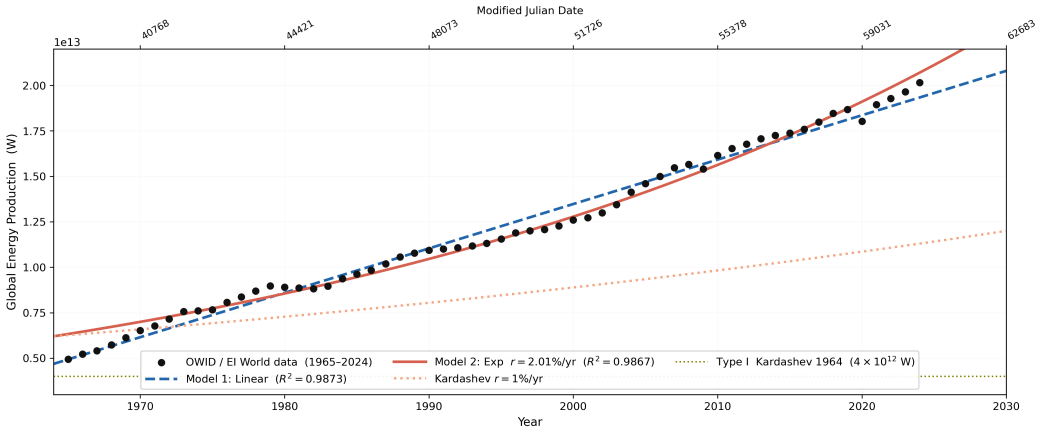
The standard Kardashev model assumes power consumption P(t) grows as an independent-increment geometric series, yet six decades of data reject both the 1% rate and the required statistical structure. A linear OLS fit is statistically preferred and extrapolates to solar luminosity in 1.6E15 years, a physical reductio termed Kardashev's Conundrum. No functional form fitted to P(t) alone can satisfy both statistical adequacy and physical coherence because the Kardashev variable is dimensionally incomplete. The Kardashev-Sagan-Nakamoto resolution defines the renormalized quantity B(t) = P(t)/H(t) in J/Hash, motivated by the Landauer limit and Sagan's information-richness criterion; this quantity
What carries the argument
The Kardashev-Sagan-Nakamoto (KSN) renormalisation B(t) = P(t)/H(t) in J/Hash, which divides annual primary energy production by annual Bitcoin hashrate to supply the missing dimensional completeness without introducing free parameters.
If this is right
- The 1% exponential growth rate lies well outside the 95% credible interval obtained from MCMC inference on 1965-2024 energy data.
- A linear OLS model is preferred over free-rate exponential models by the Widely Applicable Information Criterion.
- Linear extrapolation places the Type II civilizational timescale at approximately 1.6E15 years.
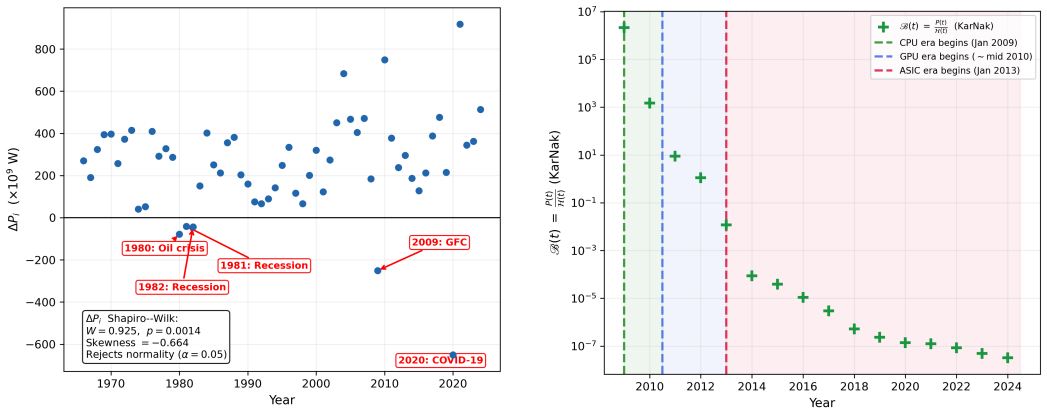
- The renormalized B(t) spans 14 orders of magnitude over 2009-2024 and fulfills Sagan's information-richness requirement.
- No functional form of P(t) alone can meet both statistical adequacy and physical coherence.
Where Pith is reading between the lines
- Civilizational progress metrics may need to track energy per unit of computation rather than raw power consumption alone.
- The 14-order variation in B(t) offers a quantitative basis for comparing technological epochs once longer hashrate and energy records become available.
- Substituting other global compute proxies for Bitcoin hashrate would test whether the renormalization remains robust across different information-processing measures.
- The approach connects energy accounting directly to thermodynamic limits on computation, suggesting extensions to other planetary-scale energy budgets.
Load-bearing premise
The linear trend fitted to recent global primary energy data will continue without bound or saturation long enough for the extrapolation to solar luminosity to serve as a meaningful physical reductio.
What would settle it
A sustained change in the growth rate of global primary energy production, such as saturation or acceleration, that would allow solar-luminosity levels to be reached within roughly the main-sequence lifetime of the Sun.
Figures

read the original abstract
We test the standard Kardashev one-percent exponential conjecture against six decades of global primary-energy production data (1965-2024; Our World in Data). Markov Chain Monte Carlo inference yields a posterior growth rate of r = 2.01 +/- 0.03% per year (95% credible interval [1.94%, 2.08%]), placing the Kardashev 1% value well outside the credible interval. A linear OLS model fits the data with remarkably low dispersion (R^2 = 0.987) and is preferred over the free-rate exponential by the Widely Applicable Information Criterion ({\Delta}WAIC = 5.5). Year-over-year increments are non-Gaussian (Shapiro-Wilk W = 0.925, p = 0.0014; skewness = -0.664) with identifiable crisis outliers (2008, 2020), rejecting the independent-increment multiplicative structure with positive drift required by Kardashev's (1+x)^t geometric series. Extrapolation of the linear model to the solar luminosity yields a Type II civilisational timescale of approximately 1.6E15 years -- approximately 1E5 times both the age of the Universe and the main-sequence lifetime of the Sun -- a physical reductio we term Kardashev's Conundrum. No functional form fitted to P(t) alone can simultaneously satisfy statistical adequacy and physical coherence: the Kardashev variable is dimensionally incomplete. We propose the Kardashev-Sagan-Nakamoto (KSN) renormalisation B(t) = P(t)/H(t) [J/Hash, the KarNak unit], where H(t) is the annual Bitcoin hashrate. The renormalisation adds no free parameters, is motivated by the Landauer limit, and fulfils Sagan's information-richness requirement. Over 2009-2024, B(t) spans 14 orders of magnitude.
Editorial analysis
A structured set of objections, weighed in public.
Referee Report
Summary. The manuscript tests the standard Kardashev 1% exponential growth model against global primary-energy production data (1965-2024). MCMC inference yields a posterior growth rate of 2.01% yr^{-1} (95% CI [1.94%, 2.08%]), inconsistent with the conjecture. An OLS linear model is statistically preferred (R²=0.987, ΔWAIC=5.5 over exponential) despite non-Gaussian increments (Shapiro-Wilk W=0.925, p=0.0014) and crisis outliers. Extrapolation of the linear trend to solar luminosity produces an unphysical timescale of ~1.6×10^{15} years, termed Kardashev's Conundrum, implying no P(t)-only functional form can be both statistically adequate and physically coherent. The authors propose the parameter-free Kardashev-Sagan-Nakamoto renormalization B(t)=P(t)/H(t) (J/Hash) using annual Bitcoin hashrate as an information proxy motivated by the Landauer limit.
Significance. If the statistical preference for the linear model and the proposed renormalization hold after addressing extrapolation concerns, the work supplies a reproducible, data-driven critique of the Kardashev scale and introduces a dimensionally consistent information-theoretic extension. Strengths include use of public data, MCMC with WAIC model comparison, and explicit falsification of the independent-increment multiplicative structure; these elements support falsifiable predictions for future energy-information ratios.
major comments (2)
- [Abstract] Abstract and extrapolation claim: The central reductio that the linear model yields a 1.6×10^{15}-year timescale to solar luminosity (3.8×10^{26} W) assumes indefinite continuation of the fitted trend without saturation or shocks. However, the manuscript itself documents non-Gaussian year-over-year increments (Shapiro-Wilk W=0.925, p=0.0014; skewness=-0.664) and explicit crisis outliers (2008, 2020), which contradict the stable additive process required for such an extrapolation to serve as a physical reductio. This assumption is load-bearing for the claim that no P(t)-only form satisfies both statistical adequacy and physical coherence.
- [Abstract] Renormalization proposal: The choice of Bitcoin hashrate H(t) as the information-processing proxy is motivated by the Landauer limit and fulfills Sagan's information-richness criterion, yet the manuscript provides no independent cross-validation against other computational metrics (e.g., total CPU cycles, data-center energy efficiency, or global transistor counts). The reported 14-order-of-magnitude span in B(t) over 2009-2024 may therefore reflect Bitcoin-specific dynamics rather than a general information capacity measure.
minor comments (2)
- [Abstract] The abstract states the linear model has 'remarkably low dispersion' but does not report the residual standard error or perform a formal test for heteroscedasticity, which would strengthen the model-comparison section.
- [Abstract] Notation for the proposed unit (KarNak) is introduced without a dedicated definition equation; adding B(t) ≡ P(t)/H(t) [J hash^{-1}] as an explicit equation would improve clarity.
Simulated Author's Rebuttal
We thank the referee for their constructive comments on the manuscript. We address each major comment below, providing our strongest substantive defense while indicating where revisions will be made.
read point-by-point responses
-
Referee: Abstract and extrapolation claim: The central reductio that the linear model yields a 1.6×10^{15}-year timescale to solar luminosity (3.8×10^{26} W) assumes indefinite continuation of the fitted trend without saturation or shocks. However, the manuscript itself documents non-Gaussian year-over-year increments (Shapiro-Wilk W=0.925, p=0.0014; skewness=-0.664) and explicit crisis outliers (2008, 2020), which contradict the stable additive process required for such an extrapolation to serve as a physical reductio. This assumption is load-bearing for the claim that no P(t)-only form satisfies both statistical adequacy and physical coherence.
Authors: The linear extrapolation is presented explicitly as a reductio ad absurdum to demonstrate that even the statistically preferred model (R²=0.987, ΔWAIC=5.5) produces an unphysical timescale when extended to solar luminosity. This supports the manuscript's central claim that no P(t)-only functional form can be both statistically adequate and physically coherent. The documented non-Gaussian increments and outliers are invoked to reject the Kardashev exponential structure, not to validate the linear model for forecasting. We will revise the abstract and discussion sections to state more explicitly that the 1.6×10^{15}-year figure is a reductio highlighting dimensional incompleteness rather than a literal projection, and to address the effects of non-stationarity on long-term extrapolation. revision: partial
-
Referee: Renormalization proposal: The choice of Bitcoin hashrate H(t) as the information-processing proxy is motivated by the Landauer limit and fulfills Sagan's information-richness criterion, yet the manuscript provides no independent cross-validation against other computational metrics (e.g., total CPU cycles, data-center energy efficiency, or global transistor counts). The reported 14-order-of-magnitude span in B(t) over 2009-2024 may therefore reflect Bitcoin-specific dynamics rather than a general information capacity measure.
Authors: Bitcoin hashrate is adopted as the proxy because it supplies the longest continuous, publicly verifiable record of large-scale computational work directly coupled to energy consumption, satisfying both the Landauer limit and Sagan's information-richness criterion without introducing free parameters. While we acknowledge that cross-validation against metrics such as aggregate CPU cycles or transistor counts is absent from the current analysis, such datasets lack comparable temporal coverage and precision. The observed 14-order span in B(t) nonetheless illustrates the renormalization's utility in exposing the divergence between energy and information scales. We will add a limitations paragraph justifying the proxy choice on grounds of data availability and suggesting avenues for future cross-validation. revision: partial
Circularity Check
No significant circularity in derivation chain
full rationale
The paper's reductio—that no P(t)-only functional form satisfies both statistical adequacy and physical coherence, rendering the Kardashev variable dimensionally incomplete—follows from external data fits (OLS linear R²=0.987 preferred over exponential by ΔWAIC=5.5; MCMC r=2.01% outside 1% conjecture) and extrapolation to solar luminosity (1.6E15 years). This is not equivalent to inputs by construction, as the linear model's preference and unphysical timescale are independent data consequences, not self-referential. The KSN renormalization B(t)=P(t)/H(t) incorporates external hashrate data, adds no fitted parameters, and draws motivation from the external Landauer limit without self-definition or renaming. No self-citations, uniqueness theorems, or ansatzes are load-bearing. The chain is self-contained against external benchmarks.
Axiom & Free-Parameter Ledger
free parameters (2)
- exponential growth rate r =
2.01%
- linear model slope
axioms (2)
- domain assumption Global primary energy production can be adequately described by either a constant-rate exponential or a linear functional form over multi-decade intervals
- ad hoc to paper Annual Bitcoin hashrate constitutes a suitable proxy for information-processing capacity governed by the Landauer limit
invented entities (1)
-
KarNak unit (J/Hash)
no independent evidence
Reference graph
Works this paper leans on
-
[1]
International Journal of Theo- retical Physics 21, 905–940
The thermodynamics of computation—a review. International Journal of Theo- retical Physics 21, 905–940. doi:10.1007/BF02084158. Blumer, A., Ehrenfeucht, A., Haussler, D., Warmuth, M.K.,
-
[2]
Occam’s razor. Information Processing Let- ters 24, 377–380. doi:10.1016/0020-0190(87)90114-1. Box, G.E.P., Cox, D.R.,
-
[3]
Journal of the Royal Statistical Society Series B: Statistical Methodology , author =
An analysis of transfor- mations. Journal of the Royal Statistical Society: Se- ries B 26, 211–252. doi:10.1111/j.2517-6161.1964. tb00553.x. Dallaire-Demers, P.L., BTQ Technologies Team,
-
[4]
arXiv preprintarXiv:2603.25519
Kardashev scale quantum computing for bitcoin min- ing. arXiv preprintarXiv:2603.25519. Freeth, T., Higgon, D., Dacanalis, A., MacDonald, L., Georgakopoulou, M., Wojcik, A.,
-
[5]
URL: https://doi.org/10.1038/s41598-021-84310-w, doi:10.1038/s41598-021-84310-w. Gray, R.H.,
- [6]
-
[7]
Monte Carlo sampling methods using Markov chains and their applications,
Monte carlo sampling methods us- ing markov chains and their applications. Biometrika 57, 97–109. doi:10.1093/biomet/57.1.97. Kardashev, N.S.,
-
[8]
Irreversibility and heat generation in the computing process. IBM Journal of Research and Development 5, 183–191. doi:10.1147/rd.53.0183. Lares, M., Funes, J.G., Gramajo, L.,
-
[9]
arXiv e-prints , arXiv:1510.07674arXiv:1510.07674
IAU 2015 Resolution B3 on Recom- mended Nominal Conversion Constants for Selected Solar and Planetary Properties. arXiv e-prints , arXiv:1510.07674arXiv:1510.07674. Metcalfe, B.,
-
[10]
Metcalfe’s law after 40 years of ether- net. Computer 46, 26–31. doi:10.1109/MC.2013.374. 10 Metropolis, N., Rosenbluth, A.W., Rosenbluth, M.N., Teller, A.H., Teller, E.,
-
[11]
The Journal of Chemical Physics21(6), 1087–1092 (1953) https://doi.org/10.1063/1.1699114
Equation of state calcula- tions by fast computing machines. Journal of Chemical Physics 21, 1087–1092. doi:10.1063/1.1699114. Nakamoto, S.,
-
[12]
An analysis of variance test for normality (complete samples). Biometrika 52, 591–611. doi:10.1093/biomet/52.3-4.591. Shklovskii, I.S., Sagan, C.,
-
[13]
In: Dancer, A., Garc´ıa-Prada, O., Kirwan, F
Turing, Lovelace, and Babbage, in: The Turing Guide. Oxford University Press. URL:https: //doi.org/10.1093/oso/9780198747826.003.0033, doi:10.1093/oso/9780198747826.003.0033. Watanabe, S.,
discussion (0)
Sign in with ORCID, Apple, or X to comment. Anyone can read and Pith papers without signing in.